
How to Regulate Emotions in 2025: A Practical Guide

TL;DR:
Effective emotion regulation involves practicing body-based and cognitive tools aligned with arousal levels each day. Specific techniques like emotion labeling, slow breathing, and grounding help manage intense feelings before using reframing strategies. Consistent micro-practice and self-compassion build resilience and improve emotional responses over time.
Emotional regulation is the ability to manage your feelings constructively without suppressing them. It draws on the interplay between the amygdala, which fires emotional responses, and the prefrontal cortex, which applies judgment and control. Adults who build these skills report stronger relationships, better mental health, and more consistent decision-making. Knowing how to regulate emotions in 2025 means combining neuroscience-backed techniques with daily habits that fit real life. This guide covers the most effective strategies, how to apply them step by step, and how to avoid the mistakes that keep most people stuck.
What are the most effective evidence-based emotion regulation techniques?
Emotion regulation is the clinical term for what most people call "managing feelings." The field draws on decades of research in cognitive neuroscience and clinical psychology. Three foundational tactics can interrupt automatic emotional reactions in under five minutes: naming the feeling, slow breathing, and rating intensity on a scale of 0 to 10. These micro-interventions take about 20 seconds each and work best when repeated up to five times daily to shift your emotional baseline over time.
Naming emotions with precision matters more than most people realize. Specific affect labeling reduces amygdala reactivity by engaging the prefrontal cortex. Saying "I feel humiliated" instead of "I feel bad" gives your brain a more accurate target to process. That specificity is what triggers the cognitive control areas that calm the limbic system.
Cognitive reappraisal is more effective than suppression as an emotion regulation strategy. Reappraisal means changing how you interpret a situation before the emotional response peaks. Suppression means pushing the feeling down after it has already fired. Habitual reappraisal leads to better interpersonal functioning and well-being. Suppression, by contrast, tends to amplify the emotion it tries to hide.
The 5-4-3-2-1 grounding technique is a clinically recommended sensory tool for managing overwhelming emotions. You consciously notice five things you see, four you can touch, three you hear, two you smell, and one you taste. This sequence reorients your nervous system to the present moment, which is especially useful during panic or trauma responses. Mindfulness and acceptance round out the foundational toolkit by teaching you to observe feelings without reacting to them automatically.
Name it: Identify the specific emotion, not just "stressed" or "upset."
Rate it: Assign a number from 0 to 10 to track intensity and change.
Breathe: Three slow, deliberate breaths activate the parasympathetic nervous system.
Ground it: Use the 5-4-3-2-1 technique when emotions feel physically overwhelming.
Reframe it: Ask what else this situation could mean before reacting.
Pro Tip: Set a phone reminder three times a day to pause and name your current emotion with one specific word. This single habit builds the labeling reflex that makes all other techniques work faster.
How can you implement emotional regulation in daily life?
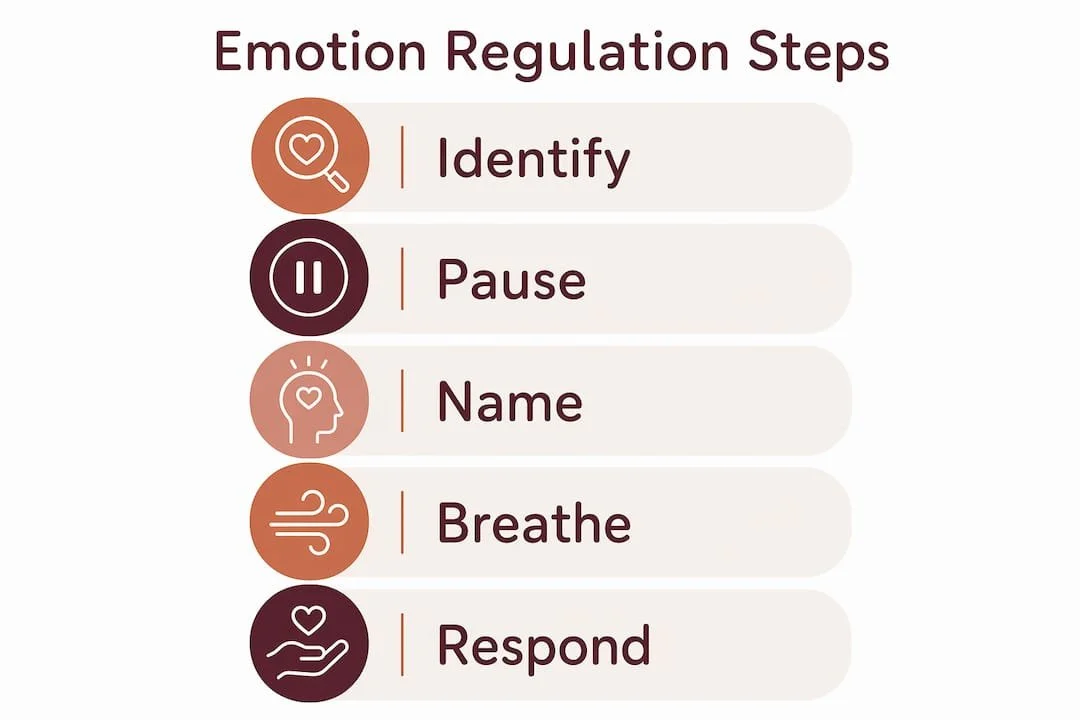
Daily practice beats occasional deep work every time. Frequent brief exercises shift physiological baselines faster than infrequent long sessions. Repetition matters more than intensity when you are trying to change emotional patterns. Think of it as micro-dosing regulation throughout your day rather than saving it for a crisis.
A practical daily sequence looks like this:
Morning check-in (2 minutes): Name your current emotional state with one specific word. Rate its intensity from 0 to 10. Write it in a journal or notes app.
Midday reset (1 minute): Take three slow breaths. Notice any body tension and label what you feel. This interrupts emotional buildup before it compounds.
Trigger log (ongoing): When a strong reaction occurs, note the trigger, the emotion, and the body sensation. Patterns become visible within two weeks.
Evening review (3 minutes): Identify one moment where you regulated well and one where you did not. Self-compassion here is not optional. It is what makes the practice sustainable.
Weekly reflection: Review your trigger log. Look for recurring situations, people, or times of day. Use that data to plan ahead.
Combining body-based tools with cognitive tools produces better results than using either alone. Breathing and movement reset your physiology first. Journaling and reframing then process the thoughts. Trying to think your way out of a high-intensity emotional state before your body has calmed down rarely works.
| Tool | Type | Best used when |
|---|---|---|
| Slow breathing | Body-based | Acute stress or anxiety spike |
| 5–4–3–2–1 grounding | Body-based | Panic, dissociation, or flooding |
| Emotion labeling | Cognitive | Any emotional state, daily habit |
| Cognitive reappraisal | Cognitive | Moderate arousal, before reacting |
| Journaling | Cognitive | End of day, pattern recognition |

Pro Tip: Pair your midday reset with something you already do, like making coffee or washing your hands. Attaching a new habit to an existing one is the fastest way to make it automatic.
What challenges and common mistakes occur when regulating emotions?
The biggest misconception about emotion regulation is that the goal is constant calm. It is not. The goal is to respond to feelings rather than react to them automatically. Expecting perfection creates a second layer of distress when you inevitably feel something difficult. That secondary shame or frustration is often harder to manage than the original emotion.
Suppression is the most common and most counterproductive strategy. Attempting to suppress or escape emotions often amplifies and prolongs distress through what researchers call the "white bear effect." Tell yourself not to think about a white bear, and the image becomes impossible to avoid. The same mechanism applies to emotions. Acceptance without judgment, by contrast, allows you to experience a feeling while still choosing your response.
Vague labeling is another underrated mistake. Saying "I feel bad" gives your brain nothing specific to work with. Granularity in labeling emotions engages the cognitive control areas that suppress limbic reactivity. The more precise your vocabulary, the more effectively your prefrontal cortex can regulate the response. Building an emotional vocabulary is a skill, and it improves with deliberate practice.
Common pitfalls to watch for:
Skipping body-based tools: Trying to reframe thoughts while physically dysregulated rarely works. Calm the body first.
Inconsistency: Practicing only during crises builds no baseline. Daily micro-practice is what creates lasting change.
Self-criticism after a setback: Harsh self-judgment after a regulation failure increases emotional reactivity. Self-compassion is a regulation tool, not a luxury.
Confusing regulation with suppression: Regulation means processing and responding. Suppression means avoiding and hiding. They produce opposite outcomes.
Repair matters as much as prevention. When you do react in a way you regret, the ability to acknowledge it, reconnect, and move forward is itself a regulation skill. Adults who practice emotional healing after setbacks build resilience faster than those who focus only on preventing difficult emotions.
How do you match regulation strategies to your emotional state?
Not every technique works at every arousal level. Matching your intervention to your current state is what separates effective regulation from wasted effort. The concept of the "window of tolerance" describes the zone where your nervous system can process experience without shutting down or exploding. Outside that window, cognitive tools lose most of their power.
Matching regulation interventions to arousal level increases their effectiveness significantly. Bottom-up strategies reset physiology and work best when arousal is high. Top-down strategies process thoughts and work best when you are already moderately calm.
| Arousal level | Best strategy type | Examples |
|---|---|---|
| High (flooded, panicked) | Bottom-up | Breathing, cold water, movement, grounding |
| Moderate (anxious, irritable) | Bottom-up then top-down | Breathe first, then reframe or journal |
| Low (numb, disconnected) | Bottom-up activating | Light exercise, music, social contact |
| Calm (baseline) | Top-down | Cognitive reappraisal, perspective-taking, planning |
Physical exercise and adequate sleep directly impact emotional stability and resilience. These are not lifestyle bonuses. They are physiological prerequisites for effective regulation. A person running on poor sleep will find every cognitive technique harder to execute. Movement and rest are bottom-up regulation tools that work around the clock.
Sensory input is another underused bottom-up tool. Cold water on the face, a short walk, or even a change of physical environment can shift arousal levels within minutes. For adults managing intense emotional responses tied to stress, starting with the body is almost always the right move. Cognitive reappraisal and perspective-taking become available once the nervous system has enough room to think.
Consistency and integration into daily routines produce the most durable results. Regulation practiced only in emergencies is like a fire drill run only during actual fires. The nervous system learns through repetition in low-stakes moments, which is exactly what makes it reliable when the stakes are high. Intense emotional experiences, including those connected to stage fright and performance pressure, respond well to the same bottom-up-first approach.
Key Takeaways
Effective emotion regulation requires matching body-based and cognitive tools to your current arousal level, practiced consistently in small daily doses rather than reserved for crisis moments.
| Point | Details |
|---|---|
| Name emotions specifically | Precise labeling reduces amygdala reactivity and engages cognitive control. |
| Micro-dose daily practice | Brief, frequent exercises shift emotional baselines faster than occasional long sessions. |
| Start with the body | Bottom-up tools like breathing and movement must precede cognitive reframing at high arousal. |
| Avoid suppression | Suppressing emotions amplifies distress; acceptance with chosen response is the effective alternative. |
| Self-compassion is a skill | Harsh self-judgment after setbacks increases reactivity; repair and self-compassion build resilience. |
What I have learned about emotional regulation that most articles miss
The framing most people bring to emotional regulation is the problem. They treat it as a performance skill, something to master so they stop feeling difficult things. That framing guarantees frustration. Emotional regulation is a learned skill built through practice and self-compassion, not a destination where you finally feel nothing uncomfortable.
What I have seen consistently, both in clinical settings and in the research, is that the adults who make the most progress are not the ones who try hardest to stay calm. They are the ones who get curious about their reactions instead of ashamed of them. Curiosity creates the pause that regulation requires. Shame collapses it.
The neuroscience backs this up. Grounding techniques serve as bridges to present-time awareness during moments of intense emotional flooding. But the bridge only works if you are willing to step onto it. That willingness comes from accepting that you are having a hard moment, not from demanding that you should not be having one.
Start smaller than you think you need to. One breath. One word for the feeling. One moment of noticing before reacting. Those micro-moments compound into a fundamentally different relationship with your emotional life. That is not a metaphor. It is how the prefrontal cortex actually builds regulatory capacity over time.
— Juiced
Alvaradotherapy's approach to building emotional regulation skills
Practical techniques give you a strong foundation. Professional support takes that foundation further, especially when emotional patterns are rooted in trauma, PTSD, or complex relational history.
Alvaradotherapy offers online EMDR trauma therapy for adults in California, with licensed therapists who specialize in trauma-informed care. EMDR directly targets the nervous system patterns that make emotion regulation difficult, working at the physiological level where cognitive tools alone cannot reach. For adults whose emotional responses feel disproportionate or stuck, a free consultation with Alvaradotherapy is a practical next step. Services are available in English and Spanish, online throughout California.
FAQ
What is emotion regulation?
Emotion regulation is the ability to manage your feelings constructively without suppressing them. It involves both body-based and cognitive strategies that help you respond to emotions rather than react automatically.
How long does it take to improve emotional regulation?
Consistent daily practice of brief techniques, such as labeling emotions and slow breathing, can shift your emotional baseline within a few weeks. Long-term change in deep patterns typically takes months of regular practice.
What is the difference between regulation and suppression?
Regulation means processing and choosing a response to a feeling. Suppression means pushing the feeling down, which research shows amplifies and prolongs distress through the "white bear effect."
Which technique works best for intense emotions?
Bottom-up tools like the 5-4-3-2-1 grounding technique and slow breathing work best at high arousal levels. Cognitive tools like reappraisal become effective only after the body has calmed down first.
Can therapy help with emotional regulation?
Yes. Trauma-informed therapies like EMDR address the nervous system patterns that underlie chronic dysregulation. Professional support is especially effective when emotional responses are tied to past trauma or PTSD.
