

TL;DR:
PTSD causes recurring relationship issues like emotional disconnection, communication breakdown, and trust erosion. Evidence-based treatments demonstrate that recovery is possible for most couples when supported by trauma-informed care.
PTSD relationship struggles are defined as the recurring patterns of emotional disconnection, communication breakdown, and trust erosion that occur when post-traumatic stress disorder (PTSD) affects one or both partners in a romantic relationship. Clinically, PTSD is a trauma- and stressor-related disorder recognized in the DSM-5, and approximately 6% of U.S. adults experience it in their lifetime. That number translates to millions of couples quietly managing symptoms that neither partner fully understands. The encouraging reality is that evidence-based treatments show recovery rates of 60–80%, meaning healing is not just possible. It is the expected outcome when the right support is in place.
How do PTSD relationship struggles affect intimate partnerships?
PTSD disrupts relationships through five core symptom clusters: intrusion, avoidance, emotional numbing, hypervigilance, and negative mood changes. Each cluster creates a specific friction point between partners. Understanding which symptom is driving a conflict is the first step toward responding with compassion rather than defensiveness.

Hypervigilance, flashbacks, and irritability create the most visible day-to-day friction. A partner with PTSD may startle at a loud noise, interpret a neutral facial expression as a threat, or shut down mid-conversation without warning. To the other partner, these reactions can feel personal. They are not.
| PTSD Symptom | Relationship Impact |
|---|---|
| Hypervigilance | Constant alertness reads as distrust or hostility |
| Emotional numbing | Withdrawal feels like rejection or loss of love |
| Flashbacks | Unpredictable mood shifts disrupt daily connection |
| Avoidance | Social withdrawal limits shared experiences |
| Irritability | Frequent conflict erodes emotional safety |
Avoidance is particularly damaging to intimacy. A person with PTSD may avoid conversations, physical touch, or situations that trigger memories of the trauma. Over time, this creates a growing emotional distance that both partners feel but neither knows how to close. The non-PTSD partner often fills that silence with self-blame.
Emotional numbing is a protective brain mechanism, not a reflection on the partner or the relationship. The brain suppresses emotional responsiveness as a survival strategy. Recognizing this distinction changes everything. It shifts the conversation from "you don't love me anymore" to "your nervous system is protecting you, and we can work through this together."
Pro Tip: When a partner with PTSD goes quiet or withdraws, try saying “I’m here when you’re ready” instead of pressing for an explanation. Predictability and low pressure are the fastest routes back to connection.
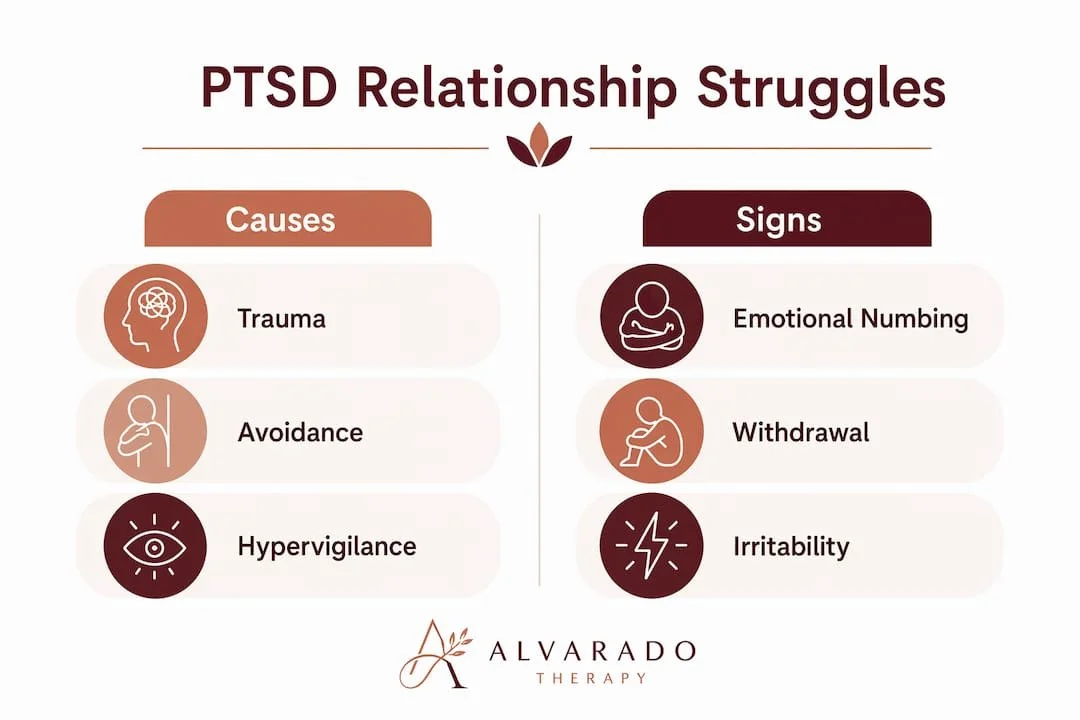
Check the signs of PTSD in relationships if you are unsure whether what you are experiencing fits this pattern.
What unique challenges does complex PTSD pose to relationships?
Complex PTSD, or CPTSD, develops from prolonged or repeated trauma such as childhood abuse, domestic violence, or captivity. It shares PTSD's core symptoms but adds three additional features: affective dysregulation, persistent negative self-concept, and severe interpersonal difficulties. These features make relationship stability significantly harder to maintain.
A 2026 study published in Frontiers in Psychology found that higher CPTSD symptoms reduce relationship quality with a standardized coefficient of β = −0.35 (p < 0.001). That is a strong, statistically significant effect. It means that as CPTSD severity increases, relationship satisfaction drops in a measurable, predictable way.
The same research identified two key mediators: mentalization and playfulness. Mentalization is the ability to understand your own and your partner's mental states accurately. Playfulness is the capacity for lightness, humor, and spontaneous connection. CPTSD erodes both. A person who grew up in an unsafe environment often learned that other people's emotions are unpredictable and dangerous. Reading a partner's intentions accurately becomes genuinely difficult.
Attachment insecurity is the thread running through most CPTSD relationship patterns. People with CPTSD often fear both intimacy and abandonment simultaneously. They may push partners away to feel safe, then panic when the partner actually creates distance. This push-pull cycle exhausts both people and can feel impossible to break without outside support.
Pro Tip: Therapeutic interventions that build mentalization skills and restore a sense of play, such as structured couples activities or therapist-guided role-play exercises, show real promise for CPTSD-affected relationships. Ask a trauma-informed therapist about mentalization-based treatment (MBT) as an add-on to standard PTSD care.
How can partners support each other in PTSD-affected relationships?
Supporting a partner with PTSD requires learning the difference between a trauma response and a personal offense. That distinction is not always easy to hold in the heat of a difficult moment. But it is the single most protective skill a non-PTSD partner can develop.
Predictability is one of the most powerful tools available. A person with PTSD feels safest when their environment is consistent and low-surprise. Simple habits, such as texting before coming home, keeping routines stable, and giving advance notice of changes, reduce the number of moments the nervous system has to manage as potential threats.
What to do and what to avoid when supporting a partner with PTSD:
Do learn the specific triggers your partner has identified and help minimize unnecessary exposure.
Do ask your partner what kind of support they want before assuming what they need.
Do maintain your own friendships, hobbies, and mental health care.
Do encourage professional treatment without making it an ultimatum.
Don't take emotional withdrawal as a personal rejection.
Don't pressure your partner to talk about the trauma before they are ready.
Don't dismiss symptoms as overreactions or attention-seeking.
Don't neglect your own emotional needs in the effort to be endlessly available.
Partners of people with PTSD often experience secondary trauma, a real clinical phenomenon recognized by the National Center for PTSD. Absorbing a partner's distress, hypervigilance, and emotional pain over time takes a measurable toll. Self-care for the non-PTSD partner is not selfish. It is what makes sustained support possible.
Couples therapy focused on trauma-informed care improves communication, rebuilds trust, and restores emotional connection in PTSD-affected relationships. It gives both partners a structured space to practice new patterns with a trained guide present. When one partner feels unsafe speaking, a skilled therapist can hold that space in a way neither partner can hold alone.
Pro Tip: If your partner is not yet ready for couples therapy, individual therapy for you as the supporting partner is a legitimate and valuable first step. You do not have to wait for your partner to be ready before you start getting support.
For partners looking for additional grounding, finding hope when you feel hopeless offers both spiritual and practical perspectives that many people in this position find genuinely useful.
What evidence-based treatments improve PTSD relationship outcomes?
The three treatments with the strongest evidence base for PTSD are Eye Movement Desensitization and Reprocessing (EMDR), Cognitive Processing Therapy (CPT), and Prolonged Exposure (PE) therapy. All three show recovery rates of 60–80% in clinical studies. That means the majority of people who complete a full course of treatment experience significant symptom reduction.
EMDR works by helping the brain reprocess traumatic memories so they lose their emotional charge. CPT targets the distorted beliefs that trauma creates, such as "I am permanently damaged" or "No one can be trusted." Prolonged Exposure gradually reduces avoidance by helping the person safely approach trauma-related memories and situations. Each approach addresses a different mechanism, and a skilled clinician will match the treatment to the individual.
Treatment adherence matters as much as treatment choice. Dropping out of therapy early is the most common reason people do not see full recovery. The early sessions of trauma therapy can feel destabilizing before they feel stabilizing. Knowing that discomfort is a normal part of the process, not a sign that therapy is making things worse, helps people stay the course.
Best practices for couples navigating PTSD recovery together:
Agree on a shared understanding of PTSD symptoms before conflicts arise, not during them.
Establish a "pause signal," a word or gesture both partners use when a conversation is escalating beyond what either can manage in the moment.
Schedule regular low-stakes connection time that has nothing to do with trauma or therapy.
Build a crisis plan together that outlines what each partner will do if a severe trigger occurs.
Review the plan with a therapist every few months and adjust it as recovery progresses.
Healing relationships and trauma simultaneously requires addressing both individual symptoms and relational distress at the same time. Treating only one side of the equation leaves the other unresolved. The most durable recoveries happen when both partners are engaged in some form of support, whether individual therapy, couples therapy, or both.
Pro Tip: Daily PTSD coping strategies such as grounding exercises, diaphragmatic breathing, and structured journaling reduce baseline arousal between therapy sessions. Lower baseline arousal means fewer triggered reactions in everyday relationship moments.
Key Takeaways
PTSD relationship struggles are treatable when both partners understand the symptoms driving the conflict and commit to trauma-informed support and professional care.
| Point | Details |
|---|---|
| Symptoms drive conflict | Hypervigilance, numbing, and avoidance create friction that is neurological, not personal. |
| CPTSD deepens relational harm | CPTSD reduces relationship quality significantly, with mentalization and playfulness as key recovery levers. |
| Secondary trauma is real | Non-PTSD partners absorb distress over time and need their own support to sustain the relationship. |
| Evidence-based treatment works | EMDR, CPT, and Prolonged Exposure show 60–80% recovery rates when completed fully. |
| Couples therapy accelerates healing | Trauma-informed couples therapy rebuilds trust and communication more effectively than individual work alone. |
What I have learned from working with PTSD-affected couples
The most common mistake I see is when the non-PTSD partner concludes that the relationship is broken because their partner seems unreachable. That conclusion is understandable. It is also almost always wrong.
What looks like emotional absence is usually a nervous system in overdrive. The person with PTSD is not choosing distance. They are surviving it. When partners understand that distinction at a gut level, not just intellectually, the entire dynamic shifts. Blame gives way to curiosity. Defensiveness gives way to patience.
The second mistake is waiting too long to get outside help. Couples often spend years trying to solve a clinical problem with relationship effort alone. Therapy is not a last resort. It is the most direct route to the outcome both partners want.
The third thing I have seen consistently is that recovery is rarely linear. There will be weeks of real progress followed by a hard setback. Couples who survive those setbacks are the ones who decided in advance that a bad week does not erase the progress. That decision, made before the setback arrives, is what keeps people in the process long enough to heal.
The research on PTSD effects on relationships confirms what I see in practice: healing is possible, and the couples who make it are the ones who stayed curious about each other when it would have been easier to give up.
— Juiced
Therapy options for PTSD relationship healing at Alvaradotherapy
Alvaradotherapy specializes in exactly the kind of care that PTSD-affected couples and individuals need most. The practice offers online EMDR trauma therapy for clients across California, with licensed therapists trained in trauma-informed approaches that address both individual symptoms and relational distress.
For couples specifically, Alvaradotherapy's online couples therapy provides a structured, safe space to rebuild communication and trust under the guidance of a trauma-informed clinician. Sessions are available in both English and Spanish, making care accessible to a broader range of couples. If you are ready to take a concrete next step, a free consultation is the clearest way to find out which services fit your situation best.
FAQ
What are the most common PTSD relationship struggles?
The most common struggles include emotional withdrawal, communication breakdowns, trust issues, and PTSD and intimacy issues caused by avoidance and hypervigilance. These symptoms are neurological responses to trauma, not choices the affected partner is making.
How does PTSD affect intimacy in relationships?
PTSD reduces intimacy through emotional numbing, avoidance of physical closeness, and hypervigilance that keeps the nervous system in a constant state of alert. These responses make vulnerability feel unsafe, which is the foundation of genuine intimacy.
Can couples therapy help when one partner has PTSD?
Trauma-informed couples therapy improves communication, rebuilds trust, and restores emotional connection in PTSD-affected relationships. It is most effective when combined with individual trauma treatment for the partner with PTSD.
What is the difference between PTSD and complex PTSD in relationships?
Complex PTSD adds affective dysregulation, a negative self-concept, and severe interpersonal difficulties to standard PTSD symptoms. Research shows CPTSD reduces relationship quality significantly more than PTSD alone, with mentalization and playfulness as the key areas most affected.
How long does recovery from PTSD relationship struggles take?
Recovery timelines vary by individual, trauma history, and treatment engagement. Evidence-based treatments like EMDR, CPT, and Prolonged Exposure show recovery rates of 60–80%, with meaningful symptom reduction typically occurring within a full course of treatment.
