
Step by Step Guide to Immigration Evaluations

TL;DR:
Immigration evaluations are clinical assessments that document how trauma and mental health symptoms impact daily functioning for legal cases. Proper document preparation, honest disclosures, and understanding the process are essential for a successful evaluation. These evaluations support your legal claim but do not guarantee immigration outcomes.
An immigration evaluation is a formal clinical assessment that documents how mental health symptoms, trauma, or hardship affect a person's daily functioning in the context of an immigration case. This step by step guide to immigration evaluations covers every phase of the process, from gathering documents to receiving your final report, so you can walk into your appointment prepared and confident. Whether you face a hardship petition, asylum claim, or employment-based green card application, knowing what to expect removes uncertainty and strengthens your case.
What documents and prerequisites does the immigration evaluation process require?
Document preparation is the foundation of any successful immigration evaluation. Missing a single certified record can stall your case before the clinical work even begins. Incomplete or missing documentation is the leading cause of USCIS Requests for Evidence, and gaps in certified translations or credential evaluations commonly cause 3–12 month delays or outright denials. That timeline matters when your legal status is at stake.

Core documents every applicant needs
Every applicant should gather the following before scheduling their evaluation appointment:
Personal identification: passport, government-issued ID, visa, or immigration documents
Legal notices and court documents: any USCIS correspondence, removal orders, or hearing notices
Police reports or crime victim documentation: relevant for asylum, VACA, or U-Visa cases
Medical records: prior diagnoses, treatment history, and prescription records
Educational credentials: diplomas, transcripts, and foreign degree evaluations
Key documents include personal ID, legal notices, police reports, medical records, and court documents. Each item gives the clinician concrete evidence to connect your history to your current mental health symptoms.
Credential verification for education-based cases
Employment-based green card applicants face an additional layer. USCIS 2026 standards require foreign degree credentials to be verified by evaluators recognized by NACES (National Association of Credential Evaluation Services) or AICE (Association of International Credential Evaluators). Submitting unverified credentials is one of the most common and most avoidable mistakes in the process.
Pro Tip: Start collecting documents at least three months before your scheduled evaluation. Certified translations alone can take four to six weeks, and credential evaluations from NACES or AICE members add additional processing time.
| Document Category | Examples |
|---|---|
| Personal identification | Passport, visa, government ID |
| Legal and court records | USCIS notices, removal orders, hearing documents |
| Medical records | Diagnoses, treatment notes, prescriptions |
| Educational credentials | Diplomas, transcripts, NACES/AICE evaluations |
| Supporting evidence | Police reports, crime victim documentation |
What are the steps in the immigration evaluation process?
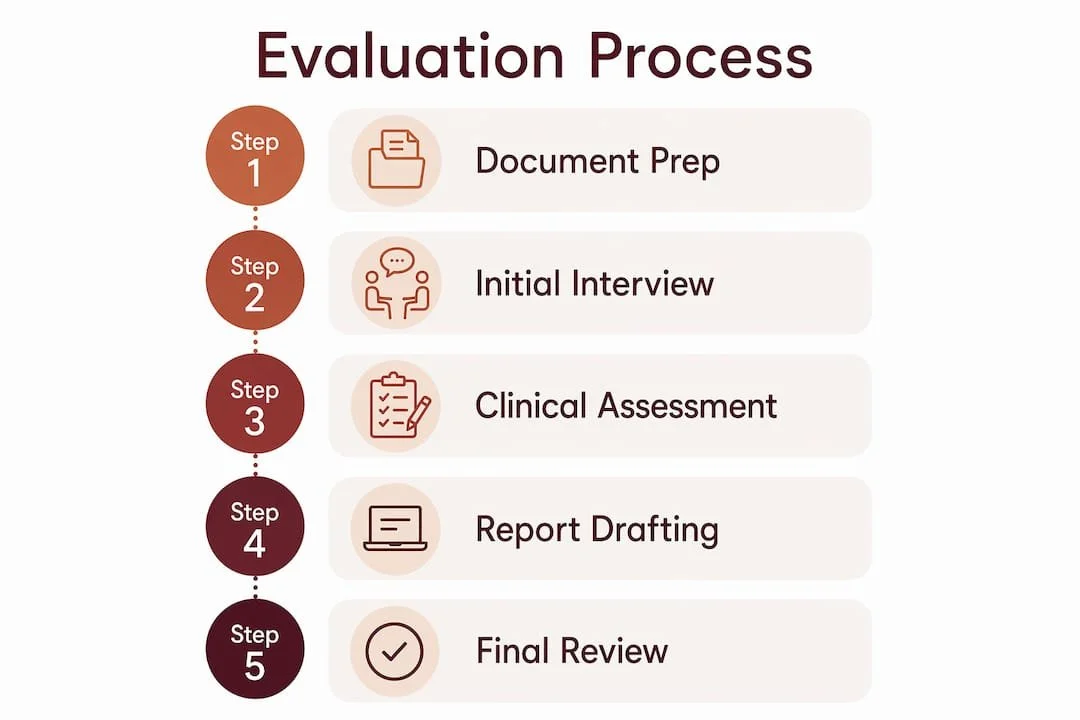
A typical immigration evaluation includes an initial consultation, clinical interviews, collateral record review, and report writing, usually spread across multiple sessions. Each step builds on the last. Skipping or rushing any phase weakens the final report.
The complete stepwise immigration assessment
Initial consultation. The evaluator reviews your case type, explains the process, and confirms which documents you need to bring. This session sets the clinical focus for everything that follows.
Clinical interview. The licensed clinician conducts a structured interview covering your personal history, trauma exposure, mental health symptoms, and how those symptoms affect daily life. This is the core of the evaluation.
Standardized assessment tools. The evaluator administers validated screening measures relevant to your case. Common instruments assess PTSD, depression, anxiety, and cognitive functioning. Validated screening tools and detailed clinical interviews are crucial for producing a strong, defensible report.
Collateral document review. The clinician reviews your medical records, legal documents, and any supporting evidence you provided. This step connects your reported symptoms to objective records.
Collateral interviews (when applicable). Some evaluators speak with family members, treating physicians, or attorneys to corroborate your account. This is not always required but strengthens complex cases.
Report writing. The evaluator drafts a formal report using neutral, evidence-based clinical language. The final report is prepared for attorneys or courts with clinical clarity and legal relevance. It documents diagnoses, symptoms, and functional impairments without making legal conclusions.
Report delivery and attorney review. The completed report goes to your immigration attorney, who submits it as part of your legal filing. Some evaluators offer a brief follow-up to answer questions about the report's content.
Telehealth options now make steps 1 through 5 accessible without in-person visits for many case types. Alvaradotherapy offers telehealth immigration evaluations for clients across California, which removes geographic barriers for applicants in rural areas or those with limited mobility.
Pro Tip: Ask your evaluator upfront how many sessions the process typically requires and what the turnaround time is for the written report. Attorneys often need the report weeks before a filing deadline.
How should you prepare emotionally and practically for your evaluation?
Emotional preparation is as important as document preparation. Applicants who arrive knowing what to expect communicate more clearly, stay calmer under stress, and give evaluators the detail needed to write a strong report.
Proper emotional preparation involves honesty, documenting symptoms in advance, and understanding the evaluation's focus. Clinicians are not judging you. They are gathering clinical data to document how your experiences have affected your mental health and functioning.
What to do before your appointment
Write down the major events in your history with approximate dates. Memory under stress is unreliable, and a written timeline keeps your account consistent.
List your current symptoms, including sleep problems, anxiety, flashbacks, physical complaints, and changes in mood or concentration.
Note how symptoms affect daily tasks: work, parenting, relationships, and self-care.
Prepare questions for the evaluator about the process, the report, and what happens next.
Confirm logistics at least 48 hours in advance: location or telehealth link, session length, and what to bring.
What to avoid
Do not minimize or exaggerate symptoms. Evaluations use neutral, evidence-based clinical language to connect symptoms to daily functioning. Inconsistencies undermine credibility.
Do not arrive without your documents. Even one missing record can require a follow-up session and delay your report.
Do not treat the evaluation as a therapy session. It is a clinical assessment with a specific legal purpose.
Pro Tip: If you know you have a trauma history, tell the evaluator at the start of the session. Trauma-informed clinicians adjust their approach when they know what to expect, which makes the interview more accurate and less distressing for you.
Licensed clinicians conducting these evaluations apply trauma-informed care, cultural competence, and forensic interviewing skills to produce accurate and fair assessments. Knowing this can ease anxiety before you walk in.
What mistakes should you avoid during the immigration evaluation process?
The most damaging mistakes in immigration evaluations are preventable. Most come from misunderstanding the evaluation's purpose or rushing the preparation phase.
| Common Error | Best Practice |
|---|---|
| Missing or incomplete documents | Use a checklist and start gathering records at least three months early |
| Choosing an unqualified evaluator | Verify licensure and experience with immigration cases before booking |
| Treating the evaluation as therapy | Understand it is a clinical assessment for legal documentation |
| Expecting a guaranteed outcome | Evaluations document symptoms objectively; legal decisions rest with USCIS or the court |
| Poor attorney-evaluator communication | Share all relevant legal documents with the evaluator before the first session |
Choosing a qualified evaluator
Not every licensed therapist is qualified to conduct immigration evaluations. The clinician must have specific training in forensic interviewing, cultural competence, and immigration case types. Ask directly about their experience with cases similar to yours before committing.
Evaluations summarize symptoms, diagnoses, and functional impact without making legal conclusions or guarantees. Understanding this distinction prevents disappointment and keeps expectations realistic. The evaluation supports your attorney's legal argument. It does not replace it.
Attorney and evaluator collaboration is a critical piece that applicants often overlook. Your attorney should brief the evaluator on the legal theory of your case before the clinical interview begins. That context helps the evaluator frame the report in legally relevant terms without compromising clinical objectivity. Alvaradotherapy's clinicians are experienced in working alongside immigration attorneys to produce reports that serve both clinical and legal standards.
Key Takeaways
A successful immigration evaluation depends on thorough document preparation, honest clinical disclosure, and a clear understanding that the evaluation is objective documentation, not advocacy or therapy.
| Point | Details |
|---|---|
| Start documents early | Gather certified records and credential evaluations at least three months before your appointment. |
| Know each process step | Evaluations span consultation, clinical interview, testing, record review, and report writing across multiple sessions. |
| Prepare emotionally | Write down your symptom history and timeline before the appointment to communicate clearly and consistently. |
| Avoid common errors | Missing documents and unqualified evaluators are the two most preventable causes of delays and weak reports. |
| Understand the purpose | Evaluations document clinical impact for legal use; they do not guarantee immigration outcomes. |
What I have learned from sitting with clients before their evaluations
After working with clients preparing for immigration psychological evaluations, one pattern stands out clearly. The applicants who struggle most are not the ones with the most complex trauma histories. They are the ones who arrive believing the evaluation is either a therapy session or a character reference letter.
That misunderstanding creates real problems. When someone expects emotional support, they are caught off guard by structured clinical questions. When someone expects the evaluator to advocate for them, they feel let down by neutral, objective language in the report. Immigration psychological evaluations focus on documenting the human impact of trauma, separation, and legal uncertainty through clinical assessment, not advocacy. That is not a cold fact. It is actually protective. Objective clinical documentation carries far more legal weight than a letter of support.
The clients who do best are the ones who come in having already talked to their attorney, written down their symptom history, and accepted that honesty is the only strategy that works. They do not perform distress. They describe it. That distinction matters enormously in a forensic clinical context.
My honest advice: treat the evaluation as a professional collaboration, not a test you can pass or fail. Bring your documents, tell the truth, and trust that a well-written clinical report does its job. The immigration psychological evaluation guide for 2026 from Alvaradotherapy walks through exactly what that preparation looks like in practice.
— Juiced
Alvaradotherapy's immigration evaluation services
Alvaradotherapy is a California-based, trauma-informed mental health practice with licensed clinicians who specialize in immigration psychological evaluations for asylum, hardship, U-Visa, and other case types.

The practice serves clients in Pasadena, Ventura, and online throughout California and New York, making professional evaluations accessible regardless of where you live. Clinicians are bilingual in English and Spanish and apply trauma-informed, culturally responsive methods to every assessment. If you are ready to take the next step, visit the what to expect page for a full overview of services and to schedule a consultation. For clients also dealing with PTSD or complex trauma, Alvaradotherapy's trauma therapy services provide ongoing support alongside the evaluation process.
FAQ
What is an immigration psychological evaluation?
An immigration psychological evaluation is a formal clinical assessment conducted by a licensed mental health professional. It documents how mental health symptoms and trauma affect a person's daily functioning to support an immigration legal case.
How long does the immigration evaluation process take?
The process typically spans multiple sessions over several weeks, depending on case complexity. Report writing and delivery to the attorney adds additional time after the clinical sessions are complete.
What documents should I bring to my immigration evaluation?
Bring personal identification, legal notices, court documents, medical records, and any police reports relevant to your case. Missing documents can require follow-up sessions and delay your final report.
Can I do my immigration evaluation by telehealth?
Many evaluators, including Alvaradotherapy, offer telehealth immigration evaluations for clients across California and New York. Confirm with your evaluator whether your specific case type qualifies for a remote assessment.
Does a positive evaluation guarantee my immigration case will succeed?
No. An evaluation documents clinical findings objectively and supports your attorney's legal argument. Evaluations summarize symptoms and functional impact without making legal conclusions or guaranteeing any outcome.
