
Immigration Psychological Evaluation Guide for 2026

TL;DR:
An immigration psychological evaluation documents mental health issues relevant to your legal case and is used as evidence.
Preparation with complete records and an organized timeline improves the process and report quality.
An immigration psychological evaluation is a formal clinical assessment conducted by a licensed mental health professional to document mental health, trauma, or hardship relevant to your immigration case. Courts, USCIS, and immigration attorneys use these evaluations as legal evidence. The process follows a defined workflow for immigration evaluations that includes document preparation, clinical interviews, standardized psychological testing, and a written report. This guide walks you through every stage so you know exactly what to expect, what to bring, and how to prepare.
What is an immigration psychological evaluation guide?
An immigration psychological evaluation, formally called a forensic mental health assessment, produces a clinical document for use in legal proceedings. It is not therapy. The evaluator's job is to provide an objective clinical assessment linked to your immigration case, not to treat or counsel you. That distinction matters because many people arrive expecting a therapeutic conversation and instead encounter a structured, evidence-gathering process.

These evaluations serve asylum claims, hardship waivers, VAWA petitions, U-visa applications, and immigration court hearings. The evaluator documents your psychological history, trauma exposure, current mental health status, and how those factors connect to your legal situation. Psychological evaluations can double the likelihood of success in an immigration case when paired with legal representation. That figure alone explains why attorneys increasingly request them as standard practice.
Alvaradotherapy conducts these evaluations as part of its trauma-informed practice, serving clients across Pasadena, Ventura, and online throughout California in both English and Spanish.
What documents do you need before your evaluation?
Preparation is the single biggest factor you control before your first appointment. Arriving with complete documentation shortens the evaluation process and strengthens the final report.
Bring the following to your intake session:
Legal notices: All USCIS correspondence, court hearing notices, and attorney letters related to your case
Medical and mental health records: Prior diagnoses, prescriptions, therapy notes, or hospital records
School records: IEPs, disciplinary records, or transcripts that document hardship or learning difficulties
Court and police records: Any documentation of abuse, crime victimization, or legal proceedings in your home country or the U.S.
Personal timeline: A written chronology of key life events, immigration history, and traumatic experiences
Each document type serves a specific purpose. Key documents like legal notices and medical records give the evaluator corroborating evidence to support what you share verbally. Without them, the report rests entirely on self-report, which carries less legal weight.
Pro Tip: Create a single folder, physical or digital, organized by category before your first session. Label each section clearly. Evaluators review records between sessions, and a well-organized file reduces back-and-forth delays.
A personal timeline is often overlooked but consistently valuable. Write it out in chronological order before your appointment. Include dates of migration, traumatic events, family separations, and any contact with law enforcement or medical providers. The more specific you are, the more the evaluator can anchor clinical findings to documented facts.
Step-by-step immigration evaluation process explained
The evaluation process typically spans 2 to 4 weeks from intake to report delivery. That timeline includes clinical interviews, psychological testing, records review, and report writing. Understanding each phase removes the uncertainty that makes this process feel intimidating.
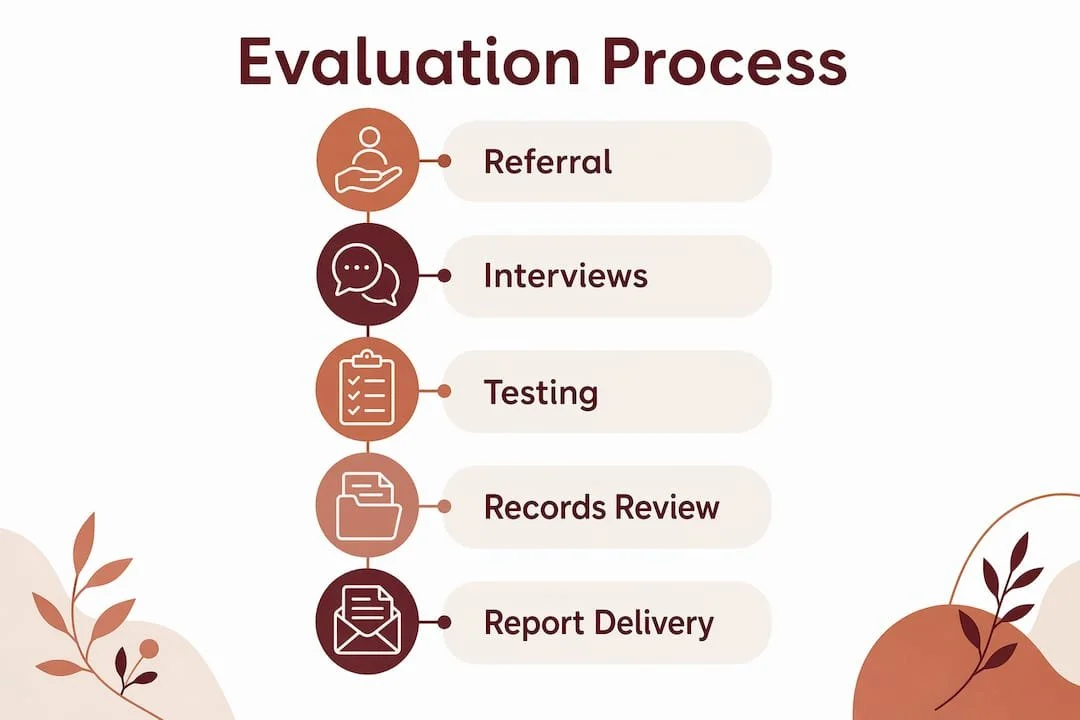
Phase 1: Referral and scheduling
Your attorney or a community organization typically refers you to a licensed psychologist or licensed clinical social worker. You schedule an intake appointment and receive a list of documents to bring. Some evaluators send intake forms in advance to gather basic background information.
Phase 2: Clinical interviews
Most evaluations require 1 to 3 interview sessions lasting 60 to 180 minutes each. The evaluator asks about your childhood, family history, immigration experience, trauma exposure, current symptoms, and daily functioning. These sessions are structured but conversational. The evaluator is not trying to catch you in inconsistencies. They are building a complete clinical picture.
Phase 3: Psychological testing
Standardized tests provide objective data that supports the clinical interview findings. Common instruments include the MMPI-3, PAI, Beck Depression Inventory, Beck Anxiety Inventory, MoCA, and WAIS-IV. The specific tests depend on your case type and presenting concerns. A trauma-focused case may prioritize the MMPI-3 and Beck Inventories, while a cognitive assessment may add the MoCA or WAIS-IV.
Phase 4: Records review
The evaluator reviews all documents you provided alongside any records requested from third parties. This step connects your reported history to objective evidence and strengthens the clinical conclusions.
Phase 5: Report writing and delivery
The final report runs 8 to 15 pages and includes your background, clinical findings, formal diagnoses, psychological test results, and an analysis linking your mental health to the specifics of your immigration case. Standard reports take 1 to 2 weeks to complete. Expedited turnaround is available in 3 to 5 days for urgent court deadlines.
| Phase | Typical timeframe | Purpose |
|---|---|---|
| Intake and scheduling | 1–3 days | Gather documents, confirm scope |
| Clinical interviews | 1–3 sessions, 60–180 min each | Build clinical history |
| Psychological testing | 1–2 sessions | Objective symptom measurement |
| Records review | Concurrent with interviews | Corroborate reported history |
| Report writing | 1–2 weeks standard, 3–5 days expedited | Produce legal document |
Pro Tip: Ask your evaluator upfront whether expedited delivery is available and what the additional cost is. If your court date is within six weeks, request expedited service at the time of scheduling, not after.
How to prepare for your evaluation appointment
Honest communication is the most important thing you bring to the evaluation. The evaluator's credibility with the court depends on accuracy, not on making you look good. Exaggerating symptoms or minimizing them both undermine the report's legal value.
Confidentiality in these evaluations works differently than in therapy. The report goes to your attorney and may be submitted to the court or USCIS. Understand that what you share will be documented. Ask your evaluator at the start of the first session to explain exactly who will receive the report and under what circumstances.
Use this checklist to prepare before your appointment:
Confirm the appointment date, time, location, and whether an interpreter is needed
Bring your complete document folder organized by category
Write out your personal timeline and review it the night before
Get adequate sleep before each session; fatigue affects how clearly you communicate
Eat before your appointment; testing sessions can run two hours or more
Bring a trusted support person to wait for you if the emotional content feels heavy
Emotional topics will come up. The evaluator expects this and is trained to handle distress. You do not need to suppress your emotions to appear credible. Crying, pausing, or asking to take a moment are all normal. What matters is that you continue engaging honestly rather than shutting down.
Building trust with your evaluator takes time. If something feels unclear or uncomfortable, say so directly. A good evaluator will adjust their approach. Alvaradotherapy's clinicians are trained in trauma-informed care, which means they prioritize your sense of safety throughout the process.
Common mistakes and challenges in immigration evaluations
The most common mistake is starting too late. Schedule your evaluation 8 to 12 weeks before your USCIS or court filing deadline. That buffer accounts for scheduling delays, multiple interview sessions, testing, and report writing. Missing a deadline because the report was not ready is entirely preventable.
Other frequent errors include:
Incomplete documentation: Arriving without records forces the evaluator to rely on self-report alone, which weakens the report
Confusing evaluation with therapy: The evaluation is a one-time legal assessment. It does not provide treatment, and the evaluator is not your therapist
Misunderstanding the report's purpose: The report documents clinical findings. It does not guarantee a favorable immigration outcome. It strengthens your case by providing professional evidence
Failing to disclose relevant history: Omitting prior mental health treatment, substance use history, or trauma because it feels embarrassing can create gaps that undermine the report's credibility
Cost is a common concern. Most health insurance plans do not cover immigration psychological evaluations because they are legal assessments rather than medically necessary treatments. Fees vary by provider and case complexity. Ask about sliding-scale options or nonprofit legal aid organizations that subsidize evaluation costs for low-income clients.
The Supreme Court's recent immigration rulings have increased pressure on individuals to provide strong supporting evidence in their cases. A well-documented psychological evaluation is one of the most credible forms of that evidence.
Key Takeaways
A complete, well-documented immigration psychological evaluation is the strongest clinical evidence you can provide to support your immigration case.
| Point | Details |
|---|---|
| Start early | Schedule your evaluation 8–12 weeks before filing deadlines to avoid preventable delays. |
| Bring full documentation | Legal notices, medical records, and a personal timeline all strengthen the final report. |
| Evaluation is not therapy | The process produces a legal document, not ongoing treatment or counseling. |
| Testing adds credibility | Standardized tools like the MMPI-3 and Beck Inventories provide objective clinical data. |
| Honest communication matters | Accurate self-reporting protects the evaluator’s credibility and the report’s legal weight. |
What I've learned from watching clients go through this process
The clients who get the most out of their evaluations are not the ones with the most dramatic histories. They are the ones who prepared. They showed up with organized folders, a written timeline, and a clear understanding that this was a legal process, not a therapy session.
The biggest misconception I see is that people believe they need to perform distress to be believed. That is not how it works. A skilled evaluator reads inconsistency immediately, and overstatement damages credibility far more than a calm, factual account of genuine suffering. The MMPI-3 and PAI are specifically designed to detect response bias. Honest answers always serve you better.
I also think people underestimate how much the evaluator's trauma-informed approach matters. When a clinician understands complex trauma, they ask better questions, create more space for disclosure, and write reports that capture the full clinical picture rather than a surface-level summary. That depth is what makes a report persuasive to a judge or USCIS officer.
The immigration evaluation process is demanding, but it is manageable when you treat it as a structured task rather than an emotional ordeal. Prepare your documents. Write your timeline. Sleep before your sessions. Trust the process.
— Juiced
Alvaradotherapy's immigration evaluation services
Alvaradotherapy specializes in trauma-informed immigration psychological evaluations for clients across California, serving in both English and Spanish. The practice's licensed clinicians conduct evaluations for asylum claims, hardship waivers, VAWA petitions, and U-visa applications, with both standard and expedited report timelines available.
If you are preparing for an immigration case, understanding what to expect from the evaluation process is the first step toward a confident appointment. Alvaradotherapy also offers immigration evaluation services with culturally responsive care and trauma-sensitive clinical practice. Reach out to schedule a consultation and get your documentation organized before your deadline.
FAQ
What is an immigration psychological evaluation?
An immigration psychological evaluation is a formal clinical assessment conducted by a licensed mental health professional to document mental health, trauma, or hardship for use in immigration legal proceedings. It is a legal document, not a form of therapy.
How long does the evaluation process take?
The full process typically takes 2 to 4 weeks, including 1 to 3 clinical interview sessions and 1 to 2 weeks of report writing. Expedited turnaround is available in 3 to 5 days for urgent deadlines.
Does insurance cover immigration psychological evaluations?
Most health insurance plans do not cover these evaluations because they are legal assessments rather than medically necessary treatments. Ask your provider about sliding-scale fees or nonprofit legal aid programs.
What psychological tests are used in immigration evaluations?
Common tests include the MMPI-3, PAI, Beck Depression Inventory, Beck Anxiety Inventory, MoCA, and WAIS-IV. The specific instruments depend on your case type and the clinical concerns being assessed.
When should I schedule my immigration psychological evaluation?
Schedule your evaluation at least 8 to 12 weeks before your USCIS or court filing deadline. That window accounts for multiple sessions, testing, records review, and report writing without last-minute pressure.
