
Modern Grief Counseling: Evidence-Based Methods That Work

TL;DR:
Modern grief counseling helps individuals integrate loss into their identity using evidence-based methods like CBT, ACT, EMDR, and CGT. It views grief as a permanent part of life that can be managed through pacing, exposure, and personalized therapy, supporting emotional and physical healing. Access begins with brief consultations and online sessions, enabling people to start healing on their own schedule.
Modern grief counseling is a therapeutic process designed to help you adapt to loss by integrating grief into your identity rather than seeking closure or moving on. This approach draws on evidence-based methods including Cognitive Behavioral Therapy (CBT), Acceptance and Commitment Therapy (ACT), and Eye Movement Desensitization and Reprocessing (EMDR). Professional psychotherapy for grief produces 87.5% symptom improvement over 14 weeks. That figure tells you something direct: structured, modern grief counseling works, and it works measurably. If you are searching for contemporary bereavement support that meets you where you are, this guide covers the methods, frameworks, and practical steps that matter most.
What are the key evidence-based approaches in modern grief counseling?
Modern grief counseling is not a single method. It is a set of clinically tested approaches, each targeting different aspects of how loss disrupts your thinking, body, and sense of self.
CBT, ACT, and narrative therapy
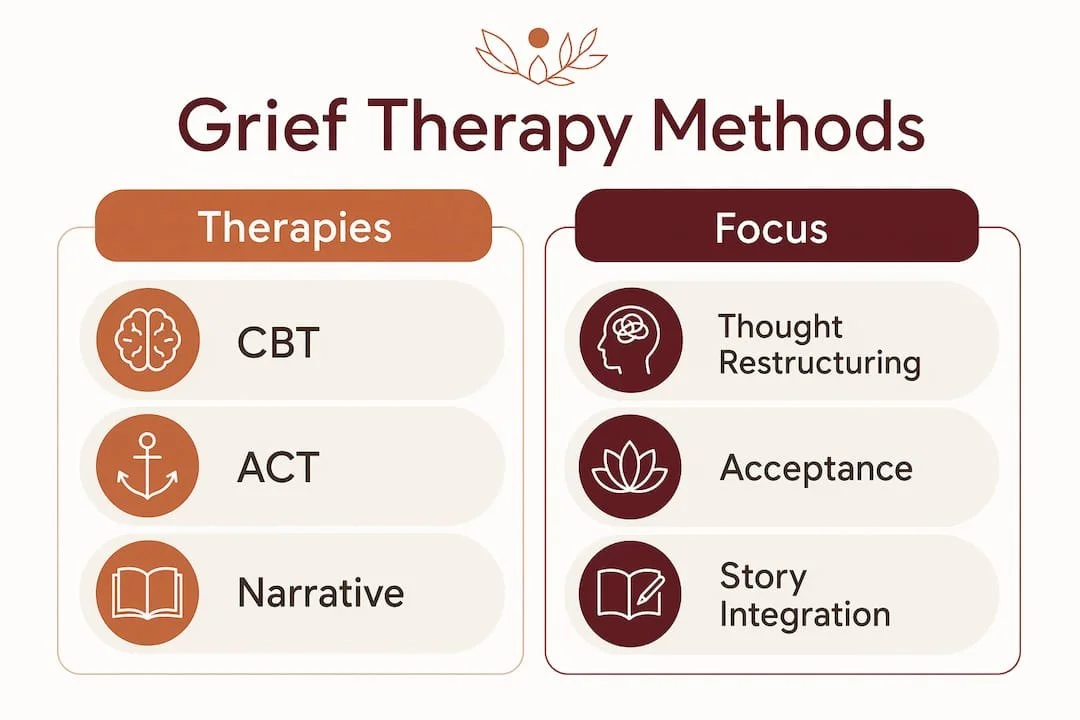
Cognitive Behavioral Therapy identifies and restructures the distorted thoughts that grief produces, such as "I should have done more" or "I will never feel normal again." ACT shifts the goal from eliminating painful feelings to accepting them while still moving toward a meaningful life. Narrative therapy helps you rewrite the story of your loss so that it becomes part of your identity rather than the end of it. Each method addresses grief from a different angle, which is why many therapists combine them.
Complicated Grief Therapy for prolonged grief
Complicated Grief Therapy (CGT) is the most structured option for people whose grief has not lifted after many months. CGT blends CBT, interpersonal therapy, and exposure techniques into 12–16 weekly sessions with clear, goal-oriented work. Research shows CGT produces faster recovery than standard counseling for prolonged grief disorder. If your grief is interfering with work, relationships, or basic daily function, CGT is the most evidence-supported path forward.
The table below compares the primary techniques used in contemporary bereavement support:
| Technique | Core focus | Best suited for |
|---|---|---|
| CBT | Reframing grief-related thoughts | Guilt, rumination, distorted beliefs |
| ACT | Accepting pain while living fully | Avoidance, emotional numbness |
| EMDR | Processing traumatic loss memories | Sudden, traumatic, or violent loss |
| CGT | Structured exposure and goal work | Prolonged grief disorder |
| Narrative therapy | Rebuilding identity and meaning | Identity disruption after loss |
Pro Tip: Ask a prospective therapist which of these methods they are trained in before your first session. A therapist who can name their approach and explain it plainly is one who will use it consistently.
Choosing the right grief therapy approach depends on how long you have been grieving, whether trauma is involved, and what your daily functioning looks like right now.
How do modern grief counseling frameworks conceptualize the grieving process?
The most important shift in contemporary grief theory is this: grief is not a problem to solve. It is a permanent part of who you are, and the goal is to grow your life around it.
The Dual Process Model
The Dual Process Model, developed by researchers Margaret Stroebe and Henk Schut, describes grief as an oscillation between two modes. Loss-oriented coping means focusing directly on the pain of the loss. Restoration-oriented coping means attending to life changes, new roles, and daily responsibilities. Healthy grieving moves back and forth between these two states. Staying locked in only one mode, either constant grief or constant distraction, slows recovery.
Rethinking the stages of grief
The Kübler-Ross stages (denial, anger, bargaining, depression, acceptance) remain widely known, but modern clinicians apply them as flexible reference points rather than a fixed sequence. Rando's six-R tasks offer a more practical framework:
Recognize the loss as real
React to the separation with full emotional expression
Recollect and re-experience the deceased and the relationship
Relinquish old attachments and assumptions about the world
Readjust to a new world without forgetting the old one
Reinvest emotional energy into new relationships and goals
These tasks are not linear. You may cycle through them repeatedly over months or years, and that is normal.
Growing around grief, not past it
Modern grief therapy focuses on growing around grief rather than achieving closure. This model recognizes that the loss stays with you while your life expands around it. Grief becomes part of your identity rather than an obstacle blocking your future. Effective counseling also provides validation and compassionate presence, normalizing anger, confusion, and guilt as standard parts of mourning. That normalization alone reduces the shame many people carry about how they grieve.
What personalized and trauma-informed techniques enhance grief counseling?
Grief and trauma frequently overlap, especially after sudden, violent, or unexpected loss. Trauma-informed grief counseling addresses both at once by prioritizing nervous system safety before processing the loss itself.

Nervous system regulation first
EMDR and ACT reduce nervous system activation in grief clients, enabling functional coping without constant triggering. This matters because a dysregulated nervous system cannot process grief effectively. When your body is in a state of chronic hyperarousal, talking about the loss only retraumatizes rather than heals. Therapists trained in trauma-informed care establish safety and calm first, then move into grief processing.
For a detailed look at how EMDR applies specifically to loss, Alvaradotherapy's resource on EMDR for traumatic loss explains the process step by step.
Pacing and physical recovery
Grief causes physical fatigue and nervous system exhaustion, requiring reduced commitments and increased rest, especially in the early stages. This is not weakness. It is biology. Clients who pace their energy during early grief show better emotional and physical resilience over time. Reducing your workload, saying no to social obligations, and sleeping more are not avoidance. They are recovery.
Situational exposure
Situational exposure helps you return to places, activities, or people you have been avoiding since the loss. Avoidance maintains fear. Gradual, supported exposure reduces it. A therapist might guide you to visit a location connected to your loved one, or to return to a hobby you shared together. Each small step rebuilds your capacity to hold grief without being overwhelmed by it.
Crying as regulation, not weakness
Crying is a physiological tool for nervous system regulation, aiding grief processing and preventing emotional energy from becoming physically stuck. Suppressing tears does not protect you. It delays the release your body needs. Therapists actively help clients identify safe spaces where they can cry without judgment.
Pro Tip: Designate one specific place in your home as your "grief space." A chair, a corner, a room. When you need to cry or feel the weight of your loss, go there. This trains your nervous system to associate emotional release with safety rather than unpredictability.
How can individuals access modern grief counseling and start coping?
Starting grief counseling feels like a large step when you are already exhausted. The structure is simpler than most people expect.
Most practices begin with a 15-minute consultation to assess your needs and match you with the right therapist. From there, a structured program like CGT runs 12–16 weekly sessions. Standard individual grief counseling typically meets weekly for 50 minutes. Progress is measured by your ability to function daily, not by whether you feel sad less often.
Here are practical steps to start and sustain your grief work:
Schedule a consultation. A 15-minute call is enough to determine whether a therapist is the right fit. You do not need to have your grief figured out before you call.
Consider online grief counseling. Virtual sessions remove the barrier of travel and allow you to grieve in your own space. For many people, this makes it easier to be emotionally open.
Join a support group for grieving. Peer groups provide community and reduce the isolation that grief creates. Many hospitals, hospices, and community centers offer free or low-cost groups.
Maintain continuing bonds. Writing letters to your loved one, keeping a meaningful object nearby, or visiting a significant place are all healthy ways to stay connected without avoiding grief.
Build daily rituals. A short morning walk, a nightly journal entry, or a weekly visit to a meaningful location gives grief a container. Structure reduces the feeling that grief is everywhere all the time.
Use mental health resources between sessions. Worksheets, guided exercises, and psychoeducation materials extend the work you do in therapy into your daily life.
Grief does not follow a schedule. Some weeks will feel lighter. Others will knock you back. The goal of effective grief management is not a straight line upward. It is a growing capacity to carry the loss while still living fully.
Key takeaways
Modern grief counseling works because it treats grief as something to integrate, not eliminate, using evidence-based methods that address both the emotional and physical toll of loss.
| Point | Details |
|---|---|
| Integration over closure | Modern counseling helps grief become part of your identity, not an obstacle to remove. |
| Evidence-based methods | CBT, ACT, EMDR, and CGT each target different aspects of grief with measurable results. |
| Trauma-informed pacing | Nervous system regulation and rest are clinical priorities, not signs of weakness. |
| Situational exposure works | Returning to avoided places and activities reduces fear and restores daily function. |
| Access starts small | A 15-minute consultation and online sessions lower the barrier to starting grief counseling. |
What I have learned from working alongside grief
The biggest misconception I see is that grief counseling is about helping people "get over it." That framing does more harm than the grief itself. Every person who walks into a therapy room carrying loss is not broken. They are responding normally to something that was never supposed to be easy.
What actually moves people forward is not speed. It is permission. Permission to feel angry, confused, relieved, and devastated in the same week. Permission to cry in a designated chair at 2 p.m. on a Tuesday. Permission to still love someone who is gone. The shift from closure to integration is not just a theoretical update in grief science. It is a profound relief for the people sitting across from a therapist.
Pacing matters more than most people realize. The clients who push hardest to "get back to normal" fastest are often the ones who hit the wall hardest six months later. The ones who rest, reduce their load, and let themselves be supported tend to build something more durable.
Personalized care is not a luxury in grief work. It is the whole point. A 28-year-old who lost a parent suddenly needs something different from a 60-year-old who lost a spouse after a long illness. Grief counseling that does not account for your specific loss, your culture, your nervous system, and your life is not grief counseling. It is a script.
Seek support. Keep the connections that matter. And give yourself the same patience you would give someone you love.
— Juiced
Alvaradotherapy's approach to grief counseling
Alvaradotherapy is a California-based trauma-informed practice offering grief counseling grounded in EMDR, CBT, and Complicated Grief Therapy. Licensed therapists serve clients across Pasadena, Ventura, and online throughout California, in both English and Spanish.
If you are ready to understand what therapy looks like before committing to a full program, Alvaradotherapy's intake process starts with a straightforward consultation. Sessions are available online, so geography is not a barrier. Whether your grief is recent or has been with you for years, the practice offers personalized care designed around your specific loss. You can book a consultation to take the first step at a pace that works for you.
FAQ
What is modern grief counseling?
Modern grief counseling is a structured, evidence-based therapeutic process that helps individuals integrate loss into their identity rather than seeking closure. Methods include CBT, ACT, EMDR, and Complicated Grief Therapy.
How long does grief counseling typically last?
Structured programs like Complicated Grief Therapy run 12–16 weekly sessions. Standard individual counseling varies based on the complexity of the loss and the person's goals.
Is online grief counseling effective?
Online grief counseling delivers the same evidence-based methods as in-person therapy and removes barriers like travel and scheduling. Many people find it easier to be emotionally open in their own space.
What is Complicated Grief Therapy?
Complicated Grief Therapy (CGT) is a structured treatment for prolonged grief disorder that blends CBT, interpersonal therapy, and situational exposure techniques. It shows faster recovery outcomes than standard counseling for people whose grief has not improved over time.
How do I know if I need grief counseling?
If grief is interfering with your work, relationships, sleep, or daily function for more than a few months, professional support is the right step. A 15-minute consultation is enough to assess whether structured grief counseling fits your situation.
