
Effective Grief Counseling: What Actually Helps You Heal

TL;DR:
Effective grief counseling helps individuals process loss and rebuild a meaningful life through structured therapy. Psychotherapy, especially grief-focused protocols like GF-CBT and CGT, has strong evidence supporting its effectiveness for prolonged or complicated grief. Finding a qualified, compatible therapist and actively engaging in the process enhances healing and adaptation.
Effective grief counseling is a structured therapeutic process that helps people process loss, manage overwhelming emotions, and rebuild a meaningful life after bereavement. Psychotherapy is the primary evidence-based method for improving grief symptoms and related depression, supported by a review of 169 randomized controlled trials showing moderate-strength evidence for its effectiveness. The clinical term for what most people call grief counseling is bereavement therapy, and understanding the difference between normative grief and complicated grief determines how much professional support you actually need. If you are wondering how to cope with loss and whether therapy is right for you, this guide gives you the clearest picture available.

What is effective grief counseling and who benefits most?
Effective grief counseling is not about fixing grief or making it disappear. It is a therapeutic relationship built on active listening, empathy, and helping you process the story of your loss at your own pace. A skilled grief counselor validates your emotions, helps you adapt to life changes, and supports you in finding new meaning without erasing the person or thing you lost.
Not every bereaved person needs formal counseling. Many people recover naturally with the support of family, friends, and community. Grief counseling is most critical for people experiencing prolonged grief disorder (PGD), traumatic loss, or grief that significantly impairs daily functioning. The distinction matters because universal grief counseling is not supported by research as necessary for everyone.
People who benefit most from bereavement therapy include:
Those experiencing prolonged grief disorder, where intense grief persists beyond 12 months and disrupts daily life
People who lost someone suddenly or traumatically, such as through suicide, accident, or violence
Individuals with limited social support or who feel isolated in their grief
Those whose grief has triggered co-occurring depression, anxiety, or PTSD
People who feel stuck, unable to adapt to life without the person they lost
One of the most common misconceptions about grief is that it follows a predictable sequence. Grief is individual, cyclical, and non-linear, and misapplying the five stages model can cause real distress when people feel they are "doing it wrong." A good grief counselor never imposes a timeline or a sequence on your experience.
Pro Tip: Trust your own grief experience as a guide. If your grief feels unmanageable, persistent, or is affecting your work, relationships, or health after several months, that is a reliable signal that professional support would help.
Which therapy methods have the strongest evidence?
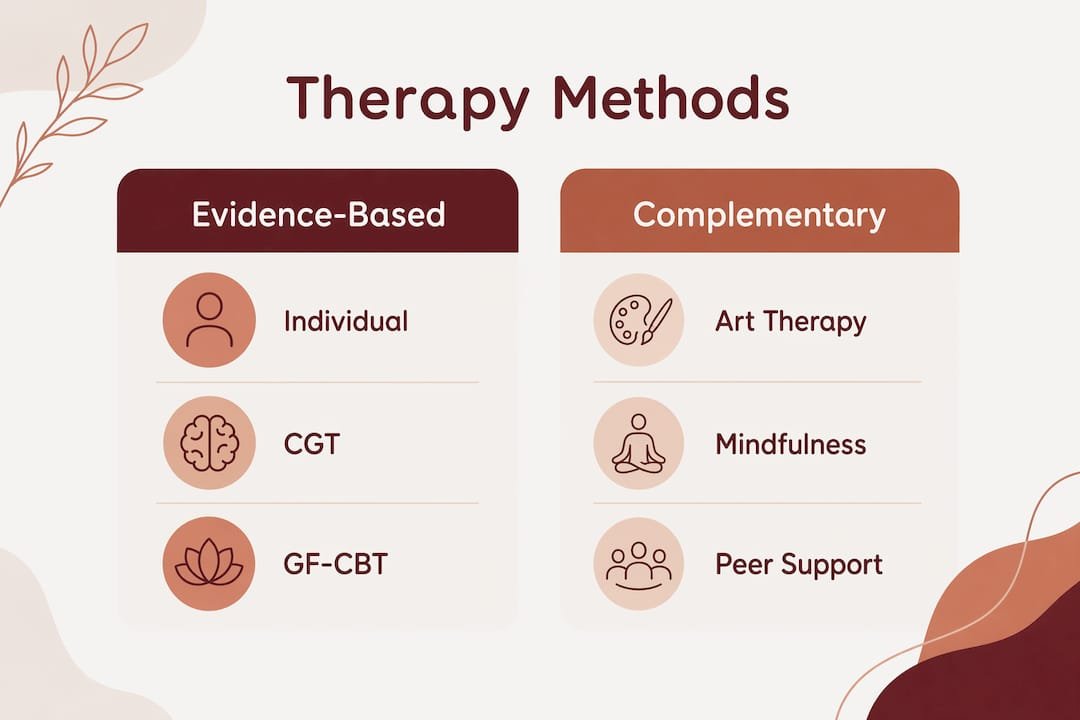
Individual psychotherapy is the gold standard for treating grief disorder and depression after loss. A review of 169 RCTs, including 76 trials focused specifically on grief symptoms, found moderate-strength evidence that psychotherapy improves grief disorder, depression, and overall grief symptoms. That level of evidence places psychotherapy well above most other available interventions.
Grief-Focused Cognitive Behavioral Therapy (GF-CBT)
GF-CBT adapts standard cognitive behavioral therapy to address grief-specific thought patterns, avoidance behaviors, and emotional processing. A 2026 randomized clinical trial of 113 older adults published in JAMA Psychiatry found that group GF-CBT produced large symptom reductions (effect size d=1.74) at six months, and individual GF-CBT produced similarly large reductions (d=1.46). Group therapy was noninferior to individual therapy. That finding is significant because it means group formats offer a real clinical option, not just a budget alternative.
Complicated Grief Therapy (CGT)
Complicated Grief Therapy is a structured 16-session protocol designed specifically for prolonged grief disorder. CGT works on two tracks simultaneously: processing the narrative of the loss and restoring life goals and relationships. This dual focus distinguishes CGT from generic talk therapy and makes it the most targeted option for people with PGD.
Emerging and complementary approaches
Art therapy, mindfulness meditation, and peer support groups show promise as adjunct supports, but the evidence for these as standalone grief treatments is weaker. Expert-facilitated support groups show some benefit for depression, but the evidence strength is low compared to individual psychotherapy. These approaches work best alongside, not instead of, structured therapy.
| Method | Format | Typical Length | Evidence Strength |
|---|---|---|---|
| Individual psychotherapy | One-on-one | Varies | Moderate to strong |
| Grief-Focused CBT (GF-CBT) | Individual or group | 12–20 sessions | Strong |
| Complicated Grief Therapy (CGT) | Individual | 16 sessions | Strong (for PGD) |
| Expert-led support groups | Group | Ongoing | Low to moderate |
| Art therapy / meditation | Individual or group | Varies | Emerging |
Pro Tip: If cost or scheduling is a barrier, group GF-CBT is clinically equivalent to individual therapy for many people. A group setting also reduces isolation, which is one of the most painful parts of grief.
What happens in grief therapy sessions?
Grief therapy sessions follow a recognizable structure, even though the emotional content is deeply personal. Knowing what to expect helps you show up more prepared and get more from each session.
A typical course of bereavement counseling includes these components:
Assessment and goal setting. Your therapist gathers your history, the nature of your loss, and your current symptoms to build a picture of your needs and set realistic goals.
Loss narration. You tell the story of your loss, including the circumstances, your relationship with the person, and what their absence means to your life now.
Emotional processing. Your therapist helps you sit with difficult emotions like guilt, anger, or profound sadness without suppressing or rushing through them.
Cognitive restructuring. Unhelpful thought patterns, such as self-blame or catastrophizing, are identified and gently challenged.
Continuing bonds work. Therapy helps you build a life around grief, not erase it. You learn to maintain a meaningful internal relationship with the person you lost rather than forcing detachment.
Restoration planning. You work on re-engaging with life goals, relationships, and identity in ways that honor your loss.
Grief therapy also addresses co-occurring conditions. Depression, anxiety, and PTSD frequently accompany significant loss, and a skilled therapist treats these alongside grief rather than in isolation. For people whose grief is rooted in trauma, approaches like EMDR can be integrated into the therapy for loss to address traumatic memories directly.
Grief counseling should adapt to your individual experience rather than enforce a rigid sequence of stages. Your therapist's job is to follow your process, not lead you through a predetermined script.
How do you find an effective grief counselor?
Finding the right grief counselor requires more than a Google search. Qualifications matter, but so does fit. A therapist with specific training in bereavement counseling techniques, PGD, or trauma-informed care will serve you better than a generalist with no grief-specific experience.
Before your first session, ask these questions:
What training or certifications do you have in grief or bereavement counseling?
Are you familiar with Complicated Grief Therapy or Grief-Focused CBT?
Do you have experience with my type of loss (traumatic, sudden, disenfranchised)?
Do you offer online grief counseling or telehealth sessions?
How do you approach grief? Do you follow a specific protocol?
The format of therapy also matters. Individual therapy offers privacy and depth. Group therapy provides community and the relief of knowing you are not alone. Online grief counseling removes geographic and scheduling barriers, which is especially relevant for people in rural areas or those managing caregiving responsibilities. Alvaradotherapy offers online counseling throughout California, making evidence-based grief support accessible regardless of location.
Individualized assessment is key because not all bereaved people benefit equally from the same approach. If your grief involves trauma, a therapist trained in both trauma and bereavement will provide more targeted care than one trained in only one area.
Pro Tip: The therapeutic alliance, meaning the trust and connection between you and your therapist, is one of the strongest predictors of therapy outcomes. If you do not feel heard after two or three sessions, it is reasonable to try a different therapist.
How to get the most from grief counseling
Active participation in therapy accelerates healing. The more honestly you engage, the more your therapist can tailor support to your actual experience.
Honest sharing is the foundation. Grief is not always socially acceptable to express fully, and many people minimize their pain even in therapy. Naming what you actually feel, including anger, relief, or guilt, gives your therapist the information needed to help you. Patience with your own pace matters equally. Talk therapy provides a reliable presence that helps clients navigate profound life changes, but that navigation takes time and cannot be rushed.
Self-care practices between sessions reinforce what you work on in therapy. Journaling, mindful breathing, and gentle physical activity all support emotional regulation and give you a way to process feelings between appointments. Avoid comparing your grief timeline to others. Grief is not a competition, and someone else recovering faster says nothing about your loss or your resilience.
Set realistic expectations. Therapy does not erase grief. It builds your capacity to carry it. The goal is a life that has room for both your loss and your continued growth. For a deeper look at grief recovery strategies and how therapy supports that process, Alvaradotherapy's resources offer clear, evidence-grounded guidance.
Pro Tip: Before each session, write down one thing you want your therapist to understand about your week. That single sentence often opens the most productive conversations.
Key Takeaways
Effective grief counseling works best when matched to the type and severity of grief, using evidence-based methods like individual psychotherapy, GF-CBT, or Complicated Grief Therapy.
| Point | Details |
|---|---|
| Psychotherapy is the gold standard | A review of 169 RCTs confirms moderate-to-strong evidence for psychotherapy improving grief and depression. |
| Group therapy is clinically equivalent | GF-CBT in group format produces outcomes equal to individual therapy, with the added benefit of community. |
| CGT targets prolonged grief specifically | The 16-session CGT protocol addresses both loss narration and life goal restoration for PGD. |
| Grief is not linear | Counseling should adapt to your individual, cyclical experience rather than enforce stage-based timelines. |
| Therapeutic alliance predicts outcomes | Finding a therapist you trust and connect with is as important as the method they use. |
What I have learned about grief that most articles get wrong
Grief counseling is often described as a process of "working through" loss, as if grief is a problem with a solution on the other side. That framing does real harm. The people I have seen make the most meaningful progress in therapy are not the ones who "got over" their loss. They are the ones who learned to carry it differently.
The most common misconception I encounter is that grief counseling is for people who are broken or cannot cope. The truth is the opposite. Seeking therapy for loss is an act of clarity. It says you understand that what you are carrying is real and that you deserve skilled support in bearing it.
What actually shifts in effective therapy is not the grief itself. It is your relationship to it. Clients often describe a moment when the loss stops feeling like an obstacle to living and starts feeling like part of who they are. That shift does not happen on a schedule. It happens when the therapeutic space is safe enough for the full weight of the loss to be felt and witnessed.
I also want to name something that rarely appears in clinical literature: grief changes your identity. The person you were before the loss does not simply resume. Therapy at its best helps you reconstruct who you are in the presence of absence. That is not a small thing. It is the whole thing.
— Juiced
Alvaradotherapy's approach to grief and emotional healing
Alvaradotherapy is a California-based, trauma-informed practice offering evidence-based grief counseling, individual therapy, and specialized support for PTSD and complex trauma. The team works with adults navigating loss of all kinds, including traumatic bereavement, prolonged grief, and grief complicated by anxiety or depression.

Services are available in person across Pasadena and Ventura, and through online therapy throughout California, making it straightforward to access care that fits your schedule and location. Alvaradotherapy's therapists are bilingual in English and Spanish and bring trauma-sensitive, identity-affirming care to every session. If you are ready to understand what therapy looks like in practice, the consultation page is a clear starting point for finding the right fit.
FAQ
What is the most effective therapy for grief?
Individual psychotherapy is the most evidence-supported treatment for grief disorder and depression, backed by a review of 169 randomized controlled trials. Grief-Focused CBT and Complicated Grief Therapy are the most effective structured protocols for prolonged or complicated grief.
How long does grief counseling typically take?
The length varies by the type and severity of grief. Complicated Grief Therapy follows a defined 16-session protocol, while general bereavement counseling may run shorter or longer depending on individual needs and progress.
Is online grief counseling as effective as in-person therapy?
Online grief counseling delivers the same evidence-based methods as in-person therapy and removes barriers like distance and scheduling. Telehealth formats are especially useful for people in rural areas or those with caregiving responsibilities.
When should I seek grief counseling versus relying on natural support?
Grief counseling is most beneficial when grief persists beyond 12 months, significantly impairs daily functioning, or follows a traumatic loss. Natural support from family and community is often sufficient for normative grief without these complications.
Can grief counseling help with depression and anxiety caused by loss?
Yes. Skilled grief therapists address co-occurring depression, anxiety, and PTSD alongside grief, often integrating approaches like cognitive restructuring or EMDR to treat the full picture of what you are experiencing.
