
How Does Couples Therapy Work: What to Expect

TL;DR:
Couples therapy treats the relationship as the client, helping partners break negative cycles and build healthier patterns. Sessions involve information gathering, real-time practice, and homework, often lasting around 12 sessions for moderate issues. Effectiveness depends on engagement, modality match, and timing, with therapy improving relationship health or supporting healthier separation if needed.
Couples therapy treats the relationship itself as the client, not either individual. A trained therapist steps in as a neutral third party, managing a three-way dynamic between Partner A, Partner B, and the relationship as its own entity. The core mechanism is straightforward: the therapist helps both partners stop fighting each other and start teaming up against the negative interaction cycles that keep pulling them apart. New patterns replace old ones through real-time practice in sessions and structured work between them.
Here is what the early process typically looks like:
First session: intake interview, clinical history, confidentiality review, and mutual goal-setting
Session length: usually 50–60 minutes, weekly or biweekly
Immediate next step: identify one or two specific concerns you want to address before your first appointment, then book a consultation with a licensed therapist
Clinical literature draws a useful distinction: short-term couples counseling typically runs six sessions or fewer and focuses on a specific, contained issue. Couples therapy proper is longer, more open-ended, and explores the relational patterns underneath the surface conflict. Knowing which one you need shapes everything from how you choose a therapist to how long you budget for the process.
Table of Contents
What are the main evidence-based approaches to couples therapy?
Alvaradotherapy offers trauma-informed couples therapy in California and New York
How does couples therapy work session by session?
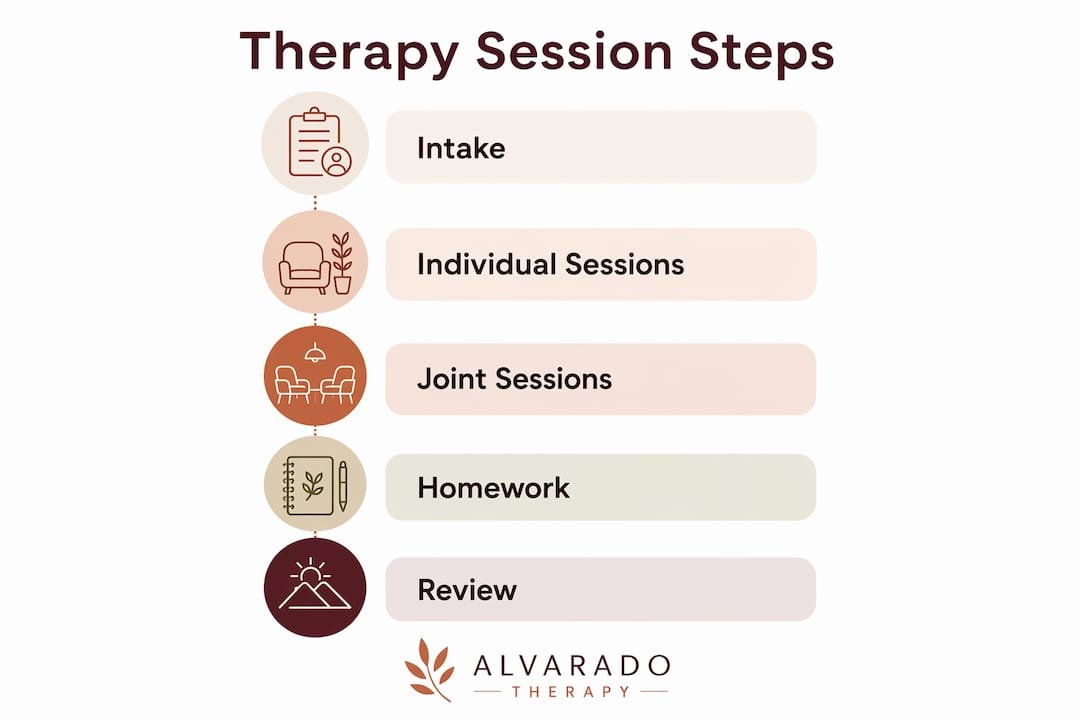
The first session is less about solving problems and more about gathering information. The therapist will ask about your relationship history, individual backgrounds, what brought you in, and what you each hope to get out of the process. Most clinicians also conduct a brief safety screening during intake, asking about intimate partner violence, substance use, and any active mental health crises. This is not a formality. It determines whether couples therapy is appropriate at all, or whether one or both partners need individual stabilization first.
After intake, sessions follow a recognizable rhythm:
Check-in: Each partner briefly shares what has come up since the last session.
Focused topic: The therapist introduces or continues work on a specific pattern or skill.
Real-time practice: Partners try a new communication approach or emotional response in the room, with the therapist guiding and interrupting when old patterns surface.
Reflection: The therapist helps both partners notice what just happened and why it matters.
Homework assignment: A specific exercise to practice before the next session.
Therapists sometimes schedule individual sessions with each partner separately, particularly early in treatment. This gives each person space to share information they might not feel safe disclosing jointly, and it helps the therapist understand each partner's perspective without the other present. The key condition: anything shared individually may or may not remain confidential depending on the therapist's policy, so ask about this explicitly before agreeing to individual sessions.
Pro Tip: Ask your therapist in the first session how they handle information shared in individual meetings. Some therapists hold individual disclosures in confidence; others treat the couple as the unit and share relevant information with both partners. Knowing the policy upfront prevents surprises.

One thing many couples do not expect: therapy can feel harder before it feels easier. Surfacing long-suppressed grievances temporarily increases friction as old patterns get named and challenged. That destabilization is usually a sign the work is happening, not a sign the therapy is failing. A good therapist will name this dynamic and help you stay regulated through it.
What are the main evidence-based approaches to couples therapy?
Most therapists draw from multiple modalities rather than applying one method rigidly. Still, understanding the major approaches helps you ask better questions and recognize whether a therapist's training fits your situation.
| Approach | Core focus | Session style and homework | Evidence base | Best fit | Timeline |
|---|---|---|---|---|---|
| Emotionally Focused Therapy (EFT) | Attachment patterns; emotions as the driver of relational cycles | Experiential; partners access vulnerable emotions in session; homework involves emotional check-ins | Among the strongest research support for attachment-based distress | Emotional disconnection, anxious/avoidant cycles, trauma history | 8–20 sessions |
| Gottman Method | Behavioral patterns; the “Four Horsemen” (criticism, contempt, defensiveness, stonewalling) | Structured exercises; detailed homework (Love Maps, bids for connection) | Decades of longitudinal research; strong evidence base | Chronic conflict, communication breakdown, rebuilding friendship | 12–20+ sessions |
| Cognitive-Behavioral Couple Therapy (CBCT) | Thought patterns and behaviors that maintain conflict; skill acquisition | Psychoeducation, thought records, behavioral experiments; significant homework load | Well-established; strong evidence for anxiety, depression, and conflict | Couples where distorted thinking drives conflict; comorbid individual issues | 12–20 sessions |
| Integrative Behavioral Couple Therapy (IBCT) | Acceptance of differences alongside behavior change | Empathy-building; less structured homework than traditional BCT | Effective for roughly 69% of couples in treatment, compared to 50–60% for traditional behavioral models | Couples stuck in recurring conflict over fundamental differences | 20 sessions |
| Imago Relationship Therapy | Childhood relational wounds and how they shape partner selection | Structured “Imago Dialogue” (mirroring, validation, empathy); journaling homework | Clinically developed; growing evidence base, less meta-analytic depth than EFT or IBCT | Couples wanting to understand the deeper “why” behind their patterns | 12–20 sessions |
A few things worth noting about this table. EFT, developed by Sue Johnson, is grounded in attachment theory and targets the emotional cycles beneath surface arguments. Imago, developed by Harville Hendrix and Helen LaKelly Hunt, works from the premise that we unconsciously choose partners who mirror both the positive and negative traits of our early caregivers. IBCT evolved directly from traditional behavioral couples therapy and added an acceptance component that the original model lacked.
Pro Tip: Match your presenting problem to the approach. If the core issue is emotional distance or an anxious/avoidant cycle, ask specifically about EFT-trained therapists. If the problem is daily conflict and communication breakdown, Gottman-trained clinicians are a strong fit. Trauma history in one or both partners often calls for a therapist who can blend couples work with trauma-informed approaches like EMDR.
Couples therapy used proactively, not just in crisis, is worth mentioning here. Life transitions like becoming parents, navigating a career change, or approaching retirement are exactly the moments when relational patterns get stress-tested. Entering therapy before things break down is often more efficient than waiting until the damage is severe.
How long does couples therapy typically take?
The honest answer: it depends on what you bring in. A contained issue, like preparing for a major life transition or improving communication around a specific topic, might resolve in six sessions or fewer. That is the short-term counseling model. Deeper relational patterns, especially those involving infidelity, trauma, or years of accumulated resentment, typically require longer work.

A common clinical estimate for couples therapy is around 12 sessions for moderate relational distress. EFT, one of the most research-supported approaches, often runs 8–20 sessions. Some couples, particularly those dealing with complex trauma or severe disconnection, work for longer.
Factors that tend to shorten the process:
Both partners are motivated and complete homework consistently
The presenting issue is specific and recent, not a years-long pattern
Neither partner has untreated individual mental health conditions that complicate the relational work
Factors that tend to extend it:
Infidelity, especially recent disclosure
One or both partners carrying unresolved individual trauma
Significant ambivalence about the relationship itself
Inconsistent attendance or homework avoidance
A useful decision point: after six to eight sessions, check in with your therapist about progress. Are the negative cycles becoming more visible? Are you both practicing new responses? If there is no movement after eight sessions, it is worth discussing whether the modality is the right fit, whether individual therapy should run alongside couples work, or whether an intensive format might accelerate progress.
Does couples therapy actually work? What the research says
The short answer is yes, with important caveats. The research on couples therapy is more robust than many people realize, and the mechanisms of change are reasonably well understood across modalities.
The central mechanism, consistent across EFT, Gottman, IBCT, and CBCT, is interrupting the negative interaction cycle. Partners stop reacting to each other's surface behavior and start recognizing the pattern itself as the problem. That shift, from "you are the problem" to "this cycle is the problem," is what relational science identifies as the core driver of improvement.
What predicts better outcomes:
Both partners are genuinely engaged, not one dragging the other
Early alliance with the therapist (both partners feel understood, not judged)
Consistent homework completion between sessions
A modality matched to the presenting problem (EFT has particularly strong evidence for attachment-based distress)
IBCT data offers a useful benchmark. Integrative behavioral couples therapy shows effectiveness for roughly 69% of couples in treatment. That is a meaningful improvement over the 50–60% rate for traditional behavioral models. At a five-year follow-up of couples who participated in either IBCT or traditional behavioral therapy, outcomes varied, with some couples experiencing no change, some facing deterioration, and others improving or recovering.
Couples therapy is not a guarantee of staying together. Its primary value is increasing the likelihood of either a healthier repair or, when reconciliation is not possible, a healthier separation. Framing it as "save the relationship or fail" sets up a false binary that makes the process harder for everyone involved.
That framing matters. Therapy improves relational functioning and can support a more constructive ending when reconciliation is not the right outcome. Some couples leave therapy with a clearer, more respectful path to separation than they could have found on their own.
A few honest research limitations: most studies use self-report measures, follow-up periods vary widely, and samples tend to skew toward white, heterosexual, married couples. The evidence base for LGBTQ+ couples, couples from non-Western cultural backgrounds, and couples navigating severe trauma is growing but still thinner than the mainstream literature. For couples therapy effectiveness research specific to trauma-informed approaches, the picture is more nuanced and worth discussing directly with a clinician.
How do you find and choose a good couples therapist?
Credentials matter, but they do not tell the whole story. Here is what to look for.
Relevant licenses in the U.S.:
LMFT (Licensed Marriage and Family Therapist): Training specifically focused on relational and systemic work. Often the most directly relevant credential for couples therapy.
LCSW (Licensed Clinical Social Worker): Broad clinical training with a systems perspective; many LCSWs specialize in couples and family work.
PsyD or PhD (Licensed Psychologist): Doctoral-level training; often stronger in assessment and research-informed practice. Look for a specialization in couples or relational therapy.
A license tells you someone met minimum training and ethical standards. What it does not tell you is whether they have specific training in a couples modality, experience with trauma, or the temperament to manage a high-conflict room without taking sides.
Questions to ask during a consultation:
What modality do you primarily use with couples, and what training have you had in it?
How do you handle individual sessions, and what is your confidentiality policy for those?
Do you have experience working with couples where one or both partners have trauma histories?
What does homework typically look like in your practice?
What are your fees, and do you offer a sliding scale?
Red flags to watch for:
The therapist consistently sides with one partner or validates one perspective without exploring the other
Safety concerns (IPV, substance use) are minimized or not screened for
The therapist lacks any specific training in a recognized couples modality
Boundaries around individual sessions are unclear or inconsistently applied
Pro Tip: Cultural and language fit matters more than many people expect. A therapist who shares or genuinely understands your cultural background, or who can conduct sessions in your primary language, removes a layer of friction that otherwise slows the work. Ask about this directly before committing.
For a deeper look at effective couples counseling methods and what to look for in a clinician, the Alvaradotherapy blog covers the practical side of this decision in detail.
How much does couples therapy cost in the U.S.?
Private-practice couples therapy typically runs $150 to $400 per session for a 50–60 minute appointment. Geography, clinician training level, and whether sessions are in-person or via telehealth all influence where a given therapist lands in that range. A Gottman-certified therapist in a major metro area will generally charge more than a licensed therapist in a smaller market using an integrative approach.
Insurance basics:
Most insurance plans do not cover couples therapy directly unless one partner has a diagnosable mental health condition (depression, anxiety, PTSD) that the therapy is treating.
When coverage applies, the therapist must be in-network and preauthorization may be required.
Always call your insurance company before assuming coverage. Ask specifically whether "couples therapy" or "marriage counseling" is covered, and under what diagnostic codes.
Lower-cost options:
Community mental health clinics: Often offer sliding-scale fees based on income
University training clinics: Graduate students supervised by licensed clinicians; significantly lower fees, often $20–$60 per session
Sliding-scale private practices: Many therapists reserve a portion of their caseload for reduced fees; ask directly
Couples workshops and intensives: Some evidence-based programs (like Gottman-based workshops) offer structured skill-building at lower per-hour cost than ongoing weekly therapy
Practical tips on fees:
Ask about cancellation policies before your first session. A 24–48 hour notice requirement is standard; shorter windows can result in full-session charges.
Ask whether the practice offers session packages or intensives, which sometimes reduce the per-session cost.
If cost is a barrier, say so directly. Many therapists will either adjust their fee or refer you to a colleague who can.
How to prepare for your first couples therapy session
Walking in without preparation is fine, but walking in with a little structure makes the first session more productive. Here is a practical checklist.
Before your first appointment:
Complete any intake paperwork the practice sends in advance
Bring insurance information if you plan to use it
Write down two or three specific concerns you want to address, not a comprehensive grievance list
Note any significant recent events (a major argument, a disclosure, a life change) that provide context
If safety is a concern for either partner, have emergency contact information and local resources on hand
Common homework you might be assigned:
Communication experiments: Practicing a specific listening or speaking technique from the session in a low-stakes conversation at home
Tracking bids for connection: Noticing when your partner reaches out for emotional connection and how you respond
Scheduled positive time: Deliberately planning shared activities with no agenda beyond being together
Individual reflection exercises: Journaling prompts or worksheets to process what came up in session
Between-session homework is not optional in most approaches. The real change happens in the practice between sessions, not just in the room. Many couples are surprised by how emotionally demanding the assigned exercises can be.
If one partner is reluctant: This is common. One person often initiates therapy while the other attends reluctantly or under pressure. A good therapist can work with ambivalence, but both partners need to show up. If a partner refuses entirely, individual therapy focused on the relationship is a legitimate starting point. Some therapists will also see one partner individually with the explicit goal of improving the relationship, though this has limits.
For a detailed walkthrough of what to expect in your first session, Alvaradotherapy has a practical guide that covers the intake process and early session logistics.
When couples therapy might not be appropriate
Couples therapy is not the right starting point for every situation. Knowing the contraindications can protect both partners and prevent harm.
Clear contraindications:
Active intimate partner violence (IPV): Conjoint therapy in an abusive relationship can escalate danger for the victim. The National Domestic Violence Hotline (1-800-799-7233) and local domestic violence programs offer safer alternatives, including individual safety planning.
Active substance use that impairs safety: Couples therapy requires both partners to be present and regulated. Active addiction that affects cognitive function or safety needs to be addressed first, typically through individual treatment or a substance use program.
Active suicidal ideation without stabilization: If either partner is in acute crisis, individual stabilization takes priority before relational work begins.
What to expect during destabilization:
Couples therapy often surfaces issues that have been suppressed for years. In the early and middle phases, conflict can temporarily increase as old patterns get named and challenged. This is documented in the clinical literature and is usually a sign the process is working, not failing. A skilled therapist will monitor this and adjust pacing if the distress becomes unmanageable.
Legal and privacy considerations:
Therapists in the U.S. are mandated reporters. If a child or vulnerable adult is at risk, the therapist is legally required to report it, regardless of what was shared in a confidential session.
Confidentiality has limits: imminent danger to self or others, court orders, and certain insurance billing requirements can all affect what remains private.
Couples therapy cannot substitute for individual care when severe personality disorders, criminal violence, or acute psychiatric conditions are present. In those cases, a referral to specialized individual treatment is the appropriate step.
Pro Tip: If you are unsure whether couples therapy is safe for your situation, a brief individual consultation with a licensed therapist before starting conjoint sessions is a low-risk way to get clarity. You do not have to figure this out alone.
For trauma-informed conflict resolution guidance that accounts for safety and history, Alvaradotherapy's approach integrates these considerations from the first contact.
Key Takeaways
Couples therapy works by treating the relationship as the client, interrupting negative interaction cycles, and building new patterns through real-time practice and consistent homework, with outcomes that depend heavily on both partners' engagement and the right modality match.
| Point | Details |
|---|---|
| Core mechanism | Therapy helps partners team up against the negative cycle, not each other, which is the central driver of change across all major modalities. |
| Typical timeline | Short-term counseling runs six sessions or fewer; couples therapy averages around 12 sessions, and approaches like EFT often run 8–20 sessions. |
| Realistic outcomes | Therapy improves the likelihood of healthy repair or a healthier separation; it is not a guarantee of staying together. |
| Cost range | Private-practice sessions typically cost $150–$400; sliding-scale, university clinics, and intensives offer lower-cost alternatives. |
| Alvarado Therapy | Alvarado Therapy offers trauma-informed, bilingual couples therapy online in California and New York, with EMDR-informed approaches available when trauma is part of the picture. |
What couples therapy actually demands, and why that matters
The gap between what people expect from couples therapy and what it actually requires is wider than most articles admit. People often walk in hoping the therapist will arbitrate, declare a winner, and hand them a communication script. That is not what happens, and the misalignment sets couples up to quit too early.
What therapy actually demands is that both partners tolerate being uncomfortable in front of each other, on purpose, repeatedly. The real-time practice component is not a soft exercise. It asks you to try a new emotional response while your nervous system is still running the old one. That is hard. It is also why homework completion predicts outcomes so strongly. The session is the rehearsal; the week between sessions is where the actual rewiring happens.
There is also a tendency to treat couples therapy as a last resort, something you try when everything else has failed. That framing costs people years. Therapy used proactively, during a major life transition or when a pattern is just starting to calcify, is almost always faster and less painful than therapy entered in full crisis. The research on preventive couples work supports this, and clinically it makes intuitive sense: it is easier to interrupt a pattern that is three months old than one that is three years old.
One more thing worth saying plainly: a therapist who cannot maintain neutrality is not just ineffective, they are actively harmful. If you leave sessions consistently feeling like the therapist is on your partner's side, or your partner consistently feels the same, that is not a minor stylistic issue. It is a reason to change therapists. The three-way alliance, both partners feeling genuinely understood, is not a nice-to-have. It is the mechanism.
Alvaradotherapy offers trauma-informed couples therapy in California and New York
Most couples therapy practices treat relational distress as a communication problem. Alvaradotherapy treats it as what it often is: a relational pattern shaped by individual histories, attachment wounds, and sometimes trauma. That distinction changes how sessions are structured, what the therapist pays attention to, and how quickly couples can move through stuck points.
Alvaradotherapy's licensed therapists offer online couples therapy in California and New York, with bilingual English-Spanish services and EMDR-informed approaches available when trauma is part of the picture. The practice serves clients across Pasadena, Ventura, and throughout California via telehealth, with a sliding-scale option and a straightforward intake process. Sessions are trauma-sensitive from the first contact, which means safety screening, cultural responsiveness, and a clear explanation of what to expect are built into the process, not added as afterthoughts.
To get started, visit the consultation page to book a free initial consultation and find out whether the practice is the right fit for your situation.
Useful sources and further reading
These are the sources worth reading if you want to go deeper on the research or verify specific claims:
Harvard Health: Will couples therapy improve your relationship? A clear, evidence-grounded overview from Harvard Medical School covering when couples therapy helps, what to expect, and how to find a qualified therapist. Good starting point for anyone new to the topic.
Psychology Today: How Does Couples Therapy Work? Covers the therapist's role, session structure, typical duration, and cost. Useful for understanding the practical mechanics of the process.
Psychology Today: Why Does Couples Therapy Work? A more conceptual piece on the mechanisms of change, including the "teaming up against the cycle" framework and the documented risk of early destabilization.
Simply Psychology: Couples Therapy Guide One of the more thorough overviews available, covering EFT, Gottman, IBCT, and Imago in depth, along with evidence summaries and session expectations.
Wikipedia: Couples Therapy A useful aggregator of research findings, including the IBCT effectiveness data and a comparative overview of major modalities. Best used as a map to the primary literature, not as a primary source itself.
Alvaradotherapy: Couples Therapy Success — What Actually Works A practice-specific discussion of outcome predictors and realistic expectations, grounded in the same research literature and written for adults considering therapy.
Alvaradotherapy: Couples Therapy Advantages That Strengthen Any Relationship Covers the preventive and proactive case for couples therapy, including how it supports couples navigating major life transitions before a crisis develops.
This article is general educational information, not professional mental health advice. For guidance specific to your situation, consult a licensed mental health professional or contact a qualified therapist directly.
