
How VOCA Empowers Trauma Recovery in California

TL;DR:
VOCA funds trauma-focused mental health services for crime victims in California, including therapy and recovery centers.
Limits include 60 therapy sessions for direct victims and dependency on trauma-relatedness and insurance billing.
Funding gaps and system strain affect access, emphasizing the need for stable, long-term support.
Thousands of Californians are getting trauma-focused mental health support right now, and many have no idea it's being funded by a federal law called VOCA, the Victims of Crime Act. This program quietly powers a significant portion of the state's crime victim services, from individual therapy to specialized recovery centers. VOCA funds California's Victim Compensation Program through CalVCB, reimbursing mental health counseling for adult crime victims and their families. If you or someone you care about is healing from crime-related trauma, understanding how VOCA works could open real doors to support you didn't know existed.
Table of Contents
Key Takeaways
| Point | Details |
|---|---|
| VOCA funds trauma recovery | VOCA directly supports therapy for adult crime survivors across California through CalVCB-managed funds. |
| Clear session and dollar limits | Therapy reimbursement is capped at set sessions and amounts, with possible treatment plan extensions. |
| TRCs drive results | Trauma Recovery Centers funded by VOCA achieve major improvements for underserved adults. |
| Eligibility and rules matter | Only crime-related, documented trauma care qualifies and payor-of-last-resort rules affect coverage. |
| Funding instability remains a barrier | While California has filled some gaps, ongoing federal cuts risk the future of survivor services. |
What is VOCA and why does it matter in California?
VOCA, the Victims of Crime Act, was signed into federal law in 1984. It created the Crime Victims Fund, a pool of money collected from federal criminal fines and penalties, not taxpayer dollars. That fund flows from the federal government to states, which then distribute it to victim service programs. In California, that distribution runs through CalVCB, the California Victim Compensation Board.
CalVCB uses VOCA-funded mental health reimbursements to cover counseling for adult crime victims and derivative victims, meaning people who were not directly harmed but experienced trauma because of what happened to someone close to them. Think of a parent whose child was assaulted, or a spouse who witnessed violence. Both can qualify.
This matters because trauma doesn't resolve on its own. Without access to consistent, specialized mental health care, survivors often face worsening PTSD, anxiety, depression, and difficulty functioning in daily life. For many Californians, especially those without insurance or with limited financial means, VOCA-funded services are the only realistic path to professional support.
Here's who may qualify for VOCA-funded services in California:
Direct victims: Adults who were personally victimized by a crime
Derivative victims: Family members or household members of a direct victim
Survivors of homicide victims: Those grieving a loved one killed by crime
Those meeting crime-relatedness criteria: Services must be linked to the crime's psychological impact
Pro Tip: You don't need to have filed a police report in all cases. CalVCB evaluates applications on a case-by-case basis, and documentation requirements vary. Check CalVCB's eligibility guidance or talk to a licensed provider who works with therapy for crime victims to understand your options before assuming you don't qualify.
California's size and population diversity make VOCA especially important here. Urban and rural communities alike rely on this funding to serve survivors who would otherwise fall through the cracks of an already strained mental health system.
How VOCA-funded mental health support works
Once you know VOCA exists, the next question is how it actually pays for therapy. The process involves eligibility verification, provider requirements, and a reimbursement structure that's more structured than most people expect.
CalVCB session limits set the framework: direct adult victims can receive up to 60 session hours or $10,000 for outpatient mental health services. Derivative adult victims receive up to 30 sessions or $5,000. Extensions are possible, but they require an additional treatment plan submitted by your provider.
Here's a quick breakdown:
| Victim type | Session limit | Dollar cap | Extensions available? |
|---|---|---|---|
| Direct adult victim | 60 hours | $10,000 | Yes, with treatment plan |
| Derivative adult victim | 30 sessions | $5,000 | Yes, with treatment plan |
To access reimbursement, a few key things must be in place. Crime-relatedness and insurance must both be addressed: CalVCB verifies that treatment is linked to the crime's trauma, and VOCA acts as a payor of last resort, meaning private insurance or Medi-Cal must be billed first if you have coverage. VOCA then covers what remains.
Providers must use specific billing codes. Common ones include CPT code 90834 for standard psychotherapy and 90791 for intake evaluations. Your therapist needs to be licensed and meet CalVCB's provider requirements to be eligible for reimbursement.
Here's what the process typically looks like for getting started:
Apply to CalVCB and get approved as a crime victim
Choose a licensed mental health provider who accepts CalVCB reimbursement
Complete an intake evaluation (CPT 90791)
Your provider submits a treatment plan and bills using approved CPT codes
VOCA reimburses after any other insurance coverage is applied
If you need more sessions beyond initial limits, your provider submits an extended treatment plan
Pro Tip: Ask any potential therapist upfront whether they are enrolled with CalVCB and familiar with the documentation requirements. Providers who regularly work with VOCA clients will streamline this process significantly. You can also explore accessing online therapy in California if in-person access is a barrier. And if you're still searching, guidance on choosing a trauma therapist can help you find the right fit.
The impact of Trauma Recovery Centers (TRCs)
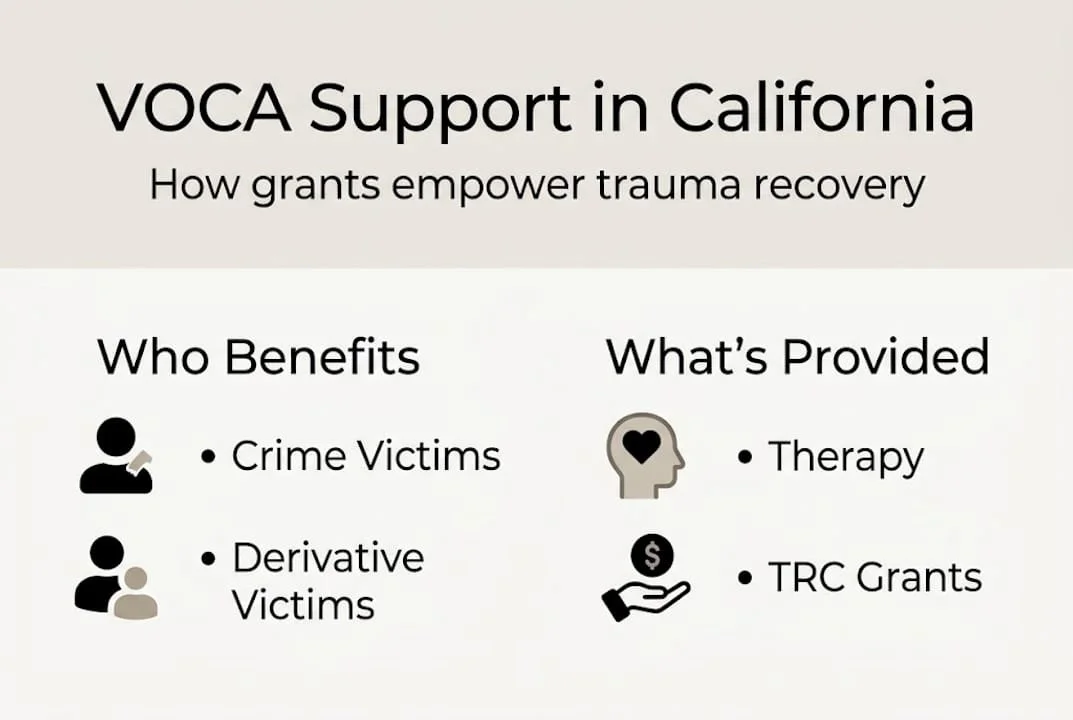
Beyond individual therapy reimbursements, VOCA funds something more specialized: Trauma Recovery Centers, or TRCs. These are multidisciplinary hubs designed specifically for crime victims who face the greatest barriers to care.

VOCA supports TRCs in California by funding grants that allow these centers to provide trauma-informed mental health services to underserved violent crime victims. In 2025 to 2026, the demand for these grants was massive, with $67 million requested against only $18 million available.
So what makes a TRC different from a regular therapy clinic?
| Feature | Traditional therapy | Trauma Recovery Center |
|---|---|---|
| Services | Individual counseling | Therapy, case management, advocacy, peer support |
| Staff model | Single clinician | Multidisciplinary team |
| Target population | General public | Underserved crime victims |
| Trauma focus | Varies | Explicitly trauma-informed throughout |
| Access support | Limited | Active outreach and navigation support |
The outcomes data is striking. PTSD scores in LA County TRCs improved from an average of 42.3 to 27.6 (p<0.001), while quality of life scores also showed meaningful gains across multiple domains.
"Multidisciplinary, trauma-informed models are not a luxury for underserved survivors. They are the difference between stabilization and ongoing crisis."
TRCs often serve communities that face compounded barriers: language differences, immigration concerns, poverty, and distrust of systems. Their approach meets people where they are. Services commonly offered include:
Individual trauma-focused therapy (including EMDR and CBT)
Group therapy and peer support
Case management and advocacy
Crisis intervention
Coordination with legal and medical services
For survivors whose trauma is layered and whose lives are complicated by other stressors, this kind of trauma recovery workflow is often the only model that actually works. The evidence also underscores the importance of cultural responsiveness in trauma care, especially in California's diverse communities.
Limitations, challenges, and new developments
VOCA is powerful, but it's not without real limitations. Understanding them matters if you're trying to access services or advocate for someone who needs them.
First, not everything qualifies. Therapy unrelated to a verified crime is excluded. Child custody disputes, general life stress, or pre-existing conditions not connected to the crime in question don't qualify for reimbursement. CalVCB verifies crime-relatedness carefully, which means documentation is essential. Recent SB 877 updates did expand access in one significant way: out-of-state providers are now eligible post-2023 if they hold a license recognized in California. That's a meaningful change for people in border areas or with limited local options.
Here are some key limitations to know:
Payor of last resort: VOCA only pays after insurance (including Medi-Cal) has been billed
Crime-relatedness requirement: Services must be clearly tied to the crime's impact
No child custody coverage: Therapy related to custody disputes is excluded
Provider enrollment required: Therapists must register with CalVCB to bill
Session caps: Limits apply unless extensions are formally approved
The bigger concern right now is funding. Federal VOCA cuts have created service gaps across the state. California backfilled more than $100 million on a one-time basis to prevent immediate collapse of services, but that kind of emergency patch doesn't replace stable, predictable funding.
Pro Tip: If you're working with a provider who suddenly loses VOCA funding or can no longer accept new VOCA clients, ask CalVCB about their referral network. Understanding trauma-sensitive therapy options and having a backup plan matters. Resources on starting therapy in California can also help you navigate next steps if your access shifts.
Advocacy organizations continue to push for stable, long-term VOCA funding at the federal level. Until that stability arrives, survivors and providers alike have to navigate a system that can shift mid-year.
Our take: The true power—and pitfalls—of VOCA in trauma recovery
From where we sit, working directly with trauma survivors and the systems that support them, VOCA is genuinely life-changing for many Californians. The evidence backs this up. When survivors access consistent, trauma-informed care, recovery is real and measurable.
But here's what the data also shows: TRC grant demand alone reveals a system under severe strain. When $67 million is requested and only $18 million is available, the math means people don't get care. Funding cycles that run only two years make it nearly impossible for programs to hire, retain, and build the kind of multidisciplinary teams that actually move the needle on PTSD.
The paperwork burden is also real. Survivors shouldn't have to become experts in CPT codes and treatment plan submissions just to get help. That's where community advocacy and knowledgeable providers make all the difference. If VOCA is going to fulfill its promise, California needs sustained investment, not emergency patches. We believe in trauma-informed care advances and the science behind them, but systems have to be funded well enough to actually deliver them.
Take the next step in your healing with trauma-informed support
If you've recognized your own story in what we've covered here, you don't have to figure out next steps alone. Navigating VOCA, finding the right provider, and beginning trauma-focused therapy are all things we can help with.
At Alvarado Therapy, our licensed clinicians specialize in PTSD and trauma counseling and are experienced in supporting victims of crime therapy through the CalVCB process. We serve clients across California, in English and Spanish, with both in-person and online sessions available. If you're ready to take the next step, you can consult a trauma therapist and start moving toward real, supported recovery.
Frequently asked questions
Who qualifies for VOCA-funded mental health counseling in California?
Adults directly affected by a crime or those affected through trauma (derivative victims) may qualify for reimbursement of trauma-focused mental health counseling if the crime and need are verified by CalVCB.
How many therapy sessions does VOCA usually cover?
VOCA covers up to 60 sessions for direct adult victims and 30 sessions for derivative adult victims, with possible extensions through formally submitted treatment plans.
What makes a Trauma Recovery Center (TRC) different from traditional therapy?
TRCs offer multidisciplinary, trauma-informed care built specifically for underserved crime victims, combining therapy with advocacy, case management, and peer support. PTSD outcomes in LA County TRCs showed significant improvement, with scores dropping from 42.3 to 27.6, and TRC grants in California reflect the high demand for this model.
What are the main exclusions for VOCA mental health reimbursement?
Therapy not connected to a verified crime, including child custody disputes or unrelated mental health concerns, is excluded. SB 877 updates now allow some out-of-state providers post-2023 if they meet California licensing requirements.
Does funding instability impact VOCA support in California?
Yes. Federal VOCA cuts have created meaningful service gaps, and while California backfilled over $100 million on a one-time basis, long-term needs remain unmet for many survivors across the state.
