
Bilingual Therapy Guide for Spanish-Speaking Adults

TL;DR:
Bilingual therapy improves trauma recovery by fostering trust and emotional safety in clients’ native language.
Research shows up to 60% better outcomes and higher retention rates with bilingual therapists.
Using clients’ native language enhances emotional resonance and cultural understanding, leading to deeper healing.
Have you ever sat in a therapy session, searching for the right English word to describe your pain, only to feel like something essential gets lost? For many Spanish-speaking adults in California, traditional English-only therapy creates an invisible barrier. You show up. You try. But healing feels just out of reach. Bilingual therapy allows you to process trauma in the language where your memories and emotions actually live, leading to deeper access and a stronger connection with your therapist. This guide walks you through the research, the preparation, and the real experience of bilingual sessions so you can step into healing with confidence.
Table of Contents
Key Takeaways
| Point | Details |
|---|---|
| Native language heals deeper | Processing trauma in your primary language unlocks greater emotional relief and trust with your therapist. |
| Cultural match matters | Choosing a therapist who understands your background leads to better retention and long-term outcomes. |
| Language switching boosts clarity | Moving between Spanish and English (or Spanglish) during sessions can help you access and express complex emotions. |
| Bilingual therapy outperforms traditional | Studies show bilingual approaches reduce symptom severity by up to 60% for Spanish-speaking trauma survivors. |
How bilingual therapy supports trauma recovery
When trauma happens, the brain encodes those experiences alongside the language you were thinking and feeling in at that moment. For most Spanish-speaking adults, that language is Spanish. Trying to revisit those memories in English is like reading a poem in translation: technically accurate, but missing the soul of the original.
The benefits of bilingual therapy go beyond simple communication. When you work with a therapist in your native language, trust builds faster, emotional safety increases, and the hardest memories become more approachable. That is not a small thing. That is often the difference between staying in therapy long enough to heal and dropping out because it feels pointless.
The numbers back this up. Research shows up to 60% improvement in trauma symptom management when Latinx clients work with bilingual therapists, making it roughly twice as effective compared to English-only treatment. Separately, empirical data confirms that native-language therapy significantly improves outcomes for both PTSD and anxiety disorders.
Here is a quick look at how outcomes compare:
| Outcome Area | Monolingual English Session | Bilingual Session |
|---|---|---|
| Symptom reduction (trauma) | Moderate | Up to 60% improvement |
| Client retention rates | Lower | Significantly higher |
| Emotional access during session | Limited | Deeper and more direct |
| Therapeutic alliance (trust) | Slower to build | Faster and stronger |
| Dropout risk | Higher | Lower |
The role of bilingual therapists also extends to cultural understanding. A therapist who speaks Spanish is not just translating words. They understand the cultural weight of concepts like respeto, vergüenza, or familismo that shape how you experience and carry pain.
Some people worry that mixing languages or using a bilingual therapist will create confusion. Research on bilingual counseling consistently shows the opposite. Bilingualism enhances emotional clarity rather than muddying it. You are not confused. You are simply whole.
Key ways bilingual therapy improves your healing:
Builds trust more quickly because the therapist understands your cultural context
Allows you to describe grief, fear, and shame without losing nuance in translation
Reduces the cognitive load of managing two languages during emotionally heavy work
Supports stronger EMDR processing by working in the language closest to the traumatic memory
Lowers dropout rates, which means you actually finish the work
Preparing for your first bilingual therapy session
Knowing bilingual therapy works is one thing. Walking into that first session feeling ready is another. The more you prepare, the faster you and your therapist can get to the work that matters.
Start with the practical stuff. Have your insurance card or payment information ready. Bring any prior mental health records if you have them, though they are not required. Know your emergency contacts and have a rough timeline of when your symptoms started or what brought you to therapy now.

Next, think about language comfort. You do not need to decide whether to speak only Spanish or only English. Most bilingual sessions flow naturally between both. What matters is knowing which language feels safer for talking about specific emotions or memories. You might find that grief lives in Spanish, but describing logistics is easier in English. Both are valid.
Therapist cultural competence is also something worth asking about when you first contact a practice. Does your therapist understand immigration trauma? Collective grief? The pressure of being the family's bridge between two cultures? These are real clinical issues, not background noise.
Best practices in bilingual counseling emphasize therapist cultural competence, flexible language switching including Spanglish, avoiding interpreters for deep emotional work, and directly addressing immigration and collective trauma as valid clinical concerns.
Here is how the three session types differ:
| Session Type | Language Access | Cultural Fit | Depth of Emotional Work |
|---|---|---|---|
| Interpreter-assisted | Indirect, delayed | Minimal | Limited |
| English-only monolingual | Direct but restricted | Surface level | Moderate |
| Bilingual therapist | Full, flexible | Deep and integrated | Strongest |
When choosing the right EMDR therapist, ask specifically about their bilingual experience and whether they have worked with Latinx clients navigating complex or intergenerational trauma.
What to prepare before your first session:
A brief summary of what brings you to therapy (a few sentences is enough)
Any relevant medical or psychiatric history
Notes on which emotions or topics feel hardest to talk about
Awareness of which language feels most natural for emotional expression
A support plan for after your session, since processing can stir things up
Pro Tip: If you come from a family with strong cultural values around privacy or shame, you do not need to share everything at once. Start with what feels safe and let trust build naturally over a few sessions.
What happens during a bilingual therapy session?
You have scheduled your session. Now what? Knowing the structure ahead of time removes the fear of the unknown, which is especially important for trauma survivors whose nervous systems are already on high alert.
A typical bilingual therapy session follows a clear, gentle arc:
Check-in: Your therapist starts by asking how you are feeling in both body and mind. This is not small talk. It helps set the emotional baseline for the session.
Language check: You briefly discuss which language or mix feels right for today. This can change session to session.
Main work: This is where trauma processing, EMDR, or focused conversation happens. Your therapist guides the pace.
Language flexibility: If a topic shifts and one language feels more natural, you or your therapist may switch. This is encouraged, not avoided.
Feedback and grounding: Before closing, your therapist helps you return to a stable, grounded state. This is non-negotiable for trauma work.
Closing: You discuss any homework, next steps, or what to watch for before your next session.
Flexible language switching supports emotional clarity, and using Spanglish or shifting between languages mid-session is actively encouraged for deeper processing. It is not a sign of weakness or confusion. It is a clinical tool.
Research also confirms that Spanish-speaking therapists achieve equivalent or better outcomes in CBT and EMDR post-training compared to their English-only counterparts. The quality of care does not suffer because of bilingualism. It improves.
Important: Emotional safety is the foundation of trauma therapy. If at any point a language, topic, or technique feels wrong, you have the right to say so. Your therapist should adjust without hesitation.
Bilingual therapy in California is also widely available online, which means you do not have to drive across the county to find a culturally matched therapist. Additionally, EMDR intensives offer a condensed format that can accelerate progress for those who want deeper work over fewer, longer sessions.
NIH research on bilingual therapeutic approaches continues to grow, and the evidence consistently points in the same direction: language match matters for healing.
Pro Tip: You can ask your therapist to switch languages at any point during the session. If you feel stuck or disconnected, that shift alone can open up emotional access you did not know was blocked.
Troubleshooting, common myths, and special cases
Once you begin bilingual therapy, you might run into some bumps or doubts. These are normal, and most have clear, practical solutions.
Common challenges you might face:
Feeling self-conscious about mixing Spanish and English (this is actually a clinical strength)
Worry that switching languages will confuse your therapist or lose the thread of the session
Older family members who speak a regional Spanish dialect not familiar to your therapist
Uncertainty about whether your indigenous or heritage language can be accommodated
Fear that asking for language changes is somehow being difficult or demanding
Let this be clear: Bilingualism does NOT cause confusion in therapy. It enhances emotional clarity. The research is consistent on this point.
For trauma recovery to happen, you need to feel emotionally accurate, not just linguistically understood. And emotional accuracy often lives in the language you grew up feeling things in.
Best practices in bilingual counseling are clear: trained interpreters should only be used in emergency situations, not as a substitute for a genuine language match during deep emotional work. If you are regularly working through an interpreter, you are being underserved.
Here is how to handle edge cases:
If your therapist does not know your regional dialect: Ask for clarification when a word or phrase is misread. Therapists trained in bilingual practice expect this.
If you speak an indigenous language: Ask the practice directly whether any clinicians have that competency. If not, request an interpreter only for administrative parts of the session, not emotional processing.
If older family members are involved in your care: Advocate for a language match that fits their primary dialect, not the one most convenient for the clinic.
Pro Tip: If you ever feel emotionally stuck or like the words are not landing, try describing the feeling in your other language. That small shift can unlock something significant.
Why bilingual therapy is more than a language choice: A deeper look
Most conversations about bilingual therapy stop at communication. They say, "It helps because you can express yourself better." That is true, but it misses the deeper point.
The real value is in emotional resonance and cultural safety. A word like angustia does not translate cleanly into English. "Anxiety" comes close, but it misses the chest-heaviness, the dread, the specific cultural weight that word carries. When a therapist hears angustia and understands it fully, without needing it translated, something in you relaxes. That relaxation is therapeutic. It is not incidental.
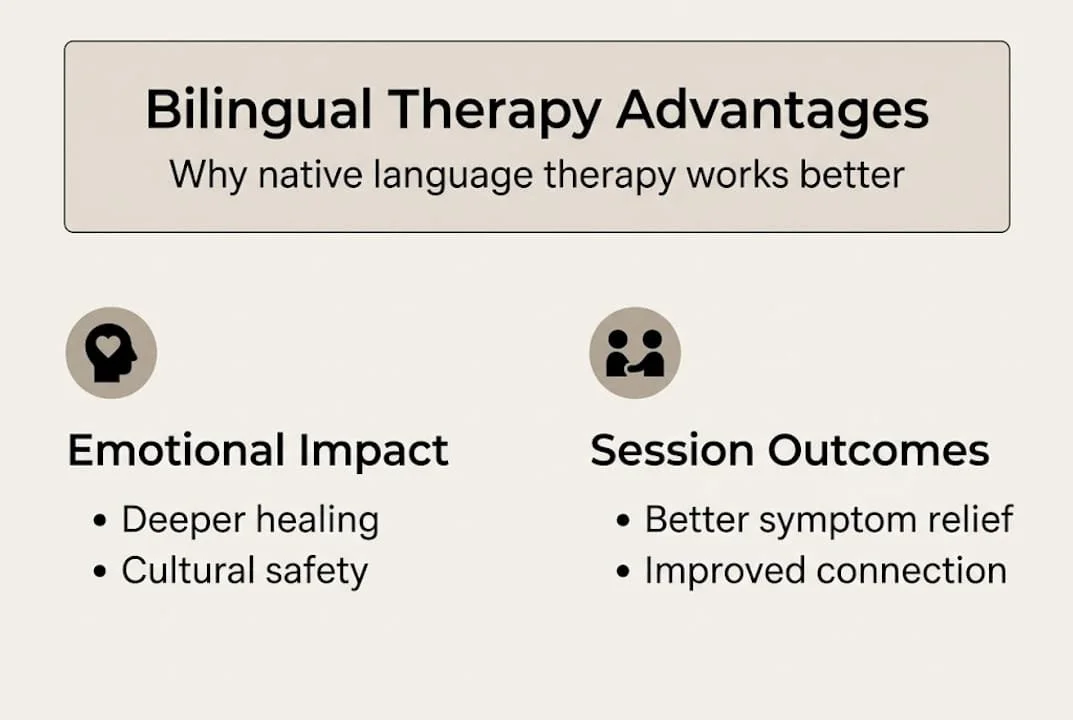
Monolingual English therapy can absolutely help on the surface. It can teach coping skills and challenge distorted thinking. But the richest, safest healing happens in the language where your original wounds formed. Contrasting perspectives on bilingual vs. monolingual therapy show that while English-only approaches have value, native-language therapy consistently reaches deeper emotional layers that English-only sessions miss.
The myth that "any good therapist will do" is worth challenging directly. Cultural and linguistic match is not a luxury. For trauma survivors, it is often the clinical variable that determines whether healing actually happens. Culturally responsive trauma care is not about being politically correct. It is about being clinically effective.
Get support with bilingual trauma therapy in California
If this guide has resonated with you, that feeling is worth following. Healing is not meant to happen in a language that does not fully hold your story.
At Alvarado Therapy, we offer culturally responsive, Spanish-language trauma and EMDR sessions across California, with therapists available in Pasadena, Ventura, and online statewide. Whether you are beginning to understand what to expect in EMDR sessions or already know you are ready to address PTSD and complex trauma, we are here to meet you where you are. You deserve a therapist who understands not just your words, but your world. Take the next step and book a consultation today. Your healing does not have to wait.
Frequently asked questions
Do I need to speak perfect Spanish or English to benefit from bilingual therapy?
No. Using Spanglish or naturally switching between languages is both common and clinically encouraged because it helps you express feelings with greater accuracy. Flexible language switching is a recognized best practice, not a workaround.
Is it okay to ask my therapist to switch languages during a session?
Absolutely. You should feel fully empowered to request a language shift at any point, and a well-trained bilingual therapist will welcome it. Clients requesting language shifts for deeper emotional processing is considered best practice.
What if my family speaks an indigenous or rare dialect?
Whenever possible, seek a therapist who is familiar with your specific dialect. Interpreters for rare dialects should only be used in emergency or administrative situations, not as a substitute for real language match in emotional work.
Does research show bilingual therapy is really more effective for trauma recovery?
Yes. Studies consistently show up to double the effectiveness and significantly lower dropout rates compared to traditional English-only therapy, especially for Latinx clients processing trauma, anxiety, and grief.
