
Why bilingual therapy doubles trauma recovery success

TL;DR:
Therapy in clients' native language significantly improves trauma processing and healing outcomes.
Culturally responsive therapy increases retention, reduces dropout, and speeds symptom reduction.
Bicultural competence in therapists is crucial for genuine understanding and effective trauma care.
Healing from trauma is not just about finding the right words. It's about finding them in the right language. Research shows that bilingual therapy is twice as effective for trauma recovery in Latinx clients, with symptom management improving by up to 60%. For Spanish-speaking adults in California carrying PTSD, anxiety, grief, or the weight of immigration stress, this is not a small detail. It changes everything. This guide walks you through the neuroscience, the cultural evidence, and the practical steps to find care that truly fits who you are.
Table of Contents
Key Takeaways
| Point | Details |
|---|---|
| Native-language healing | Healing trauma in your native language allows for deeper emotional access and more effective therapy. |
| Cultural adaptation boosts results | Culturally adapted bilingual therapy leads to higher retention rates and faster improvement for Latinx clients. |
| Evidence-based methods work | Therapies like CBT and EMDR are just as successful in Spanish when adapted to the client's experience. |
| Bicultural fit is key | Therapist understanding of both language and culture is essential for successful trauma recovery. |
The neuroscience behind native language in trauma therapy
When something traumatic happens, your brain does not store the memory like a file in a folder. It stores it as a felt experience, wrapped in the sights, sounds, smells, and language of that moment. This is why traumatic memories are encoded in the native language, making authentic expression far easier when therapy happens in that same language.
Think about it this way. If you learned fear in Spanish, processing that fear in English is like trying to describe a vivid dream in a language you only partially speak. Something gets lost. The emotional precision drops. And in trauma therapy, emotional precision is everything.
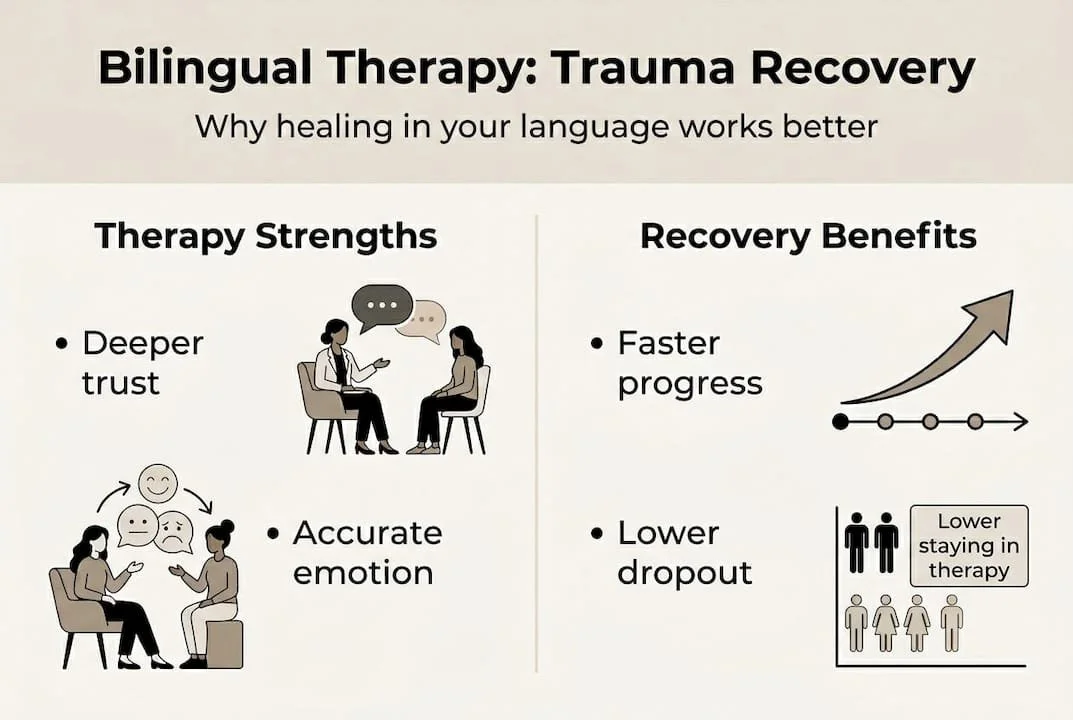
Studies confirm that native-language therapy doubles effectiveness for trauma recovery. This is not just about comfort. It's about neurological access. When clients speak in their first language, they can reach the emotional core of a memory more directly, which means faster processing and more lasting relief.
For trauma recovery in California, where millions of Spanish-speaking adults carry layered experiences of immigration, family separation, and cultural displacement, this science matters deeply.
Common misconceptions about language and therapy:
"Any bilingual therapist will do" — language fluency alone is not the same as emotional fluency
"Therapy in English is fine if I'm somewhat comfortable" — comfort is not the same as deep access
"Translating my feelings is just a minor inconvenience" — translation creates cognitive distance from raw emotion
"My trauma happened here, so English therapy makes sense" — trauma is stored in the language of the original experience
The bilingual therapists' role goes far beyond speaking two languages. They hold space in the emotional register of your lived experience.
Pro Tip: When evaluating a potential therapist, ask them not just if they speak Spanish, but whether they think and feel in Spanish. A therapist who learned Spanish academically may still miss the emotional texture of your experience.
How cultural responsiveness enhances therapy results
Language opens the door. Culture determines whether you stay in the room.
For many Latinx clients, therapy feels foreign not because of the language barrier, but because the framework feels alien. Western therapy often centers the individual, while many Latin American cultures center the family unit, known as familismo. When a therapist does not understand that your healing is tied to your relationships, your community, and your faith, the work can feel disconnected from your real life.
Culturally responsive therapy improves retention by 30 to 40% and speeds up symptom reduction by 25%. That is not a marginal improvement. That is the difference between staying in therapy long enough to heal and dropping out before real change happens.
Key cultural factors that affect therapy engagement and outcomes:
Familismo: Family loyalty and obligation shape how clients define problems and solutions
Respeto: Respect for authority figures can affect how openly clients challenge or question a therapist
Immigration stories: Undocumented status, border trauma, and separation grief require specific sensitivity
Faith and spirituality: Many Latinx clients integrate religious belief into their healing process
Personalismo: The preference for warm, personal relationships over formal, transactional ones
A meta-analysis on cultural adaptation found large effect sizes (d=0.45 to 0.50) when therapy is culturally adapted, confirming this is not just a feel-good approach. It produces measurable clinical results.
| Outcome measure | Standard therapy | Culturally adapted bilingual therapy |
|---|---|---|
| Client retention rate | Baseline | 30 to 40% higher |
| Symptom reduction speed | Baseline | 25% faster |
| Client satisfaction | Moderate | Significantly higher |
| Dropout rate | Higher | Substantially lower |
For trauma recovery in Spanish-speaking adults, one-size-fits-all therapy is not just ineffective. It can reinforce the sense that mental health care was never designed for people like you. Culturally sensitive therapists in California are changing that, and the data backs them up.

Evidence-based therapies in Spanish: What works and why
Not every therapy that works in English has been tested or adapted for Spanish-speaking clients. But several have, and the results are strong.
CBT and EMDR are highly effective for PTSD and anxiety when linguistically and culturally adapted. Cognitive Behavioral Therapy (CBT) helps clients identify and shift thought patterns that keep trauma responses active. Eye Movement Desensitization and Reprocessing (EMDR) uses bilateral stimulation to help the brain reprocess traumatic memories. Both have robust evidence bases in Spanish.
"Effect sizes for culturally and linguistically adapted therapies are large, with d=1.37, meaning clients see dramatically better outcomes than with unadapted approaches." Source
How therapists adapt evidence-based methods for language and culture:
Translate and culturally validate all assessment tools and worksheets
Adjust metaphors and examples to reflect Latinx lived experiences
Incorporate family systems thinking where appropriate
Address immigration-related trauma as a distinct clinical concern
Use culturally resonant language for emotional states (for example, susto, nervios)
| Therapy | Evidence in Spanish | Effect size | Best for |
|---|---|---|---|
| CBT | Strong | d=0.80 to 1.20 | Anxiety, PTSD, depression |
| EMDR | Strong | d=1.10 to 1.37 | PTSD, complex trauma |
| PE (Prolonged Exposure) | Moderate to strong | d=0.90 to 1.10 | PTSD, avoidance |
| CPT (Cognitive Processing Therapy) | Strong, including accelerated CPT in Spanish | d=0.85 to 1.20 | PTSD, guilt, shame |
For trauma-informed care results, choosing a method that has been validated in your language is not optional. It is the foundation of effective treatment.
Pro Tip: In your first session, ask your therapist, "How do you adapt this therapy for someone with my cultural background?" A confident, specific answer is a green flag. A vague one is worth noting.
Beyond bilingual: The importance of bicultural competence and therapist fit
Here is something most people do not realize until they are already in therapy. Speaking the same language is not the same as sharing the same world.
A therapist can be fluent in Spanish and still miss the weight of what it means to cross a border alone at 16. They can use the right words and still not understand why you cannot "just set limits" with your mother without it feeling like a betrayal of everything your family sacrificed.
Bicultural competence is essential for effective trauma therapy with immigrant and Latinx clients. This means the therapist does not just speak your language. They understand your context.
What makes a therapist truly bicultural:
Personal or professional experience with Latin American culture and immigration
Familiarity with intergenerational trauma patterns in Latinx families
Understanding of how acculturation stress affects mental health
Awareness of how machismo, gender roles, and family loyalty shape emotional expression
Knowledge of community-specific stressors like undocumented status or deportation fear
"For Spanish-speaking immigrants, bicultural rapport is as critical as bilingual skill. Without it, even technically sound therapy can feel disconnected from the client's lived reality."
Immigration grief and bicultural nuances require a therapist who understands complex dynamics, not just vocabulary. And using an interpreter? Research is clear that this approach carries significant risks. Interpreters disrupt the flow of emotional disclosure, create privacy concerns, and can introduce subtle distortions in meaning that are especially harmful in trauma work.
The cultural competence in therapy that leads to 73% better outcomes is built on relationship, not just translation. Your therapist's role in immigration support extends beyond clinical skill. It is about being a witness who truly understands your story.
Why the future of trauma recovery is bilingual and bicultural
Most articles about bilingual therapy stop at "it's more effective." But here is what they miss: simply translating a therapy protocol into Spanish is not bilingual therapy. It is a Spanish-language copy of something designed for a different population.
True bilingual-bicultural care requires therapists who carry both worlds inside them. That is rare. And the shortage of genuinely bicultural clinicians is one of the biggest unspoken crises in mental health care for Latinx communities in California.
Insurance gaps make it worse. Many of the most culturally competent providers do not accept insurance, pricing out the very clients who need them most.
Future research must compare bilingual to monolingual interventions, but the evidence already points clearly toward tailored, culturally sensitive approaches as the gold standard. The field knows this. The structural barriers are the real obstacle.
What we believe, having worked with this community directly, is that the lived-experience bond between client and therapist is one of the strongest predictors of healing. When your therapist has navigated similar cultural tensions, the therapeutic relationship becomes something far more powerful than technique. It becomes recognition. And recognition, for someone who has felt invisible, is already part of the cure. The path to 2x more effective healing runs through that bond.
Get support from bilingual, trauma-informed therapists today
If this article has shown you anything, it's that the how of therapy matters just as much as the what. Finding a therapist who speaks your language and understands your culture is not a luxury. It is a clinical necessity for deep, lasting healing.
At Alvarado Therapy, our bilingual and bicultural team specializes in trauma-informed care for Spanish-speaking adults across California. Whether you are dealing with PTSD, grief, anxiety, or the layered effects of immigration stress, we offer PTSD and trauma support grounded in evidence and cultural understanding. Learn what to expect from trauma therapy and take the first step toward healing in the language of your heart. Schedule a consultation today.
Frequently asked questions
How is bilingual therapy different from traditional therapy?
Bilingual therapy uses your native language and cultural framework to help you access emotional wounds more directly. Native-language therapy enables deeper processing and is twice as effective for trauma healing compared to therapy conducted in a second language.
What cultural adaptations work best for Latinx clients in trauma therapy?
Incorporating values like familismo, honoring immigration stories, and using familiar emotional language makes therapy feel safer and more relevant. Culturally responsive therapy significantly improves dropout rates and speeds up symptom reduction.
Do evidence-based therapies actually work in Spanish?
Yes. Methods like CBT, EMDR, and Prolonged Exposure show large effect sizes for adapted therapies when delivered in Spanish with appropriate cultural modifications, making them highly effective for trauma and anxiety.
Why shouldn't I use an interpreter for trauma therapy?
Interpreters disrupt trust, reduce privacy, and can subtly alter meaning during sensitive disclosures. Bicultural competence in a therapist is essential, and relying on interpreters can undermine the trauma processing work significantly.
How do I find the right bilingual-bicultural therapist in California?
Look for a therapist with trauma specialization, genuine Spanish fluency, and cultural roots or deep experience similar to yours. Therapist fit is one of the strongest predictors of successful trauma recovery in bilingual settings.
