
Why Culturally Responsive Therapy Matters for Healing

TL;DR:
Culturally responsive therapy adapts treatment to reflect clients' cultural values and lived experiences.
It improves retention and symptom reduction for Latinx and BIPOC clients compared to standard therapy.
Finding skilled, individualized therapists who incorporate humility and ongoing cultural assessment is essential.
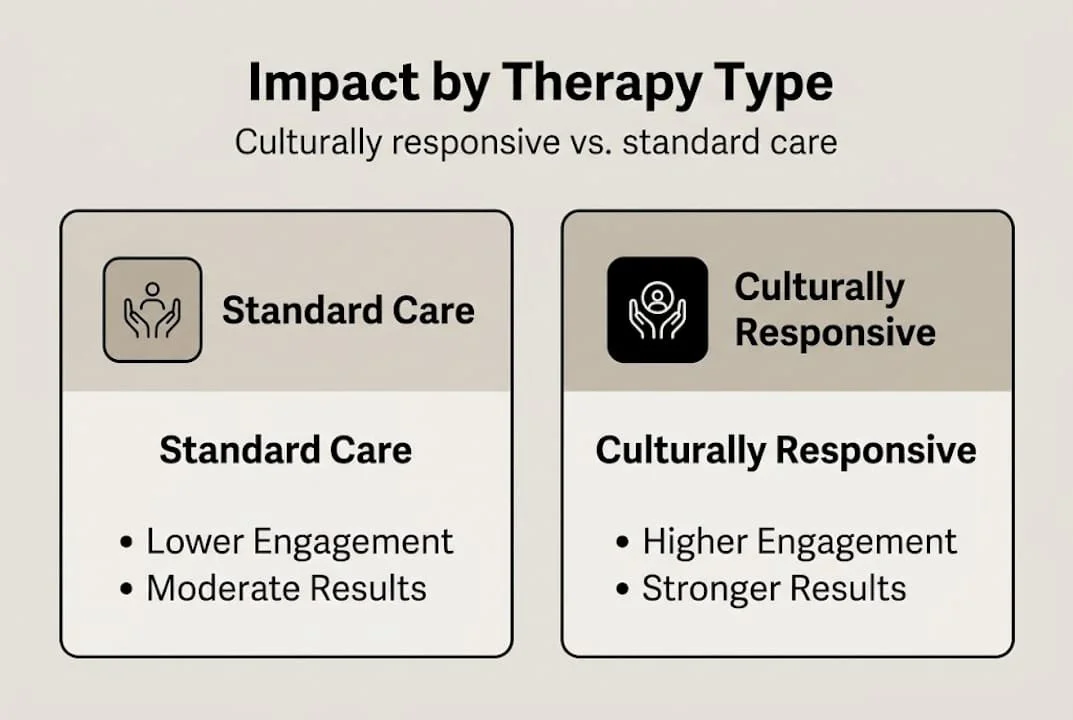
Therapy is often sold as a universal solution, but the evidence tells a different story. For Latinx and BIPOC communities in California, standard mental health care frequently misses the mark, leaving clients feeling misunderstood, unseen, and less likely to stay in treatment. Culturally responsive therapy improves retention by 20 to 40% and accelerates symptom reduction by 25% compared to standard approaches. That gap is not a minor detail. It represents real people not getting the healing they deserve. This guide explains what culturally responsive therapy actually means, why it produces better outcomes, and how you can find a therapist who truly fits your life and community.
Table of Contents
Key Takeaways
| Point | Details |
|---|---|
| Better outcomes for BIPOC clients | Culturally responsive therapy leads to higher retention and more effective healing for Latinx and BIPOC individuals. |
| Personalized, not generic | This therapy adapts to each client's cultural background and lived experience for lasting results. |
| Evidence-based results | Research confirms that symptom reduction and emotional recovery are stronger with culturally adapted care. |
| Bilingual and community focus | Spanish-language and values-based services directly support Latinx trauma recovery and reduce barriers. |
What is culturally responsive therapy and why does it matter?
Culturally responsive therapy is not just therapy delivered by a bilingual clinician. It is a structured, ongoing approach that adapts counseling methods to reflect a client's cultural values, lived experiences, community context, and identity. The difference between this and standard therapy is significant, and understanding it helps you make smarter choices for your healing.
Standard therapy often assumes a universal framework, meaning the same techniques, the same communication style, and the same assumptions about family, independence, and emotional expression apply to everyone. For many Latinx and BIPOC clients, this creates a mismatch. Concepts like self-reliance or individual-focused healing may conflict with deeply held values around family loyalty, community, and collective wellbeing.
Culturally responsive therapy works differently. It integrates cultural values integration such as familismo (prioritizing family bonds), personalismo (valuing warm, personal relationships), and respeto (respect for elders and authority) directly into treatment. It also recognizes the real psychological weight of immigration stress, systemic racism, and intergenerational trauma, treating these not as background noise but as central clinical concerns.
Key mechanisms that make culturally responsive therapy effective:
Language accessibility, including Spanish-language and bilingual sessions
Integration of cultural values like familismo and personalismo
Recognition of racism, discrimination, and immigration stress as clinical factors
Identity-affirming therapy that validates the full complexity of who you are
Ongoing therapist self-reflection and cultural humility
| Feature | Standard therapy | Culturally responsive therapy |
|---|---|---|
| Language | English only | Bilingual or Spanish-language |
| Cultural values | Rarely addressed | Integrated into treatment |
| Racism/immigration stress | Often overlooked | Treated as clinical priorities |
| Family involvement | Individual focus | Family and community context |
| Therapist self-reflection | Variable | Ongoing and required |
Meta-analyses show culturally adapted interventions reduce PTSD and anxiety more effectively than standard models. This is not a soft preference. It is a measurable clinical advantage.
Pro Tip: Do not confuse cultural responsiveness with cultural competence. Competence implies a skill you learn once. Responsiveness is an active, continuous process of listening, adapting, and growing alongside each client.
How culturally responsive therapy works in practice
Knowing the definition is one thing. Understanding what it actually feels like to sit in a session is another. Here is what you can realistically expect when you work with a culturally responsive therapist in California.
From your very first session, a culturally responsive therapist will ask questions that go beyond your symptoms. They want to understand your family structure, your immigration history if relevant, your community ties, and how your cultural background shapes the way you experience stress, relationships, and healing. This is not small talk. It is clinical assessment done right.
What to expect step by step:
Initial intake: Your therapist gathers a full cultural history, not just a symptom checklist.
Goal setting: Treatment goals are shaped around your values, not a generic wellness template.
Session language: You choose English, Spanish, or a bilingual blend that feels natural.
Intervention selection: Techniques like EMDR or cognitive processing are adapted to honor your worldview.
Ongoing adjustment: Your therapist continuously checks in and adjusts based on your feedback.
Bilingual therapy enhances PTSD symptom management by nearly 60% for Latinx clients. That number reflects something real: when you can express your pain in the language closest to your heart, healing moves faster.

Trauma-focused approaches that incorporate cultural context also address acculturative stress, the psychological strain of navigating between two cultures, and intergenerational trauma passed down through family systems. These are not add-ons. They are core to effective care for many Latinx and BIPOC clients.
| Outcome area | Standard care | Culturally adapted care |
|---|---|---|
| PTSD symptom reduction | Moderate | Significantly higher |
| Therapy retention | Lower | 20 to 40% higher |
| Anxiety relief | Variable | More consistent |
| Client trust and engagement | Often limited | Substantially improved |
Explore bilingual therapy in California and identity-affirming care to understand how these approaches are being applied right now across the state.
Pro Tip: Look for therapists who ask about your family, community, and history in the first session, not just your symptoms. That curiosity is a strong signal they are doing this work the right way.
Research-backed benefits for Latinx and BIPOC clients
With those concrete examples in mind, the next question is: do these approaches actually work? Here is what the research says.
The numbers are hard to argue with. Retention improves by 20 to 40% and symptom reduction increases by 25% when therapy is culturally adapted. The effect size, measured at d=0.50, places culturally responsive therapy in the medium-to-large range for clinical impact. That is a meaningful difference in real-world terms.
"Culturally congruent practices show medium-large effect sizes for symptom reduction and retention gains, making them among the most evidence-supported adaptations in mental health care."
For California's Latinx and BIPOC communities, these gains matter for several specific reasons:
Trauma and PTSD: Culturally adapted trauma therapy reduces avoidance, shame, and symptom severity faster than standard PTSD protocols.
Anxiety: Clients who feel understood culturally report lower anxiety levels and greater willingness to practice coping skills outside sessions.
Relationships: When therapy honors values like familismo, couples and families engage more openly and sustain progress longer.
Retention: Dropping out of therapy early is one of the biggest barriers to healing. Culturally responsive care dramatically reduces dropout rates.
Review trauma recovery data and therapy outcomes research for a deeper look at how these numbers translate into real client stories across California.
These results also challenge a harmful assumption: that Latinx and BIPOC clients are simply less engaged with mental health care. The data shows the opposite. When care is relevant and respectful, communities show up and stay.
Common myths, challenges, and how to find the right therapist
While the benefits are clear, you may have concerns about how to find help that avoids common pitfalls. Let us tackle those questions now.
One of the most persistent myths is that culturally responsive therapy means treating all Latinx or all BIPOC clients the same way. It does not. Individualized assessment is essential, and therapist self-reflection is required to avoid flattening the enormous diversity within any cultural community. A Mexican American client in Los Angeles and a Guatemalan immigrant in Fresno may share some cultural touchpoints but have vastly different healing needs.
"Avoid monolithic cultural assumptions. Intra-cultural variation is significant, and every client deserves an individualized cultural assessment process that honors their specific story."
Common myths worth debunking:
"Therapy is the same for everyone." Research consistently shows otherwise.
"Any bilingual therapist is automatically culturally responsive." Language is one tool, not the whole approach.
"All Latinx or BIPOC clients want the same interventions." Intra-community diversity is enormous.
"Good culturally responsive therapists are impossible to find in California." They exist, and knowing what to look for helps.
When evaluating a potential therapist, ask these questions directly: Do you have experience working with clients from my cultural background? How do you incorporate cultural values into treatment? How do you handle it when your own cultural assumptions might be getting in the way?
Strong therapists will welcome these questions. They will not be defensive. Look for identity-affirming approaches that validate your full identity, trauma-informed care that does not pathologize your community's experiences, and relationship healing support that respects your family's values and dynamics.
Our perspective: What most guides miss about culturally responsive therapy
Most articles about culturally responsive therapy focus on techniques: use the right language, incorporate the right values, check the right boxes. What they rarely mention is therapist humility. And that is the part that matters most.
The best therapists recognize they always have cultural blind spots. No amount of training eliminates the risk of projecting assumptions onto a client. What separates truly effective clinicians is their willingness to notice those moments, name them, and recalibrate. That takes ongoing self-examination, not a one-time workshop.
Real healing in this context flows from collaboration. When a therapist partners with you to co-create a treatment approach that fits your life, your family, and your history, the work becomes genuinely transformative. It stops being something done to you and starts being something built with you.
We believe cultural identity in healing is not a specialty niche. It is the foundation of ethical, effective care for every client who walks through the door. Therapist reflexivity and client empowerment are not soft skills. They are the engine of lasting change.
Ready to experience culturally responsive healing?
If this guide has helped you see what truly effective, identity-honoring therapy looks like, the next step is finding care that actually delivers it.
At Alvarado Therapy, our licensed clinicians specialize in trauma therapy for BIPOC clients, offering EMDR, individual counseling, and couples therapy services in both English and Spanish. We serve clients across Pasadena, Ventura, and online throughout California. Our team is built around cultural humility, lived experience, and a genuine commitment to your healing. Whether you are navigating trauma, anxiety, immigration stress, or relationship challenges, we are here to meet you where you are. Request a consultation today and take the first step toward care that truly fits your life.
Frequently asked questions
How do I know if my therapist is truly culturally responsive?
A culturally responsive therapist adapts treatment to your unique background, prioritizes your lived experience, and avoids stereotypes by asking open, respectful questions. Individualized assessment and ongoing therapist self-reflection are the clearest signs you are working with someone who takes this seriously.
Does culturally responsive therapy work for symptoms like anxiety or relationship challenges?
Yes. Culturally adapted interventions reduce PTSD and anxiety more effectively than standard models and produce stronger outcomes for relationship challenges in Latinx and BIPOC communities. The evidence is consistent across multiple studies.
Is Spanish-language or bilingual therapy more effective for Latinx clients?
Yes. Bilingual therapy improves PTSD symptom management by nearly 60% for Latinx clients by combining language access with culturally integrated values and treatment methods.
Does culturally responsive therapy address issues like systemic racism or immigration stress?
Yes. Culturally responsive therapy actively recognizes and treats systemic racism, discrimination, and immigration-related stress as core clinical concerns, not background factors. These mechanisms include language accessibility and community-informed care that validates your full experience.
Recommended
Culturally Responsive Therapy: 30% Better Trauma Recovery — Alvarado Therapy
Cultural responsiveness in therapy: trauma recovery in CA — Alvarado Therapy
How cultural identity improves trauma therapy results in CA — Alvarado Therapy
Why Cultural Competence in Therapy Leads to Better Outcomes — Alvarado Therapy
