
I-601 vs I-601A for U.S. Applicants: 5 Checks, Psych Eval Guidance

If you're physically present in the U.S. with unlawful presence as your only problem and a qualifying spouse or parent who's a citizen or permanent resident, file I-601A. If you have other grounds of inadmissibility, such as fraud or a prior removal, or you're already stuck abroad after a consular finding, you need the broader I-601. Check the current USCIS instructions for your exact category, and talk to an immigration attorney if anything about your case is unclear.
TL;DR:
The I-601A provisional waiver only covers unlawful presence and must be filed in the U.S. before departing for the consular interview, with no other grounds of inadmissibility involved.
An approved I-601A does not guarantee reentry or fix other issues like fraud or prior removal; additional grounds must be addressed with the full I-601 from abroad if they emerge later.
Evidence supporting hardship claims should be specific and well-documented, with psychological evaluations providing crucial impact assessments, especially for mental health-related factors.
Disclosing all inadmissibility issues upfront is critical; unreported grounds like old misrepresentations or prior removals can invalidate the waiver and worsen your case.
Always verify current USCIS requirements and consult an attorney when uncertain about grounds of inadmissibility or supporting evidence to avoid costly mistakes.
Table of Contents
Why Inadmissibility Waivers Exist in the First Place
Federal immigration law, specifically INA §212, lists dozens of reasons someone can be denied a visa or green card. These are "grounds of inadmissibility," and they cover a wide range of situations.
Common triggers include:
Unlawful presence in the U.S. beyond a certain period
Fraud or misrepresentation to immigration officials
Certain criminal convictions
Some health-related conditions
Prior deportation or removal orders
A waiver doesn't erase what happened. It asks the government to overlook a specific statutory bar because refusing to would cause "extreme hardship" to a qualifying U.S. citizen or permanent resident relative. That standard is subjective by design, and it's why documentation, including medical, financial, and psychological evidence, carries so much weight in these filings.
Form I-601: The Broader Waiver for Bigger Problems
Form I-601 is the workhorse waiver. USCIS uses it to excuse a wide range of inadmissibility grounds tied to immigrant visas, adjustment of status, and other benefits, not just unlawful presence. That makes it the right form for people with fraud findings, certain criminal history, or prior removal orders, and for applicants abroad after a consular officer has already found them inadmissible.
Because I-601 covers more ground, USCIS instructions require disclosure of every applicable inadmissibility issue. An approved waiver only applies to the grounds you actually listed, so leaving something out doesn't protect you. It just guarantees a problem later.
Evidence typically includes:
Medical records documenting a relative's condition
Financial records showing dependency or hardship
Psychological evaluations establishing emotional and functional impact
Country-conditions research if relocation is part of the hardship argument
Pro Tip: File I-601 evidence as a complete narrative, not a folder of disconnected documents. Reviewers respond to a clear line connecting the hardship to the specific qualifying relative.
Form I-601A: The Provisional Waiver, and Its Sharp Limits
Form I-601A exists for one narrow purpose: waiving unlawful presence under INA §212(a)(9)(B) before you leave the country for your consular interview. It's faster and less stressful because you find out about approval while still in the U.S., rather than gambling on a hardship argument after you've already departed.
To qualify, you generally need:
Physical presence in the United States at filing
A qualifying spouse or parent who is a U.S. citizen or permanent resident
A pending immigrant visa case with the National Visa Center fee paid
To be at least 17 years old
Availability for biometrics collection
I-601A waives unlawful presence only. Fraud, certain criminal convictions, and prior removals disqualify you outright, and if those grounds surface at your consular interview after I-601A approval, the waiver becomes worthless and you're stuck abroad filing I-601 instead.
Pro Tip: Never assume unlawful presence is your only issue. A single unreported voluntary departure order or a border-crossing misstatement years ago can void an otherwise clean I-601A case.
I-601 vs I-601A: A Side-by-Side Look
| Comparison Point | I-601 | I-601A |
|---|---|---|
| Where filed / timing | Abroad after consular finding, or with certain adjustment cases | Inside the U.S., before departing for the interview |
| Grounds covered | Broad: unlawful presence, fraud, crime, prior removal, and more | Unlawful presence only (INA §212(a)(9)(B)) |
| Who may file | Applicants with a qualifying relative facing various inadmissibility grounds | Applicants with a qualifying U.S. citizen or permanent resident spouse or parent |
| Effect of approval | Resolves the specific listed grounds for visa issuance | Provisional only; doesn't guarantee the visa or allow reentry until consular processing confirms no other grounds |
| Common evidence | Medical, financial, psychological, country-conditions | Same categories, focused narrowly on unlawful presence hardship |
| Processing considerations | Often longer, since it's tied to consular scheduling abroad | Generally faster since it happens before departure |
Three things worth remembering: I-601A only works if unlawful presence really is your only ground of inadmissibility. An approved provisional waiver isn't a visa and doesn't authorize reentry; it just clears one hurdle before the consulate reviews everything else. And if new grounds appear during the consular interview, you'll need I-601 filed from abroad, which usually means a longer separation than you planned for.
Building an Extreme-Hardship Case That Actually Persuades
Hardship evidence works best when it's specific, not generic. Vague claims about missing a spouse rarely move an adjudicator. Documented, functional impact usually does.
Strong hardship files draw on:
Medical records showing a qualifying relative's chronic or acute conditions
Financial documentation proving dependency, debt, or income loss
Caregiving records if the relative needs ongoing support
Country-conditions reports when relocation risk is part of the argument
An immigration psychological evaluation adds a layer most other documents can't: a clinical diagnosis, an assessment of functional impairment, and a nexus statement tying that impairment directly to potential separation from the applicant. Practitioners consistently point to psychological documentation as a factor that often distinguishes a persuasive hardship case from a thin one built only on general emotional distress.
Timing matters. Schedule the evaluation early enough that the clinician can review medical and family history in depth, not as a rushed add-on before filing. Confidentiality protections apply the same way they would to any therapy record, and a licensed clinician experienced in immigration evaluations will know how to frame findings in language adjudicators actually use.
Common Mistakes and a Quick Decision Checklist
The most frequent I-601A failure isn't a weak hardship argument. It's an undisclosed ground of inadmissibility the applicant didn't realize applied to them, like an old misrepresentation on a visa application or a removal order from years ago that never got resolved.
Other recurring errors: filing I-601A without confirming the qualifying relative meets the exact citizenship or residency requirement, submitting hardship evidence that describes general sadness instead of documented impairment, and assuming approval means you're cleared to travel immediately.
Run through this before you file:
Confirm your only inadmissibility issue is unlawful presence, not fraud, crime, or removal.
Verify you have a qualifying spouse or parent who is a citizen or permanent resident.
Gather medical, financial, and psychological evidence before, not after, drafting your hardship statement.
If anything is uncertain, especially prior immigration history, get legal review before submitting anything.
When in doubt about grounds of inadmissibility you didn't disclose the first time, stop and call an attorney. That's not a step to skip.
Publisher Perspective: How Clinicians Support Waiver Evidence
Alvaradotherapy conducts immigration psychological evaluations across California and New York, and the pattern we see is consistent: legal teams respond to evaluations that connect diagnosis to real functional consequences, not just a hardship checklist. A clear nexus statement, tied to specific family circumstances, tends to carry more weight than broad claims of distress. If you're preparing for an evaluation, gather medical and family history records first.
— Juiced
Another Path to Stronger Evidence: Immigration Evaluations
Legal strategy for I-601 or I-601A rests with your attorney, but the clinical evidence behind extreme hardship is where Alvaradotherapy fits in. Our immigration psychological evaluations produce a structured report: diagnosis, functional impairment assessment, and a nexus statement connecting that impairment to the hardship your qualifying relative would face.
Evaluations typically take a few weeks from intake to final report, so scheduling one early gives your attorney time to incorporate it before filing rather than scrambling to add it later. Bilingual clinicians work with English and Spanish-speaking families across California and New York, in person and online. If you're building a case around PTSD or complex trauma tied to a family separation risk, that clinical picture often needs professional documentation an attorney can't provide alone. Start with a consultation to discuss your evaluation needs and timeline, or go directly to the immigration evaluations page to see report types and next steps.
Where to Verify Forms, Fees, and Current Processing Times
Confirm details directly with USCIS before filing: the I-601 form and instructions and the I-601A form and instructions both list current eligibility rules and evidence requirements. For legal context on unlawful presence bars, the ILRC's advisory on §212(a)(9)(B) is a solid resource, and Boundless's explainer covers the practical filing process. Fees and processing times change, so check the USCIS pages directly rather than relying on older estimates.
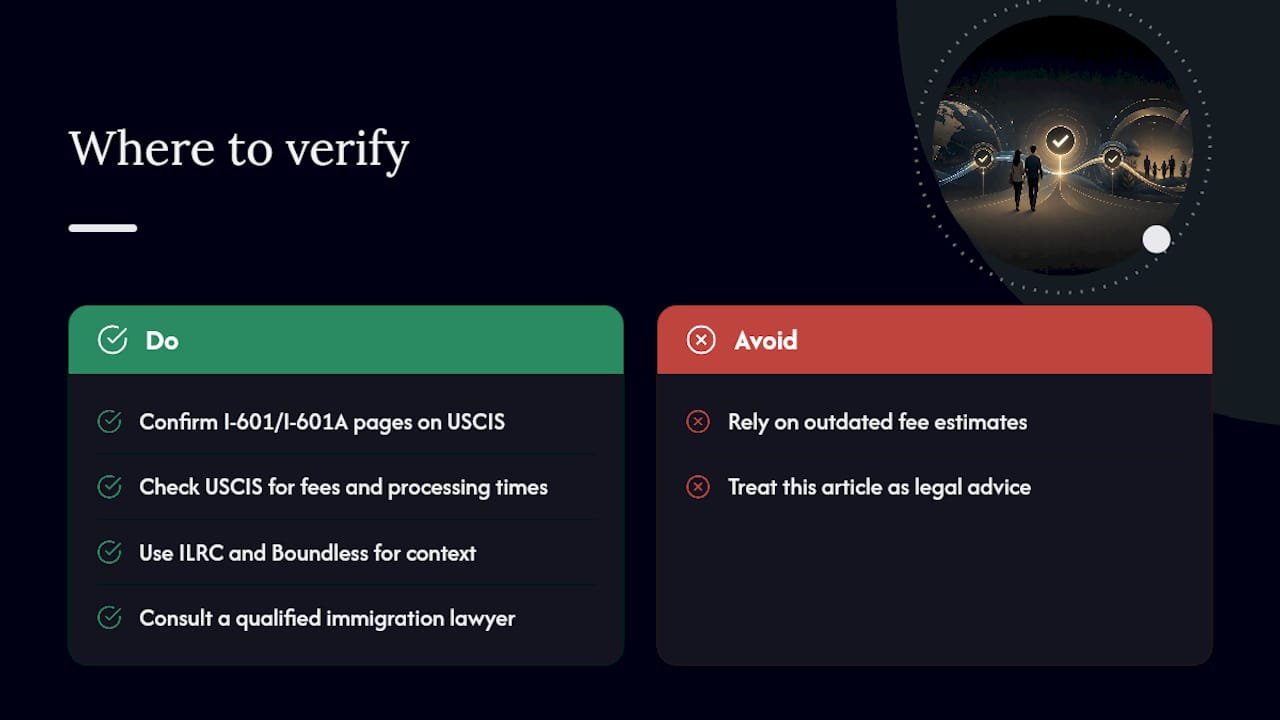
This article is general information, not a substitute for advice from a qualified lawyer. Consult a qualified legal professional about your own circumstances before acting on anything here.
Sources
I-601, Application for Waiver of Grounds of Inadmissibility | USCIS
How to Apply For a Waiver of Inadmissibility: US Immigration | Boundless
