
EMDR for Depression: Best When Trauma or Treatment Resistance Exists

EMDR reduces depressive symptoms with a moderate to large effect (Hedges' g around 0.75 in the most recent meta-analysis), and the benefit is strongest for depression tied to trauma or past adverse experiences and for cases that haven't responded to standard treatment. The evidence base is still thinner than for PTSD, built mostly on small trials with real limitations. What follows covers the mechanism, the actual trial data, who tends to benefit, and how to find a qualified provider.
TL;DR:
EMDR shows moderate to large effects for depression, especially for cases linked to trauma or past adverse experiences, with effect sizes nearly doubling in severe depression.
The evidence base is limited by small sample sizes, varied follow-up periods, and heterogeneity across studies, warranting cautious interpretation.
EMDR tends to benefit those with trauma-related or treatment-resistant depression and co-occurring PTSD or anxiety, but it's unsuitable for active psychosis, severe suicidality, or dissociation.
Typical treatment involves weekly 60 to 90-minute sessions, starting with stabilization and gradually progressing to trauma processing, with some people opting for intensive protocols.
A qualified EMDR therapist should have documented training and ongoing supervision; treatment often complements medication or CBT rather than replacing them.
Table of Contents
How EMDR Works for Depression: The AIP Model and Brain-Based Theories
What the Research Shows: Meta-Analyses and Randomized Trials
What Clinical Experience With EMDR and Depression Actually Looks Like
Why the "EMDR Cures Depression" Narrative Oversimplifies the Real Picture
How EMDR Works for Depression: The AIP Model and Brain-Based Theories
EMDR follows a structured eight-phase protocol: history taking, preparation, assessment, desensitization, installation, body scan, closure, and reevaluation. During the desensitization phase, the therapist guides the patient through bilateral stimulation, usually side-to-side eye movements, but sometimes alternating taps or tones, while the patient briefly holds a distressing memory in mind.
The theory behind it is called the Adaptive Information Processing (AIP) model. It proposes that some memories get stored in the brain without being fully processed, still carrying the original sensory charge and negative belief attached to them ("I'm worthless," "I'm unsafe"). Depression, in this framework, isn't just a mood state. It's partly maintained by these stuck memory networks feeding a persistent negative self-view.
Two mechanisms get cited most often to explain why bilateral stimulation helps:
Working-memory taxation: holding a memory in mind while simultaneously tracking eye movements or taps splits attention, which appears to reduce the memory's emotional vividness over repeated sets.
Memory reconsolidation: reactivating a memory under new conditions may let the brain re-store it with less emotional intensity, similar to how memories update naturally over time but accelerated within session.
Some neuroimaging work suggests EMDR may help normalize activity in brain regions tied to emotional regulation, though this research is still preliminary.
This mechanism also explains a pattern clinicians see often: depression rooted in identifiable trauma or loss tends to respond better to EMDR than depression with no clear precipitating event, because there's a specific memory network for the protocol to target.
What the Research Shows: Meta-Analyses and Randomized Trials
The clearest recent evidence comes from a 2024 meta-analysis and meta-regression pooling 25 studies and 1,042 participants. It found EMDR produced a Hedges' g of approximately 0.75 for reducing depressive symptoms, a moderate-to-large effect by most clinical standards.
The severity pattern matters more than the average effect. The same meta-regression found the effect size nearly doubles for severe depression (g ≈ 0.99) compared with mild-to-moderate cases (g ≈ 0.46). EMDR appears to do more for the people who are struggling the most, not less.
That pattern shows up in trial data too. The EDEN randomized-controlled trial tested EMDR added to treatment-as-usual against treatment-as-usual alone in a small clinical sample. The EMDR group showed larger drops on the BDI-II and roughly double the remission rate, with remission occurring in about half of EMDR patients compared to about a quarter in the TAU-only group. Separately, a systematic review of trauma-focused treatments found EMDR produced large pooled effects on depression (d ≈ 1.17, dropping to about 0.83 after removing outlier studies) and outperformed non-trauma-focused CBT in several comparisons.
None of this makes EMDR a settled science for depression the way it is for PTSD. Here's what limits the confidence:
Most trials have small sample sizes, often fewer than 100 participants total.
Follow-up periods vary widely, so durability of results beyond a few months is unclear.
Heterogeneity across studies (different depression severities, different protocols, different comparison groups) makes averaging effect sizes imprecise.
Several reviews flag risk-of-bias concerns, including inconsistent blinding of outcome assessors.
If you're weighing EMDR for your own depression, treat these numbers as a real, promising signal, not a guarantee. The direction of the evidence is consistent across multiple independent research teams, and that consistency counts for something even though sample sizes are still catching up to the size of the claim.
Who Is Most Likely to Benefit From EMDR for Depression
EMDR tends to help most when depression traces back to something specific: childhood adversity, a traumatic loss, an abusive relationship, or an event your mind still hasn't fully filed away. It also shows the strongest signal in treatment-resistant depression, meaning depression that hasn't improved much with medication, standard CBT, or both. Because EMDR targets specific unprocessed memories and belief networks rather than symptoms broadly, it can reach something those other approaches sometimes miss.
Depression with co-occurring PTSD or anxiety is a particularly strong fit, since EMDR was originally developed for trauma and the protocol handles overlapping symptoms well.
That doesn't mean EMDR is right for everyone at every stage. A qualified clinician typically screens for:
Active psychosis or a current manic episode, which usually needs stabilization first
Unstable or acute suicidality, requiring a safety plan before trauma processing begins
Severe dissociation, which may call for a modified pacing or a different stabilization-focused approach first
Pro Tip: If you're not sure whether trauma is a factor in your depression, say so in the intake session. A good EMDR therapist will assess this directly rather than assuming, and can recommend stabilization work first if your nervous system needs it.
What EMDR Sessions for Depression Actually Look Like
A typical EMDR session runs 60 to 90 minutes. Early sessions focus on history taking and building coping skills you can use between appointments; a memory doesn't usually get actively reprocessed until phase three or four, once your therapist confirms you have enough stability to handle it.
From there, a general course of treatment for depression tends to follow one of these paths:
Weekly sessions, often 8 to 20 total, spaced a week apart, giving time to integrate each session's processing.
Brief protocols, sometimes 4 to 12 sessions, used for more contained or single-incident trauma linked to depressive symptoms.
EMDR intensives, which compress the same processing into consecutive multi-hour sessions over a few days, useful for people who want faster results or can't commit to a long weekly schedule.
Short-term reactions after a processing session are common and not usually a red flag. Expect possible tiredness, vivid or unusual dreams, or brief shifts in mood in the 24 to 48 hours afterward, according to Cleveland Clinic's patient guidance. Contact your therapist if distress feels unmanageable or lingers well beyond that window.
Pro Tip: Build in light recovery time after sessions, especially early on. Skip scheduling anything demanding right after an EMDR appointment until you know how your body typically responds. Reviewing preparation steps beforehand also makes the first few sessions less disorienting.
How EMDR Fits With Medication and Other Therapies
EMDR isn't typically positioned as a replacement for medication or CBT. It's most often studied and used as an addition to whatever treatment you're already receiving. The EDEN trial specifically tested EMDR layered on top of treatment-as-usual, not as a standalone substitute, and that's the model most clinicians follow in practice.
If you're on an antidepressant, there's no evidence you need to stop it to start EMDR. If you're doing CBT, the two can run in parallel, though most therapists avoid starting both at once so you're not managing two sets of homework and reflection exercises simultaneously.
One practical difference worth knowing: EMDR usually asks less of you between sessions than CBT does.
CBT often relies on structured homework, like thought logs or exposure exercises, to drive progress.
EMDR's processing work happens mostly within the session itself, with between-session tasks limited to grounding or stabilization skills rather than active assignments.
That distinction matters if homework-heavy therapy has felt like an extra burden in the past.
Finding and Evaluating a Qualified EMDR Therapist
Not every therapist who lists "EMDR" on their profile has equivalent training. Here's how to vet one properly:
Confirm licensure in your state and verify documented EMDR training through a recognized program, not just a weekend workshop.
Ask about ongoing consultation or supervision, since EMDR skill develops with case consultation, not just an initial certificate.
Ask directly about their experience treating depression specifically, since some EMDR-trained clinicians work almost exclusively with PTSD.
Ask about session format and safety planning: how they screen for stabilization needs, whether they offer telehealth, and how fees or insurance billing work.
The EMDRIA directory is the standard place to verify training credentials. If a therapist seems dismissive of your questions or vague about their training, that's a reason to keep looking. Alvaradotherapy offers EMDR through both online sessions and in-person care across California and New York, with bilingual English-Spanish therapists as one option worth considering.
What Clinical Experience With EMDR and Depression Actually Looks Like
Depression that responds well to EMDR usually has a story attached to it, a specific loss, a pattern of childhood neglect, an event the person keeps replaying without resolution. Clinicians who work with EMDR regularly notice that patients often can't initially connect their low mood to a specific memory. Part of the early assessment work is helping them make that connection before processing even starts.
Alvaradotherapy structures its individual EMDR services around this reality: intake includes a real assessment of whether trauma is driving the depression, not an assumption that every case fits the same protocol. The clinic offers both standard weekly sessions and EMDR intensives for people who want a more compressed timeline, alongside bilingual care for Spanish-speaking clients navigating the same symptoms.
Why the "EMDR Cures Depression" Narrative Oversimplifies the Real Picture
The evidence supports something more specific and more useful than either extreme you'll find online: EMDR isn't a fringe treatment, and it isn't a universal fix for depression either. It's a targeted tool that works best when depression has an identifiable trauma component, and the research increasingly says so directly, with severity-linked effect sizes that reward exactly the cases people assume are hardest to treat.
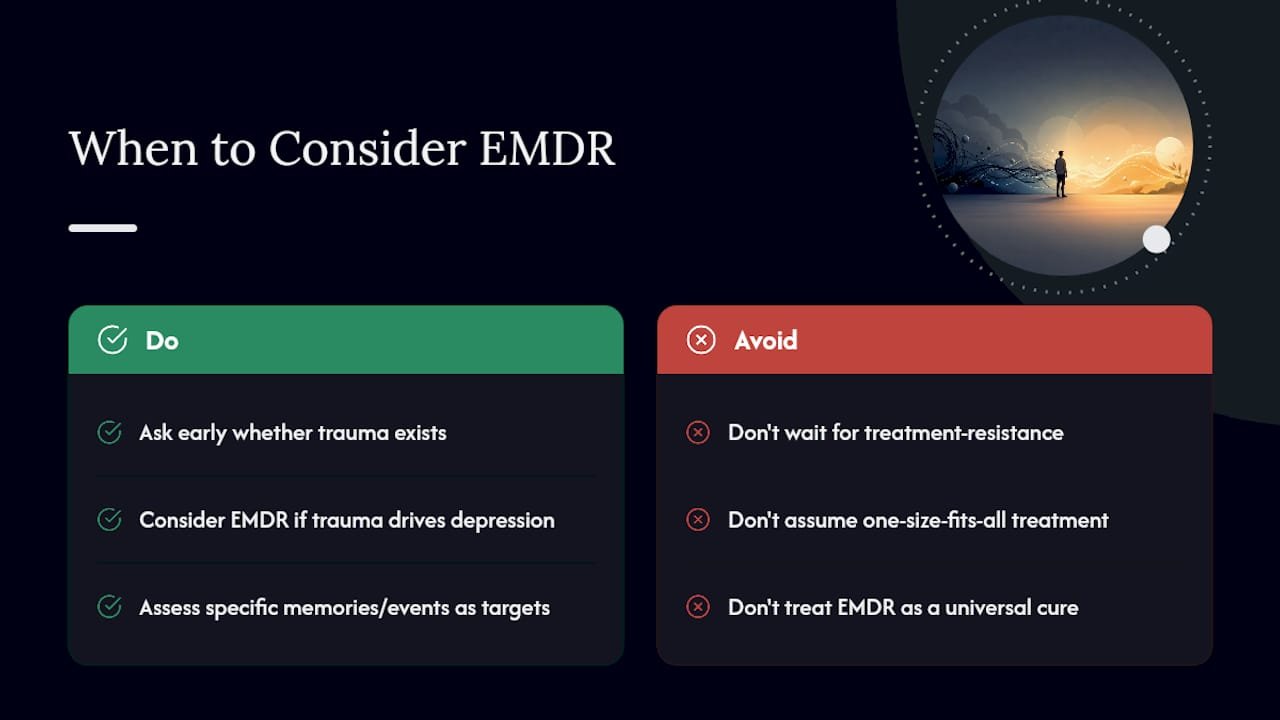
Conventional advice often treats depression as one uniform condition needing one uniform first-line response, usually medication, sometimes generic CBT. That flattens a real distinction: depression driven by unresolved trauma behaves differently than depression without that root, and it can call for a different first move. The mistake I see readers make most often is treating EMDR as a last resort after everything else fails, when the research actually suggests it deserves consideration earlier, particularly if a specific memory or event sits underneath the mood symptoms.
If you take one thing from this, it's this: don't wait for treatment-resistance to ask whether trauma is part of your depression. Ask now, and let the answer guide which treatment you try first.
— Juiced
How Alvarado Therapy Can Help You Move Forward
Alvarado Therapy is a direct option for readers ready to explore whether EMDR fits their depression, not just another source of information to read and set aside. The practice offers online EMDR across California and New York, in-person sessions in Pasadena and Ventura, EMDR intensives for a faster timeline, individual therapy, and bilingual English-Spanish care for clients who need it.

Getting started is simple: book an intake session, bring the questions covered above about training and experience with depression, and ask directly about fees and insurance coverage during that first conversation. You can review what to expect from the intake and treatment process before booking, or start with a brief consultation if you want to talk through fit before committing to a full course of sessions. If PTSD or complex trauma symptoms overlap with your depression, the PTSD and complex trauma page covers how that combination is typically approached in treatment planning.
This article is general information, not a substitute for advice from a qualified doctor. Consult a qualified healthcare professional about your own circumstances before acting on anything here.
