
Trauma Therapy Without Insurance in the US: Options from $10–$80 and EMDR Ready

You can get trauma therapy without insurance. Start with sliding-scale therapists, community health centers, university training clinics, telehealth platforms, or peer support groups, depending on your budget and urgency. If you're in crisis right now, call or text 988 first. Everything else, including superbills and payment plans, can wait until you're safely connected to care.
TL;DR:
Most low-cost trauma therapy options, such as sliding scale clinics and university training centers, charge between $10 and $80 per session, making access more affordable.
Confirm clinicians use evidence-based trauma treatments like EMDR or CPT and verify their licenses to ensure quality care before committing to sessions.
Using superbills for out-of-network reimbursement can offset therapy costs, with plans often reimbursing 50% to 80% after meeting deductibles, which takes several weeks.
For immediate safety concerns, calling 988 or texting crisis lines is essential; these resources provide free, confidential support without insurance requirements.
Negotiating with private therapists for lower fees or payment plans is often possible if you state your budget clearly, especially for clients committed to consistent treatment.
Table of Contents
Low-Cost Trauma Therapy Options: Sliding Scale, Clinics, and Telehealth
Superbills, Out-of-Network Reimbursement, and Other Ways to Cut the Cost
When Should You Use a Crisis Line Instead of Waiting for an Appointment?
Can You Negotiate a Lower Fee or Payment Plan With a Private Therapist?
Where Can You Find Nonprofits and Charities Offering Free Trauma Therapy?
A Publisher's Perspective: How Alvarado Therapy Supports Clients Without Insurance
How Alvarado Therapy Can Help You Start Trauma Therapy Without Insurance
Low-Cost Trauma Therapy Options: Sliding Scale, Clinics, and Telehealth
Sliding scale means a therapist adjusts the fee based on what you actually earn. Most clinicians who offer it reserve a handful of reduced-fee slots, often just two or three per week, and fill them on a first-come basis, so calling on the first of the month when caseloads shift is a real tactic, not a myth.
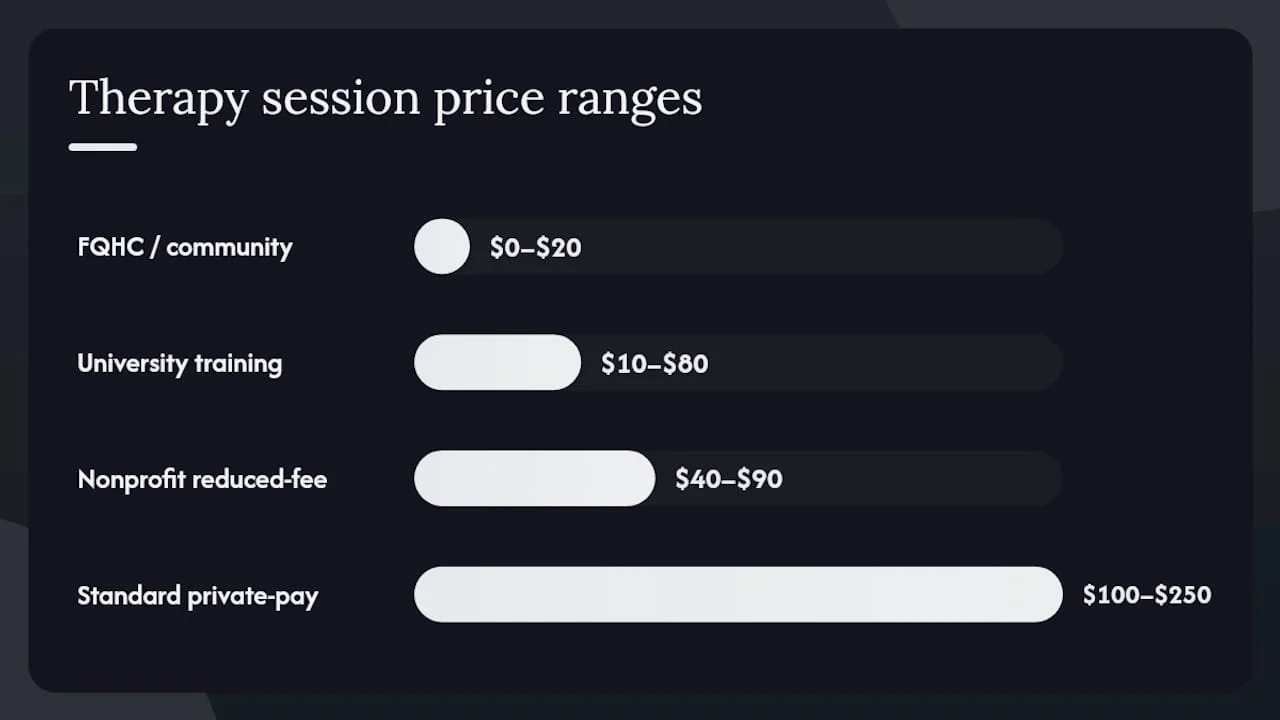
Federally Qualified Health Centers and community mental health centers set fees on an income-based sliding scale, sometimes as low as $0 to $20 a session, and many employ licensed clinicians with trauma training. The HRSA FQHC locator lets you search by ZIP code and confirms which centers offer behavioral health, not just primary care.
University training clinics are one of the best-kept secrets in mental health access. Graduate students in psychology or counseling programs see clients under the direct supervision of a licensed psychologist, and because the clinic's mission is training rather than profit, fees often land between $10 and $80 a session, according to industry cost breakdowns. The tradeoff is a newer therapist, but the supervision layer means a seasoned clinician is reviewing every case.
Telehealth has widened access to trauma specialists who might not have an office anywhere near you. Some platforms run on subscription models that undercut standard private-pay rates, and a growing number of independent EMDR and CPT-trained clinicians now offer virtual sessions across state lines where licensed.
Group therapy and peer-led support are clinically legitimate, not a consolation prize; many also find that massage for anxiety and depression relief can be a beneficial complement to traditional trauma therapy, offering additional non-therapy self-care support through relaxation and stress reduction Massage for anxiety & depression relief | Excelsior Integrative. Trauma-focused groups run by community agencies or nonprofits typically cost far less than individual sessions and add the benefit of peer validation that many trauma survivors say individual therapy alone doesn't provide.
Realistic price anchors, per treatment cost data:
Sliding scale and training clinic sessions: roughly $10 to $80
Reduced-fee private therapy through nonprofit networks: roughly $40 to $90
Standard private-pay therapy: commonly $100 to $250 or more, depending on credentials and market
How Do You Find and Verify an Affordable Trauma Therapist?
Finding the option is only half the job. Confirming the clinician can actually treat trauma, not just talk about it, matters just as much when you're paying out of pocket for a limited number of sessions.
Search Findtreatment and the SAMHSA no-insurance resource page for local, income-based programs.
Check the HRSA FQHC locator for community health centers offering behavioral health.
Browse Open Path Collective, a nonprofit directory of clinicians offering reduced-fee sessions, often between $40 and $90.
Call your local university's psychology or counseling department and ask if they run a public training clinic.
Email or call three to five clinicians with the same short script: "Do you have any sliding-scale or reduced-fee openings, and what trauma modalities do you use?"
When you get someone on the phone, ask directly whether they use EMDR, Cognitive Processing Therapy, or another evidence-based trauma protocol, not just "talk therapy." Ask about their license (LCSW, LMFT, PhD, or LPC with documented trauma training), whether they're a supervised trainee, what a session actually costs after any discount, and their cancellation policy before you book anything.
Watch for red flags: a clinician who can't name a specific trauma treatment method, vague answers about fees, or pressure to commit to a long package upfront.
Pro Tip: Instead of asking "Do you have sliding scale?" (easy to say no to), ask "Would you be open to a single reduced-fee session so I can see if we're a good fit?" Framing it as a trial, not a long-term ask, gets a yes far more often.
Superbills, Out-of-Network Reimbursement, and Other Ways to Cut the Cost
A superbill is an itemized receipt your therapist gives you after each session, listing the diagnosis code, procedure code, session length, and fee paid. If you have a health plan with out-of-network (OON) benefits, even one you're not using for in-network therapy, you can submit that superbill for partial reimbursement.
Here's how the math generally works: your insurer sets an "allowed amount" for the service, you owe your deductible first, and after that, many plans reimburse 50% to 80% of the allowed amount. Processing typically takes two to six weeks. It's not free money upfront. You still pay the therapist directly at the time of service, then wait for the check.
Ways to lower your net cost while you wait on reimbursement or build savings:
Use an HSA or FSA if you have one; therapy is a qualified medical expense.
Ask your employer whether an EAP exists, even if you skipped enrolling in the health plan.
Space sessions every two weeks instead of weekly once you're stable, cutting cost without cutting care.
Ask about a single-case agreement if a specialist you want is technically out of network for a plan you do have.
Typical reimbursement snapshot: after meeting a deductible, OON plans commonly return 50% to 80% of the allowed amount, with reimbursement checks arriving two to six weeks after you submit the superbill.
When Should You Use a Crisis Line Instead of Waiting for an Appointment?
If you're in danger of hurting yourself or someone else, skip everything above and use a crisis resource right now.
988 Suicide & Crisis Lifeline: call or text 988 for free, 24/7 support, no insurance needed.
Crisis Text Line: text HOME to 741741 for a trained crisis counselor by text.
SAMHSA National Helpline: free referrals to local treatment, including no-cost and low-cost options.
911 or your nearest ER: for immediate physical danger, not for general distress.
Calls and texts to 988 and the SAMHSA helpline are confidential, and counselors will often connect you to local, low-cost follow-up care instead of just ending the call.
Can You Negotiate a Lower Fee or Payment Plan With a Private Therapist?
Yes, and more clinicians are open to this than most people assume. Private-practice therapists set their own rates, which means they also have room to adjust them, especially for a client committed to consistent sessions rather than sporadic ones.
Be direct and specific rather than vague. Instead of "I can't really afford this," try: "My budget is $60 a session. Is there any flexibility, or a lower rate for biweekly sessions?" Naming a number gives the therapist something concrete to work with instead of guessing.
Payment plans are another underused option. Some therapists will let you pay a partial fee at each session and settle the balance monthly, or offer a reduced rate for the first month while you're both determining fit. Ask this during the initial consultation call, not after you've already started, so expectations are clear from session one.
Timing your ask matters too. Many therapists reassess their sliding-scale roster each January or when a client transitions off their caseload, so asking to be added to a waitlist for a lower rate, even if none is available immediately, can pay off within a few months.
If a therapist says no, ask if they know a colleague who might have sliding-scale room. Trauma-informed clinicians tend to know their local referral network well, and a warm referral often moves faster than a cold search.
Where Can You Find Nonprofits and Charities Offering Free Trauma Therapy?
Nonprofit and charitable mental health programs exist specifically to fill the gap that insurance leaves open, and they're often more generous with trauma-specific care than people expect.
Start with Open Path Collective, a nonprofit network connecting people without adequate insurance to private clinicians offering sessions in the reduced-fee range. Local domestic violence and crime-victim advocacy centers frequently provide free trauma counseling regardless of income, funded through state victim-assistance grants. Many faith-based organizations and community foundations also fund a set number of free or heavily discounted sessions each year, even for people outside their congregation.
Search your county's department of mental health or behavioral health website directly. Most publish a list of contracted nonprofit providers that serve uninsured residents at no cost, funded through block grants rather than insurance billing. University-affiliated hospitals sometimes run grant-funded trauma research programs that offer free treatment to participants, which is worth asking about if you're near a medical school.
Local chapters of the National Alliance on Mental Illness (NAMI) don't provide therapy directly but maintain updated lists of free and low-cost providers in your area, and they're a fast way to shortcut hours of independent searching.
Do Medicaid or Marketplace Plans Cover Trauma Therapy?
If you're uninsured, checking Medicaid eligibility should be near the top of your list, not an afterthought. States that expanded Medicaid cover mental health services, including trauma-focused therapy, as an essential health benefit, often with no or minimal copay.
Eligibility depends on income, household size, and your state's specific expansion status, so the number that qualifies you in California may not match another state. Medicaid has state-specific application help and can point you to your local enrollment office. If you're not sure whether you qualify, apply anyway. Coverage decisions happen fast, and many states now allow retroactive coverage for care received shortly before approval.
Marketplace plans through Healthcare are worth checking too, especially during open enrollment or after a qualifying life event like job loss, since subsidized plans can bring monthly premiums down to a level that's cheaper than paying out of pocket for weekly sessions long-term.
Veterans and people eligible through Indian Health Service have separate, often more direct paths. VA mental health services cover trauma treatment for eligible veterans regardless of discharge status in many cases, and IHS facilities provide no-cost behavioral health to eligible Native American and Alaska Native patients.
Are There Grants or Scholarships for Trauma Therapy?
Direct scholarships earmarked specifically for trauma therapy are limited, but they exist, and a few adjacent funding sources cover a lot of the same ground.
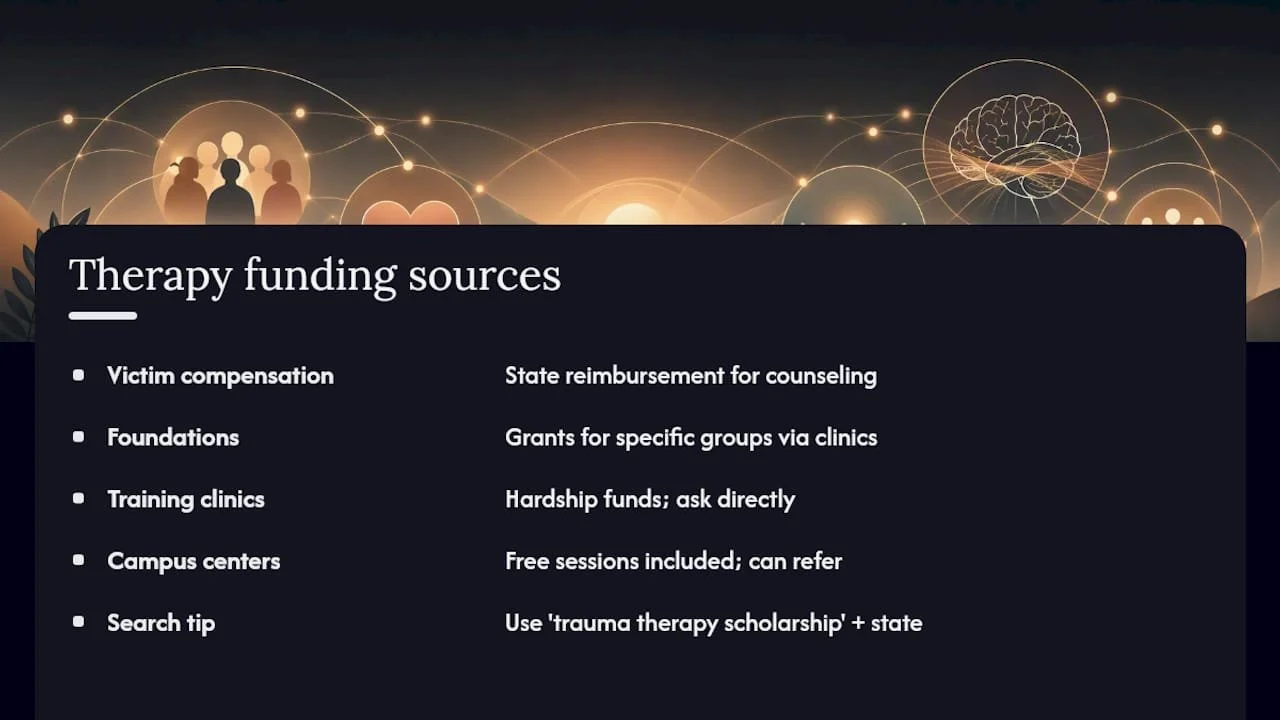
Victim-compensation funds, run at the state level, reimburse crime victims for counseling costs, sometimes retroactively, even without insurance. Every state has one, typically administered through the attorney general's office or a crime victims' board, and eligibility usually doesn't hinge on reporting to police within a rigid timeframe, though requirements vary by state.
Some private foundations fund therapy grants for specific populations, including survivors of sexual assault, first responders, and refugees. These are usually awarded through a partnering clinic rather than paid directly to the individual, so ask any nonprofit or training clinic you contact whether they administer grant-funded slots.
University training clinics sometimes have small hardship funds separate from their standard sliding scale, reserved for clients who can't afford even the lowest published fee. It's rarely advertised online, so ask directly when you call.
If you're a student, campus counseling centers often include a set number of free sessions in tuition and can refer you to off-campus grant programs once you exceed that limit. Search terms like "trauma therapy scholarship" combined with your state and population (veteran, survivor, refugee) tend to surface region-specific funds that generic searches miss.
How Do You Get the Most Out of an EAP Without Insurance?
An Employee Assistance Program often survives even when your health insurance doesn't, because EAPs are usually a separate employer benefit tied to your job, not your health plan enrollment. If you're employed but skipped insurance for cost reasons, check whether your employer still offers an EAP; many do automatically for every employee.
Most EAPs cover three to eight free counseling sessions per issue, per year, with no cost to you and no claim filed anywhere that touches your health record. That's often enough for an initial trauma assessment, stabilization, and a warm handoff to longer-term care.
Ask your HR department directly whether the sessions are per issue or per year total, since some plans let you access a new set of sessions if you're dealing with a distinct concern, like a new instance of assault versus ongoing grief. Also confirm whether the EAP allows trauma-specific referrals or only offers general counseling; some contracted EAP networks include EMDR-trained clinicians if you ask specifically.
Once your EAP sessions run out, ask the EAP counselor for a referral to a sliding-scale or reduced-fee provider. EAP staff typically maintain their own local referral lists and can bridge you directly into a lower-cost option instead of leaving you to start the search from zero.
A Publisher's Perspective: How Alvarado Therapy Supports Clients Without Insurance
Alvarado Therapy works with trauma, PTSD, complex trauma, and grief every day, offering EMDR therapy, individual and couples counseling, and bilingual care in English and Spanish across California, New York, and online. Clients without insurance aren't turned away without options.
Practically, that means pointing people toward the right entry point for their budget, whether that's a sliding-scale conversation, a referral to a community resource, or starting with a focused EMDR intensive instead of an open-ended weekly commitment. The goal is matching the format to what someone can actually sustain, not what looks best on paper. For readers who want to understand what a first EMDR session involves before reaching out, the PTSD assessment guide walks through what clinical intake looks like.
— Juiced
How Alvarado Therapy Can Help You Start Trauma Therapy Without Insurance
Some practices specialize specifically in trauma, EMDR, and complex PTSD rather than general talk therapy. Some practices offer individual EMDR sessions and intensives, bilingual care in English and Spanish, and fully online sessions across multiple states, reducing location barriers for accessing trauma-trained care.
If cost is your main concern, the most useful first step is a consultation, where you can ask directly about fees, session structure, and whether a sliding-scale or reduced-rate arrangement fits your situation before committing to ongoing care. Many people underestimate how much clarity a single conversation provides. A first appointment typically includes a review of your history, a discussion of what EMDR or trauma-focused treatment involves, and a plan tailored to how much support you actually need right now, not a generic intake script. If trauma from a crime or violent incident is part of what you're processing, the trauma therapy for victims of crime page outlines specialized support available for that specific situation. Start by requesting a consultation to ask about fees and availability, or review what to expect from your first session.
This article is general information, not a substitute for advice from a qualified doctor. Consult a qualified healthcare professional about your own circumstances before acting on anything here.
