
Why seek an immigration evaluation? Strengthen your case

TL;DR:
Psychological evaluations with clinical evidence can strengthen immigration cases involving trauma or hardship.
A detailed, nexus-established report increases approval chances and reduces RFEs from USCIS.
The process involves clinical interviews, standardized testing, and culturally sensitive documentation by licensed professionals.
Many Californians submit immigration applications with strong paperwork but still face denials, requests for evidence (RFEs), or frustrating delays. The reason is often invisible on the forms: unaddressed psychological hardship. When trauma, abuse, fear, or family separation drives your case, objective clinical evidence of mental health impacts is what turns a plausible story into compelling, credible proof. This guide walks you through who benefits from immigration psychological evaluations, exactly how the process works, and why the right report can make the difference between approval and denial.
Table of Contents
Key Takeaways
| Point | Details |
|---|---|
| Legal credibility boost | A professional evaluation makes hardship and trauma claims concrete and credible for immigration officials. |
| Emotional validation | The process helps applicants feel heard, understood, and guided toward better mental health. |
| Approval chances rise | Detailed, trauma-informed reports can significantly reduce requests for more evidence or denials. |
| Selection matters | Choosing experienced, immigration-savvy clinicians is key to a report’s effectiveness. |
| Ongoing support | An evaluation can be the first step to healing—not just a legal formality. |
What is an immigration evaluation and who needs one?
An immigration psychological evaluation is a formal clinical assessment performed by a licensed mental health professional. Its purpose is to document your psychological condition, connect your symptoms to the hardship you are experiencing, and present that information in a format the United States Citizenship and Immigration Services (USCIS) can weigh as credible evidence. This is not a therapy session, and it is not a letter of support from a friend. It is a structured, professional report that carries real legal weight.
Several types of immigration cases commonly benefit from these evaluations:
VAWA petitions (Violence Against Women Act): For survivors of domestic abuse seeking protection regardless of their abuser's immigration status.
U and T visas: For victims of crime or human trafficking who cooperated with law enforcement.
Asylum applications: For individuals fleeing persecution, violence, or political danger in their home country.
Hardship waivers (I-601 and I-601A): For applicants who must show that their absence would cause extreme hardship to qualifying U.S. citizen or permanent resident relatives.
Cancellation of removal: For those in removal proceedings who need to demonstrate exceptional hardship to family members.
N-648 medical certifications: For naturalization applicants seeking an exemption from English or civics requirements due to a medical or mental health condition.
Pro Tip: Even if your case type is not listed above, if your application involves claims of trauma, abuse, medical or mental health conditions, or the emotional consequences of family separation, ask your immigration attorney whether a psychological evaluation could strengthen your position.
The concept of nexus is essential here. Nexus means the direct, documented connection between your psychological symptoms and the immigration consequences you face. Without that link, USCIS may see your hardship claim as vague or unsubstantiated. A well-crafted evaluation establishes the nexus clearly, preventing unnecessary RFEs or outright denials by showing reviewers exactly how your mental health is tied to the outcome of your case. Understanding what therapist roles in evaluations look like in practice can also help you choose the right provider from the start. For a broader overview, this California-specific evaluation guide covers what local applicants need to know.
How do immigration evaluations actually boost your application?
USCIS does not operate on an all-or-nothing standard for most immigration benefits. Instead, officers weigh the totality of the evidence, meaning your case is viewed as a whole picture. A credible, detailed psychological evaluation is one of the most powerful pieces of that picture, particularly when hardship or trauma is central to your claim.
Consider what USCIS says about extreme hardship assessments. The USCIS Policy Manual explicitly recognizes psychological impact, including separation trauma, as a key factor in extreme hardship determinations, and credible evidence from qualified professionals carries significant weight in that totality assessment. This is not a minor footnote. It means a strong evaluation can tip a borderline case toward approval.
The difference between a strong evaluation and a weak one is not just style. It is substance, structure, and credibility. Here is how they compare:
| Feature | Strong evaluation | Weak evaluation |
|---|---|---|
| Length and detail | 8 to 10 or more pages, individualized | 1 to 3 pages, generic |
| Nexus established | Clear connection to immigration hardship | Vague or absent |
| Diagnostic rigor | Standardized tests, clinical interviews | Informal impressions only |
| Cultural sensitivity | Adapted to client’s background | One-size-fits-all |
| Clinician qualification | Trauma/immigration experience | General practice only |
| USCIS compliance | Meets evidentiary standards | May be rejected or given low weight |
Weak evaluations are not just unhelpful. As immigration attorneys consistently note, generic reports without nexus actively lead to RFEs, lower evidentiary weight, and reduced approval chances. A strong evaluation, in contrast, explains trauma's effect on memory and credibility, which is crucial when USCIS officers question inconsistencies in a survivor's account.
Here are the most common outcomes when applicants submit strong evaluations:
Fewer requests for evidence. USCIS officers have the clinical documentation they need without asking for more.
Greater narrative coherence. The evaluation explains behaviors and inconsistencies that might otherwise look suspicious.
Higher approval rates. Attorneys report dramatically better outcomes with credible, detailed psychological reports.
Faster case processing. When the record is complete and compelling, fewer back-and-forth exchanges are needed.
Stronger appeal foundation. If a case was previously denied, a new evaluation gives appeal officers something concrete to weigh.
"The psychological impact of separation, loss, and trauma is not just an emotional detail. It is often the single factor that shifts a borderline hardship case from denial to approval."
For more on how this plays out in California specifically, the California process and win rates data is eye-opening. And if you are concerned about the emotional toll of going through this process, understanding the emotional impact of evaluations can help you prepare.
What happens during the evaluation process?
Many applicants avoid seeking an evaluation because they do not know what to expect. The process is less intimidating than it sounds, and knowing the steps in advance helps you show up prepared and get the most out of your sessions.

Here is a breakdown of the core stages, methods, and the clinicians involved:
| Stage | What happens | Method used |
|---|---|---|
| Intake and screening | Clinician reviews your background, case type, and legal context | Intake forms, attorney coordination |
| Clinical interview | You share your history, experiences, and current symptoms | Structured or semi-structured interview |
| Psychological testing | Standardized tools measure trauma, anxiety, depression, and more | PCL-5, PHQ-9, BDI-II, and other validated tests |
| Cultural adaptation | Clinician considers language, identity, and cultural context | Bilingual sessions, culturally informed frameworks |
| Report writing | Detailed narrative connecting findings to immigration consequences | USCIS-compliant, 8 to 10 or more pages |
| Attorney review | Final report shared with legal team for submission | Coordination as needed |
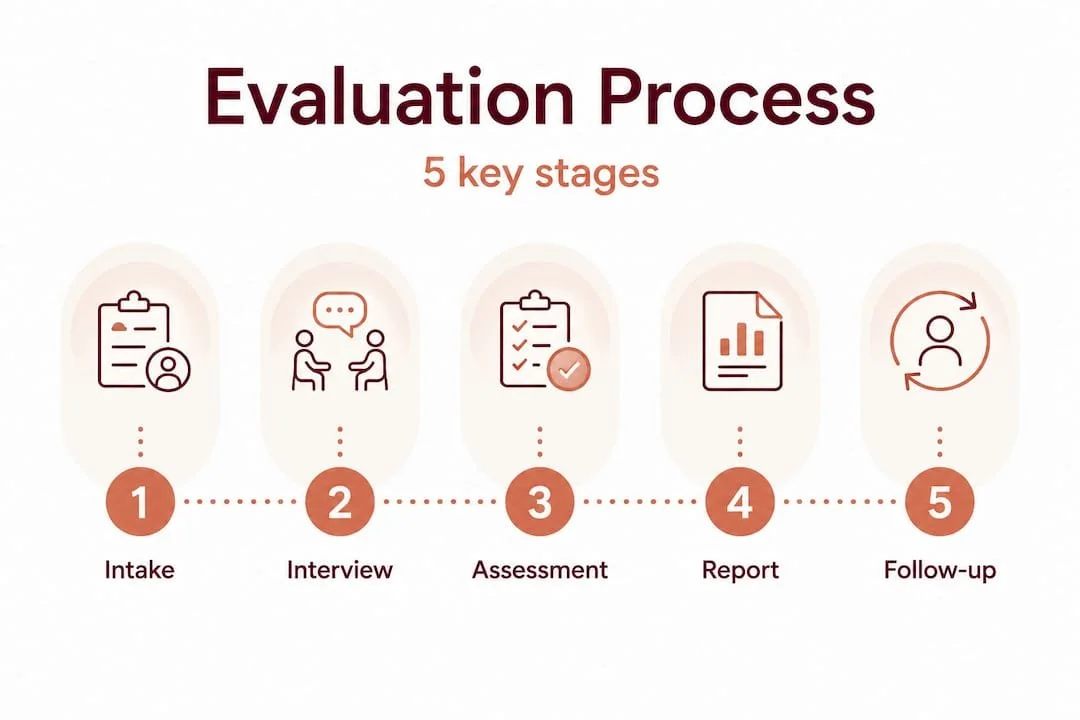
Valid immigration evaluations are conducted by licensed clinicians including psychologists, LCSWs (licensed clinical social workers), and psychiatrists, using clinical interviews, standardized tests, and culturally sensitive methods. Reports must be detailed, individualized, and USCIS-compliant to carry real evidentiary weight.
Here is what you can do to make the most of your evaluation:
Before: Gather any relevant documents, including police reports, medical records, or prior therapy notes. Ask your attorney what the evaluation needs to address. Choose a clinician with direct immigration and trauma experience.
During: Be honest and specific about your experiences and symptoms, even if they are painful. The clinician is not judging you. Their job is to document your reality accurately.
After: Review the report with your attorney before submission. Ensure all factual details are accurate and the nexus to your case is clearly stated.
Pro Tip: When interviewing potential evaluators, ask directly: "Have you written reports for cases like mine, and how do you address trauma effects on memory and credibility in your reports?" A clinician who can answer that question with specificity is one who understands both the clinical and legal dimensions of the work. You can learn more about what to expect by reading about the therapist evaluation process and comparing types of evaluations available in California.
Beyond approval: Mental health benefits of seeking an immigration evaluation
Legal outcomes aside, there is something profoundly important that happens when a licensed professional formally acknowledges your pain. Immigration stress is one of the most under-recognized forms of chronic trauma. Fear of deportation, family separation, detention, and uncertainty about the future create real psychological harm. And yet, most applicants carry that burden silently because no one has ever asked them to name it.
A psychological evaluation changes that. The benefits extend well beyond what ends up in your USCIS file:
Validation. Having your trauma formally recognized and documented makes something invisible finally visible. Many clients describe this alone as deeply healing.
Reduced anxiety. The process of organizing and articulating your experiences with a trained professional can lower the sense of chaos and helplessness that often accompanies immigration cases.
Professional connection. The evaluation often introduces you to a clinician who can provide ongoing therapy, crisis support, or EMDR treatment if needed.
Empowerment. Rather than waiting passively for a bureaucratic outcome, you become an active participant in building your own case narrative.
Access to community resources. Clinicians conducting evaluations often connect clients with advocacy organizations, legal aid, and support groups in California.
Research supports what our clients tell us anecdotally. Empirical studies confirm that thorough forensic evaluations bolster credibility by documenting trauma consistent with an applicant's claims, which in turn validates the applicant's lived experience and reduces the psychological burden of being disbelieved. That validation matters clinically, not just legally.
The evaluation is not the end of the road. Think of it as a bridge. On one side is the confusion and fear of the immigration process. On the other side is a path toward both legal resolution and genuine healing. For many clients, starting with an evaluation is what finally opens the door to the healing benefits of immigration therapy they needed all along.
Our perspective: Why every applicant deserves a real, trauma-informed evaluation
We want to be direct about something the immigration services industry does not always say out loud: not all evaluations are equal, and a bad one can hurt you more than having none at all.
We have seen the consequences when applicants use low-cost, generic letters that lack clinical depth. These reports often ignore trauma-informed frameworks, skip standardized testing, and fail to establish any meaningful nexus. USCIS officers are trained to assess the quality of evidence. A one-page letter with no diagnostic rationale signals to a reviewing officer that the claim was not taken seriously, which can undermine everything else you submitted.
The forensic and trauma-informed approach to immigration evaluations is distinct from general therapy in ways that matter enormously. A general therapist may know you well, but without immigration-specific forensic training, they may not know how to explain trauma's effect on memory, address cultural factors in symptom presentation, or structure a report that meets USCIS evidentiary standards. These are specialized skills, and the difference between someone with them and someone without is often the difference between approval and denial.
"A trauma-informed evaluation does more than fill a USCIS checklist. It restores dignity and hope to someone who has spent years being doubted."
We also want to reframe how you think about this process. Seeking an evaluation is not surrendering to bureaucracy. It is an act of self-advocacy. You are saying: my experience is real, my suffering is documented, and I deserve to have it treated seriously by the systems making decisions about my future. That is a powerful stance, especially for those who have spent years minimizing their own pain to survive.
Before you hire anyone to write your evaluation, ask them directly how they handle trauma assessment methods and cultural adaptation in their reports. Ask them about their experience with your specific case type. And read about trauma-informed care outcomes so you understand what is actually possible when the right clinician is involved.
Get started with expert immigration evaluations and trauma care
Choosing the right clinician for your immigration evaluation is one of the most important decisions you will make in this process. You need someone who understands both the legal landscape and the human cost of trauma. Generic providers cut corners that can cost you your case.
At Alvarado Therapy, our bilingual, trauma-informed clinicians in Pasadena, Ventura, and across California specialize in exactly this work. We offer immigration evaluation services that meet USCIS evidentiary standards while treating you with the care and cultural sensitivity you deserve. If your case involves PTSD, complex trauma, or abuse, our trauma and PTSD care programs provide the ongoing support you need beyond the evaluation itself. Ready to take the first step? Schedule a consultation and let us help you build a case and a healing path that honors your full story.
Frequently asked questions
Is an immigration evaluation required for all immigration cases?
No, but it is strongly recommended for cases involving trauma, hardship waivers, asylum, or family separation, since objective clinical evidence of mental health impacts significantly strengthens these specific petition types.
Who can perform a valid immigration evaluation in California?
Only licensed mental health clinicians, such as psychologists, LCSWs, and psychiatrists with expertise in both immigration cases and trauma, can produce reports that carry real weight with USCIS.
How long does the immigration evaluation process take?
Typically, the process takes 2 to 4 weeks from intake to final report, though timelines vary based on the clinician's availability, the complexity of your case, and whether expedited processing is needed.
Can a psychological evaluation help if my case was previously denied?
Yes. A detailed, trauma-informed evaluation can provide compelling new evidence for appeal applications, since strong evaluations address memory and credibility in ways that weak or generic prior reports often failed to do.
Does an evaluation address mental health needs beyond the immigration case?
Absolutely. Evaluations validate lived trauma and regularly serve as the entry point to ongoing therapy, anxiety relief, and trauma recovery that many applicants needed long before they ever filed a petition.
Recommended
Why immigration evaluations matter for California cases — Alvarado Therapy
Immigration Evaluations: Key Steps and Expert Insights — Alvarado Therapy
Understanding immigration evaluations for Californians: 2026 — Alvarado Therapy
Immigration Evaluations in California: Trauma-Informed Guide — Alvarado Therapy
