
Identity-affirming therapy for trauma recovery in California

TL;DR:
Identity-affirming therapy validates all aspects of a person's cultural, racial, and social identities.
Preparing with personal history, cultural values, and clear goals enhances therapy effectiveness.
Culturally responsive, adaptable trauma treatments improve healing outcomes for diverse Californians.
Finding a therapist who understands your trauma is hard enough. Finding one who also honors your culture, language, identity, and lived experience? That feels nearly impossible for many Californians. Whether you're a first-generation immigrant, a person of color, a member of the LGBTQ+ community, or someone navigating the intersection of multiple marginalized identities, the wrong therapeutic environment can actually deepen harm rather than support healing. APA guidelines for treating PTSD emphasize culturally responsive, trauma-informed care that accounts for discrimination, cultural context, and identity factors. This guide walks you through exactly how to find, prepare for, and benefit from identity-affirming trauma therapy in California.
Table of Contents
Key Takeaways
| Point | Details |
|---|---|
| Identity matters in therapy | Therapy that recognizes and adapts to your cultural and lived experience is more effective for trauma recovery. |
| Preparation leads to success | Gathering personal, cultural, and historical information gives you and your therapist a strong foundation. |
| Customize your workflow | An identity-affirming therapy workflow adapts proven trauma treatments to your unique needs at every step. |
| Track your healing | Using feedback and progress tools empowers you and ensures your therapy stays on track. |
| Advocate for your needs | Self-advocacy and open communication make identity-affirming therapy safer and more successful. |
What is identity-affirming therapy and why does it matter?
Identity-affirming therapy is a therapeutic approach that explicitly recognizes and validates who you are. That includes your race, ethnicity, gender identity, sexual orientation, immigration status, religion, disability, and any other dimension of self that shapes your daily experience. It's not just about being "nice" or "respectful." It's a structured clinical commitment to treating the whole person within their real social and cultural context.
At the heart of this approach are two key principles. The first is intersectionality, the understanding that your identities don't exist separately but overlap and interact in ways that shape your experiences of both trauma and healing. A queer Latina woman, for example, may be navigating trauma tied to racism, homophobia, and gender-based violence all at once. A therapist who addresses only one thread while ignoring the others is missing most of the picture.
The second principle is cultural humility, which means your therapist remains curious and open about your background rather than assuming they already know what your culture means to you. Cultural humility is an ongoing practice, not a one-time certification.
Here's what sets identity-affirming therapy apart from traditional approaches:
It treats your cultural background as a clinical asset, not a complication
It adapts language, metaphor, and even pacing to your cultural norms
It names and validates the real harm caused by systemic oppression
It avoids pathologizing (labeling as a disorder or defect) cultural practices and beliefs
It ensures that therapeutic goals align with your values, not just diagnostic criteria
Traditional trauma therapy, even when well-intentioned, can fall short for people from marginalized communities. Protocols designed without diverse populations in mind may inadvertently reinforce shame, silence cultural grief, or ignore how systemic racism and discrimination function as ongoing traumatic stressors. As the APA stresses competent, non-discriminatory care that adapts to diverse identities, this means any therapist working in California must go beyond generic clinical practice.
"Culturally responsive care is not an optional add-on. It is a clinical and ethical requirement for effective trauma treatment." This is especially true in a state as diverse as California, where nearly 40% of residents were born outside the United States and over 200 languages are spoken.
Explore more about this approach in our identity-affirming therapy guide and learn why identity-affirming therapy matters in California specifically.
Preparation: What you need before starting identity-affirming therapy
Understanding the core concepts, the next step is getting ready to start therapy with the right preparation. Starting therapy is a significant decision. Going in prepared makes the experience safer and more effective from the very first session.
What to gather before your first appointment:
A rough timeline of your significant life experiences, including any trauma
Notes on your cultural values, family dynamics, and community ties
Your language preferences, whether you want sessions in English, Spanish, or another language
Your goals for therapy, even if they feel unclear right now
Any questions you have about the therapist's training or approach
Insurance information and any financial concerns you want to address upfront
One of the most important steps is evaluating a potential therapist's cultural competence before committing. You deserve a therapist who has real training in working with diverse populations, not just someone who checks a box. The role of cultural identity in trauma therapy outcomes is significant. Studies consistently show that therapeutic alliance, meaning how well you connect and trust your therapist, is one of the strongest predictors of healing.
| What to assess | Green flag | Red flag |
|---|---|---|
| Cultural training | Intersectional, ongoing education | One diversity workshop years ago |
| Language capacity | Fluent or uses trained interpreter | Relies on client to translate |
| Approach to identity | Openly explores its role in trauma | Treats it as irrelevant or secondary |
| Response to feedback | Curious and open | Defensive or dismissive |
| Trauma specialization | EMDR, CPT, trauma-focused CBT | No specific trauma training |
Pro Tip: During your first consultation, ask directly: "How do you incorporate cultural identity into your trauma work?" A strong therapist will have a genuine, detailed answer. Vague responses like "I respect all cultures" are a warning sign.
In California, therapists with intersectional training and genuine cultural humility are the ethical and clinical standard you should expect. Knowing what questions to ask puts you in a position of informed self-advocacy from day one. Understanding the value of cultural responsiveness in therapy can help you evaluate your options with confidence.

Step-by-step workflow: Identity-affirming therapy in action
Once you're prepared, here's a step-by-step workflow for working through identity-affirming trauma therapy.
1. Intake with a cultural and identity lens Your first sessions are about building safety and mutual understanding. Share as much or as little as you feel ready to. A skilled therapist will ask about your cultural background, community connections, and how your identity has shaped your experience of trauma, not just what happened to you.
2. Collaborative goal-setting Together with your therapist, you'll set goals that reflect both symptom relief and personal values. This might include reducing PTSD symptoms, strengthening your cultural identity, improving relationships within your community, or reclaiming a sense of self that trauma eroded.
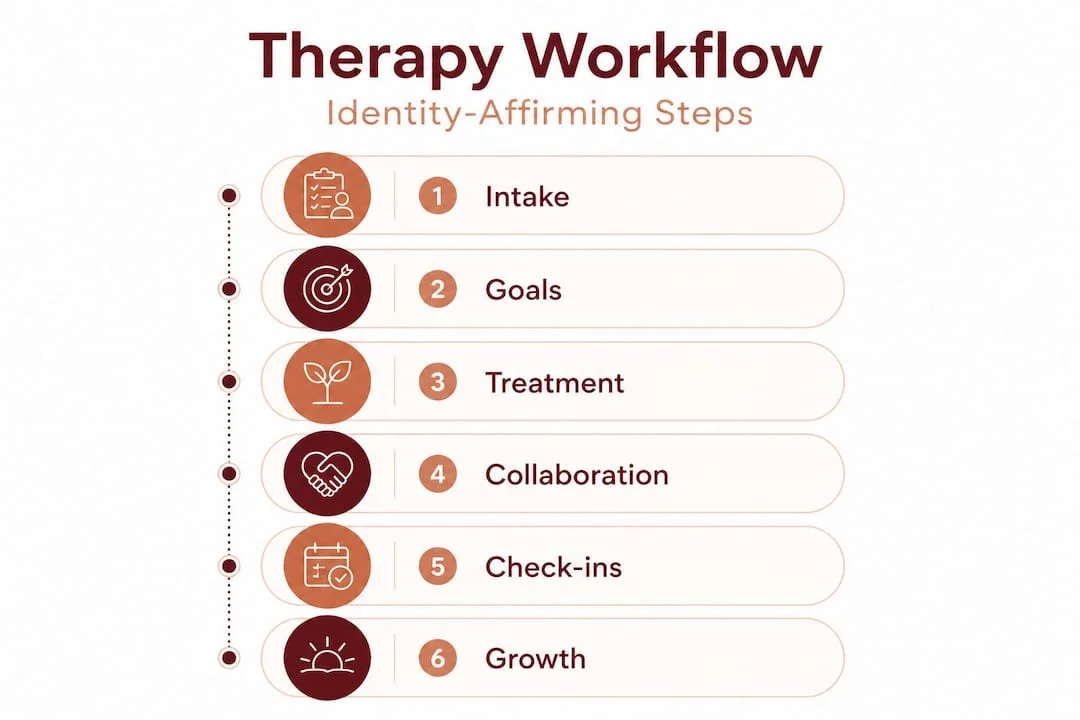
3. Selection of evidence-based treatment, adapted to your context The APA guidelines recommend CPT, Prolonged Exposure, and trauma-focused CBT as strongly evidenced treatments for PTSD. In an identity-affirming framework, these methods are adapted. For example, Cognitive Processing Therapy (CPT) might explore how cultural shame, systemic racism, or immigration trauma contributed to stuck points, rather than applying a generic protocol without context.
4. In-session collaboration and self-advocacy You are not a passive recipient in this process. Speak up when something doesn't feel right. If a metaphor misses the mark or an exercise feels culturally tone-deaf, say so. Your feedback makes therapy better and more tailored to you.
5. Regular check-ins and adjustments Every few weeks, you and your therapist should review what's working and what isn't. Good identity-affirming therapy is flexible. What helps one person may not help another, and that's expected.
6. Empowerment and growth beyond symptom reduction Healing isn't just about reducing distress. It's about reclaiming agency, strengthening your identity, and reconnecting with your strengths and community. The final phase of therapy should feel expansive, not just like the absence of pain.
| Treatment | Adapted for identity-affirming care | Standard application |
|---|---|---|
| CPT (Cognitive Processing Therapy) | Explores cultural context, systemic factors, and collective trauma | Focuses primarily on individual thought patterns |
| Prolonged Exposure | Paced with cultural considerations around shame and disclosure | Standard exposure hierarchy |
| Trauma-focused CBT | Integrates cultural strengths and family systems | Individual symptom reduction |
| EMDR | Adapts bilateral stimulation to cultural comfort | Standardized protocol |
Because limited high-quality data specific to California adults exists for culturally adapted protocols, skilled therapists rely on APA guidelines while remaining flexible and client-centered. Research consistently supports better PTSD outcomes with identity-affirming therapy, and the evidence for culturally responsive approaches improving trauma recovery continues to grow. A trauma healing workflow grounded in identity affirmation can make a real, measurable difference in how quickly and deeply you heal.
Pro Tip: Keep a simple therapy journal between sessions. Note what felt meaningful, what felt off, and any memories or emotions that surfaced. Bringing this to your next session helps your therapist adapt in real time.
Troubleshooting and common challenges in identity-affirming therapy
You now know the workflow, but real-life therapy sometimes faces challenges. Knowing what to watch for keeps you safe and empowered.
Red flags to watch for in therapy:
Therapist minimizes or dismisses cultural or identity-related concerns
Sessions feel like you are educating your therapist rather than being supported
Microaggressions (subtle, often unintentional remarks that demean your identity) go unaddressed when you raise them
You feel pressure to assimilate or "translate" your experience into a dominant-culture framework
Your religious or spiritual beliefs are treated as obstacles rather than resources
"A therapeutic relationship that replicates power imbalances you already experience in daily life is not a safe healing environment. You have both the right and the responsibility to name that."
If you notice these patterns, start by addressing them directly in session if you feel safe enough to do so. You might say something like, "When you said that, it didn't feel right to me. Can we talk about it?" Many therapists genuinely want to correct course and will respond well to honest feedback.
If the pattern continues, it is completely appropriate to seek a different therapist. Switching is not failure. It is self-advocacy. In California, you can report ethics concerns to the California Board of Behavioral Sciences (BBS) or the APA. You can also ask for a referral to a clinician with more relevant cultural experience.
The APA's non-discriminatory care standards are clear. Every client deserves competent, identity-respecting care. Understanding the principles of trauma-sensitive therapy and safe healing will help you recognize what that should look like in practice.
Tracking progress: Measuring your outcomes and growth
As you move through therapy, it's key to track your own healing. Progress in trauma therapy doesn't always look linear. Some weeks feel like breakthroughs. Others feel like you're going backward. Tracking gives you a clearer, more accurate picture than your feelings on any single day.
How to track your progress:
Use a brief symptom checklist weekly, such as noting your sleep quality, intrusive thoughts, emotional reactivity, and sense of safety on a scale of 1 to 10
Track identity-related markers too, such as how connected you feel to your culture, how often you feel seen and understood, and how strongly you feel your sense of self
Review your therapy goals every 4 to 6 weeks with your therapist and note changes
Keep a brief log of "moments of strength," times when you handled something difficult better than you would have before therapy
Ask your therapist to share any standardized measures they use, such as the PCL-5 for PTSD symptoms, and track those scores over time
| Progress dimension | What to track | How often |
|---|---|---|
| Symptom relief | Sleep, intrusions, hypervigilance | Weekly |
| Cultural affirmation | Sense of belonging, identity strength | Monthly |
| Relationship quality | Trust, communication, boundaries | Monthly |
| Empowerment | Self-advocacy, agency, decisions | Ongoing |
| Therapy goals | Progress toward stated goals | Every 4 to 6 weeks |
The APA's strong evidence for CPT, Prolonged Exposure, and trauma-focused CBT also supports using outcome measures to guide treatment adjustments. If your scores aren't improving after 8 to 12 sessions, it's worth discussing a change in approach with your therapist. Research on cultural competence and therapy outcomes shows that clients who feel culturally understood show significantly greater improvement across all measures.
Why most therapy workflows fail diverse Californians—and how identity-affirming care changes everything
Here's an uncomfortable truth. Most mainstream trauma therapy workflows were designed by, tested on, and validated for relatively homogeneous populations. The evidence base for gold-standard trauma treatments is strong, but the research samples often underrepresent people of color, immigrants, LGBTQ+ individuals, and others navigating multiple layers of marginalization. That's not a small gap. It's a fundamental limitation.
When therapists apply rigid protocols without adaptation, they risk creating a clinical environment that mirrors the very systems that caused harm. Imagine a Salvadoran immigrant survivor of political violence being asked to complete standard exposure exercises without any acknowledgment of how ongoing immigration stress, family separation, or anti-immigrant rhetoric functions as a continuous traumatic environment. The protocol might "work" on paper while leaving the person feeling profoundly unseen.
California has both the opportunity and the responsibility to model something better. With its extraordinary diversity, strong mental health workforce, and community of culturally responsive practitioners, this state can lead the way. That means moving away from "adapt if convenient" toward "adapt as a clinical standard." It means requiring intersectional training as part of therapist credentialing. It means funding research that includes and centers diverse California communities.
We also need to be honest about what we don't yet know. As the data shows, limited high-quality empirical evidence exists for culturally adapted protocols in California specifically, and more rigorous research is urgently needed. But the absence of perfect data is not permission to ignore identity. It's a call to be more attentive, more flexible, and more collaborative with each client.
The answer isn't to abandon evidence-based treatments. It's to hold them lightly, apply them thoughtfully, and prioritize the person in front of you over the protocol in your binder. Understanding why culturally responsive therapy matters for genuine healing is the foundation of that shift. The most effective therapists we know aren't the ones who follow protocols most faithfully. They're the ones who know their clients most deeply.
Get expert support with identity-affirming trauma therapy in California
If the steps in this guide resonate with you, the next move is connecting with a therapist who is already doing this work at a high level. Knowing the framework matters, but having the right support alongside you makes all the difference.
At Alvarado Therapy, our licensed therapists specialize in trauma and PTSD treatment with a genuine commitment to identity-affirming, culturally responsive care. We work with adults across Pasadena, Ventura, and online throughout California, in both English and Spanish. Whether you're exploring trauma and PTSD therapy options for the first time or ready to go deeper with an intensive approach, we meet you where you are. Learn what to expect in EMDR and trauma therapy with us, and when you're ready, schedule a consultation to take your first step toward healing that truly honors all of who you are.
Frequently asked questions
What makes therapy identity-affirming compared to traditional methods?
Identity-affirming therapy recognizes your unique cultural and personal context and adapts treatment methods accordingly, while APA guidelines for PTSD emphasize that culturally responsive, trauma-informed approaches must account for discrimination and identity factors that standard methods often overlook.
How do I know if a therapist is truly identity-affirming?
Look for therapists with intersectional training, demonstrated experience with diverse populations, and a genuine commitment to non-discriminatory, culturally competent care, and ask direct questions during your first consultation about how they incorporate identity into trauma work.
Which evidence-based trauma therapies can be adapted for identity-affirming care?
Cognitive Processing Therapy (CPT), Prolonged Exposure, and trauma-focused CBT are the treatments with the strongest evidence base, and when guided by APA PTSD recommendations, skilled therapists adapt these methods to honor cultural context, systemic factors, and individual identity.
What if my therapist doesn't understand my background?
You can and should name the concern directly in session, and if the pattern continues, seeking a therapist who is a better cultural fit is a valid act of self-advocacy, as APA ethics require that care be adapted to each client's unique identity and context.
Recommended
What Is Identity-Affirming Therapy? A Guide to Healing — Alvarado Therapy
Step-by-step trauma healing: EMDR guide for Californians — Alvarado Therapy
Cultural responsiveness in therapy: trauma recovery in CA — Alvarado Therapy
California relationship transition support: Heal in 3-4 years — Alvarado Therapy
