
Attachment Theory Explained: Healing Trauma and Relationships
TL;DR:
Early caregiving relationships shape adult attachment styles and emotional responses.
Attachment patterns influence adult relationship behaviors, feelings of safety, and anxiety levels.
Healing involves therapy, safe relationships, and understanding that attachment patterns can change over time.
Most people assume that if they have anxiety, trouble trusting others, or a pattern of painful relationships, the answer lies in something happening right now: a difficult partner, a stressful job, or a rough few years. But the research tells a different story. Attachment theory is a psychological framework proposing that early caregiving relationships shape your expectations about closeness, safety, and support, influencing emotion regulation and relationship patterns well into adulthood. What this means, practically, is that the nervous system you bring to every close relationship today was largely built in your very first ones. Understanding why that matters is the first step toward real change.
Table of Contents
Key Takeaways
| Point | Details |
|---|---|
| Attachment is lifelong | Your earliest bonds shape patterns that affect adult relationships and mental health. |
| Four main styles | Secure, anxious, avoidant, and disorganized patterns each express unique coping and intimacy traits. |
| Attachment is changeable | Targeted therapy can help transform attachment patterns and promote healing. |
| Trauma links are real | Insecure and disorganized attachment often play a role in adult trauma and anxiety. |
| Practical healing steps | Working with a skilled therapist can help you create safer, more secure relationships. |
What is attachment theory? The basics you need to know
Attachment theory began with British psychiatrist John Bowlby, who spent decades studying how children respond to separation from caregivers. His core argument was straightforward: humans are biologically wired to seek closeness to a protective figure, especially under stress. This isn't a character flaw or neediness. It's survival.
Mary Ainsworth later expanded Bowlby's work through her famous "Strange Situation" experiments in the 1970s. She observed how infants responded when briefly separated from their caregiver and then reunited. What she found was that children didn't respond the same way. Some were distressed but quickly comforted. Others were inconsolably upset. Still others seemed almost indifferent. These patterns became the foundation for classifying attachment styles.
Attachment theory proposes that early caregiving relationships shape expectations about closeness, safety, and support, influencing emotion regulation and relationship patterns into adulthood. This is a critical point: we're not just talking about childhood psychology. These patterns follow you.
Here's a quick breakdown of what attachment theory covers:
Secure attachment: The caregiver is reliably available and responsive. The child feels safe exploring and returning for comfort.
Insecure attachment: The caregiver is inconsistent, unavailable, or frightening. The child adapts by becoming either hypervigilant or emotionally distant.
Internal working models: Mental blueprints built through early experience that shape how you expect relationships to feel and function.
Caregiving relationships as the foundation: Not just parents, but any primary attachment figure, including grandparents or other consistent caregivers.
| Attachment type | Caregiver pattern | Child's response |
|---|---|---|
| Secure | Consistent, responsive | Explores freely, seeks comfort when distressed |
| Anxious/Ambivalent | Inconsistent | Clingy, hard to soothe |
| Avoidant | Emotionally unavailable | Self-reliant, suppresses distress |
| Disorganized | Frightening or frightened | Confused, contradictory responses |
Why does this matter for adults? Because those early internal working models don't disappear when you turn 18. They become the invisible operating system running in the background of every close relationship, job stress, or therapy session you experience.
How attachment styles shape adult emotions and relationships
Having covered the basics, let's explore how attachment theory plays out in real adult experiences. The four attachment styles identified in childhood have adult counterparts, and recognizing them can be genuinely eye-opening.
Attachment styles are commonly described as secure, anxious, avoidant, and disorganized; disorganized attachment in particular is often linked to caregiving environments where the parent was both a source of comfort and a source of fear.
Here's how each style tends to show up in adult relationships and emotional life:
Secure attachment in adults: You generally feel comfortable with closeness and independence. Conflict doesn't feel catastrophic. You can ask for help without feeling ashamed, and you can tolerate a partner needing space without spiraling. This doesn't mean life is perfect. It means your emotional regulation has a solid foundation.

Anxious (ambivalent) attachment in adults: You may find yourself preoccupied with whether your partner really loves you, interpreting small cues like a slow text reply as rejection. Relationship anxiety can show up as constant reassurance-seeking, jealousy, or fear of abandonment. The nervous system is hypervigilant, always scanning for signs of threat to the connection.
Avoidant attachment in adults: Closeness feels uncomfortable, even threatening. You may pride yourself on self-sufficiency, but intimacy triggers a quiet internal alarm. In practice, this can look like pulling away emotionally just when a relationship deepens, or feeling trapped when someone needs more from you.
Disorganized attachment in adults: This is often the least discussed and the most connected to trauma's effect on relationships. If the person who was supposed to protect you was also the source of fear, your nervous system learned a contradictory lesson: closeness is both necessary and dangerous. Adults with disorganized attachment may want intimacy intensely but sabotage it just as intensely.
| Attachment style | Common adult behaviors | Emotional pattern |
|---|---|---|
| Secure | Open communication, comfort with conflict | Regulated, resilient |
| Anxious | Reassurance-seeking, fear of abandonment | Hyperactivated, preoccupied |
| Avoidant | Emotional distance, self-reliance | Deactivated, dismissive |
| Disorganized | Push-pull dynamics, difficulty trusting | Chaotic, unresolved fear |
Pro Tip: You don't need a formal diagnosis to benefit from understanding your attachment style. Simply noticing your patterns under relationship stress is already valuable clinical data.
Attachment, trauma, and anxiety: What's the connection?
Once the main patterns are clear, it's natural to wonder how and why these attachment styles shape emotional struggles and opportunities for healing.
The connection between attachment and anxiety is biological, not just psychological. When a child's attachment figure is reliably available, the child develops what Bowlby called a secure base and safe haven: a person who provides comfort when you're distressed and support when you want to explore. This dual function regulates the nervous system from the outside in during early development. Over time, that regulation becomes internalized.
When that safe haven is absent, unpredictable, or frightening, the nervous system doesn't get that external regulation. Instead, it adapts by staying in a state of high alert, which is the fertile ground for anxiety, hypervigilance, and trauma responses. This is why adults who experienced early neglect or abuse often describe anxiety that seems to have no clear cause. The nervous system is responding to an old threat that isn't there anymore, but the body hasn't gotten the message.
For adults working through these patterns, clinical applications of attachment theory focus on internal working models and relational patterns rather than treating attachment style as a fixed destiny. This is an important reframe. Knowing your attachment style is not a life sentence. It's a map.
Here are the key mechanisms that connect attachment patterns to adult mental health:
Internal working models: These mental blueprints predict how others will respond to your needs. If they predict rejection, you may stop expressing needs altogether, which is isolating and anxiety-producing.
Emotional regulation deficits: Without early co-regulation, adults may struggle to calm themselves after conflict or stress, which amplifies anxiety.
Hypervigilance: An unresolved disorganized attachment can prime the nervous system to stay constantly alert for danger, even in safe situations.
Avoidance cycles: Avoidant strategies may protect from immediate distress but prevent the kinds of close relationships that would actually help rewire old patterns.
Therapy as a corrective experience: A consistent, attuned therapeutic relationship can itself function as a new attachment experience, helping shift internal working models.
For those dealing with anxiety triggers that seem outsized or mysterious, attachment wounds are often the missing piece of the explanation. Approaches like EMDR for anxiety work directly on the memory networks where these early patterns are stored. And for anyone questioning whether their struggles are serious enough to warrant trauma therapy, the answer is almost always: yes, earlier is better.
Key insight: Anxiety that doesn't respond to logic is often attachment anxiety. It's not irrational. It's a nervous system that learned, early and deeply, that connection was unreliable or dangerous.
Pathways for healing: How to shift your attachment patterns
Armed with an understanding of where attachment wounds come from, let's address how real healing and change are actually possible.
The most important thing to know: attachment patterns are not hardwired for life. Research consistently shows that new relational experiences, both in therapy and in everyday relationships, can shift internal working models and create more secure functioning. This process takes time and intention, but it is not reserved for people who had perfect childhoods.
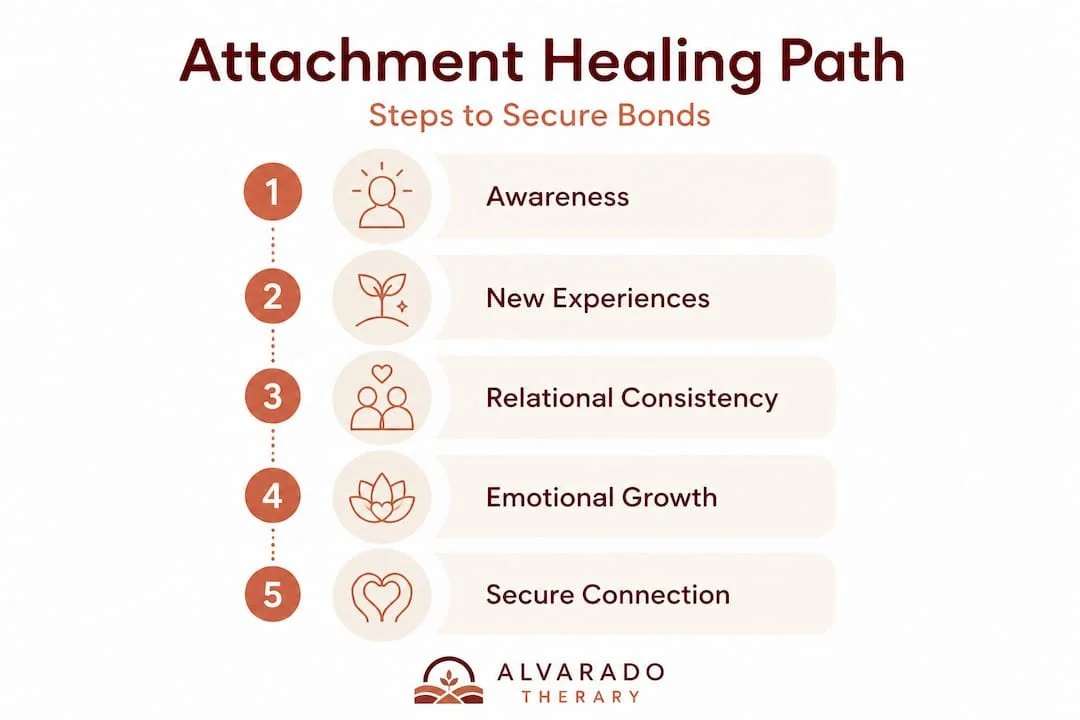
Clinical interventions rooted in attachment theory are designed to alter relational patterns for lasting change, not simply manage symptoms. That's a meaningful distinction. You're not just learning coping strategies. You're actually updating the nervous system's predictions about what relationships feel like.
Here are concrete pathways that support attachment healing:
Work with a trauma-informed therapist: The therapeutic relationship itself is a vehicle for change. A therapist who is consistent, attuned, and non-reactive gives your nervous system a new reference point for what safety feels like. Exploring therapy plans for trauma with a knowledgeable clinician is a strong starting point.
EMDR therapy: Eye Movement Desensitization and Reprocessing targets the stored memory networks where attachment-related fear and shame live. It doesn't require you to talk through every detail of past pain. It works at the level of how memories are processed and stored in the nervous system.
Build predictable, safe relationships: Healing doesn't only happen in therapy. Close friendships, mentoring relationships, or healthy romantic partnerships can all provide corrective relational experiences. The key is consistency and emotional safety.
Practice self-reflection: Journaling, mindfulness, and somatic practices can help you notice when old attachment patterns are activated, which is the first step to responding differently.
Follow a structured approach to anxiety: For people with anxious attachment, a step-by-step approach to anxiety relief can provide structure when the nervous system feels chaotic.
Understand trauma-informed frameworks: Learning what trauma-informed therapy actually means helps you ask better questions and advocate for the right kind of support.
Pro Tip: You don't need to find a perfect relationship to heal. Even one consistent, trustworthy person in your life, whether a therapist, a friend, or a partner, can begin to shift decades-old internal working models.
The timeline for attachment healing is not linear. Some people notice meaningful shifts in months. Others work through layers over several years. Both are normal. What matters most is that you stay in motion, not that you move fast.
What most resources miss about attachment theory and healing
Here's the uncomfortable truth most attachment theory content glosses over: labeling your attachment style can become its own trap.
Walk into any corner of wellness culture online and you'll find quizzes, infographics, and threads helping people identify whether they're "anxious," "avoidant," or "disorganized." The information isn't wrong. But the framing often is. When people use attachment style labels as permanent identity categories, they inadvertently create a story that forecloses change. "I'm anxiously attached" becomes "I'm just like this."
In clinical practice, the focus has shifted away from style as a fixed label and toward pattern as something fluid and context-dependent. Attachment patterns can vary across relationships and life circumstances. Someone might function securely in a long-term friendship but become anxiously activated in a romantic relationship. That's not inconsistency. That's how attachment actually works.
Understanding the relationship between trauma bonding and attachment is another area where popular summaries fall short. Trauma bonding is not just "loving someone who hurts you." It's a neurobiological response rooted in disorganized attachment dynamics, where threat and comfort become chemically tangled in the nervous system. Treating it as a simple choice to leave misses the depth of what's actually happening.
The most hopeful and honest thing we can tell you is this: incremental, relational change is real. Not dramatic overnight transformation. Not a new personality. But a gradually expanding capacity to tolerate closeness, ask for what you need, and trust that not every relationship will repeat the old pain. That's what healing actually looks like in practice, and it's worth every step of the work.
Get attachment-informed support for trauma and relationships
Understanding attachment theory is one thing. Having skilled support to work through it is another.
At Alvarado Therapy, our licensed therapists bring a trauma-informed, attachment-aware lens to every session. Whether you're working through complex trauma and PTSD, navigating difficult relationship patterns with the help of couples therapy, or ready to explore deeper healing through EMDR therapy, our team is here to meet you where you are. We offer care in English and Spanish, serving clients across Pasadena, Ventura, and throughout California via telehealth. Healing your attachment patterns is not a solo project. You don't have to figure it out alone.
Frequently asked questions
Is my attachment style permanent, or can it change over time?
Attachment patterns often shift throughout life with new relational experiences and therapy. Clinical interventions are specifically designed to alter relational patterns for lasting change, not treat attachment style as fixed.
How do I know which attachment style I have?
Patterns in your close relationships, such as chronic reassurance-seeking or difficulty with intimacy, often reveal your attachment style. Therapists use clinical tools such as interviews and self-report measures to assess attachment more precisely.
Can therapy help heal insecure attachment patterns from childhood?
Yes. Therapy that targets attachment-relevant processing can help you develop more secure relational patterns. Interventions targeting relational patterns are evidence-based approaches for exactly this kind of healing.
Is disorganized attachment always a sign of trauma?
Not exclusively. Disorganized attachment often emerges in contexts where the caregiver is both a source of comfort and fear, but other factors beyond trauma can also contribute to its development.
