
Cope Ahead for Anniversary Grief Reactions With Trauma Informed Steps

An anniversary reaction is a temporary return of grief or trauma symptoms around a meaningful date, and it's one of the most common, most misunderstood parts of loss. It doesn't mean healing has failed or stalled. It usually eases within a few weeks, and preparing for it in advance, what clinicians call "coping ahead," is often what makes the biggest difference.
TL;DR:
People with trauma history or sudden, traumatic losses tend to experience sharper, more intense anniversary reactions than those with anticipated grief.
Most anniversary symptoms, including emotional, cognitive, and physical signs, typically peak in the lead-up and resolve within a few weeks after the date.
Preparing in advance by scheduling support, lightening obligations, and creating rituals reduces the emotional impact of anniversaries effectively.
Trauma-focused therapies like EMDR and grief therapy can help reprocess triggers and prevent future distress during anniversary periods.
Signs indicating professional help is needed include persistent or worsening symptoms beyond three weeks, suicidal thoughts, or physical symptoms that disrupt daily functioning.
Table of Contents
What Does an Anniversary Reaction Feel Like, and How Long Does It Last?
When Should You Get Professional Help for Anniversary Grief?
How Do You Mark an Anniversary and What Do You Say to Someone Grieving?
What Alvarado Therapy Sees in Clients Facing Grief Anniversaries
What Is an Anniversary Reaction, and Who Gets Them?
Clinicians define an anniversary reaction as a resurgence of grief or trauma symptoms tied to a date carrying emotional weight, most often the date someone died, but not only that. The VA National Center for PTSD notes the trigger list is broader than most people expect: birthdays, wedding anniversaries, holidays, the first day of a season the person loved, even a smell or a song tied to the event can set off the same cascade.
The reaction shows up most intensely in two groups. People grieving a sudden or traumatic death (accident, overdose, violence, suicide) tend to have sharper reactions than those grieving an anticipated loss after a long illness. And anyone with a trauma history, including PTSD from combat, abuse, or a violent crime, often experiences anniversaries of the traumatic event itself, not just death dates.
Common triggers include:
The exact date of death, diagnosis, or the traumatic event
Birthdays and wedding anniversaries involving the deceased
Major holidays, especially the first ones after a loss
Seasonal cues (first snow, back to school, a particular smell or song)
News coverage of similar events, for public tragedies or mass violence
Milestone dates like "one year since" or "five years since"
Divorce anniversaries, the date a family lost a home, and the date of a diagnosis all follow the same pattern, even though they don't involve death. Grief researchers increasingly treat these as variations of the same phenomenon rather than separate categories.
What Does an Anniversary Reaction Feel Like, and How Long Does It Last?
Symptoms cluster into four groups, and most people experience some combination rather than all of them. Emotionally, expect renewed sadness, sudden tearfulness, irritability, or a flat numbness that feels like the early days of grief again. Cognitively, intrusive thoughts and replaying memories of the loss are common, along with trouble concentrating.
For people with a trauma history, the reaction can escalate further: flashbacks, panic attacks, dissociation, or a spike in hypervigilance. Physically, the VA and other clinical sources describe fatigue, chest tightness, sleep disturbance, and disorientation as common companions.
Emotional: sadness, irritability, numbness, sudden crying
Cognitive: intrusive memories, poor concentration, disorientation
Trauma-specific: flashbacks, panic attacks, dissociation, hyperarousal
Physical: fatigue, chest tightness, headaches, disrupted sleep
Timing follows a fairly consistent arc. Symptoms often begin in the anticipatory period, days or even weeks before the actual date, and that lead-up window is frequently harder than the day itself. A 2025 integrative systematic review covering 58 studies found this anticipatory buildup and post-date recovery pattern consistently documented across case reports, qualitative interviews, and quantitative research.
Quick fact: Most anniversary reactions recede within a few weeks of the date, according to the VA National Center for PTSD. If distress persists well beyond that window or escalates instead of settling, it's worth a closer look with a professional.
Why Do Anniversaries Hit So Hard?
The mechanism isn't mysterious once you understand how memory works. Your body encodes trauma and loss with a kind of temporal marker, not just what happened, but roughly when. A 2025 clinical review describes this as temporal indexing in procedural memory: the nervous system flags a calendar window as significant, and as that window approaches, your body responds as if the threat or loss is happening again, even without a conscious trigger.
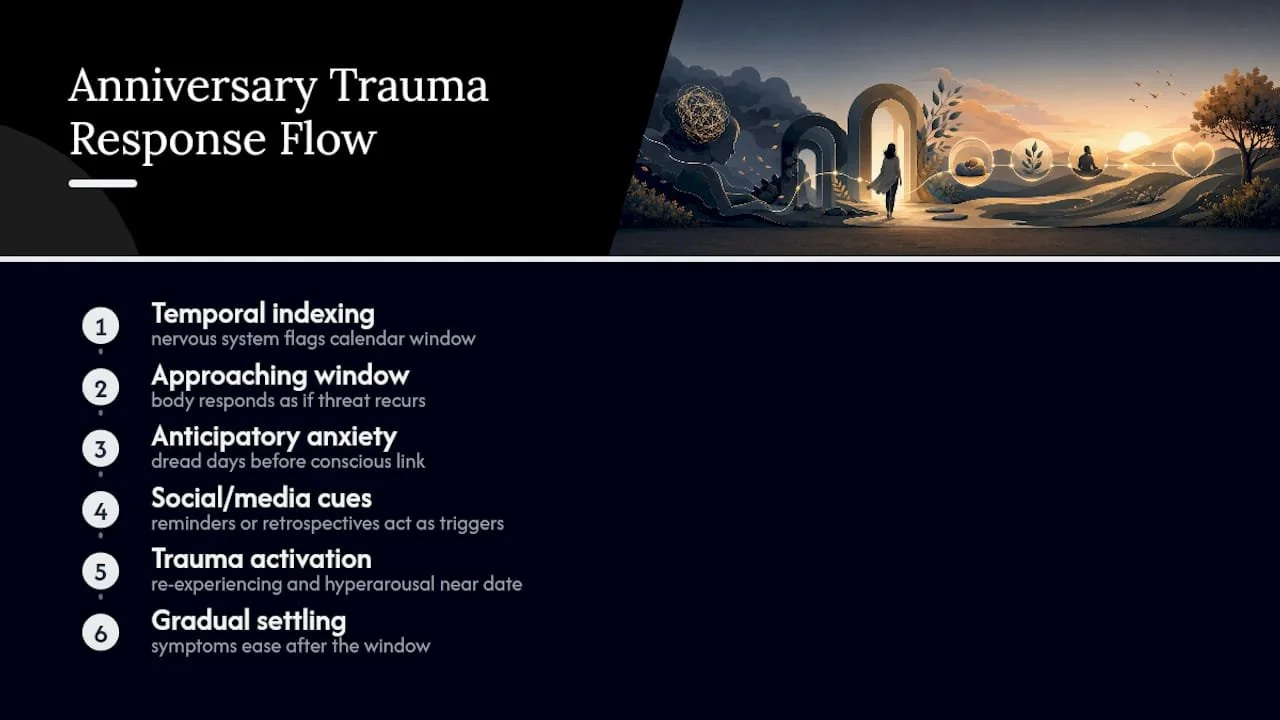
That's why people often feel dread or unease for days before they consciously connect it to the date. Anticipatory anxiety then compounds the problem. Once you notice you're anxious, your mind starts scanning for reasons, and it finds them, amplifying normal stress into something that feels unmanageable.
Social rituals and media coverage add another layer. Public tragedies get news retrospectives; personal losses get calendar reminders from social media, or family members calling to check in, which is caring but also a trigger in itself. For people without trauma involved, the reaction tends to stay in the emotional and cognitive lanes: sadness, memory, low mood.
For people with trauma histories, the anniversary can reactivate the body's threat response directly, producing re-experiencing symptoms and hyperarousal that feel closer to the original event than to ordinary grief. This is a key reason trauma-informed approaches matter: the treatment target isn't just sadness, it's a nervous system still bracing for a wound that already happened.
How Do You Cope With a Grief Anniversary?
The strongest tool available is preparation, not willpower. Waiting to see how the day feels and reacting in real time tends to produce worse outcomes than deciding ahead of time how you'll handle it.
In the weeks before the date:
Mark the date on your calendar and tell one or two trusted people it's coming, so you're not managing it alone or explaining yourself in the moment.
Reduce obligations that week if you can. Move non-essential appointments, skip optional social commitments, and lighten your own expectations.
If you're in therapy, mention the date to your clinician ahead of time so you can plan extra support or a check-in session.
Decide in advance whether you want to mark the day with a ritual, spend it quietly, or keep it as ordinary as possible. There's no wrong answer, but deciding beats deciding in the moment.
Line up a grounding toolkit: a playlist, a photo, a specific person you can call, a breathing exercise you already know works for you.
On the day itself, lean on sensory anchors rather than trying to think your way through the distress. Paced breathing (four counts in, six counts out) calms the nervous system faster than most people expect. Grounding techniques, naming five things you can see, four you can touch, three you can hear, pull attention out of intrusive memory loops and back into the present. Limit news and social media that day if the loss involves public tragedy or if scrolling tends to spiral you. A short ritual, lighting a candle, visiting a place, reading a letter, gives the day structure instead of letting it feel formless and endless.
In the days after, expect a comedown, not an instant return to normal. Rest matters more than pushing through. Resume your routine gradually rather than all at once, and if you promised yourself extra support that week, actually use it instead of deciding you're fine now that the date has passed.
Pro Tip: If trauma symptoms show up (flashbacks, panic, dissociation) rather than straightforward sadness, scale your supports up accordingly: book a clinical check-in before the date rather than after, and treat grounding skills as a daily practice that week, not a last resort.
When Should You Get Professional Help for Anniversary Grief?
Most anniversary reactions are self-limiting, uncomfortable but temporary, and resolve without intervention. A smaller set of warning signs signal it's time to bring in a professional rather than wait it out.
Thoughts of suicide or self-harm, at any intensity, need immediate professional attention.
Distress that doesn't ease within two to three weeks after the date, rather than gradually improving.
Escalating avoidance that starts interfering with work, relationships, or daily functioning.
Physical symptoms severe enough to disrupt sleep, appetite, or basic function for an extended stretch.
A sense that this year's reaction is markedly worse than previous years rather than following the usual pattern.
On the treatment side, several approaches have solid evidence behind them for anniversary-related distress. Grief-focused therapy and Complicated Grief Treatment target the loss itself and how the mind organizes the story of what happened. Cognitive behavioral approaches help interrupt the anticipatory anxiety spiral before it escalates. EMDR is particularly useful when trauma symptoms (flashbacks, hyperarousal, dissociation) are part of the picture, since it targets the way the nervous system stores the memory rather than only the narrative around it. If you're trying to distinguish a normal anniversary reaction from something more entrenched, signs of complicated grief is worth a read. Telehealth has made trauma-informed grief therapists far easier to reach regardless of location, and crisis lines remain available around the clock if distress becomes acute.
How Do You Mark an Anniversary and What Do You Say to Someone Grieving?
Rituals work because they give grief a container instead of letting it spread formlessly across the whole day. Writing a letter to the person you lost, sharing a meal that was meaningful to them, visiting a specific place, or making a donation in their name are all common, low-effort ways to mark the date with intention rather than dread.
Write or read a letter addressed to the person you lost
Share a meal or dish that carried meaning for them
Visit a meaningful place, a grave, a park, a home
Make a donation or small gesture in their memory
Light a candle or hold a brief moment of quiet reflection
A thoughtfully chosen memorial gift can also anchor a ritual for family members who want something tangible to hold onto each year.
If you're not sure what to say to someone on a grief anniversary, keep it simple and specific rather than vague.
If you're the one grieving and need to ask for support, a direct request works better than hoping someone notices:
What Alvarado Therapy Sees in Clients Facing Grief Anniversaries
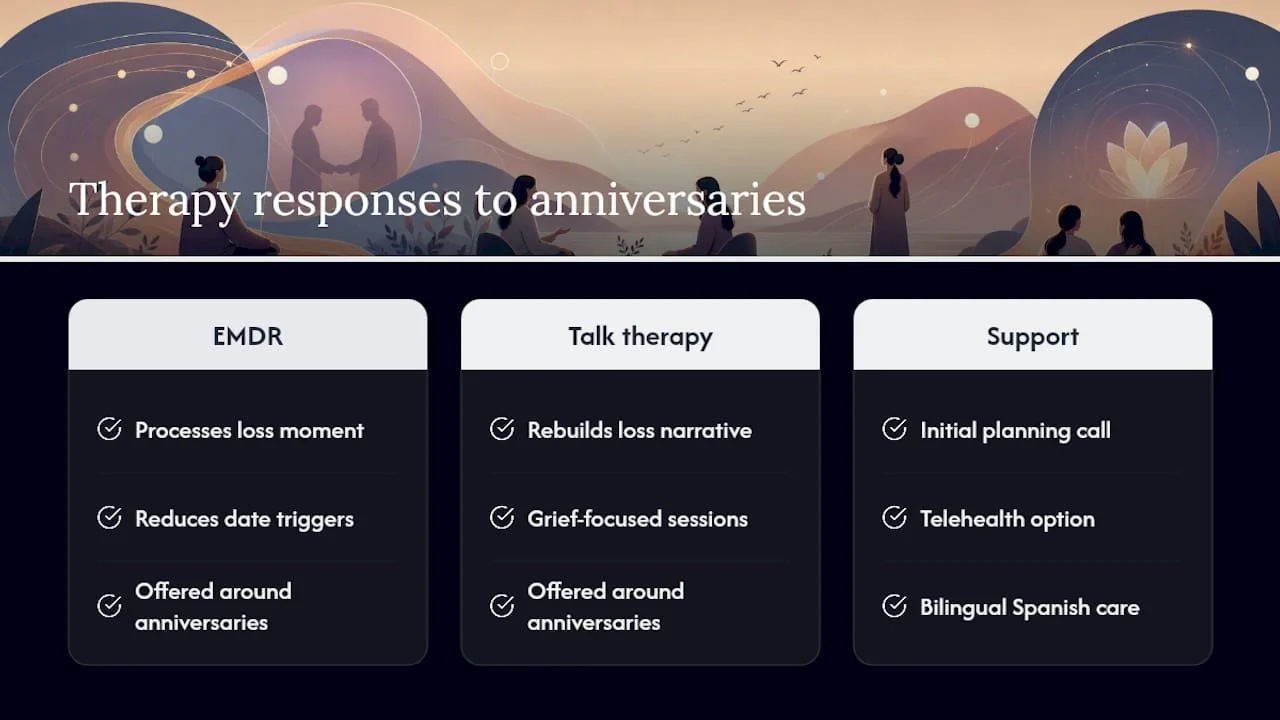
Working with clients through repeated grief anniversaries makes one thing clear: the anticipatory dread is almost always worse than the day itself, which matches what the research on temporal conditioning describes. EMDR gives the nervous system a way to process the specific moment of loss so the date stops functioning as a live trigger, while grief-informed talk therapy helps rebuild the narrative around what happened.
Clients reaching out around an anniversary can expect a straightforward first step: a conversation about what's coming up, what's worked or hasn't in past years, and a plan that might include EMDR, grief-focused sessions, or both. Telehealth sessions help provide support without adding a commute to an already heavy week, and bilingual care is available for Spanish-speaking clients who want to work in their first language
A Reflection on Sitting With Anniversary Grief
Clinicians who work with grief for any length of time notice a pattern: clients often apologize for "still" feeling something years later, as if there's a deadline on missing someone. There isn't. One clinician's observation that stuck with us: a client who'd lost a parent a decade earlier described the tenth anniversary hitting harder than the fifth, not because healing had reversed, but because the milestone number itself carried new weight.
A useful sentence to borrow for yourself: "This feeling doesn't mean I'm broken or behind. It means the date still matters, and that's allowed." Self-compassion on these days isn't indulgence. It's the accurate response to something genuinely hard.
— Juiced
Get Support Before Your Next Grief Anniversary
Alvaradotherapy gives you a way to prepare for a hard date with an actual plan instead of just hoping this year feels different. Unlike waiting until distress peaks to look for a therapist, working with a trauma-informed clinician ahead of a known anniversary means the coping-ahead strategies covered here, grounding tools, session timing, ritual planning, get built with someone who treats grief and trauma daily.
Grief counseling, EMDR for trauma-related anniversary reactions, and individual therapy are available through telehealth, with care offered in English and Spanish. If trauma symptoms like flashbacks or hyperarousal are part of your reaction, the PTSD and complex trauma page outlines how EMDR is used for exactly this. If you're not sure what a first session looks like, what to expect walks through the process before you book. Reach out now to schedule a consultation ahead of your next difficult date, not after it's already passed.
Sources
This article is general information, not a substitute for advice from a qualified doctor. Consult a qualified healthcare professional about your own circumstances before acting on anything here.
