
Boost Alliance: Build Cultural Humility in Your Clinic (r = 0.66)

Cultural humility in therapy is a lifelong, reflective stance in which clinicians acknowledge power imbalances, treat clients as the expert on their own lives, and keep learning rather than assuming mastery. A meta-analysis found a strong correlation between cultural humility and therapeutic alliance, along with a moderate correlation with better psychotherapy outcomes overall. It benefits therapists and clients across every racial, ethnic, religious, and identity background.
TL;DR:
Consistently practicing self-reflection and maintaining curiosity about a client's identity improves trust and cooperation, which correlates with better therapy outcomes.
Incorporating ongoing reflexivity routines and institutional policies ensures cultural humility becomes a standard, rather than a one-time effort.
Building trust early by introducing humility practices can lead to stronger alliance and more effective treatment, especially when cultural or language differences are involved.
Using brief, repeatable tools like cultural formulation worksheets and reflexivity logs enhances clinicians' awareness without overwhelming session flow.
Interpreted sessions require deliberate preparation, direct client engagement, and plain-language materials to prevent alliance ruptures caused by language gaps.
Alvaradotherapy
Find Culturally Responsive Therapy
Alvarado Therapy offers bilingual, culturally responsive mental health care in English and Spanish across California, including online sessions.
Table of Contents
Key Components: What Cultural Humility Looks Like in Session
Cultural Humility vs. Cultural Competence: The Real Difference
Weaving Cultural Humility Into Treatment Plans and Progress Tracking
What Cultural Humility in Therapy Actually Means
Cultural humility is a process, not a credential. Psychologists Melanie Tervalon and Jann Murray-García coined the term in 1998 to describe an ongoing practice built on three pillars: self-reflection, a genuine commitment to power-sharing, and lifelong learning rather than a fixed body of knowledge you complete once and file away. The framework treats the client as the authority on their own experience, which flips the traditional clinical hierarchy on its head.
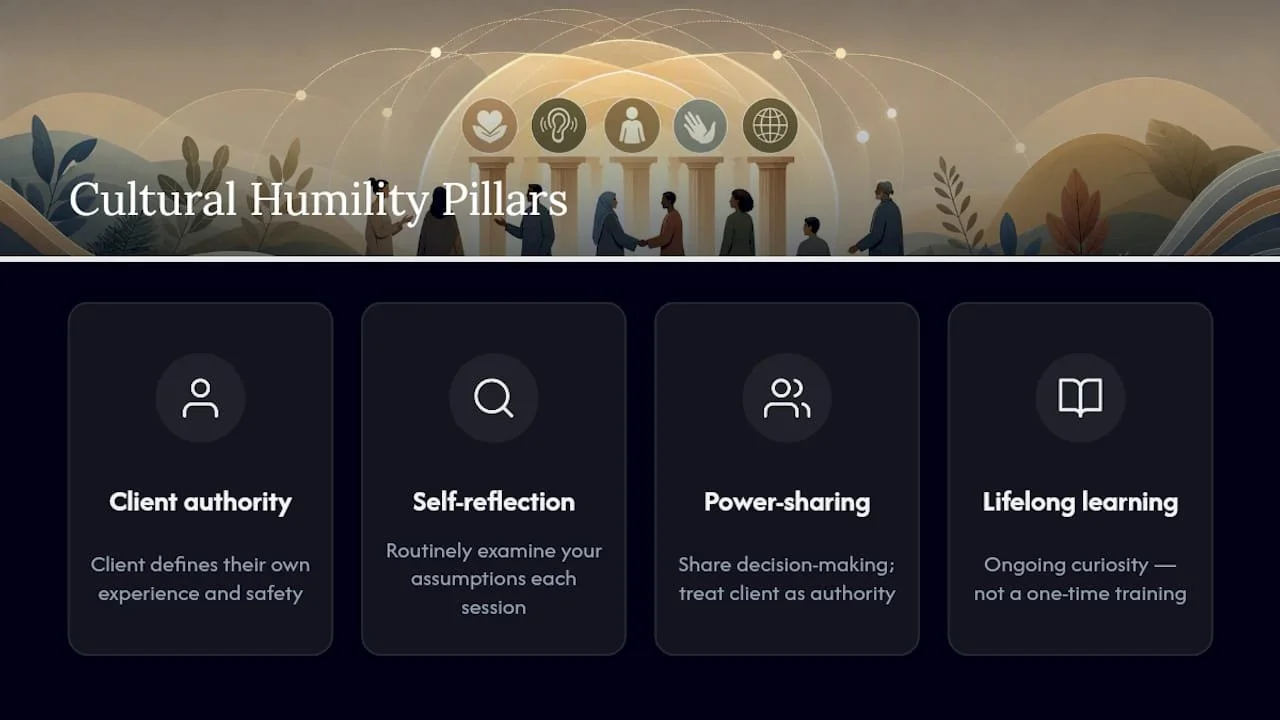
That process orientation matters clinically because a one-time diversity training does not change behavior the way ongoing reflexivity does. A clinician who attends a single seminar on, say, Latino family dynamics can walk away with a mental checklist that gets applied to every client who shares that background, regardless of how that individual actually relates to their culture, religion, or family structure. Research on multicultural counseling has flagged this exact failure mode: content-heavy training can accidentally teach stereotyping instead of preventing it. Cultural humility asks something harder and more durable: stay curious, stay uncertain, and let the client correct you.
This connects directly to person-centered and trauma-informed models that most trauma clinicians already practice. Trauma-informed care insists that the client sets the pace and defines what safety means for them. Cultural humility extends that same logic to identity: the therapist does not arrive with a fixed map of what a client's ethnicity, gender, faith, or immigration history "means" for treatment. Reflexivity here means routinely asking yourself where your own assumptions might be steering the session, not just once during graduate training but in every intake, every rupture, every plan for termination.
One useful reframe: cultural humility is what happens when a clinician treats every client's identity as something to be discovered collaboratively rather than diagnosed from the outside.
Key Components: What Cultural Humility Looks Like in Session
Self-reflection has to be structured or it turns into good intentions with no follow-through. Practical routines include supervision prompts specifically about identity dynamics in the room, a short reflective journal entry after sessions involving cultural rupture or unfamiliar territory, and periodic use of tools like the Implicit Association Test to surface biases you would not name on your own. The IAT is a self-awareness exercise, not a diagnostic instrument, and it should never be weaponized against clients or used to "prove" a clinician is unbiased.
Valuing client expertise shows up in small, repeatable behaviors: setting treatment goals collaboratively instead of importing a standard template, asking how a client wants terminology used (for their identity, their family structure, their pronouns), and explicitly asking consent before exploring cultural or religious material rather than assuming it is fair game.
Institutional behavior matters just as much as individual habit. A clinic demonstrates cultural humility through:
Hiring practices that build a genuinely multilingual, multi-identity clinical team
Continuing education choices that favor practice-based training over lecture-only seminars
Waiting room materials and intake forms available in multiple languages
Interpreter access built into scheduling, not treated as an afterthought
Effective allyship requires more than stated values. It needs authentic motivation, consistent action, and accountability when mistakes happen. Without that, allyship becomes performative, which clients tend to notice and which can damage the relationship faster than saying nothing at all.
Pro Tip: Keep a running "curiosity log" for a month, a private note of every moment you caught yourself assuming rather than asking. Review it in supervision. The pattern that emerges is usually more instructive than any single training module.
Cultural Humility vs. Cultural Competence: The Real Difference
Cultural competence, as originally taught, framed diversity as a body of facts to master: learn the norms of a given group, check the box, move on. Cultural humility rejects the premise that any clinician can achieve mastery over an entire culture, because cultures are not monolithic and individuals within them vary enormously. The shift from competence to humility is a shift from content to process, from "I know about this group" to "I stay curious about this person."
Cultural safety, a related concept from Indigenous health scholarship, adds another layer: it centers the client's subjective experience of whether an interaction felt respectful and non-harmful, judged by the client rather than the clinician. Cultural sensitivity in counseling, meanwhile, usually refers to a baseline awareness that differences exist and matter. Humility sits above both, functioning as the ongoing discipline that keeps sensitivity from calcifying into assumption and keeps safety from becoming a static certification.
None of this means existing competence training is worthless. Programs that pair didactic material on CLAS standards with hands-on components, like structured interviewing practice, tend to produce clinicians who carry humility into real sessions far more reliably than lecture-only formats. The fix is not abandoning content but restructuring how it is delivered, with reflection and practice built in rather than bolted on.
What the Research Says About Alliance and Outcomes
A 2024 systematic review and meta-analysis found that therapist cultural humility correlates strongly with therapeutic alliance at r = 0.66, a substantial relationship by clinical research standards, and with psychotherapy outcomes at r = 0.39. Both figures come from pooled data across the reviewed studies, with alliance showing the tighter confidence interval and the more consistent signal.
Therapist cultural humility correlates with therapeutic alliance at r = 0.66 and with treatment outcomes at r = 0.39, according to the 2024 systematic review and meta-analysis.
That gap between the two numbers tells its own story. Humility appears to do its strongest work by building trust and connection first; outcome improvement follows, but more modestly and likely through several intermediate steps, like a client staying in treatment longer or disclosing more honestly.
The evidence has real limits worth naming honestly:
Studies in the review used different measures of humility, from self-report scales to client ratings, which introduces heterogeneity into the pooled numbers.
Randomized controlled trials isolating cultural humility as the sole intervention variable remain scarce, so causation is harder to pin down than the correlation strength suggests.
Most measurement tools were developed and validated primarily in American clinical settings, which limits how confidently the findings generalize elsewhere.
A separate study indicates that introducing culturally humble practices early in treatment, rather than retrofitting them later, produces stronger improvement. The practical takeaway for any clinician deciding where to invest limited training time: alliance-building through humility is not a soft add-on. It is one of the more reliably supported levers available for improving outcomes across identity differences.
How to Build Cultural Humility Into Your Practice This Week
Session-level change starts with language, not overhaul. Try opening intakes with a genuinely open-ended question like "What should I understand about your background or identity to support you well?" rather than a checklist of demographic boxes. Build a brief cultural check-in into treatment plan reviews, and negotiate the session agenda collaboratively rather than dictating it.
Ask before assuming. Replace "I understand that in your culture..." with "Can you tell me what that means for you specifically?"
Book a recurring supervision slot dedicated to identity dynamics, not just crisis cases.
Curate continuing education around practice-based formats, not passive lecture credits. Alvaradotherapy's own inclusive mental health resources collect reading and training starting points for exactly this.
Consult your community when facing unfamiliar territory. A five-minute call with a colleague who shares a client's background beats guessing.
Name ruptures directly. If a client signals that something landed wrong, a specific, timely acknowledgment followed by a negotiated repair step protects the alliance far better than silence or over-apologizing.
Clinic-level policy carries as much weight as individual habit. The CLAS standards from the U.S. Department of Health and Human Services Office of Minority Health give a structured framework for language access, workforce diversity, and organizational accountability, and clinics can use them to audit intake forms, interpreter workflows, and documentation practices rather than leaving humility to individual goodwill.
Pro Tip: When a rupture happens, resist the urge to explain your intent first. Acknowledge the impact before you defend the intention. Clients remember which order you chose.
Repair deserves its own emphasis because it is where performative allyship gets exposed. A therapist who apologizes vaguely and moves on signals that the relationship's comfort matters more than the client's experience. A therapist who names the specific misstep, asks what repair would look like, and follows through demonstrates the accountability that separates real allyship from a talking point.
Clinical Tools That Support Cultural Humility
The DSM-5 Cultural Formulation Interview offers sixteen structured questions exploring a client's cultural identity, their explanatory model of distress, and psychosocial stressors tied to culture. Full administration takes time most intakes do not have, so many clinicians adapt it into a short-form version, pulling four or five questions that fit the presenting concern rather than running the entire protocol.
CLAS standards work best as a clinic-wide policy document rather than an individual clinician's checklist. They shape intake paperwork, language-access commitments, and staff training requirements at the organizational level.
The IAT and similar reflexivity exercises belong in the clinician's own development, never in the client's chart. Recent frameworks for operationalizing cultural humility recommend brief, repeatable tools over lengthy one-time assessments:
A short cultural formulation worksheet completed at intake and revisited at key treatment milestones
A private clinician reflexivity log, reviewed in supervision rather than shared with clients
A one-page interpreter briefing sheet used before every triadic session
The common thread across all three: brevity and repetition beat comprehensiveness and one-time use.
Working Across Language Differences With Interpreters
Sessions involving an interpreter require deliberate structure or the clinical relationship can drift toward the interpreter instead of the client. A short pre-session briefing should cover the session's purpose, any sensitive topics likely to arise, and confidentiality expectations, all agreed upon before the client enters the room.
During the session, keep eye contact and questions directed at the client, not the interpreter, even though the response arrives secondhand. This maintains the therapeutic relationship as primary rather than letting the interpreter become the de facto conversational partner. A few habits make triadic sessions run more smoothly:
Brief the interpreter on session goals and sensitive content beforehand
Speak directly to the client using first-person phrasing ("How are you feeling," not "Ask her how she's feeling")
Slow your pace and shorten sentences so meaning survives translation intact
Confirm understanding with the client directly, not by assuming accurate transmission
Use plain-language materials for limited-English-proficiency clients rather than translating dense clinical jargon verbatim
Interpreter access should be treated as a clinical necessity, not a scheduling inconvenience, since language mismatch without support is one of the fastest routes to alliance rupture.
Weaving Cultural Humility Into Treatment Plans and Progress Tracking
Treatment goals land better when they reflect how the client themselves explains their distress, not just a diagnostic label. Ask directly what the client believes caused their symptoms and what recovery would look like in their own terms, then build the plan around that explanatory model alongside standard clinical criteria.
Measurement does not need to be elaborate. A brief alliance measure administered every few sessions, paired with one or two targeted questions like "Have you felt understood in terms of your background this week?" gives a clinician real-time signal about whether humility is landing as intended, rather than waiting for a rupture to surface the problem.
Evidence-based treatments still matter and should not be discarded in the name of cultural adaptation. The better question is when to adapt delivery, pacing, or framing versus when a client's presentation calls for consultation or referral to a clinician with more specific cultural or linguistic fluency. Alvaradotherapy's writing on trauma recovery approaches in California walks through how that adaptation looks in practice for trauma-focused work specifically.
A Working Clinic's View on Practicing This Daily
Cultural humility sounds abstract until it shows up in something as ordinary as an intake form. Bilingual English and Spanish intake across some practices means the question of language access is not theoretical. It shapes which clinicians see which clients, how consent forms get written, and how EMDR intensives get explained to someone whose first language is not English.
Trauma-informed work and cultural humility overlap more than most training programs acknowledge. A client processing immigration-related trauma, for example, is not just navigating PTSD symptoms in the clinical sense. They are navigating a legal system, a cultural displacement, and often a language gap, all at once. Immigration psychological evaluations require the kind of explanatory-model listening described earlier: understanding how a client frames their own experience before mapping it onto a clinical or legal framework.
None of this claims perfection. Cultural humility is a practice clinicians return to, not a certification a clinic earns once. Readers working through their own identity and trauma history, or clinicians building out training programs, can find more on identity-affirming approaches in Alvaradotherapy's writing on identity-affirming therapy in California.
— Juiced
Getting Started With Culturally Responsive Trauma Care
Trauma treatment works better when it fits the client’s actual identity and history rather than a one-size-fits-all template. That means bilingual English and Spanish therapy delivered by clinicians who treat language access as standard practice rather than a special accommodation, EMDR sessions and intensives designed around each client's story, and immigration psychological evaluations that take a client's cultural and legal context seriously from the first conversation.
If you are wondering what a first session actually involves, the what to expect page walks through the process for online EMDR trauma therapy across California and New York, so there are no surprises before you book. Clients working through PTSD or complex trauma can also review the dedicated trauma treatment page to see how EMDR fits their specific situation. Sessions run online throughout both states, which matters for anyone balancing work, caregiving, or limited local access to bilingual, identity-affirming clinicians. Book a first session or request a consultation to start the conversation on your own terms.
Sources
For deeper study, the 2024 systematic review and meta-analysis on cultural humility and therapeutic alliance remains the strongest quantitative anchor available. The foundational paper on shifting from cultural competence to cultural humility lays out the conceptual case in full, and the 2025 work on operationalizing cultural humility offers the most concrete tools for translating theory into intake forms and session structure. Alvaradotherapy's blog on cultural competence and outcomes rounds out the practical side with clinic-level examples.
This article is general information, not a substitute for advice from a qualified doctor. Consult a qualified healthcare professional about your own circumstances before acting on anything here.
Rethinking Cultural Competence: Shifting to Cultural Humility
Operationalizing cultural humility in clinical practice: tools and practical frameworks
