
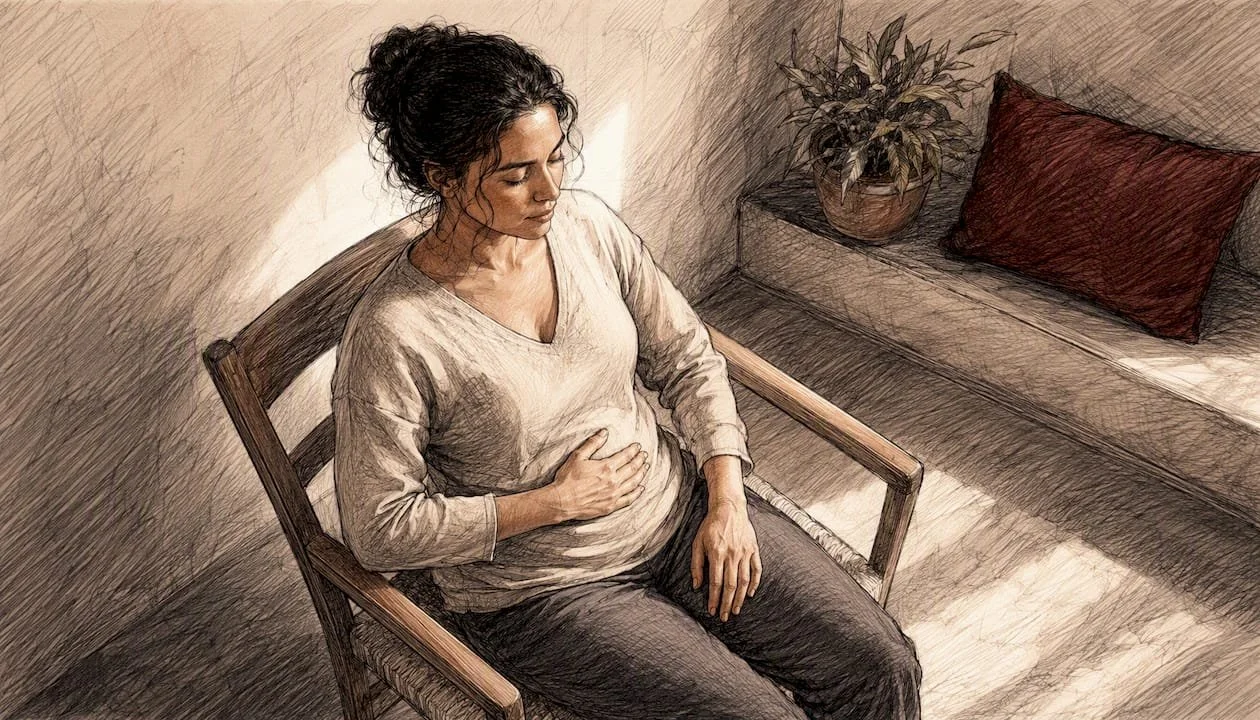
When anxiety spikes, three moves work faster than anything else: the physiological sigh, a low hum or "voo" sound, and a slow orienting scan of the room. Each one can shift your body's state within 30 to 90 seconds by signaling safety to your nervous system. Stop and check in with a professional if you feel faint, dizzy, or more disconnected instead of feeling calmer.
TL;DR:
Breathing techniques like physiological sighs and extended exhales can reduce acute anxiety within 30 seconds to a few minutes by slowing heart rate and calming the nervous system.
Vocal sounds such as humming or voicing "voo" engage the vagus nerve through muscles in the throat and inner ear, promoting relaxation, especially when kept at a moderate volume.
Slow, deliberate eye and head movements, along with grounding exercises like affirmations or touching the floor, help interrupt threat-detection loops and reinforce present-moment awareness.
Movement activities such as outdoor walking, gentle yoga, or progressive muscle relaxation discharge stored stress hormones, aiding in longer-term regulation of chronic anxiety.
Cold exposure, like splashing cold water on the face or gargling, triggers the mammalian dive reflex and slows the heart rate, but should be approached cautiously by individuals with cardiac or autonomic conditions.
Alvaradotherapy
Find Support for Anxiety and Trauma
Alvarado Therapy offers trauma-informed counseling and EMDR therapy for anxiety, trauma, grief, and relationship difficulties across California.
Table of Contents
Why Polyvagal Exercises Work for Anxiety
Your nervous system is constantly scanning for danger below the level of conscious thought. Stephen Porges, who developed polyvagal theory, called this scanning process neuroception. It happens through tone of voice, facial expression, posture, and breath, long before you consciously decide you're anxious.
Anxiety often reflects a nervous system stuck in sympathetic activation (fight or flight) or, less often, a dorsal vagal shutdown (numbness, collapse, dissociation). Polyvagal exercises for anxiety work by feeding your body cues that contradict the danger signal:
Slow exhales tell your heart rate to drop.
Low-pitched sounds vibrate the muscles around your inner ear and throat, which link directly to the vagus nerve.
Visual scanning of a calm environment interrupts threat-scanning loops.
Movement discharges the physical buildup of stress hormones.
These techniques are coping tools, not cures. Popular regulation practices like breathing drills and cold exposure help people tolerate distress in the moment by engaging the vagus nerve to slow heart rate and respiration, but they don't resolve the deeper drivers of chronic anxiety or trauma. If your anxiety is persistent or trauma-linked, exercises work best alongside therapy, not instead of it.
Breathwork Techniques: Sigh, Extend, and Resonate
Breath is the fastest lever you have over your autonomic state, and three specific patterns cover almost every situation you'll face.
The physiological sigh is the quickest tool in this entire guide. Stanford Lifestyle Medicine researchers point to it as one of the fastest downregulation methods available, often working within 30 seconds.
Take a normal inhale through your nose.
Before exhaling, sneak in a second, smaller inhale on top of it.
Release a long, slow exhale through your mouth, longer than the two inhales combined.
Repeat two or three times.
Use this the moment you notice your chest tightening or your thoughts racing. It's discreet enough to do in a meeting or a waiting room.
Extended-exhale breathing works better as a three-minute reset when you have a little more time. Inhale for a count of four, exhale for a count of six to eight. The longer exhale activates the parasympathetic brake. Do ten to twelve rounds, seated, with your shoulders dropped and your hand resting on your belly so you can feel it rise.
Resonance breathing paces your breath at roughly five to six breaths per minute, a rate associated with peak heart-rate variability. Inhale for five seconds, exhale for five seconds, no holding. This is less about crisis relief and more about training your baseline over weeks.
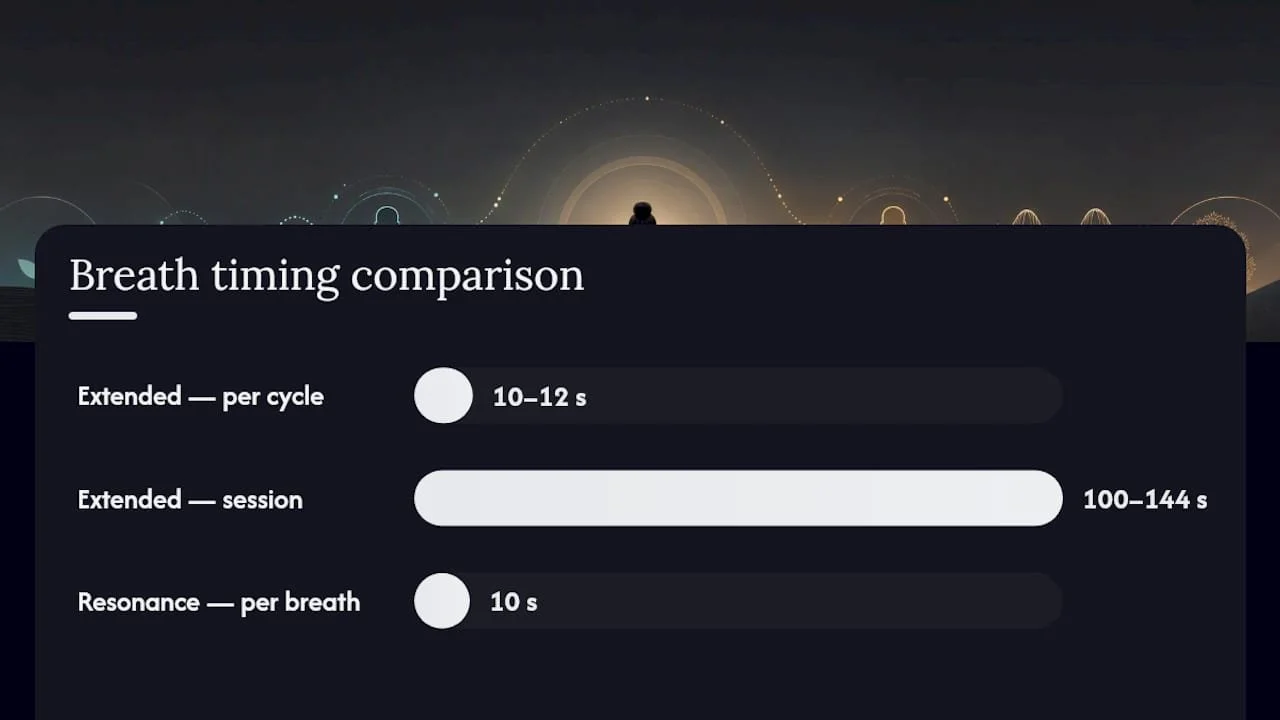
Pro Tip: If extended exhales make you lightheaded, shorten the exhale count and add a brief pause instead of forcing a longer breath. Dizziness during breathwork is a sign to ease off, not push through.
Humming, Voo Sounds, and Vocal Vagal Stimulation
Your vocal cords, throat muscles, and inner ear all sit along the path of the vagus nerve. Sound is one of the most reliable, low-effort ways to reach it.
Sit upright, relax your jaw, and hum at the lowest comfortable pitch for 20 to 30 seconds.
Try the "voo" sound: inhale, then exhale slowly while voicing "vooooo" from your belly, like a foghorn, not a whisper.
Gargle water for 20 to 30 seconds, which stimulates the same throat muscles from a different angle.
Sing along to one verse of a song at a comfortable volume, favoring lower notes over high ones.
Keep the volume moderate. A quiet, steady hum reaches the vagus nerve more reliably than a loud or high-pitched sound, which can tip you back toward activation instead of calm. If you're regulating with another person nearby, a warm, slow-paced voice, yours or theirs, does double duty: it calms you and signals safety through co-regulation.
Pro Tip: Record yourself humming a slow, low tone and keep the clip on your phone. Playing it back during a spike can work even when you don't feel like making the sound yourself.
Orienting and Grounding: How Do You Calm Your Body Fast?
Slow orienting works because it directly counters the rapid, darting eye movements your brain uses when scanning for threat.
Pause and let your eyes move slowly around the room, left to right, without fixing on anything.
Notice three neutral or pleasant details: a color, a shape, a texture.
Let your head and neck turn along with your eyes rather than staying rigid.
Take one slow breath as you finish the scan.
This takes under a minute and works in a car, an office, or a waiting room.
The 5-4-3-2-1 technique is a faster, more discreet cousin of orienting. Silently name five things you see, four you can touch, three you hear, two you smell, and one you taste. You can do the whole sequence without moving or speaking, which makes it useful in public settings where slow scanning might draw attention.
For body-based grounding, press your feet flat into the floor and notice the contact point for ten seconds. A gentle rocking motion, side to side or front to back, mimics the soothing rhythm of being held. Naming the room you're in out loud or silently ("I am in my kitchen, it is Tuesday") reinforces present-moment orientation when anxiety pulls you into anticipatory thinking. A guide on self-soothing techniques that calm your body fast walks through several more of these in detail.
Movement-Based Exercises to Discharge Stress
Sympathetic activation prepares your body to run or fight. If that energy has nowhere to go, it lingers as jitteriness, tension, or a racing mind.
A brisk ten-minute walk, ideally outdoors, gives that stored energy somewhere to go and helps your body register the stressor as "handled."
Gentle yoga sequences that pair movement with breath, like cat-cow or slow forward folds, work well when done within a comfortable range of motion rather than pushed for intensity.
A short version of progressive muscle relaxation, tensing each muscle group for five seconds and releasing, moving from feet to face, takes about five minutes and works well before sleep.
If you have a trauma history, skip exercises that ask you to hold tension in your throat, chest, or jaw for long periods. Shorten hold times and stay seated if standing feels exposed.
Relaxation-response practices like these, deep breathing, gentle movement, and physical activity, are tied to measurable improvements in physiological stress recovery.
Cold Exposure and Gargling for Fast Parasympathetic Signals
Cold application triggers the mammalian dive reflex, an old physiological response that slows your heart rate the moment cold water touches your face.
Splash cold water on your face or hold a cold, damp washcloth against your cheeks and forehead for 15 to 30 seconds.
If you're using an ice pack, wrap it in a thin cloth first and limit contact to 30 seconds at a time.
Gargle cold water vigorously for 20 to 30 seconds as a gentler alternative that still stimulates throat muscles connected to vagal pathways.
Keep your head upright or slightly forward during cold-face exposure rather than tilting back.
These practices help people tolerate acute distress by slowing heart rate and breathing through direct vagal engagement, but they aren't appropriate for everyone. Skip cold-water immersion if you have a cardiac condition, a seizure disorder, or severe dysautonomia. A brief cold splash to the face is usually gentler than full immersion and a reasonable starting point if you're unsure how your body will respond.
How to Titrate Practice and Know When to Stop
Going all in on these techniques can backfire, especially for anyone with a trauma history or an autonomic nervous system that's already sensitive.
Start with 30 to 60 seconds of any single exercise, not a marathon session.
Build up gradually over days or weeks rather than stacking five techniques in one sitting.
Anchor new practices to something you already do, like brushing your teeth or waiting for coffee to brew, so they become automatic rather than another task to remember.
Stop immediately if you feel fainting, a racing heart that won't settle, or a growing sense of disconnection from your body.
People with dysautonomia or seizure risk should be especially cautious with breath-holds or cold exposure, since aggressive versions of either can provoke orthostatic symptoms or seizure activity in vulnerable people.
If a technique consistently makes you feel worse instead of better, that's information, not failure. Reading through An explanation of the window of tolerance can help you understand why small, gradual doses of any regulation practice tend to work better than intense ones.
Pro Tip: Keep a one-line log after each practice, "calmer," "no change," "worse," so you can spot patterns over a week instead of relying on memory.
Building a Daily Practice Template That Sticks
Consistency and short transition rituals build regulation more reliably than occasional intense sessions, according to Stanford Lifestyle Medicine. A realistic weekly practice looks less like a wellness routine and more like brushing your teeth: brief, repeated, and easy to forget you're even doing it.
Morning (2 to 5 minutes): Three rounds of extended-exhale breathing before you check your phone.
Before a stressful transition (60 to 90 seconds): A physiological sigh or a slow orienting scan before walking into a meeting, a difficult conversation, or your commute home.
Midday (60 to 90 seconds): A hum or "voo" sound at your desk or in your car.
Evening (5 to 10 minutes): Progressive muscle relaxation or a short walk to close out the day's stress before bed.
| Time of day | Practice | Duration |
|---|---|---|
| Morning | Extended-exhale breathing | 2 to 5 minutes |
| Transition points | Physiological sigh or orienting scan | 60 to 90 seconds |
| Midday | Humming or “voo” sound | 60 to 90 seconds |
| Evening | Progressive muscle relaxation or walk | 5 to 10 minutes |
Scale up gradually, add resonance breathing once the basics feel automatic, and track how you feel weekly rather than daily so normal fluctuations don't discourage you. A guide on how to regulate emotions covers how to adjust this template as your baseline shifts.
When Polyvagal Exercises Are Adjuncts to Therapy
These techniques are self-help tools, not a replacement for treatment when anxiety is chronic, trauma-linked, or tied to a diagnosable condition. Trauma-informed therapists integrate regulation exercises like these directly into EMDR sessions and individual counseling, using them to help clients stay within a workable range during processing rather than as the treatment itself.
If your anxiety keeps returning despite consistent practice, or if it traces back to a specific trauma, that's a signal to bring in professional support. Therapy practices offer EMDR therapy, individual counseling, and online therapy with bilingual care available in English and Spanish.
Beyond Sound: Face and Eye Contact Exercises for Nervous System Regulation
Polyvagal theory identifies the social engagement system as a network of nerves controlling your facial muscles, middle ear, and voice, all wired to signal safety to the people around you and, in turn, to your own nervous system. Humming and vocalization tap part of this system. Your face and eyes tap the rest.
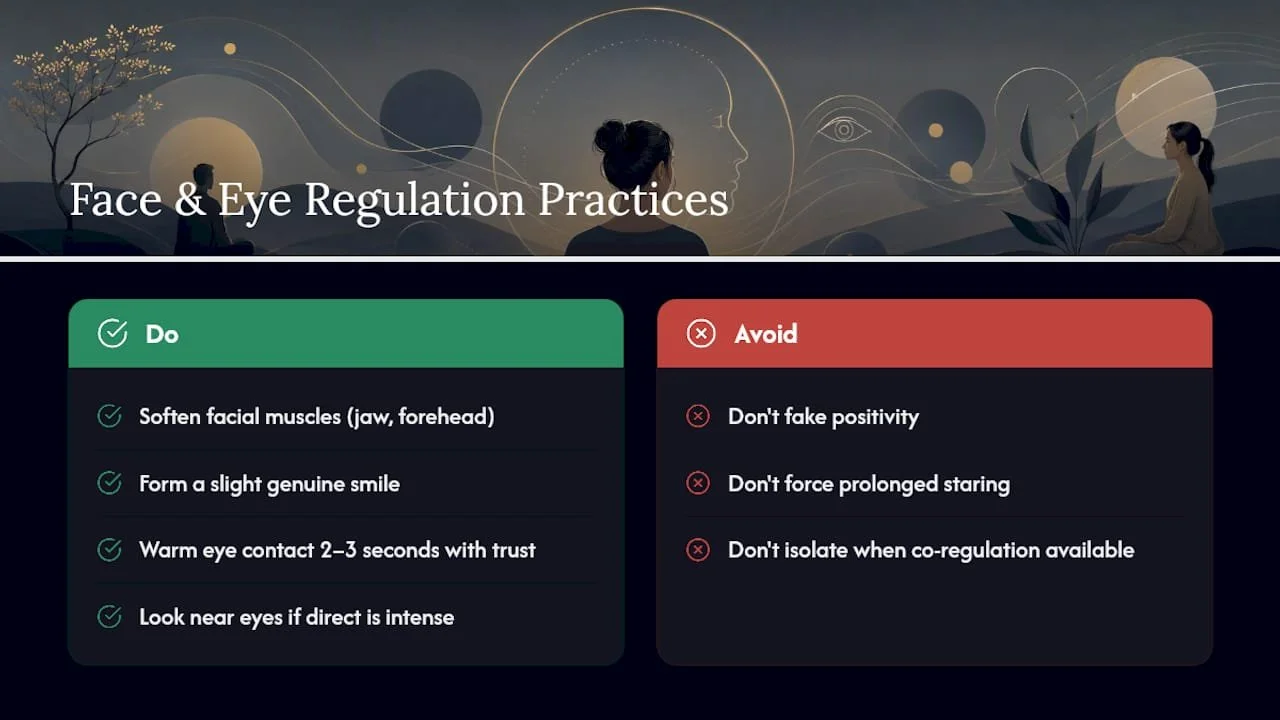
Try softening your facial muscles deliberately: unclench your jaw, relax your forehead, and let a slight, genuine smile form even if you don't feel like smiling. This isn't about faking positivity. Facial muscle tone feeds back to your brain stem and can shift your physiological state, similar to how a forced yawn can still trigger a real one.
Eye contact exercises work the same way, though they take more practice to use comfortably. If you're anxious in a social setting, brief, warm eye contact with someone you trust, even for two or three seconds, activates the same safety circuitry as a calm voice or a relaxed hand on your shoulder. If direct eye contact feels too intense, looking near someone's eyes, at their eyebrows or the bridge of their nose, still signals engagement without the intensity.
Mirroring a calm person's slow breathing, relaxed posture, or soft facial expression is a form of co-regulation that works even when you can't access it yourself in the moment. This is part of why sitting near a steady, grounded person during a hard moment often helps more than any solo exercise. For additional structured exercises along these lines, the German-language resource on vagus nerve stimulation techniques from Rubin Institut offers several more breath and sound-based variations worth exploring.
What This Guide Gets Right That Most Advice Skips
Most anxiety content treats breathing exercises and grounding techniques as a grab bag: try everything, see what sticks. That approach wastes the one advantage polyvagal-informed practice actually offers, which is specificity. A physiological sigh and a five-minute yoga sequence aren't interchangeable. One is for the moment your chest tightens at your desk. The other is for winding down before bed. Treating them as equally good options for every situation is why so many people try these tools once, feel underwhelmed, and quit.
The bigger gap in conventional advice is safety framing. Cold exposure and breath-holds get sold as universally good for you, with barely a mention of who should be cautious. Anyone with dysautonomia, a seizure history, or a significant trauma background needs a slower, more careful approach, and that caution belongs in the instructions, not as a footnote.
If you take one thing from this guide, make it this: start small, track how your body actually responds, and treat these exercises as daily maintenance rather than emergency-only tools. The people who benefit most practice for sixty seconds, several times a day, long before anxiety spikes, not just after.
— Juiced
This article is general information, not a substitute for advice from a qualified doctor. Consult a qualified healthcare professional about your own circumstances before acting on anything here.
Sources
For readers who want to go deeper than a how-to list, a few sources stand out. UC San Diego Today explains why regulation practices trended and what they actually do (and don't do) for distress. Stanford Lifestyle Medicine breaks down survival-mode physiology and fast downregulation tools like the physiological sigh. A PMC review of vagus nerve stimulation clarifies the real difference between clinical, implanted VNS and the at-home techniques covered here. Harvard Health covers the broader stress response and why movement and breathing practices support recovery.
Why Is Everyone ‘Regulating’ Their Nervous System? — UC San Diego Today
Stuck in Survival Mode: How to Regulate Your Nervous System — Stanford Lifestyle Medicine
