

The window of tolerance is the zone of nervous system arousal where you can feel strong emotions without losing your ability to think, connect, or respond thoughtfully. Step outside it and you land in one of two states: hyperarousal (racing thoughts, panic, anger) or hypoarousal (numbness, shutdown, exhaustion). The window isn't fixed. With the right tools and, often, trauma-focused therapy, it can widen so more of life fits inside it.
Inside the window: calm alertness, clear thinking, flexible responses
Hyperarousal (too much): panic, rage, hypervigilance
Hypoarousal (too little): numbness, dissociation, shutdown
The fix: targeted regulation tools now, therapy for lasting change
Key Takeaways
Widening your window of tolerance requires recognizing your early-edge signals, applying direction-specific regulation tools, and pursuing paced therapeutic work for lasting change.
| Point | Details |
|---|---|
| Definition matters | The window of tolerance is the arousal zone where strong emotion stays manageable and thinking stays clear. |
| Direction determines the tool | Hyperarousal calls for calming techniques; hypoarousal calls for activating ones, never the reverse. |
| Trauma narrows the window | Repeated or developmental trauma makes minor stressors more likely to push you outside your range. |
| Early detection is trainable | Tracking body, breath, thoughts, urges, and environment helps you catch the edge before full dysregulation. |
| Alvaradotherapy supports the work | Bilingual EMDR and trauma-focused therapy at Alvaradotherapy helps widen a chronically narrow window over time. |
Table of Contents
What Is the Window of Tolerance, Clinically and Biologically?
Hyperarousal and Hypoarousal: Signs in Body, Mind, and Behavior
Therapy Approaches That Expand the Window, and When to Get Help
What Is the Window of Tolerance, Clinically and Biologically?
Psychiatrist Daniel Siegel coined the term in the late 1990s to describe the range of arousal in which a person can process experience without becoming overwhelmed or shutting down. It's a teaching model, not a diagnosable condition. You won't find it in the DSM-5. Clinicians use it because it gives people language for something they already feel but rarely have words for.
Inside the window, your prefrontal cortex, the part of your brain responsible for planning, judgment, and impulse control, stays online. You can weigh options, read social cues, and delay reaction. Push past either edge of the window and that circuitry gets overridden by faster, older survival structures in the brainstem and limbic system. Clinical reviews connecting autonomic dysregulation to the window of tolerance model point to pathways involving the periaqueductal gray and ascending monoaminergic tracts, brain regions that govern fight, flight, and freeze responses well below the level of conscious thought.
The width of your window isn't a fixed trait. It shrinks after a bad night's sleep, during an illness, or in a season of chronic stress, and it can widen again as your baseline stability returns.
The width of your window isn't fixed and can shrink after a bad night's sleep, illness, or chronic stress, which is one reason the same argument that rolls off your back on a rested Tuesday can wreck your whole Wednesday after you've slept four hours. The window also varies by temperament and history. Someone with a stable, well-supported upbringing may tolerate a genuinely wide range of stress before tipping into dysregulation. Someone with a history of chronic threat may have a narrower window from the start, not because they're weaker, but because their nervous system learned to expect danger.
Hyperarousal and Hypoarousal: Signs in Body, Mind, and Behavior
Both states pull you outside your window, but they look almost like opposites. One state floods you with energy your body can't use productively. The other drains it away entirely.

What hyperarousal looks like
Hyperarousal is your sympathetic nervous system slamming the gas pedal. According to Psychology, this fight-or-flight response shows up as anxiety, anger, panic, or hypervigilance, and it tends to arrive fast.
Racing heart, shallow breathing, muscle tension
Agitation or restlessness you can't sit still through
Irritability that tips into snapping at people you love
Scanning a room for exits or threats without meaning to
Racing or looping thoughts that resist redirection
A parent stuck in hyperarousal might snap at a child over a spilled glass of juice, not because the juice matters, but because their body is already primed for a threat that never arrives. The reaction looks disproportionate from the outside. From the inside, it's the only gear available.
What hypoarousal looks like
Hypoarousal is the opposite pole: dorsal vagal shutdown, the body's freeze response when fighting or fleeing feels impossible or pointless. It shows up as numbness, dissociation, flattened emotion, or exhaustion, per the same Psychology.com resource.
A sense of emotional flatness or numbness, even during meaningful moments
Brain fog and slowed processing speed
Fatigue that sleep doesn't fix
Feeling disconnected from your own body or surroundings
Difficulty making even small decisions
An employee in hypoarousal might sit through an entire meeting nodding along, retaining almost nothing, and later can't explain why they feel so tired. That's not laziness or disinterest. It's a nervous system that has pulled the plug to conserve resources it perceives as scarce.
Both states interfere with the same things: working memory, emotional attunement, and follow-through. The difference is direction, not severity. Recognizing which one you're in determines which tool actually helps, because a technique that works for hyperarousal can make hypoarousal worse, and vice versa.
How to Recognize and Map Your Own Window
Most people don't notice they've left their window until they're already deep into hyperarousal or hypoarousal. The more useful skill is catching the edge, the early moment when your body signals a shift, while you still have enough regulation left to act on it. Simply Psychology's clinical guidance frames this early-catch skill as central to effective trauma work.
Try this five-part check the next time something rattles you, even mildly:
Body: Where do you feel it? Tight jaw, clenched stomach, heavy limbs?
Breath: Is it shallow and fast, or slow and barely there?
Thoughts: Are they racing and jumping topics, or sluggish and hard to form?
Urges: Do you want to move, leave, or lash out, or do you want to disappear and go still?
Environment: What just happened in the last five minutes that might have triggered this?
Running through those five questions daily, even for a week, starts to reveal your personal early-warning pattern. A simple log helps make it stick. Note the time, the trigger, the physical sensation, how you responded, and what happened afterward. Over two or three weeks, patterns emerge that are nearly impossible to see in the moment.
Pro Tip: Pick one recent stressful moment right now and rate it. Did your chest tighten and thoughts race (a hyperarousal edge), or did your mind go blank and your body feel heavy (a hypoarousal edge)? Naming it after the fact trains your brain to catch it faster next time.
Printable tracking sheets, including the window of tolerance worksheet from Johns Hopkins' counseling resources, give you a structured place to log this without having to build a system from scratch.
Tools to Return to Your Window and Widen It Over Time
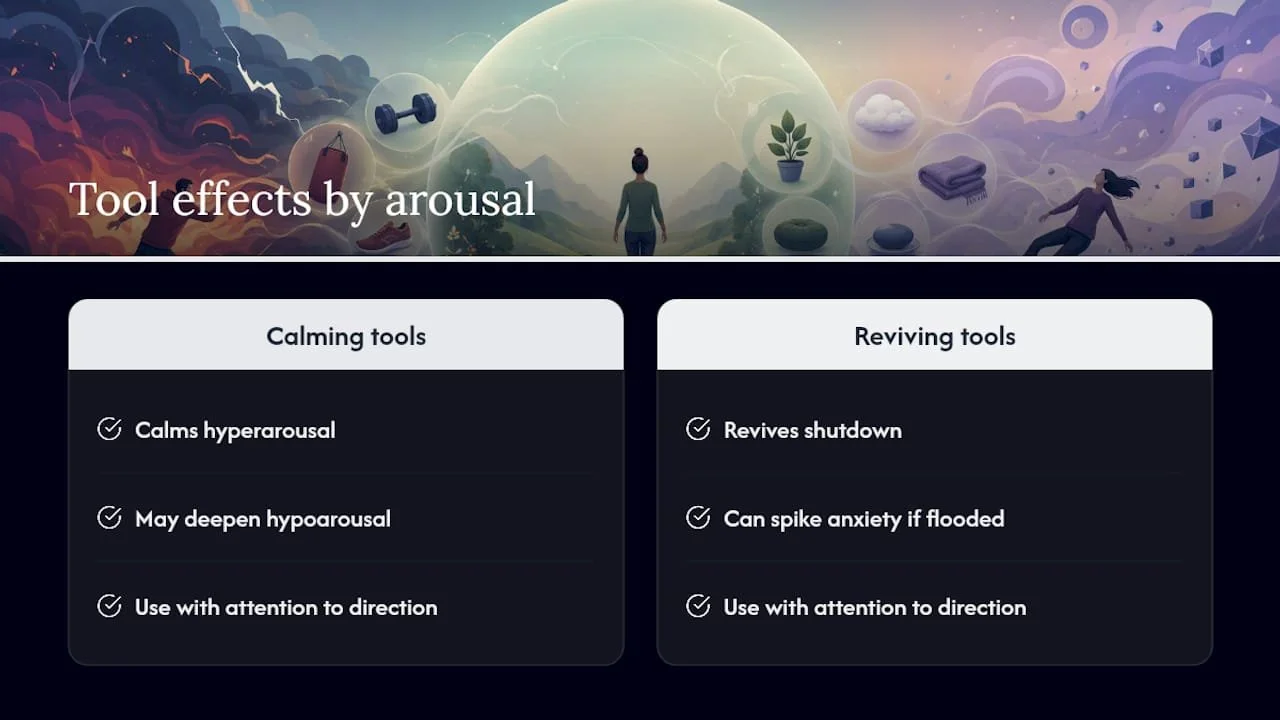
The tool that calms hyperarousal will likely deepen hypoarousal, and the tool that revives you from shutdown can spike anxiety if you're already flooded. Direction matters more than intensity.
For hyperarousal: bring the intensity down
Paced breathing: Try box breathing (inhale 4, hold 4, exhale 4, hold 4) or a 4-4-6 pattern where the exhale runs longer than the inhale, which signals safety to your vagus nerve.
5-4-3-2-1 grounding: Name five things you see, four you can touch, three you hear, two you smell, one you taste.
Progressive muscle relaxation: Tense and release each muscle group from feet to face.
Orienting to senses: Notice the temperature of the air, the texture of a chair arm, the specific color of an object nearby.
Soft, slow self-talk: A quiet, measured internal voice can down-regulate a racing system faster than trying to think your way out.
For hypoarousal: bring the energy back up
Gentle movement: A short walk, stretching, or even standing up and shifting weight from foot to foot.
Cold water: Splashing your face or holding an ice cube activates the mammalian dive reflex and jolts alertness back.
Stimulating music: Something with a strong beat can pull attention out of a fog.
Bright or sharp sensory input: Strong scents, bright light, or a burst of cold air.
Social connection: A short conversation, even a text exchange, can re-engage the social nervous system that shutdown tends to isolate.
Building a wider window over the long haul
In-the-moment tools bring you back to the window. A different set of practices, sustained over weeks and months, actually expands its edges:
Protect sleep as a nonnegotiable. Chronic sleep debt shrinks your baseline window before the day even starts.
Practice graded exposure. Deliberately approach a mildly triggering situation, at a tolerable intensity, and let your system learn it can recover.
Build regular somatic movement into your week, whether that's yoga, walking, or dance. It teaches your body that arousal can rise and fall safely.
Lean on co-regulation. Time with people who feel calm and safe helps recalibrate your own baseline, a mechanism therapeutic work at the edge of the window relies on directly.
Keep therapy consistent rather than episodic. Nervous system change tends to come from repetition, not a single breakthrough session.
Pro Tip: Start with the smallest version of any exposure practice. If a full conversation with someone difficult feels too activating, practice with a two-minute version first. Titrating the dose is what makes the exercise safe rather than retraumatizing.
One caution applies across the board: none of these tools work well if you try to force them past your capacity. If a grounding exercise itself feels overwhelming, that's a signal to scale down the intensity, not push through it.
Therapy Approaches That Expand the Window, and When to Get Help
Self-regulation tools manage the moment. Therapy changes the baseline. Several approaches are built specifically around widening the window rather than just calming a single episode.
Somatic therapies work through the body first, on the premise that trauma gets stored physically and needs a physical route out, not just a cognitive one. EMDR (Eye Movement Desensitization and Reprocessing) uses bilateral stimulation to help the brain reprocess stuck traumatic memories so they stop triggering full-body alarm responses. Sensorimotor psychotherapy and polyvagal-informed approaches both track subtle nervous system shifts in real time, teaching clients to notice and work with their own edge, the exact skill practitioner guidance identifies as central to durable change. Trauma-focused CBT rounds out the toolkit by pairing cognitive reframing with graded exposure.
Good trauma therapy sequences this work. Stabilization, building baseline regulation capacity, comes before any deep processing of traumatic material. Skipping that step and diving straight into hard memories can retraumatize rather than heal, which is why an intake with a trained clinician usually starts slow by design.
Some signals mean it's time to stop trying to manage this alone: frequent dissociation that disrupts daily functioning, thoughts of self-harm, or a window so narrow that basic tasks like work or relationships have become consistently unmanageable. These call for professional support, not more journaling.
Alvaradotherapy works with clients on exactly this kind of window-building through EMDR intensives, ongoing individual counseling, and bilingual English-Spanish care for clients across California and New York, in person and online. The approach doesn't promise a fixed timeline or a guaranteed outcome. It offers structured, paced work toward a wider, steadier window.
A note on how long this takes
Widening a chronically narrow window rarely happens in weeks. In clinical experience, meaningful, lasting shifts in nervous system flexibility tend to unfold over months, sometimes longer for complex or developmental trauma, and that pace is normal, not a sign of failure. Progress tends to show up first in small ways: recovering faster after a stressful moment, noticing an edge before it becomes a crisis. If your window feels too narrow to manage on your own, seeking a bilingual, trauma-informed assessment is a reasonable next step, not a last resort.
— Juiced
Working With Alvaradotherapy When Self-Regulation Isn't Enough
Grounding exercises and breathing techniques have real limits. When your window stays narrow no matter what you try, or when trauma keeps pulling you back into hyperarousal or shutdown, working with a clinician changes what's possible. Alvaradotherapy is built specifically around this kind of window-building work: online EMDR trauma therapy for clients across California and New York, alongside dedicated support for PTSD and complex trauma, delivered by bilingual, trauma-informed clinicians who understand that regulation capacity has to be built before deeper processing begins.

An initial consultation focuses on understanding your history, your current window, and what pace of work makes sense, not on diving straight into difficult material. Online sessions run through a secure video platform, so location within California or New York isn't a barrier to consistent care. If you're noticing your window has narrowed and self-help tools aren't holding, booking a consultation is the direct next step toward a structured plan built around your specific pattern of dysregulation.
Sources
This article draws on clinical guidance from Psychology.com's window of tolerance resource, Verywell Mind's overview of the model, Simply Psychology's clinical breakdown, and a peer-reviewed review of autonomic dysregulation. For a printable tracking worksheet, see the Johns Hopkins counseling center's window of tolerance info sheet.
This article is general information, not a substitute for advice from a qualified doctor. Consult a qualified healthcare professional about your own circumstances before acting on anything here.
Autonomic dysregulation and the Window of Tolerance model (PubMed entry)
Window of Tolerance: Understanding Your Nervous System's Safe Zone | Simply Psychology
