
What the Fawn Response Really Looks Like in Daily Life

The fawn response is an automatic survival strategy where a person appeases, agrees, or over-accommodates a perceived threat instead of fighting, fleeing, or freezing. It buys safety in the moment, then quietly erodes your sense of self the longer it runs the show.
You might be looking at your own fawning if any of this feels familiar:
You say "yes" before you've actually thought about what you want.
Agreeing to something brings a flash of relief, followed by resentment an hour later.
You struggle to name your own preferences in a group, even a small one.
Pro Tip: Notice the gap between the automatic "yes" and the delayed resentment. That gap is where the fawn response lives, and it's the first thing worth paying attention to.
TL;DR:
The fawn response is an automatic, anxiety-driven reflex developed in childhood to appease unpredictable or punitive caregivers.
It often manifests through chronic agreement, overcommitment, and difficulty recognizing personal preferences, leading to resentment.
Recovery involves building awareness, practicing small boundary experiments, and working with trauma-informed therapies like EMDR or somatic techniques.
Severe cases causing dissociation or persistent relationship issues generally require professional, trauma-informed clinical support.
Recognizing the automatic "yes" followed by delayed resentment is key to breaking the fawn pattern and rebuilding healthier relational dynamics.
Table of Contents
Understanding the Fawn Response in Psychology
Fawning gets encoded through repetition. When appeasing an unpredictable or volatile person reliably reduces danger, the nervous system files that strategy away as the fastest route to safety, and starts triggering it before conscious thought catches up. Psychotherapist Pete Walker coined the term "fawn" to describe this pattern, adding it as a fourth response alongside fight, flight, and freeze, specifically in the context of complex trauma and childhood relational injury.
The distinction that matters clinically: kindness is a choice, made from a place of security. Fawning is not a choice. It's a reflex driven by anxiety, aimed at neutralizing a threat that may not even be visible to anyone watching.
Fight, flight, and freeze are largely about escape or confrontation.
Fawn is about disarming the threat by becoming agreeable, useful, or invisible.
The trigger is often subtle: a shift in someone's tone, a pause before they answer, a raised eyebrow.
Signs and Symptoms of a Fawning Trauma Response
Fawning shows up on three levels, and most people only notice one of them until it's pointed out.
Behavioral: automatic agreement, chronic over-apologizing, taking on commitments you never wanted, and struggling to end conversations or relationships that drain you.
Identity-level: feeling like you have a different "self" for every relationship, difficulty naming your own preferences, and a slow buildup of resentment toward people you never told "no."
Somatic: a tight chest or stomach drop right before you're about to disagree, a wave of relief once you've smoothed things over, and sometimes a foggy, checked-out feeling during actual conflict.
Health researchers point to automatic agreement, over-commitment, and feeling responsible for other people's emotions as some of the most reliable markers of this pattern. If you recognize two or three of these at once, you're likely looking at a trauma-shaped habit, not a personality trait.
Why Fawning Develops in Childhood
Fawning usually takes root in homes where a caregiver's mood was unpredictable, where conflict was punished, or where authenticity, saying what you actually felt, brought criticism instead of comfort. A child in that environment learns fast: agreeing keeps things calm, and calm keeps you safe.
The strategy worked. That's the uncomfortable part. Appeasement genuinely reduced the risk of punishment or emotional withdrawal.
Because it worked, the nervous system reinforced it, turning a conscious coping tactic into an automatic one.
Over time, this pattern often links up with broader complex trauma and attachment injuries, especially when the same appeasement is required across multiple relationships.
This is why fawning appears alongside fight, flight, and freeze in trauma literature. It was never irrational. It was the most effective option available at the time.
How Fawning Shapes Relationships and Therapy
Adults who fawn tend to avoid conflict at almost any cost, absorb far more emotional labor than their partners or friends, and drift into caretaker or fixer roles that leave little room for their own needs. Over years, this builds relationships that look stable on the surface and feel one-sided underneath.
Chronic conflict avoidance often masks real disagreement rather than resolving it.
Emotional labor gets distributed unevenly, and the fawning partner rarely asks for reciprocity.
Some people show hybrid patterns, fawn-freeze (agreeing, then going numb) or fawn-flight (agreeing, then quietly withdrawing), which shapes what a therapist targets first.
Pro Tip: If you notice a fawn-freeze pattern, prioritize grounding and body awareness before boundary work. Trying to set limits while dissociated rarely sticks.
This is also why trauma-informed care focuses less on advice and more on nervous-system safety, since a dysregulated body can't practice a new relational skill it doesn't yet trust.
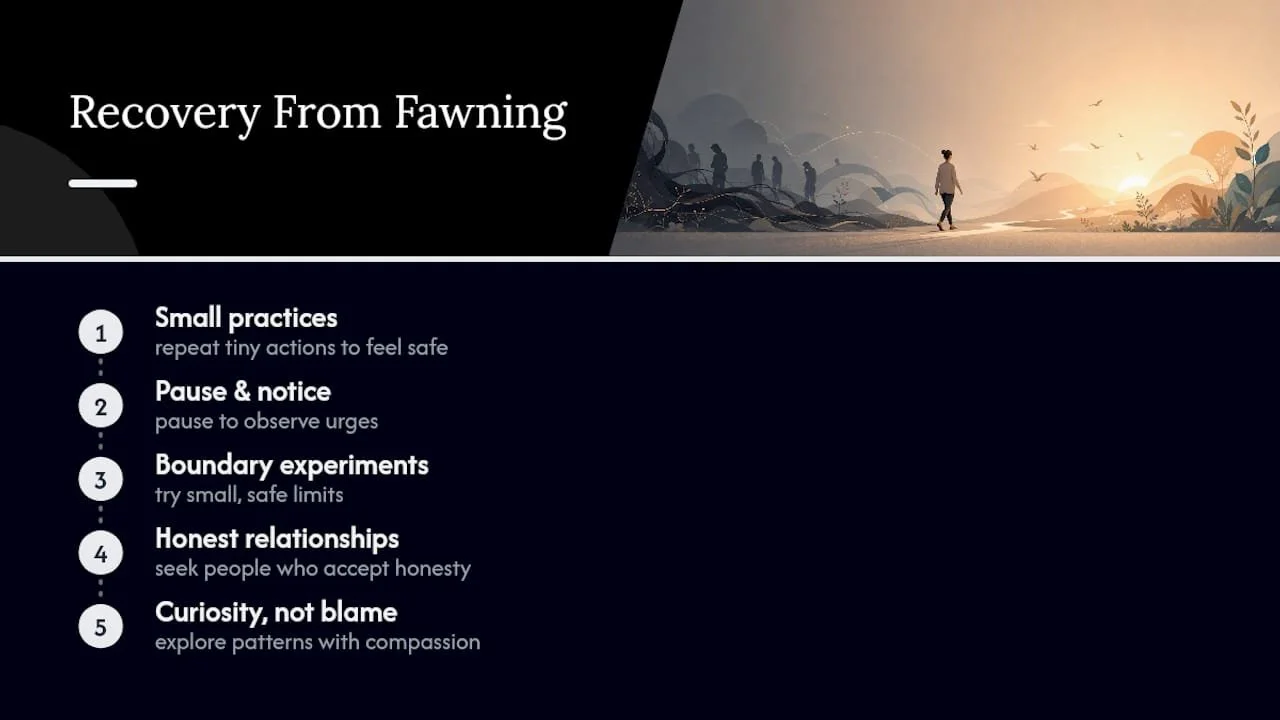
How to Start Shifting an Automatic Fawn Response
Recovery isn't about forcing yourself to say no more often. It's about giving your nervous system enough evidence, slowly, that disagreement doesn't equal danger.
Build a micro-pause. Before answering a request, take one breath and silently ask, "What do I actually want here?" That half-second interrupts the automatic yes.
Regulate first, decide second. Grounding techniques, paced breathing, or simply naming five things you can see help settle the body enough to think clearly. Clinicians note that skipping this step often makes boundary attempts feel overwhelming and short-lived.
Run small experiments. Practice a low-stakes no, declining a minor request, delaying a response by a day, before attempting bigger boundaries. A simple script like "Let me think about it and get back to you" buys space without confrontation.
Expect discomfort, and stay anyway. The anxious feeling after saying no is not a sign you did something wrong. It's your nervous system recalibrating.
On the clinical side, three approaches show up consistently for this work: EMDR targets the stored memories that keep triggering appeasement, somatic therapy rebuilds the body's ability to tolerate discomfort without shutting down, and trauma-informed CBT helps identify and rework the automatic thoughts that justify fawning. Alvaradotherapy's boundary-setting framework walks through several of these scripts in more detail, and the cost of skipping this work entirely is laid out well in this piece on what conflict avoidance costs couples.
Pro Tip: Track your "yes to no" ratio for one week without changing anything. Awareness alone starts loosening the automatic pattern.

When to Seek Professional Help for Fawning
Some signs point clearly toward working with a licensed clinician rather than trying to self-manage: dissociation that interferes with daily functioning, persistent difficulty holding a job or relationship because of appeasement patterns, thoughts of self-harm, or repeated cycles of ending up in relationships that recreate the original harm.
Trauma-informed therapy typically starts by establishing safety and nervous-system stability before touching the harder material. EMDR helps process the specific memories driving the fawn pattern, while somatic techniques rebuild the body's tolerance for conflict and discomfort.
Alvaradotherapy offers EMDR therapy and intensives for complex trauma and longstanding fawning patterns.
Sessions are available online across California and New York, with bilingual English-Spanish care.
Clinician profiles, worksheets, and a clear what to expect guide are available before you ever book a session.
Fawning Made Sense. Recovery Is Still Possible
Fawning was never a flaw. It was a strategy that kept you safe when few other options existed. That doesn't mean it has to run your adult relationships.
Small, repeated practices, a pause here, a boundary experiment there, paired with relationships that don't punish honesty, genuinely shift how your nervous system predicts danger over time. Curiosity about your own patterns will take you further than self-blame ever will.
A Clinical Perspective on Fawning and People-Pleasing
Clients rarely arrive describing themselves as "fawning." They describe exhaustion, resentment they can't explain, or a nagging sense that they don't know their own preferences anymore. That gap between self-perception and pattern is where the real work starts.
Recovery from fawning rarely happens in isolation. It happens inside relationships, including a therapeutic one, that finally don't ask you to disappear to stay safe.
— Juiced
Key Takeaways
The fawn response protects you in the short term through automatic appeasement, but left unaddressed, it erodes identity and drives one-sided relationships over time.
| Point | Details |
|---|---|
| Fawning is automatic, not chosen | It's a nervous-system reflex shaped by past threat, not a personality trait or a conscious decision. |
| Watch for the yes-then-resentment pattern | Automatic agreement followed by delayed resentment is one of the clearest self-check signals. |
| Regulation comes before boundaries | Grounding and paced breathing make boundary experiments more likely to stick than willpower alone. |
| Hybrid patterns need tailored care | Fawn-freeze and fawn-flight combinations often call for different first steps in therapy. |
| Professional help matters for severe patterns | Daily impairment, dissociation, or repeated retraumatizing relationships call for trauma-informed clinical support. |
Sources
For deeper background on trauma survival responses, RAINN's overview of fight, flight, freeze, and fawn offers survivor-focused context. The American Psychological Association's trauma resources explain the physiological basis of trauma responses in more clinical depth. NSVRC's research on psychological consequences covers the broader impact of interpersonal trauma, and Simply Psychology's explainer on the fawn response traces the term back to Pete Walker's original clinical work.
This article is general information, not a substitute for advice from a qualified doctor. Consult a qualified healthcare professional about your own circumstances before acting on anything here.
The Fawn Response: How Trauma Teaches People-Pleasing | Simply Psychology
Fight, Flight, Freeze, & Fawn: Understanding Survival Responses — RAINN
How to tell if people-pleasing is a trauma response — Healthline
