
Delayed Grief: Why Loss Can Hit You Months or Years Later

Delayed grief is when the intense feelings tied to a loss surface weeks, months, or even years after the event itself, and that timing is a common, natural response rather than proof you failed at grieving. Your mind postponed the processing until it judged the moment safer. What follows is why that happens, how to recognize it, and when it's worth getting professional support.
TL;DR:
Delayed grief is often triggered by anniversaries, sensory reminders, or new losses, surfacing months or years after the initial event due to postponed emotional processing.
It commonly involves emotional waves, physical symptoms, and behavioral changes that resemble acute grief but may persist longer and impair daily functioning.
Risk factors include traumatic deaths, multiple losses, and limited social support, with prolonged grief or PTSD requiring targeted psychotherapy like CGT, EMDR, or trauma-focused CBT.
Cultural, familial, and social norms influence how and when delayed grief manifests, often causing individuals to suppress feelings until circumstances feel safer.
Addressing delayed grief early with support and memory rituals can prevent it from worsening and help integrate unresolved emotions into daily life.
Table of Contents
What is delayed grief, exactly?
Delayed grief happens when your mind postpones the hardest emotional work of mourning until circumstances allow it. That's not avoidance in the shameful sense. It's closer to triage. A parent handling a funeral, a job, and two younger siblings often can't afford to fall apart in week one. The nervous system prioritizes function over feeling, and the grief doesn't disappear. It waits.
Delayed grief differs from anticipatory grief, which shows up before a death you can see coming, like during a terminal diagnosis. It also differs from immediate acute grief, the raw, disorganized wave that hits right after a loss. Delayed grief arrives later, sometimes long after everyone around you assumes you've "moved on."
Common pathways include:
A sudden death that required immediate logistical decisions, leaving no room to feel
Caregiving for other grieving family members, especially children
Cultural or family norms that reward composure over expression
A loss during a chaotic life period (a move, a divorce, a new baby)
What causes delayed grief and what triggers it later?
Practical demands are the most common cause. Funerals, estate paperwork, and childcare eat the early weeks when grief typically wants attention. Social expectations compound it. Many people learn early that tears make others uncomfortable, so they suppress the reaction until it's socially safer, sometimes years later.
Triggers that reopen the process include:
Anniversaries of the death or major holidays
Sensory reminders, since scent and memory are deeply intertwined in the brain and a smell can trigger grief faster than a photo
A subsequent, unrelated loss that reactivates the earlier one
Milestones the deceased would have witnessed, like a graduation or wedding
Risk factors that make delayed grief more likely include a traumatic or sudden death, multiple losses stacked close together, and thin social support at the time of the original loss.
What are the signs of delayed grief?
Symptoms of delayed grief tend to mirror acute bereavement almost exactly, just arriving out of sync with the loss itself. Verywell Mind's reporting on delayed grief reactions notes that emotional, behavioral, and physical symptoms can all surface together, often triggered by something unrelated to the death itself.
Emotional signs: sudden waves of sadness, irritability or anger with no clear cause, emotional numbness, and intense yearning for the person you lost.
Behavioral and cognitive signs: avoiding reminders, trouble concentrating at work, withdrawing from friends, or oddly, becoming unable to stop talking about the loss.
Physical symptoms: disrupted sleep, appetite swings, unexplained muscle tension or digestive issues, and persistent fatigue.
Warning signs of something more: if symptoms stay severe for months, interfere with your job or relationships, or come with intrusive memories and hypervigilance, it may be complicated grief or bereavement-related PTSD rather than a normal delayed reaction.
When does delayed grief become prolonged grief or PTSD?
Most delayed grief resolves once it finally gets room to move. Prolonged grief disorder is different. It's now a distinct diagnosis in the DSM-5-TR, defined by grief so persistent and severe it impairs daily functioning well beyond what's culturally expected, typically assessed at twelve months or more after the loss.
Traumatic bereavement, meaning a death that was sudden, violent, or witnessed, carries a distinctly higher risk of both prolonged grief and PTSD. When someone develops intrusive memories of the death itself, nightmares, or a persistent sense that the world is unsafe, that's a different clinical picture than grief alone, and it responds to different treatment.
Traumatic loss significantly raises the odds of PTSD and prolonged grief symptoms, according to research on treating PTSD after traumatic bereavement, which found that targeted psychotherapy produces measurable improvement even in cases involving sudden or violent death.
Three approaches have real evidence behind them:
Complicated Grief Therapy (CGT): a structured protocol combining grief processing with restoring day-to-day functioning.
EMDR (Eye Movement Desensitization and Reprocessing): reprocesses the traumatic memory of the death so it stops firing the body's alarm system; Alvaradotherapy's overview of EMDR for grief covers how sessions typically unfold.
Trauma-focused CBT / CT-PTSD: uses imagery transformation and memory-updating techniques to shift the memory's emotional charge, described in detail in the same PMC research on cognitive therapy after traumatic bereavement.
Medication, usually an antidepressant, can help when grief overlaps with clinical depression or anxiety, though it's rarely a standalone fix for grief itself. Seek help immediately if you notice serious impairment at work or home, thoughts of suicide, or severe symptoms that haven't budged after several months. The National Center for PTSD's guidance on managing grief notes that ongoing support and early intervention reduce the risk of longer-term mental and physical health problems, including cardiovascular and immune effects tied to unresolved bereavement.
How can you cope with delayed grief day to day?
You don't need a diagnosis to start doing something useful. Small, consistent practices often matter more than one big cathartic moment.
Journaling prompts: write a letter to the person you lost, or answer "what do I wish I'd said" without editing yourself.
Memory rituals: light a candle on their birthday, cook their favorite meal, or visit a meaningful place once a year.
Gentle movement: walking or stretching helps discharge the physical tension grief stores in the body.
Sleep hygiene: keep a consistent bedtime, since disrupted sleep tends to amplify emotional volatility.
Ask for support specifically. Instead of "I'm struggling," try "Can you check in with me every Sunday for the next month?" People generally want to help but don't know the ask.
Continuing bonds work, meaning finding ways to stay connected to the person you lost rather than "letting go" entirely, is associated with better long-term adjustment than forced detachment. Structured memory work, like organizing photos into a book or recording a voice memo about your favorite memory, gives grief a container instead of letting it leak into everything.
Pro Tip: Set a timer for ten minutes and write continuously about one specific memory, not the loss in general. Vague grief journaling ("I miss them") tends to circle. Specific memory writing ("the way they laughed at their own jokes before they finished them") tends to move something.
Why does the mind delay grief in the first place?
Repression and avoidance sound like character flaws, but they're closer to reflexes. When a loss is too big to process in real time, the mind can compartmentalize it, essentially filing the emotional content away until the practical crisis passes. This isn't conscious deception. Most people delaying grief genuinely believe they're "fine," because on some functional level, they are, right up until they're not.
Denial operates on a spectrum too. Full denial that a death occurred is rare and usually points to something more serious. Partial denial, where you intellectually know someone died but haven't let the fact land emotionally, is extremely common and often looks like staying unusually busy or unusually calm.
Avoidance keeps the delay going. Skipping the grave site, deleting old photos from your camera roll, changing the subject when their name comes up: these aren't failures of courage. They're the mind managing exposure to pain the way you'd manage exposure to a bright light, in doses it can tolerate.
One useful reframe: delayed grief often reflects a mind that postponed processing until it judged the environment safe enough to handle the fallout. Safety here doesn't mean literal danger. It means enough stability, enough support, enough bandwidth. That's why grief can wait until a divorce settles, until the kids are older, or until a subsequent loss cracks open what the first one never touched.
How do culture and family shape when grief shows up?
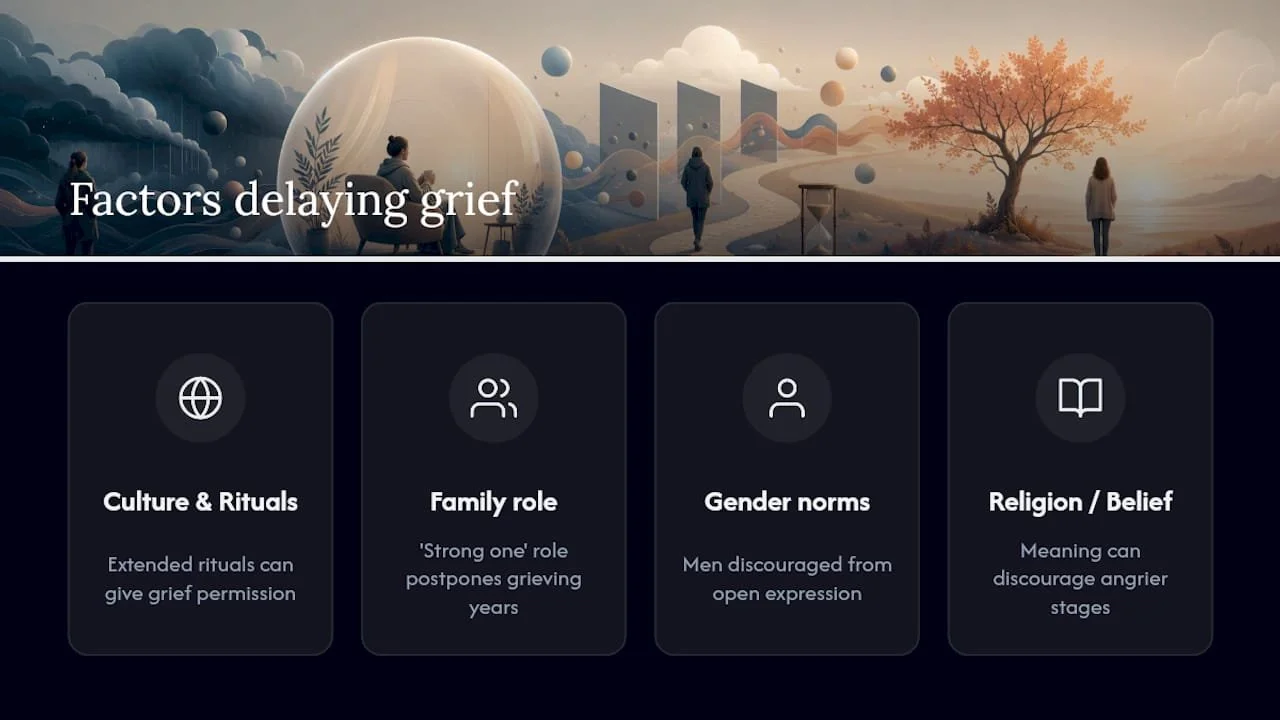
Cultural norms decide a lot about whether delayed grief gets recognized or dismissed. Some cultures build in extended, structured mourning periods, formal rituals stretching weeks or months, that give grief explicit permission to run its course. Others, particularly cultures that prize stoicism or "moving forward," can push people to suppress visible grief within days of a funeral.
Family role also matters. The person who becomes "the strong one," often the oldest sibling or a parent managing younger children, frequently doesn't get space to grieve until years later. Gender norms compound this: men in many cultures are still discouraged from open emotional expression, which pushes their grief underground until it resurfaces as irritability, physical symptoms, or a seemingly unrelated crisis.
Religious and spiritual frameworks can help or complicate the process depending on how they're applied. A framework that offers meaning ("they're at peace now") can ease acute pain while inadvertently discouraging the messier, angrier stages of grief that still need to happen. Immigrant and bicultural families sometimes navigate two conflicting sets of mourning expectations at once, which can further delay processing simply from the friction of not knowing which norm to follow.
None of this makes delayed grief less real. It means the "normal" timeline was never universal to begin with, and recognizing your own cultural script around loss is often the first step to understanding why your grief didn't show up when you expected it to.
What does delayed grief look like in real life?
Consider someone who loses a spouse suddenly and spends the first year managing an estate, a mortgage, and two kids under ten. Friends comment on how "strong" they seem. Eighteen months later, at a routine dentist appointment, they burst into tears over nothing related to the loss at all. That's delayed grief surfacing through an unrelated trigger, not a relapse or a new problem.
Or consider a case involving a missing person, where the absence of confirmed death delays grief by its very nature. Families often can't begin active mourning until legal or investigative processes resolve, and guidance on delays in missing persons cases illustrates how procedural limbo forces emotional limbo alongside it. Grief in these situations doesn't get delayed by choice. It's delayed by circumstance.
A third pattern shows up in adult children who lost a parent young, often before age ten, and grieved "appropriately" for a child at the time, only to find the loss resurfacing hard in their late twenties or thirties, frequently around milestones like marriage or having their own kids. The original grief was real but developmentally limited. The adult mind revisits it with new capacity to understand what was actually lost.
How does delayed grief affect relationships and daily life?
Delayed grief rarely stays contained to the person experiencing it. A partner who suddenly becomes withdrawn or short tempered, without connecting it to a loss from two years prior, can leave the other partner confused and hurt, often assuming the problem is about them. Unexplained irritability is one of the more common ways delayed grief leaks into a relationship before either person names it correctly.
At work, concentration problems and fatigue can look like performance issues rather than grief, especially since there's no obvious recent trigger for a manager to connect the dots. Friendships can strain too: people who supported you immediately after the loss often assume you're through the worst of it by the time the delayed wave actually hits, which can leave you feeling isolated at the exact moment you need support most.
Parenting is a common flashpoint. A parent managing delayed grief might have less patience, more distraction, or sudden tearfulness that confuses younger children who don't understand the timeline. Naming what's happening, even simply, tends to help more than pretending nothing changed.
How does a trauma-informed clinic approach delayed grief?
Alvaradotherapy treats delayed grief as a trauma-informed practice would treat any loss with a complicated timeline: through careful assessment first, not assumptions. A first session typically maps the loss, current symptoms, and what support existed at the time, then sets early goals around stabilization before deeper trauma work begins.
Because grief and trauma often overlap, especially after sudden or violent death, treatment plans commonly draw on EMDR, CT-PTSD techniques, or complicated grief therapy depending on presentation. Bilingual, culturally responsive care matters here too, since mourning norms vary widely across the families the practice serves in California and New York.
— Juiced
Ready to talk to someone about delayed grief?
If grief has been sitting unprocessed for months or years, you don't need to wait for a crisis to get support. Alvaradotherapy offers trauma-informed care specifically built for loss that doesn't follow a tidy timeline, with sessions available online and in person across California and New York.

A first session usually starts with a conversation about the loss itself and what's happening now, not a script or a checklist. It helps to come in with a rough sense of your symptoms and timeline, but nothing formal is required. Depending on what comes up, your therapist might recommend EMDR, trauma-focused CBT, or complicated grief therapy, all approaches with real evidence behind them for grief that turns complicated or traumatic. If you're not sure which service fits, the consultation page is built for exactly that uncertainty. When you're ready to see what a first session actually involves, the what to expect page walks through the process step by step, and you can book directly from there.
This article is general information, not a substitute for advice from a qualified doctor. Consult a qualified healthcare professional about your own circumstances before acting on anything here.
