

TL;DR:
A healthy boundaries workflow is a structured, repeatable process for identifying, communicating, and maintaining personal limits in relationships to build respect and trust. It involves preparation, clear behavioral statements, stated consequences, and consistent follow-through, with gradual escalation from soft to hard boundaries. Recognizing common mistakes and practicing the workflow fosters sustainable relationship health and emotional safety.
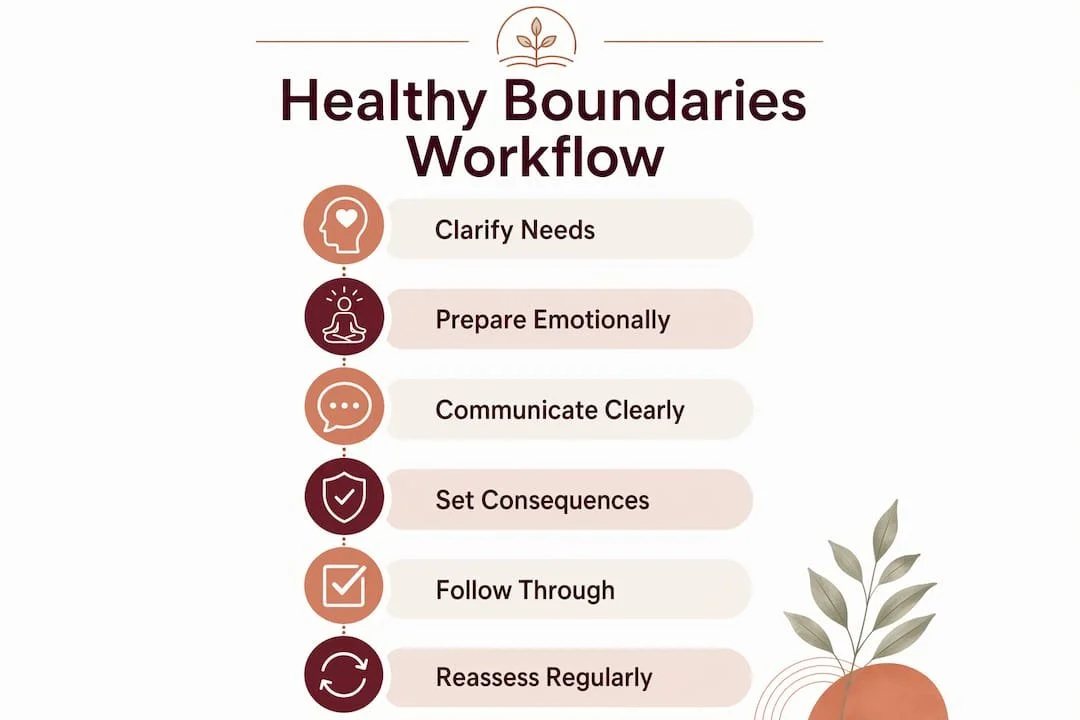
A healthy boundaries workflow for relationships is a structured, repeatable practice that protects your needs while building genuine respect and trust with the people around you. Most people treat boundary-setting as a one-time conversation. It is not. The Cleveland Clinic defines healthy boundary-setting as a six-step practice covering self-knowledge, direct communication, "I" statements, stated consequences, follow-through, and consistent application. DBT (Dialectical Behavior Therapy) frameworks and relationship psychology research both confirm that the workflow matters as much as the words you choose. This guide gives you the full process.
What is a healthy boundaries workflow for relationships?
A healthy boundaries workflow is the structured sequence of steps you follow to identify, communicate, and maintain your personal limits in any relationship. The word "workflow" is deliberate. Unlike a single conversation, a workflow repeats and adapts over time as relationships change. Think of it as a system, not a speech.

The clinical term used in therapy settings is interpersonal boundary-setting, and it draws heavily from DBT interpersonal effectiveness skills developed by psychologist Marsha Linehan. The workflow concept simply makes that clinical process repeatable for everyday use.
Before you set a single boundary, you need two things: clarity about what you need and the emotional readiness to communicate it. Vulnerability-aware timing is a core DBT principle that optimizes boundary communication by avoiding conversations during emotional flooding, hunger, or exhaustion. This means the workflow starts before you open your mouth.
Pro Tip: Write your boundary down before you say it out loud. The act of writing forces clarity and reduces the chance you will soften or abandon the statement under pressure.
What do you need before setting boundaries?
The most overlooked part of any relationship boundaries guide is preparation. Skipping it is the single biggest reason boundary conversations fail.
Self-assessment tools that actually help
DBT offers a 7-step boundary worksheet that walks you through naming patterns, identifying which boundaries have been crossed, checking your vulnerability factors, clarifying your values, writing boundaries using "I" language, planning follow-through, and anticipating barriers. This is not a journaling exercise. It is a clinical tool designed to prevent the emotional flooding that derails most boundary conversations.
The DEAR MAN communication framework, also from DBT, gives you a script structure: Describe the situation, Express your feelings, Assert your request, Reinforce the benefit, stay Mindful, Appear confident, and Negotiate. Paired with "I" statements, DEAR MAN reduces defensiveness in the person receiving the boundary. You can also explore anxiety in relationships to understand how emotional readiness connects to your ability to communicate limits clearly.
| Tool or Framework | Best Used For | Format |
|---|---|---|
| DBT Boundaries Worksheet | Full boundary audit and planning | Written worksheet |
| DEAR MAN | Scripting the actual conversation | Verbal or written |
| "I" Statements | Reducing defensiveness in delivery | Verbal |
| Values Clarification | Identifying what matters most | Written reflection |
| Vulnerability Check | Timing your conversation correctly | Self-assessment |
Practical preparation steps before any boundary conversation:
Choose a calm, private moment when neither person is hungry, tired, or mid-conflict
Write out your boundary statement in one or two sentences
Identify the consequence you will follow through on if the boundary is not respected
Rehearse the statement aloud at least once
Check your emotional state: if you are flooded, wait
How to set healthy boundaries step by step
Setting limits in personal relationships follows a clear sequence. Skipping steps, especially the consequence and follow-through steps, is why most boundaries collapse within weeks.
The six-step process
Identify the need. Name the specific behavior or situation that is affecting you. Vague discomfort does not produce clear boundaries.
Write the boundary clearly. Use one behavioral sentence. "I need you to call before coming over" is a boundary. "I need more space" is not.
Communicate with an "I" statement. "I feel overwhelmed when plans change last minute. I need 24 hours notice for schedule changes." This format owns your experience without attacking the other person.
State the consequence. Tell the person what will happen if the boundary is not respected. "If plans change without notice, I will not be able to attend." Consequences are not threats. They are information.
Plan your follow-through. Decide in advance what you will do if the boundary is crossed. Planning realistic follow-through prevents renegotiation under pressure and keeps the boundary credible.
Apply consistently. One exception teaches the other person that the boundary is negotiable. Consistency is what makes a boundary real.
Pro Tip: Psychology Today recommends starting with soft boundaries and escalating to hard ones as your comfort grows. This prevents emotional whiplash for both you and the other person.
Soft vs. hard boundaries: what is the difference?
Psychology Today's 2026 guidance distinguishes between soft and hard boundaries in romantic relationships. Soft boundaries are preferences you are willing to discuss and adjust. Hard boundaries are non-negotiable limits tied to your safety, values, or well-being.
| Boundary Type | Definition | Example |
|---|---|---|
| Soft boundary | Flexible preference, open to discussion | "I prefer not to discuss work during dinner" |
| Hard boundary | Non-negotiable limit, no exceptions | "I will not tolerate yelling during arguments" |
| Soft boundary | Comfort-based, can evolve over time | "I need some alone time on weekends" |
| Hard boundary | Safety or values-based, firm | "I will not share my location at all times" |
Clarity in communicating your limits empowers the other person to understand your expectations and reduces confusion and defensiveness on both sides. Vague hints do the opposite. They create resentment without resolution.
For couples working through this process together, communication exercises for couples offer structured practice for expressing and receiving limits without triggering defensiveness.
What to do when boundaries are crossed
Follow-through is the step most people skip, and it is the step that determines whether your boundary exists at all. A boundary without a consequence is a preference. A preference without follow-through is a wish.
Strategies for calm reinforcement
When a boundary is crossed, respond with a brief, calm reminder rather than a lecture. "Remember, I asked for 24 hours notice. I won't be able to make it tonight" is enough. Concise scripting and consistent reinforcement are what keep boundaries credible over time. Long explanations invite negotiation and signal that the boundary is soft even when it is not.
Psychology Today advises compassion with firm reminders for boundary violations that are not abusive. Occasional violations in otherwise healthy relationships do not require escalation. They require patience and consistency.
"Boundaries are not walls. They are the terms under which you stay in a relationship. Enforcing them is an act of respect, not rejection."
Troubleshooting tips for boundary maintenance:
Guilt is normal. Feeling guilty after enforcing a boundary does not mean you did something wrong. It means the boundary is new.
Pushback is information. When someone resists your boundary, that tells you how much they have relied on you not having one.
Repeated crossing requires escalation. Move from a soft boundary to a hard one, or increase the consequence.
Adjust boundaries as relationships evolve. A boundary that made sense in year one of a relationship may need revision in year five. Review your limits periodically.
Regulate before you respond. If a violation triggers strong emotion, wait until you are calm before addressing it. Responding from flooding weakens your position.
Common mistakes that undermine your boundaries
Even people who understand the theory make predictable errors when they try to set limits in personal relationships. Recognizing these patterns early saves months of frustration.
The most common mistake is over-explaining. When you justify a boundary at length, you signal that it is up for debate. Boundaries should be behavioral, brief, and reinforced consistently to remain credible. One sentence is enough. Two is fine. Five is a negotiation.
Setting too many boundaries at once is the second most common error. Introducing five new limits in a single conversation overwhelms the other person and overwhelms you. Start with the one boundary that matters most right now.
The third mistake is ignoring vulnerability factors before the conversation. DBT's vulnerability factor checks exist because emotional flooding during a boundary conversation produces vague, inconsistent, or retracted statements. If you are exhausted, hungry, or already activated, reschedule the conversation.
Pro Tip: Rehearse your boundary statement with a trusted friend or therapist before delivering it. Hearing yourself say it out loud reveals where you hedge, soften, or over-explain.
Additional patterns to watch for:
Using "we" instead of "I" to avoid ownership of the boundary
Apologizing immediately after stating a limit
Framing the boundary as a question ("Would it be okay if...?")
Failing to state any consequence at all
Labeling yourself as selfish for having needs. Psychology Today research shows that boundaries prevent burnout and promote autonomy and trust, not selfishness.
Key takeaways
A healthy boundaries workflow succeeds when you combine self-awareness, clear behavioral language, stated consequences, and consistent follow-through across every relationship in your life.
| Point | Details |
|---|---|
| Workflow over conversation | Boundary-setting is a repeatable system, not a single talk. |
| Prepare before you speak | Use DBT vulnerability checks and write your statement before delivering it. |
| Soft before hard | Start with flexible preferences and escalate to firm limits as needed. |
| Follow-through is the boundary | A limit without consistent enforcement is not a boundary. |
| Brief beats thorough | One clear sentence with a stated consequence outperforms a long explanation every time. |
Why structure changed how I think about boundaries
Most people come to boundary-setting after something breaks. A relationship that has gone too far, a pattern they can no longer ignore, or a moment of exhaustion that finally forces the question. What I have seen, both in clinical work and in my own experience, is that the people who struggle most are not the ones who lack courage. They are the ones who lack a repeatable process.
The word "workflow" bothers some people. It sounds cold for something as personal as a relationship. But structure is not the opposite of warmth. It is what makes warmth sustainable. When you know exactly what you need, how to say it, and what you will do if it is not respected, you stop spending emotional energy on ambiguity. That energy goes back into the relationship instead.
The guilt piece is real and worth naming directly. Enforcing a boundary often feels worse than being violated by one, at least at first. That feeling is not a signal that you are wrong. It is a signal that the boundary is new and your nervous system has not caught up yet. Consistency is what closes that gap. The step-by-step couples communication work that Alvarado Therapy supports reinforces exactly this: that clarity and care are not opposites.
Boundaries are not about keeping people out. They are about defining the conditions under which you can stay fully present. That is a gift to both people in the relationship.
— Juiced
How Alvarado Therapy supports your boundary work

Alvarado Therapy is a California-based, trauma-informed practice with licensed therapists serving clients in Pasadena, Ventura, and online throughout California. If you are working through boundary patterns shaped by childhood trauma, PTSD, or complex relationship dynamics, the team offers individual counseling, EMDR therapy, and online couples therapy designed to support exactly this kind of growth. Therapy gives you a structured space to practice the workflow with a clinician who can help you identify where you get stuck and why. Services are available in both English and Spanish. To take the first step, visit Alvarado Therapy to learn what to expect and book a consultation.
FAQ
What is a healthy boundaries workflow?
A healthy boundaries workflow is a structured, repeatable process for identifying, communicating, and maintaining personal limits in relationships. It includes self-assessment, clear behavioral statements, stated consequences, and consistent follow-through.
How do "I" statements help with setting limits?
"I" statements reduce defensiveness by framing the boundary around your experience rather than the other person's behavior. For example, "I feel overwhelmed when plans change last minute" is less likely to trigger conflict than "You always cancel on me."
What is the difference between soft and hard boundaries?
Soft boundaries are flexible preferences open to discussion, while hard boundaries are non-negotiable limits tied to safety or core values. Psychology Today recommends starting with soft limits and escalating to hard ones as your confidence grows.
Why do boundaries fail even when you communicate them clearly?
Boundaries fail most often because of missing follow-through. Cleveland Clinic's guidance confirms that a boundary without consistent enforcement teaches others it is negotiable. Stating the consequence and acting on it every time is what makes a boundary hold.
How do I handle guilt after enforcing a boundary?
Guilt after enforcing a limit is a normal response to a new behavior, not evidence that you were wrong. DBT frameworks treat this as an expected part of the process and recommend staying consistent rather than retracting the boundary to relieve the discomfort.
