
Couples Counseling Effectiveness: What the Research Shows

TL;DR:
Research demonstrates that couples counseling, especially with evidence-based models like EFT and CBCT, produces lasting improvements in communication, intimacy, and relationship satisfaction. Effectiveness depends on factors such as therapist neutrality, consistent practice, and early intervention, with online formats showing promising results for accessibility. Engaging couples before patterns become entrenched and aligning therapy approaches with specific relationship challenges enhances overall success.
Couples counseling effectiveness is defined by its measurable ability to improve communication, emotional intimacy, and relationship satisfaction through structured, therapist-guided intervention. Research consistently shows that evidence-based approaches like Emotionally Focused Therapy (EFT) and cognitive-behavioral couple therapy (CBCT) produce significant, lasting improvements for most couples who engage fully in the process. A 2025 EFT study reported large effect sizes maintained at three-month follow-up, and a 2025 systematic review confirmed that cognitive-behavioral and skills-based approaches show the most consistent gains in marital commitment. If you and your partner are weighing whether therapy is worth the investment, the data makes a strong case.
What does research say about couples counseling effectiveness?
The evidence base for couples counseling has grown substantially, and the findings are hard to ignore. A 2025 systematic review evaluated seven studies on psychological interventions for marital commitment and found that cognitive-behavioral and skills-based communication training produced the most consistent improvements across couples. That consistency matters because it means the benefits are replicable, not just the result of one well-designed study.
Emotionally Focused Therapy stands out for its depth of impact. A 2025 EFT study involving 24 couples in eight weekly group sessions found statistically significant improvements in marital intimacy and adjustment, with a repeated-measures ANOVA showing p < .001. The gains held at the three-month follow-up, which tells you the therapy builds skills couples actually use after sessions end. This is one of the clearest demonstrations of sustained therapy benefits in recent couples research.
Outcome measures across studies typically include intimacy, communication quality, conflict resolution, and marital adjustment scores. These are not soft, subjective impressions. They are standardized instruments that researchers use to compare results across populations and time points. The fact that multiple independent studies converge on similar improvements gives the field real credibility.
One nuance worth understanding: there is a difference between efficacy studies conducted under controlled conditions and effectiveness studies measuring real-world outcomes. Real-world counseling effectiveness shows wider variability because couples bring diverse problems, therapists vary in their fidelity to specific models, and measurement methods differ. That variability does not undermine the evidence. It means your results will depend partly on factors you can influence, including how consistently you practice skills between sessions.
Pro Tip: Ask your therapist about follow-up check-ins after your main course of sessions ends. Research shows that ongoing guided practice is what converts in-session learning into lasting relationship change.
How do different counseling models compare in effectiveness?
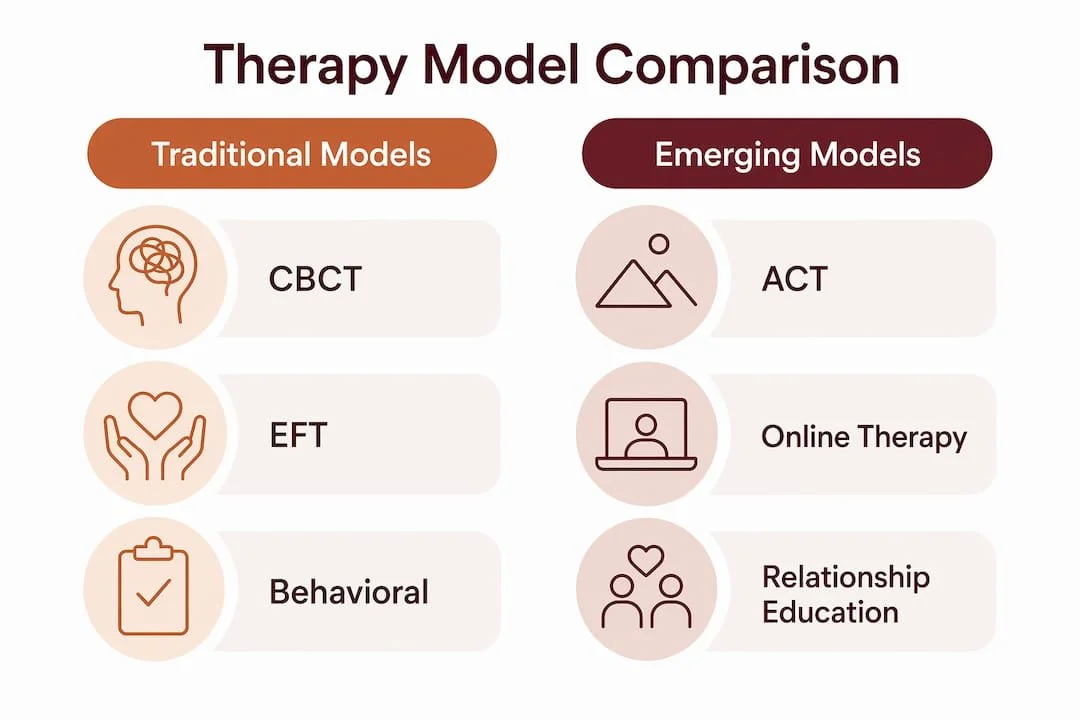
Not every therapy model works the same way, and the differences matter depending on what you and your partner are struggling with. The three most researched approaches are cognitive-behavioral couple therapy, Emotionally Focused Therapy, and Acceptance and Commitment Therapy (ACT). Each targets different mechanisms, and the right model depends on the nature of your relationship challenges.

A 2026 quasi-experimental study compared ACT-based couple therapy directly against CBCT and found that ACT produced greater reductions in cognitive distortions and stronger improvements in emotional intimacy, with stable gains at three-month follow-up. That result is significant because cognitive distortions, such as catastrophizing a partner's behavior or assuming negative intent, are often the hidden engine behind recurring conflict. A 2026 meta-analysis of 68 primary studies on ACT reported effect sizes of 1.325 for positive relationship indicators and 0.428 for negative indicators, confirming a moderate to large overall effect. High heterogeneity across those studies means the results vary by couple type and outcome measure, so no single number tells the whole story.
| Therapy model | Core mechanism | Key strength | Best suited for |
|---|---|---|---|
| Cognitive-Behavioral Couple Therapy (CBCT) | Restructuring negative thought patterns and communication habits | Consistent gains in communication and marital commitment | Couples with entrenched conflict patterns and communication deficits |
| Emotionally Focused Therapy (EFT) | Rebuilding emotional attachment bonds | Large effect sizes on intimacy and adjustment, sustained at follow-up | Couples experiencing emotional distance or attachment insecurity |
| Acceptance and Commitment Therapy (ACT) | Reducing cognitive distortions and improving emotional flexibility | Superior reduction of rigid thinking and emotional disengagement | Couples where one or both partners struggle with emotional regulation |
CBCT remains the most replicated model in the literature, which is why the 2025 systematic review identified it as the most consistently effective approach for marital commitment. EFT has fewer large-scale replications but produces some of the largest individual effect sizes. ACT is the newest of the three in couples research and is showing strong early results, particularly for couples where emotional rigidity is the core problem.
Pro Tip: Before your first session, write down the three recurring arguments you and your partner have most often. Bring that list to your therapist. It helps them identify which model or combination of techniques fits your specific dynamic.
What factors influence the success of couples counseling?
Therapy model is only one piece of the equation. Several other variables determine whether you and your partner walk away with lasting change or temporary relief.
Therapist neutrality. Harvard Health describes effective couples therapy as a structured space where the therapist guides both partners toward new interaction skills without assigning blame. When a therapist takes sides, the process breaks down. Neutrality is not passivity. It is the active skill of holding both partners' experiences simultaneously.
Willingness to practice between sessions. Ongoing guided practice beyond sessions is what converts in-session learning into lasting change. Couples who treat therapy as a one-hour-a-week event without applying skills in daily life see slower and less durable results.
Safety and appropriateness. ABC News notes that couples counseling is not appropriate in relationships involving violence or coercive control, where safety planning and individual support take priority. Couples counseling assumes a baseline of mutual respect and physical safety.
Realistic expectations. Managing expectations about the therapy process is a predictor of engagement. Couples who expect immediate resolution often disengage when early sessions feel uncomfortable or slow. Progress in therapy is rarely linear.
Therapist fidelity to the model. Real-world effectiveness varies partly because not every therapist applies a given model with equal skill or consistency. Asking a prospective therapist about their training in a specific approach, such as EFT or ACT, is a reasonable and useful question.
The therapist's role as a neutral guide who builds new interaction patterns rather than adjudicating past grievances is one of the most consistent findings across effectiveness research. Couples who understand this going in tend to engage more productively from the first session.
Are online couples therapy and relationship education effective alternatives?
Online formats have moved well beyond a pandemic-era workaround. A systematic review of nine online couple relationship education programs involving more than 2,000 couples found promising improvements across relational and individual outcomes, including relationship satisfaction, conflict patterns, and health measures. The review does not produce a single definitive effectiveness percentage, but the breadth of outcomes studied across that many couples is meaningful evidence of real-world impact.
The practical advantages of online therapy are significant for many couples:
Accessibility. Couples in rural areas, those with demanding work schedules, or partners who travel frequently can maintain consistent attendance in a way that in-person therapy often does not allow.
Reduced logistical friction. Eliminating commute time and scheduling conflicts removes barriers that cause couples to drop out of in-person therapy prematurely.
Comfort for reluctant partners. Some individuals are more willing to try therapy from a familiar environment. That initial comfort can be the difference between engaging and refusing to go at all.
The limitations are real too. Online formats can make it harder for therapists to read nonverbal cues, and some structured exercises are easier to facilitate in person. The outcomes of relationship counseling delivered online are most promising when the program includes interactive elements, live therapist contact, and structured skill practice rather than passive video content alone.
Pro Tip: When evaluating online therapy options, confirm that sessions include live, synchronous contact with a licensed therapist. Asynchronous messaging platforms and pre-recorded courses produce weaker outcomes than real-time, interactive sessions.
Key takeaways
Couples counseling produces measurable, lasting improvements in communication, intimacy, and conflict resolution when couples choose the right therapy model, engage consistently, and practice skills between sessions.
| Point | Details |
|---|---|
| EFT produces large effect sizes | A 2025 study showed significant intimacy and adjustment gains maintained at three-month follow-up. |
| CBT is the most replicated model | Cognitive-behavioral approaches show the most consistent marital commitment improvements across reviewed studies. |
| ACT targets cognitive distortions | A 2026 study found ACT outperformed CBCT in reducing rigid thinking and improving emotional intimacy. |
| Therapist neutrality is non-negotiable | Effective therapists build new interaction skills without assigning blame to either partner. |
| Online therapy shows real promise | Programs involving 2,000+ couples show meaningful relational and individual outcome improvements. |
What I've learned about what actually makes couples therapy work
After years of working with couples at Alvarado Therapy, the pattern I see most clearly is this: the couples who get the most out of therapy are not necessarily the ones in the most distress. They are the ones who come in with genuine curiosity about their own patterns rather than a desire to prove their partner wrong.
The research on couples therapy success confirms what I observe clinically. Therapy model matters, but it is not the whole story. A skilled therapist using EFT with a couple that is emotionally disengaged will outperform a technically correct CBCT protocol applied to the wrong problem. Matching the approach to the actual dynamic in the room is where clinical judgment earns its keep.
What I push back on is the idea that couples should wait until things are at a breaking point before seeking help. The effectiveness of marriage counseling is higher, not lower, when couples come in before entrenched patterns have calcified. Intervening early means there is more flexibility in the system, more goodwill to work with, and more room for the skills to take hold.
The uncomfortable truth is that therapy will ask both of you to change, not just the partner you think is the problem. Couples who accept that going in tend to make faster, more durable progress. The ones who resist it spend the first several sessions in a holding pattern that eats into their results.
— Juiced
Start your couples counseling journey with Alvarado Therapy
Alvarado Therapy offers evidence-based online couples therapy for couples across California, delivered by licensed therapists trained in Emotionally Focused Therapy and cognitive-behavioral approaches. Sessions are available online, making consistent attendance realistic regardless of your schedule or location.
Whether you are navigating communication breakdowns, emotional distance, or recurring conflict, the team at Alvarado Therapy works with you as a couple to build the specific skills your relationship needs. Bilingual services in English and Spanish are available, and the practice is committed to culturally responsive, identity-affirming care. Schedule a consultation to find the right therapist and approach for where you and your partner are right now.
FAQ
How effective is couples counseling on average?
Research shows that evidence-based approaches like EFT and CBCT produce significant improvements in intimacy, communication, and marital adjustment for most couples who complete a full course of treatment. A 2025 EFT study reported large effect sizes maintained at three-month follow-up, and a 2025 systematic review confirmed consistent gains from cognitive-behavioral approaches.
How many sessions does couples counseling typically take?
Most structured couples therapy protocols run between eight and twenty sessions, though the number varies based on the severity of issues and the therapy model used. The 2025 EFT study showing sustained improvements used eight weekly group sessions as its treatment structure.
Is online couples therapy as effective as in-person therapy?
A systematic review of nine online couple relationship education programs involving more than 2,000 couples found promising improvements in relationship satisfaction, conflict, and individual health outcomes. Effectiveness is strongest when programs include live, synchronous therapist contact and structured skill practice rather than passive content delivery.
What type of couples therapy works best for communication problems?
Cognitive-behavioral couple therapy is the most consistently replicated approach for improving communication and marital commitment, according to a 2025 systematic review. Skills-based communication and conflict-resolution training within CBCT show robust, replicable benefits across diverse couple populations.
When is couples counseling not appropriate?
Couples counseling is not appropriate in relationships involving violence or coercive control, where individual safety planning and support take priority over joint sessions. ABC News and clinical guidelines both specify that therapist neutrality, which is central to effective couples work, cannot function safely in the presence of ongoing abuse.
