
EMDR Therapy and Relationships: Heal Trauma, Connect Deeper

TL;DR:
EMDR therapy processes unresolved emotional wounds at the neurobiological level to improve connection and emotional safety. It targets attachment injuries and trauma-driven reactivity, helping partners regulate their nervous systems and rebuild trust. Starting with individual stabilization enhances the effectiveness of joint EMDR sessions in healing relational trauma.
EMDR therapy is a trauma-informed treatment that processes unresolved emotional wounds at the neurobiological level, making it one of the most effective tools available for improving how you connect with the people you love. Eye Movement Desensitization and Reprocessing, the clinical term behind the acronym, does more than reduce PTSD symptoms. It targets the attachment injuries, distorted core beliefs, and nervous system patterns that quietly sabotage relationships. This article explains how EMDR therapy and relationships intersect, what the clinical evidence shows, and how you can use this approach to build the emotional safety and connection you want.
How EMDR therapy works to heal relational trauma
EMDR therapy operates through an eight-phase framework that moves from history-taking and stabilization through active trauma reprocessing and integration. In a relational context, this structure matters because it prevents the therapy from moving faster than your nervous system can tolerate. Phases one and two focus entirely on building internal resources before any trauma memory is touched. That preparation is what makes the deeper work safe.

The core mechanism is bilateral stimulation, typically eye movements, tapping, or auditory tones, applied while you hold a distressing memory in mind. This process activates the brain's Adaptive Information Processing system, which allows traumatic memories to be stored as ordinary past events rather than live threats. When a memory loses its emotional charge, the beliefs attached to it change too. "I am unlovable" becomes "I was hurt, and I survived."
Relational trauma targets in EMDR are often subtler than combat or assault. Emotional neglect and betrayal shape self-worth and affect intimacy just as powerfully as acute trauma. A parent who never validated your feelings, a partner who betrayed your trust, a childhood home where conflict was explosive: these are the wounds EMDR addresses directly. That specificity is what separates it from traditional talk therapy, which often describes the wound without fully resolving it.
EMDR also reduces nervous system hyperarousal, the state where your body reads a partner's raised voice as a survival threat rather than a moment of frustration. When trauma-driven reactivity decreases, you stop responding to your present relationship through the filter of your past pain. That shift alone changes the entire quality of communication.
Pro Tip: Before starting EMDR for relational issues, write down three recurring conflict patterns in your relationship. Bring that list to your first session. It gives your therapist concrete targets and shortens the history-taking phase considerably.
History-taking and case conceptualization
Stabilization and resourcing
Assessment of target memories
Desensitization through bilateral stimulation
Installation of adaptive beliefs
Body scan to clear residual tension
Closure and grounding
Reevaluation at the next session
Clinical applications: using EMDR in couples and individual therapy
Individual EMDR sessions almost always precede joint couples work. Individual stabilization through EMDR prepares each partner's nervous system, enabling more effective joint sessions and genuine relational repair. Attempting couples EMDR before either partner has internal affect regulation is like trying to negotiate a peace treaty while both sides are still under fire.
Once stabilized individually, couples can engage in structured joint EMDR sessions. These often include "witness sessions," where one partner observes the other's reprocessing work without intervening. Witnessing a partner process a childhood wound in real time builds empathy faster than months of verbal explanation. It makes the invisible visible.
EMDR in couples work reduces survival-driven nervous system hijacking, decreasing negative cognitions and increasing self-regulation during conflict. Sessions are typically structured with clear beginnings and endings to prevent dysregulation from carrying into daily life. That containment is not a limitation. It is the clinical design.
Key clinical applications include:
Attachment injury repair: Processing the specific moment a partner felt abandoned, betrayed, or humiliated in the relationship
Negative cognition restructuring: Replacing beliefs like "I am not enough" with adaptive alternatives grounded in present reality
Trigger mapping: Identifying which relational cues activate survival states and targeting the original memories behind them
Dyadic resourcing: Building shared calming rituals that both partners can use when sessions activate difficult material
Emotionally Focused Therapy, developed by Dr. Sue Johnson, pairs exceptionally well with EMDR. EMDR integrates with EFT when used thoughtfully, with EMDR stabilizing the nervous system so that EFT's deeper emotional bonding work can actually land. Without nervous system regulation, EFT interventions often stall because partners cannot access vulnerability when they are in survival mode.
Pro Tip: If you and your partner are both in individual EMDR, consider scheduling a joint check-in session with a couples therapist every four to six weeks. This keeps the relational context in view while individual processing continues.
One clinical nuance worth understanding: EMDR is outcome-neutral in relationships. It does not push you toward staying or leaving. It reduces the survival-based reactions that cloud your judgment, so you can make relationship decisions based on present reality rather than unresolved trauma. That distinction is empowering, not ambiguous.
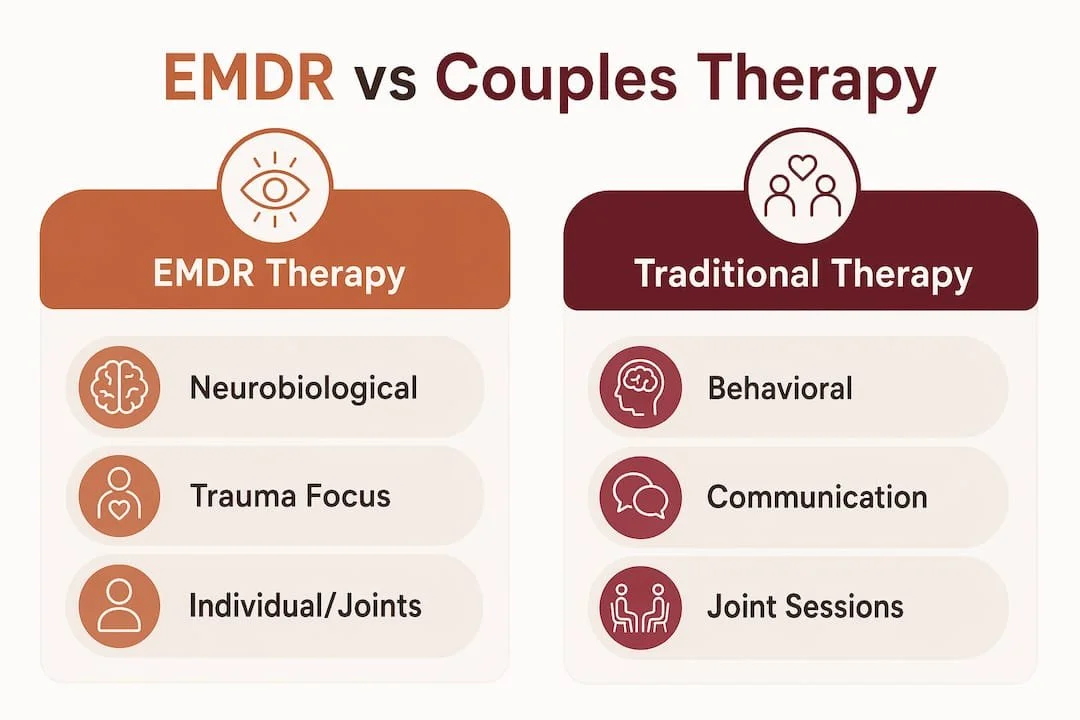
How does EMDR compare to traditional couples therapy?
Most traditional couples therapy models, including the Gottman Method and standard CBT-based approaches, work at the cognitive and behavioral level. They teach communication skills, interrupt negative cycles, and build shared meaning. These are genuinely useful tools. But they have a ceiling when unresolved trauma is driving the conflict.
| Dimension | EMDR-informed therapy | Traditional couples therapy |
|---|---|---|
| Primary focus | Neurobiological trauma reprocessing | Communication and behavioral patterns |
| Entry point | Individual stabilization first | Joint sessions from the start |
| Mechanism | Bilateral stimulation, Adaptive Information Processing | Cognitive restructuring, skill-building |
| Best for | Attachment injuries, trauma-driven reactivity | Communication deficits, conflict patterns |
| Integration potential | High, pairs well with EFT and Gottman | Moderate, less equipped for deep trauma |
Polyvagal Theory, developed by Dr. Stephen Porges, guides how skilled therapists manage two nervous systems simultaneously in couples EMDR work. Tracking each partner's autonomic state, whether they are in a social engagement state, fight-or-flight, or shutdown, determines every pacing decision in the session. Traditional couples therapy rarely operates at this level of physiological precision.
The most common misconception about EMDR in relationships is that it is a quick fix. EMDR functions as a trauma-informed lens rather than a technique, emphasizing pacing and safety over speed. Therapists who rush to trauma reprocessing without adequate stabilization risk destabilizing both partners. The slow approach is the effective one.
Practical steps to start EMDR therapy for relationship healing
Knowing whether you are ready for EMDR in a relational context starts with honest self-assessment. You do not need a formal PTSD diagnosis. If recurring conflict patterns feel automatic, if your partner's tone of voice sends you into shutdown, or if past relationships keep replaying in your current one, EMDR is worth exploring.
Signs that EMDR could benefit your relationship:
You react to your partner with an intensity that surprises even you
Certain topics feel physically unsafe to discuss, not just uncomfortable
You recognize a pattern of choosing partners who recreate familiar pain
Childhood experiences of abandonment, neglect, or abuse surface during conflict
You have tried communication-focused therapy and hit a wall
When looking for a therapist, prioritize someone trained by EMDRIA (the EMDR International Association) or the Trauma Therapist Institute. Ask directly whether they have experience using EMDR in relational contexts, not just individual trauma treatment. The skill sets overlap but are not identical.
What to expect in early sessions: the first two to four appointments focus entirely on history-taking and building internal resources. You will not be asked to reprocess trauma memories until your therapist is confident you can tolerate the activation and return to a regulated state within the session. This is not delay. It is the foundation.
Trauma-informed communication strategies practiced between sessions accelerate the gains made in EMDR. Grounding exercises, co-regulation practices with your partner, and journaling about shifts in reactivity all reinforce the neurobiological changes the therapy is building.
Pro Tip: After each EMDR session, give yourself at least 30 minutes before returning to a demanding environment. The brain continues processing after bilateral stimulation ends, and protecting that window improves outcomes.
Key takeaways
EMDR therapy heals relationships by resolving the attachment injuries and nervous system dysregulation that drive conflict, disconnection, and emotional unavailability at their source.
| Point | Details |
|---|---|
| Trauma drives relational conflict | Unresolved attachment wounds, not communication failures, are often the root cause of recurring relationship problems. |
| Individual work comes first | Building internal affect regulation through individual EMDR prepares each partner for safer, more productive couples sessions. |
| EMDR is outcome-neutral | The goal is nervous system regulation and clearer discernment, not a predetermined relationship outcome. |
| EFT and EMDR complement each other | EMDR stabilizes the nervous system so that emotionally focused relational work can reach deeper levels of connection. |
| Pacing is the therapy | Rushing to trauma reprocessing without stabilization undermines safety and effectiveness in relational EMDR work. |
What I've seen EMDR do for relationships that nothing else could
After working with clients navigating some of the most entrenched relational pain imaginable, the pattern I keep observing is this: people arrive having already done the work. They have read the books, completed the worksheets, practiced the communication scripts. They understand their patterns intellectually. And yet the same fight keeps happening, the same shutdown, the same wall.
What EMDR reaches is the part of the nervous system that does not respond to insight. A client can know, with complete cognitive clarity, that their partner is not their critical parent. But when that partner uses a certain tone, the body does not know that. EMDR changes the body's response, not just the mind's interpretation.
The attachment injuries that shape how we love are often pre-verbal. They were formed before we had language to describe them. Talk therapy, by definition, works in language. EMDR works below it. That is not a criticism of other modalities. It is an explanation of why integration matters so much.
I also want to be honest about what EMDR is not. It is not a guarantee that your relationship will survive. It is not a shortcut past the relational work that still needs to happen between two people. What it does is remove the neurobiological noise so you can finally hear what is actually true for you. That clarity, whatever it leads to, is worth pursuing.
— Juiced
Start your healing with Alvarado Therapy's EMDR services

Alvarado Therapy offers online EMDR trauma therapy for individuals and couples across California, with licensed therapists who specialize in relational trauma, attachment injuries, and complex PTSD. Whether you are working through the aftermath of a painful relationship history or trying to break a pattern that keeps repeating, the team at Alvarado Therapy brings both clinical precision and genuine care to every session. Bilingual services in English and Spanish are available, and the practice is designed to be accessible, trauma-sensitive, and affirming of your full identity. If you are ready to explore what EMDR can do for your relationships, book a consultation and take the first concrete step toward lasting change.
FAQ
What is EMDR therapy and how does it affect relationships?
EMDR (Eye Movement Desensitization and Reprocessing) is a trauma-informed therapy that reprocesses distressing memories at the neurobiological level. By resolving attachment injuries and reducing trauma-driven reactivity, it directly improves emotional safety and connection in relationships.
Can EMDR help with relationship issues even without a PTSD diagnosis?
Yes. EMDR heals relational injuries like emotional neglect, betrayal, and abandonment that affect intimacy and self-worth, not only clinical PTSD. Many people benefit from EMDR for relationship trauma without meeting the full diagnostic criteria for PTSD.
How is EMDR different from traditional couples therapy?
Traditional couples therapy focuses on communication skills and behavioral patterns, while EMDR targets the neurobiological roots of conflict through bilateral stimulation and trauma reprocessing. EMDR fills the gap when unresolved trauma is driving reactivity that communication tools alone cannot reach.
Do both partners need to do EMDR for it to help the relationship?
Not necessarily. Individual EMDR work builds self-regulation and reduces reactivity, which improves relational dynamics even when only one partner participates. Joint couples EMDR is most effective after each partner has completed individual stabilization work.
How long does EMDR take to improve relationship problems?
The timeline varies based on the complexity of trauma history and relational goals. Most clients notice meaningful shifts in reactivity within eight to twelve individual sessions, though deeper relational repair through couples EMDR work typically unfolds over several months.
