
EMDR for Trauma: What Every Adult Needs to Know

TL;DR:
EMDR is a structured therapy that helps reprocess traumatic memories by targeting how they are stored in the brain, reducing their emotional impact. It involves an eight-phase protocol, utilizing bilateral stimulation to change memory storage without requiring detailed trauma narration. Recognized by WHO and APA, EMDR effectively treats PTSD, anxiety, grief, depression, and related conditions through evidence-based, trauma-informed care.
Eye Movement Desensitization and Reprocessing, known as EMDR for trauma, is a structured psychotherapy that enables the brain to reprocess traumatic memories and reduce their emotional intensity. Unlike traditional talk therapy, EMDR does not require you to narrate your trauma in detail or analyze it intellectually. The World Health Organization and the American Psychological Association both endorse EMDR as a frontline treatment for PTSD. Whether you are healing from childhood abuse, a single traumatic event, grief, anxiety, or relationship wounds, EMDR offers a clinically validated path toward genuine recovery.
How does EMDR therapy work to heal trauma?
EMDR therapy works by targeting the way traumatic memories are stored in the brain. Under the Adaptive Information Processing model developed by Francine Shapiro, the brain has a natural capacity to process and integrate experiences. Trauma disrupts that process. Traumatic memories become stuck in a raw, unprocessed state, retaining the original emotions, physical sensations, and distorted beliefs from the moment of the event.

When a memory stays stuck, your nervous system treats it as an ongoing threat. A sound, a smell, or a facial expression can trigger the same flood of fear or shame you felt years ago. EMDR does not erase those memories. It changes how they are stored, so they lose their power to hijack your present.
The mechanism behind this shift is bilateral stimulation. During EMDR sessions, a therapist guides your eyes back and forth, or uses taps or tones alternating between left and right sides of the body. Bilateral stimulation taxes working memory, which prevents your brain from being overwhelmed while it processes the trauma. Researchers theorize this mirrors the natural memory consolidation that occurs during REM sleep, when the brain sorts and integrates the day's experiences.
The result is that memories remain accessible but lose their distressing charge. You remember what happened without reliving it.
Pro Tip: If you are comparing approaches, read about EMDR vs. talk therapy before your first consultation. Understanding the difference helps you ask better questions and set realistic expectations.
What are the 8 phases of EMDR therapy?
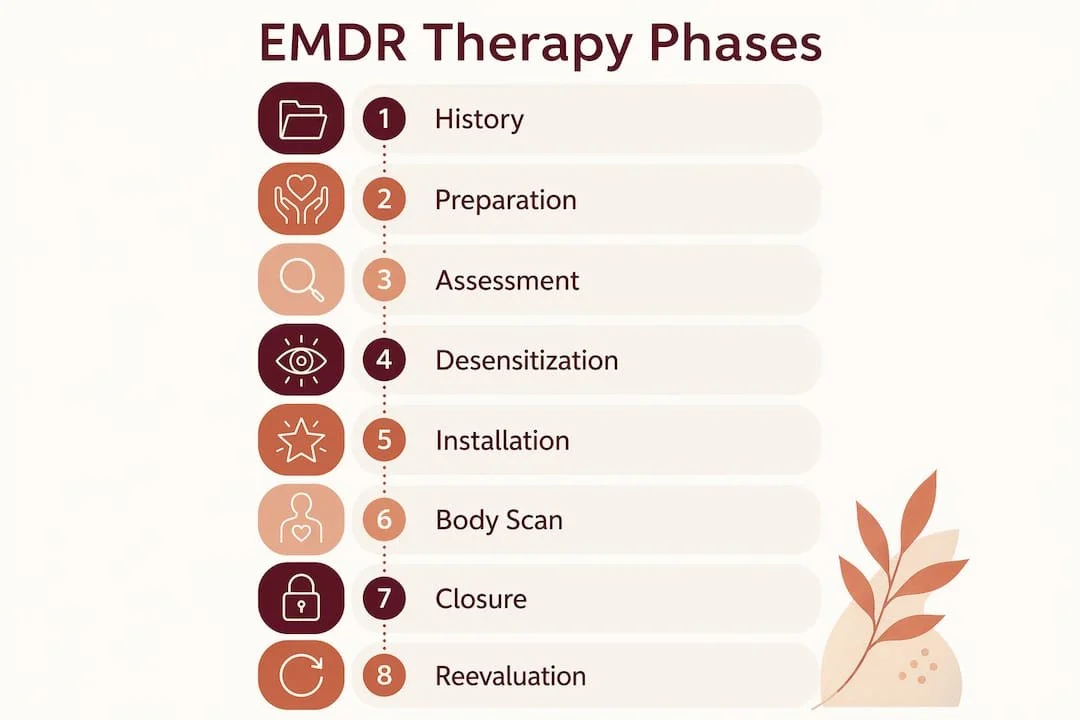
EMDR follows a precise, eight-phase protocol. Each phase has a specific purpose, and skipping steps undermines the entire process. Here is what each phase involves:
History and treatment planning. Your therapist gathers a full picture of your history, identifies target memories, and maps out a treatment sequence.
Preparation. You learn grounding techniques, breathing exercises, and how to create a mental "safe place." This phase builds the emotional stability you need before touching difficult material.
Assessment. You and your therapist identify the specific image, negative belief, emotion, and body sensation connected to the target memory. You also rate your distress on the Subjective Units of Distress Scale (SUDS).
Desensitization. This is the core processing phase. You hold the trauma image in mind while bilateral stimulation begins. Clients report spontaneous shifts in thoughts, feelings, and physical sensations across multiple sets of stimulation. The therapist checks in between sets and guides you through until distress drops to a neutral level.
Installation. The therapist helps you strengthen a positive belief to replace the negative one. For example, "I am powerless" becomes "I handled it. I am safe now."
Body scan. You mentally scan your body for any residual tension or discomfort linked to the memory. Remaining physical distress is processed with additional bilateral stimulation.
Closure. Every session ends with grounding and stabilization, whether processing is complete or not. You leave with tools to manage any emotions that surface between sessions.
Reevaluation. At the start of the next session, your therapist checks whether the previous session's gains held and whether new material has emerged.
Pro Tip: Phase 2 is where many clients underestimate the work involved. The stronger your stabilization skills, the more productive your desensitization sessions will be. Do not rush past preparation.
| Phase | Primary goal |
|---|---|
| History and planning | Identify target memories and treatment sequence |
| Preparation | Build emotional regulation and safety skills |
| Desensitization | Reduce distress linked to the trauma memory |
| Installation and body scan | Strengthen positive beliefs and clear physical residue |
| Closure and reevaluation | Stabilize between sessions and confirm lasting change |
For a detailed walkthrough of the process, the step-by-step EMDR guide at Alvaradotherapy covers each phase with practical examples.
How effective is EMDR for PTSD and related conditions?
The evidence base for EMDR is substantial. Over 30 randomized controlled trials demonstrate EMDR's effectiveness for PTSD, with faster symptom reduction compared to traditional talk therapies. The WHO, APA, and the U.S. Department of Veterans Affairs all recognize it as a first-line treatment. That level of institutional endorsement is rare in psychotherapy.
EMDR's reach extends well beyond PTSD. Research supports its use for:
Anxiety and phobias. When anxiety is rooted in a specific distressing memory or experience, EMDR can target that origin directly. You can read more about EMDR for anxiety and how it differs from standard anxiety treatment.
Grief and loss. Complicated grief often involves traumatic elements, such as sudden death or witnessing suffering. EMDR helps process the traumatic aspects so grief can move forward naturally.
Relationship difficulties. Attachment wounds and relational trauma respond well to EMDR. The role of EMDR in relationships is increasingly recognized as a distinct application.
Depression and chronic pain. EMDR shows promise for depression, phobias, and chronic pain conditions linked to distressing memories.
"EMDR is not a quick fix, but it can produce rapid symptom relief that surprises both clients and clinicians. For some people, a handful of sessions achieves what years of talk therapy could not."
One critical nuance: complex trauma requires longer preparation before active processing begins. If you experienced prolonged or repeated trauma, your therapist will spend more time on emotional regulation skills and stabilization. This is not a setback. It is the protocol working correctly.
What to expect during EMDR sessions
Knowing the logistics before you start reduces anxiety and helps you commit to the process.
Session structure and frequency. Standard EMDR sessions last 60 to 90 minutes, typically once or twice a week. A single-incident trauma often resolves in 6 to 12 sessions. Complex trauma, childhood abuse, or long-standing PTSD may require significantly more time.
What happens in the room. You do not need to tell your full story. Clients hold the trauma image in mind while bilateral stimulation does the processing work. This is one of EMDR's most misunderstood features. Many people expect to spend hours recounting painful memories. The actual experience is more internal and less verbal than that.
Emotional reactions between sessions. Processing does not stop when you leave the office. Temporary emotional increases after sessions are common and usually short-lived. Your therapist will give you grounding tools to use at home. Keeping a brief journal between sessions helps you track shifts and bring relevant material back to the next appointment.
Cost and access. Insurance coverage for EMDR aligns with standard psychotherapy rates, and many plans now cover it. Costs vary by location and therapist credentialing. To find a certified EMDR therapist, the EMDRIA (EMDR International Association) directory is the most reliable starting point. Certification from EMDRIA means the therapist has completed approved training and supervised practice hours, not just a weekend workshop.
The therapeutic relationship matters. Therapeutic alliance and patient safety are critical to EMDR's success. The protocol is powerful, but it works best inside a relationship where you feel genuinely safe. If you do not feel that safety with a therapist, it is worth finding someone else before beginning trauma processing.
For those who want faster results, EMDR intensive therapy condenses treatment into multi-hour sessions over consecutive days, which can accelerate progress significantly.
Key takeaways
EMDR for trauma works because it targets the neurological root of distress, not just its symptoms, making it one of the most evidence-supported trauma-focused therapies available.
| Point | Details |
|---|---|
| Core mechanism | Bilateral stimulation reprocesses stuck trauma memories without requiring verbal narration. |
| Eight-phase structure | Each phase serves a specific purpose; skipping preparation undermines the entire treatment. |
| Evidence base | Over 30 RCTs support EMDR’s effectiveness, with WHO and APA endorsement for PTSD. |
| Broader applications | EMDR treats anxiety, grief, depression, chronic pain, and relationship trauma, not only PTSD. |
| Treatment length | Single-incident trauma typically resolves in 6 to 12 sessions; complex trauma requires more time. |
What most people get wrong about EMDR
People come to EMDR expecting a technique. What they find, if they stay with it, is something closer to a renegotiation with their own nervous system.
The biggest misconception I see is that EMDR is just eye movements. It is not. The bilateral stimulation is one component inside a carefully structured eight-phase protocol that includes history-taking, stabilization, body-based processing, and reevaluation. Strip out the preparation phases and you do not have EMDR. You have a potentially destabilizing experience with no container.
The second misconception is that faster is always better. Some clients push hard to get into desensitization immediately because they want relief. But the preparation phase is where the real foundation gets built. Clients who rush it often hit a wall in phase four, because they lack the emotional regulation tools to stay present when difficult material surfaces. Patience in the early phases pays off significantly later.
The third thing worth saying plainly: EMDR can feel strange. Sitting quietly, holding a painful image, following a therapist's fingers, and then noticing that your feelings about the memory have genuinely shifted. It does not match what most people expect therapy to look like. That unfamiliarity makes some people skeptical. The research does not care about that skepticism. Thirty-plus randomized controlled trials are a strong argument.
If you are on the fence, the most useful thing you can do is schedule a consultation with a certified therapist and ask direct questions. The therapeutic relationship is not a bonus feature. It is part of the treatment.
— Juiced
Start healing with Alvarado Therapy's EMDR services

Alvaradotherapy offers online EMDR trauma therapy for adults across California, with licensed therapists who specialize in PTSD, complex trauma, grief, anxiety, and relationship difficulties. Sessions are available in both English and Spanish, with a trauma-informed, identity-affirming approach that meets you where you are. If you are dealing with PTSD or complex trauma, the team at Alvaradotherapy provides specialized care tailored to your history and goals. Ready to take the first step? Book a consultation and find out whether EMDR is the right fit for your healing.
FAQ
What is EMDR therapy used for?
EMDR is primarily used to treat PTSD, but research supports its application for anxiety, depression, grief, phobias, chronic pain, and relationship trauma. The WHO and APA both endorse it as a frontline treatment for trauma-related conditions.
Do you have to talk about your trauma during EMDR?
No. EMDR does not require you to narrate your trauma in detail. Clients hold the memory in mind while bilateral stimulation facilitates processing, which means the work is largely internal rather than verbal.
How many EMDR sessions does it take to see results?
Single-incident trauma typically resolves in 6 to 12 sessions. Complex or repeated trauma requires a longer course, often with extended preparation phases focused on emotional regulation before active memory processing begins.
Is EMDR covered by insurance?
Many insurance plans cover EMDR at standard psychotherapy rates. Coverage varies by provider and location, so confirm with your insurer before starting treatment.
How do I find a qualified EMDR therapist?
The EMDRIA directory is the most reliable source for certified EMDR therapists. Certification means the therapist has completed approved training and supervised clinical hours, not just introductory coursework.
Recommended
EMDR Therapy for Trauma: Steps, Effectiveness & Help in California — Alvarado Therapy
EMDR Intensives: Rapid Healing for Trauma Survivors — Alvarado Therapy
EMDR for anxiety treatment: A California adult's guide — Alvarado Therapy
EMDR Therapy in PTSD Recovery: Lasting Change and Hope — Alvarado Therapy
