
Step by Step Guide to Couples Communication
TL;DR:
Most relationship failures are caused by poor communication skills, not lack of love. Building emotional safety through structured practices and mutual commitment can improve conversations and resilience. Professional therapy offers additional support when self-guided efforts stall or involve deeper issues.
Most couples don't fail because they stopped loving each other. They fail because nobody taught them how to talk. If you've ever watched a small disagreement spiral into a three-day silence, or felt completely unheard mid-conversation, you already know how fast poor communication can erode something good. This step by step guide to couples communication gives you a practical, therapist-informed workflow you can start using today. Not theory. Not platitudes. Real exercises, real scripts, and a structure that builds emotional safety over time.
Table of Contents
Key Takeaways
| Point | Details |
|---|---|
| Mindset first, skills second | Approach communication improvement as a shared project, not a blame exercise. |
| Structure creates safety | Scheduled check-ins and predictable formats reduce defensiveness before conversations begin. |
| Feeling heard beats being right | 69% of relationship conflicts are perpetual, making empathy more useful than problem-solving. |
| Small habits compound fast | A 7-day communication plan builds lasting skills through daily, low-pressure practice. |
| Professional support accelerates growth | Couples therapy deepens communication skills and helps partners work through stuck patterns. |
Before you start: building the right foundation
The biggest mistake couples make when trying to improve communication is jumping straight to the hard conversations. That's like training for a marathon by running 26 miles on day one. You need to build the foundation before you test it.
Mutual commitment matters more than individual skill. Both of you need to agree that communication is something you're working on together. Framing this as a shared experiment rather than a correction reduces defensiveness immediately. Instead of "we need to communicate better" (which can sound like an accusation), try "let's try one new thing this week and see how it feels."
Before starting any structured workflow for couples communication, get clear on a few things:
Your communication styles. One partner may go quiet under stress while the other pursues. Neither is wrong, but both need to be understood. Mental health issues like anxiety can create specific communication barriers worth naming upfront.
Your physical space. Difficult conversations should happen somewhere private, comfortable, and screen-free. The kitchen table beats the bedroom. The car is surprisingly effective too.
Your timing. Never start a sensitive conversation when either of you is hungry, rushed, or exhausted. Pick a time with at least 30 minutes of uninterrupted space.
Your tools. Keep a small notebook nearby. Writing down key feelings before a conversation helps organize thoughts and reduces the likelihood of going blank mid-discussion.
Here's a quick comparison of reactive versus intentional communication approaches:
| Reactive approach | Intentional approach |
|---|---|
| Conversation starts during conflict | Conversation scheduled in advance |
| No structure, no time limit | Clear format with defined steps |
| Goal is to “win” the argument | Goal is mutual understanding |
| Emotions drive the pace | Agreement to pause when flooded |
| Blame-based language | “I” statements and curiosity questions |
Couples who believe that relationships succeed through intentional effort, not luck or compatibility, consistently report more satisfying and resilient partnerships. That belief is your starting point.
The 7-day step by step couples communication guide
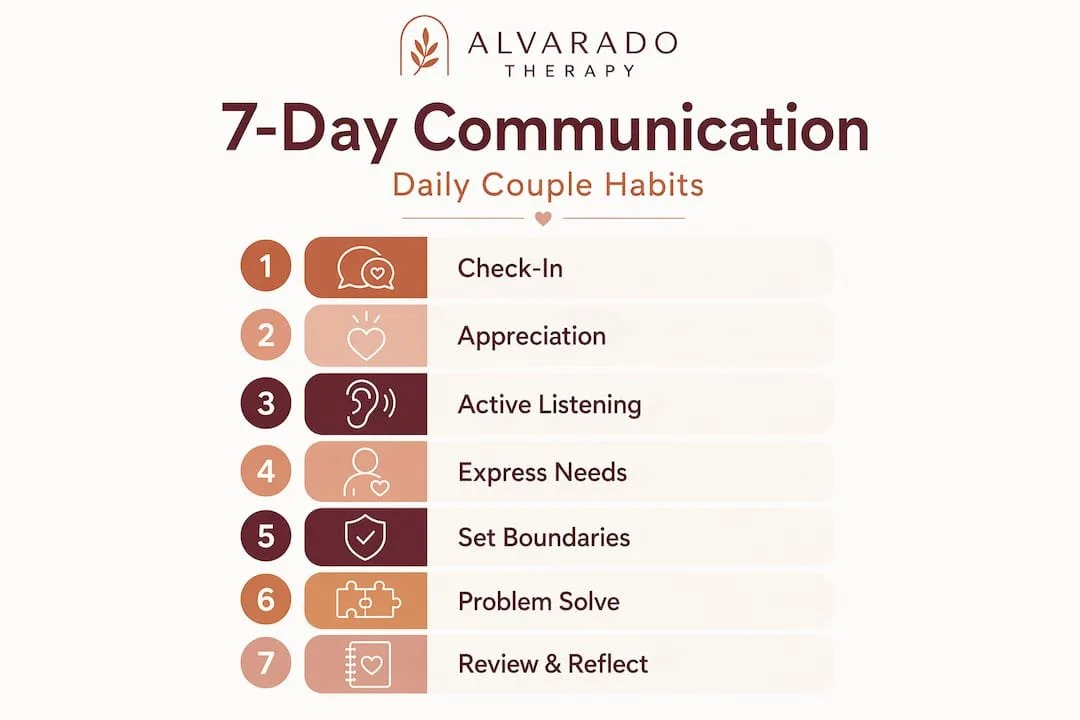
This workflow gives you and your partner a structured week of practice. Each day builds on the last. Think of it as a communication gym program, not a one-time fix.
Day 1: The 10-minute check-in. Set a timer. Each partner gets 3 minutes to share one thing that went well today and one thing that felt hard. No interruptions. No advice. Just listening. This builds the habit of daily emotional contact.
Day 2: Appreciation rounds. Each partner shares three specific things they appreciate about the other. Not "you're a great partner." Specific: "I noticed you made coffee before I woke up, and it made me feel cared for." Specificity signals that you actually see each other.
Day 3: Reflective listening practice. One partner speaks for 2 to 3 minutes on a low-stakes topic, like a work frustration or a logistical stress. The other listens, then paraphrases what they heard before responding. This Mirroring Dialogue technique slows reactions, prevents escalation, and ensures both partners feel genuinely understood.
Day 4: The "I" statement workout. Practice replacing blame statements with "I" statements. "You never listen" becomes "I feel dismissed when I'm interrupted." Write three examples from real situations in your notebook, then share them calmly. This is about building the reflex, not relitigating past fights.
Day 5: Bid tracking. Throughout the day, notice when your partner makes a "bid" for connection: a comment, a question, a touch, a joke. At the end of the day, share one bid you noticed and how you responded. Couples who engage in these intentional, structured conversations build trust steadily and reduce misunderstandings over time.
Day 6: The soft startup conversation. Choose one real, mildly sensitive topic and practice opening it without blame. Start with "I've been thinking about..." or "I want to share something, and I'm not looking for a solution yet." This technique is especially useful before conversations that have historically triggered defensiveness.
Day 7: The stress-reducing talk. Spend 20 minutes discussing an external stressor, something outside the relationship like work, money worries, or family dynamics. The rule: your partner's only job is to listen and empathize. No advice unless asked. Gottman Institute research consistently identifies this kind of daily stress-reducing conversation as one of the strongest predictors of long-term relationship satisfaction.
Pro Tip: After Day 7, repeat the week but raise the stakes slightly. Move from low-stakes topics to ones that carry a little more emotional weight. You're training your nervous systems together, not just learning scripts.
Here’s a quick reference for the week:
| Day | Exercise | Goal |
|---|---|---|
| 1 | 10-minute check-in | Daily emotional contact |
| 2 | Appreciation rounds | Strengthen positive regard |
| 3 | Mirroring Dialogue | Active listening and validation |
| 4 | “I” statement practice | Replace blame with ownership |
| 5 | Bid tracking | Recognize bids for connection |
| 6 | Soft startup conversation | Introduce sensitive topics safely |
| 7 | Stress-reducing talk | Protect relationship from outside stress |
Troubleshooting common communication roadblocks
Even with the best structure, things go sideways. Knowing how to handle that in advance is what separates couples who grow from couples who give up.
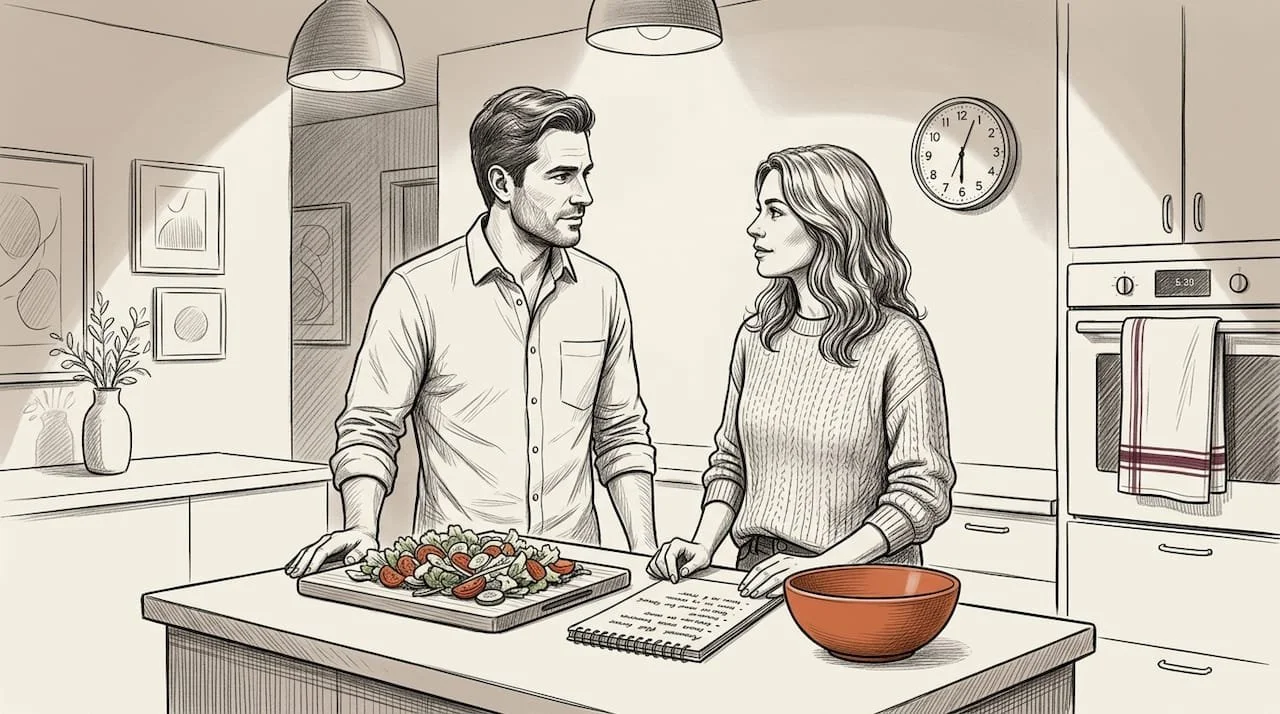
Emotional flooding is the number one derailier. When your heart rate spikes above 100 beats per minute, your brain literally cannot process nuanced information. Continuing to talk at that point makes things worse, not better. The solution is a time-out. Not a storming-off-and-slamming-doors exit. A calm, agreed-upon pause with a specific plan to return. Taking intentional time-outs, paired with a defined "revisit time," helps both partners regulate before continuing.
Here's how to do it well:
Say something neutral: "I'm getting flooded. Can we take 20 minutes and come back to this?"
Agree on a specific time to resume. Not "later." 8:00 p.m. tonight.
During the break, do something physically calming: a walk, deep breathing, or light stretching.
Return at the agreed time, even if you don't feel fully ready. Showing up matters.
Defensiveness kills more conversations than anger does. When someone feels criticized, they stop listening and start preparing their rebuttal. Couples therapist Rachel Diamond notes that prioritizing listening over fixing is what allows couples to actually navigate conflict rather than just endure it.
When you feel yourself getting defensive, name it out loud: "I notice I'm getting defensive right now. Give me a second." That moment of self-awareness interrupts the automatic reaction.
Assumptions are silent relationship killers. Most misinterpretations happen because we assume we know what our partner meant. Before reacting to something that stings, try asking: "When you said that, did you mean...?" That one question has ended more arguments before they started than almost any other technique.
Pro Tip: If you and your partner keep having the same fight in slightly different costumes, the surface issue probably isn't the real issue. Consider what underlying need is going unmet, security, respect, inclusion, affection, and address that directly.
Measuring growth and deepening your connection
Progress in communication rarely feels dramatic. It tends to show up quietly, in moments you almost miss. A conversation that used to take three days to recover from gets resolved in one. You catch yourself pausing before reacting. Your partner asks how you're really doing, and means it.
Watch for these signs that your communication is genuinely improving:
You bring up difficult topics before they become crises
Repairs after conflict happen faster and feel more sincere
You feel curious about your partner's perspective rather than threatened by it
Small annoyances don't get stored up and weaponized during bigger fights
You spend more time in conversations that feel connecting rather than draining
Forgiveness functions as a habit, not just a one-time decision. The couples who build the most resilient communication aren't the ones who never hurt each other. They're the ones who learn to release minor grievances before they calcify into resentment. After resolving a conflict, make a practice of naming it done. "I think we worked through that. I'm not holding onto it." Then actually let it go.
Keep your weekly stress-reducing talks even after things feel better. They serve as an early warning system. When external pressure builds, couples without this habit often redirect that stress at each other. The ones who maintain it notice when life is getting heavy and ask for support before resentment builds.
Dr. Sue Johnson reminds us that couples avoiding conflict need to learn how to engage constructively, because avoidance doesn't preserve connection. It quietly erodes it.
"The couples who thrive aren't the ones who never fight. They're the ones who fight and find their way back to each other." Adapted from Gottman Institute research on relationship resilience.
Revisit the couples therapy process framework periodically, especially after major life transitions like a move, a new job, or having children. Communication needs evolve, and what worked at Year 2 may need adjusting at Year 7.
My honest take on why structure saves relationships
In my experience working alongside therapists and reading the clinical literature deeply, one pattern keeps emerging: most couples don't lack love. They lack a system. They wait until emotions are running hot to try to have the conversations that require the most skill. That's like trying to learn to swim while you're drowning.
What I've found is that the couples who make the most progress fastest are the ones willing to practice when things are already fine. The 10-minute check-in on a good Tuesday builds the muscle memory for when Saturday becomes a war zone.
I've also noticed that people underestimate how much their own communication style is shaped by what they saw growing up, and how much their partner's style was shaped by completely different experiences. Two people can love each other deeply and still be operating from entirely different playbooks. That gap isn't a character flaw. It's just information.
The uncomfortable truth? Attempting to fix conflicts prematurely is one of the most common ways well-meaning couples make things worse. Most people go into a conflict conversation wanting to be understood, but start by trying to explain instead of listen. Flip that sequence. Listen first. Understand first. The solutions tend to follow naturally once both people feel genuinely heard.
My recommendation for couples just starting out: don't try to overhaul everything at once. Pick one exercise from the 7-day plan and commit to it for two weeks before adding another. Small and consistent beats ambitious and abandoned every time.
— Alvaradotherapy
Ready to go deeper? Couples therapy can help
If you and your partner have tried improving communication on your own and keep hitting the same walls, that's not a sign of failure. It's a sign you might benefit from a trained guide.
At Alvaradotherapy, licensed therapists provide online couples therapy designed to meet you where you are, whether you're managing conflict, rebuilding trust, or working through the effects of trauma on your relationship. The practice uses trauma-informed approaches that go beyond communication scripts to address the deeper patterns driving disconnection. If you're ready to explore what professional support could look like for you, book a consultation and take the next step together.
FAQ
What is the first step in improving couples communication?
The first step is establishing mutual commitment to the process and creating a safe, structured space for conversations. Starting with low-stakes exercises like daily check-ins builds the foundation before tackling harder topics.
How long does it take to see improvement?
Most couples notice measurable shifts within two to four weeks of consistent daily practice. The 7-day habit-building plan is designed to create momentum quickly through short, repeatable exercises.
What should you do when a conversation gets too heated?
Take an agreed-upon time-out with a specific plan to return. Intentional time-outs paired with a defined revisit time help regulate emotions and prevent escalation into destructive argument territory.
Why do couples keep having the same argument?
Nearly 69% of relationship conflicts are perpetual, meaning they stem from fundamental differences rather than solvable problems. Reflective listening and acceptance tend to be more effective than repeatedly trying to resolve these issues through debate.
When should couples consider professional therapy?
If self-guided communication strategies haven't produced change after consistent effort, or if past trauma is affecting how you or your partner communicates, working with a therapist can help identify patterns and build skills faster than independent practice alone.
