

Nervous system dysregulation means your autonomic nervous system, the network running your heart rate, digestion, and stress response, gets stuck out of balance. It leans too hard on sympathetic "fight-or-flight" activation, or drops into a dorsal "shutdown" state, and struggles to cycle back to a calm, ventral baseline. The good news: some tools shift your state in minutes. Others, the ones that change your baseline for good, take weeks to months of repetition.
You don't need to memorize physiology to get relief today — a helpful overview is available in the nervous system reset: QHHT and energy healing explained. Here's where to start:
Recognize the signs (physical, emotional, cognitive) before assuming it's "just stress"
Try quick regulation techniques that work in under five minutes
Understand which long-term approaches, including therapy, actually move the needle
Track progress with something measurable, like heart rate variability (HRV), a solid proxy for how well your system recovers
Know when it's time to bring in a clinical option like Alvarado Therapy
Key Takeaways
Nervous system dysregulation is an autonomic imbalance that responds to quick tools in minutes but requires weeks to months of consistent practice, and often therapy, to reset the baseline.
| Point | Details |
|---|---|
| Core definition | Dysregulation means sympathetic activation or dorsal shutdown outpaces the system's ability to recover to baseline. |
| Fast relief tools | Physiological sighs, extended exhales, and cold-water face splashes engage the vagus nerve within minutes. |
| Lasting change takes time | Baseline shifts typically require weeks to months of consistent practice, sleep habits, and exercise. |
| Track it objectively | HRV and resting heart rate trends, paired with a daily energy score, show real progress beyond how you feel. |
| Get help for red flags | Suicidal thoughts, severe dissociation, or major functional decline call for a clinical evaluation, not self-help alone. |
This article is general information, not a substitute for advice from a qualified doctor. Consult a qualified healthcare professional about your own circumstances before acting on anything here.
Table of Contents
What Nervous System Dysregulation Actually Means
Your autonomic nervous system runs on two main gears. The sympathetic branch revs you up for action: faster heart rate, sharper focus, muscles ready to move. The parasympathetic branch brings you back down. Within that recovery branch, researchers distinguish a "ventral vagal" state, where you feel safe and socially connected, from a "dorsal vagal" state, a more primitive shutdown response marked by numbness or collapse.
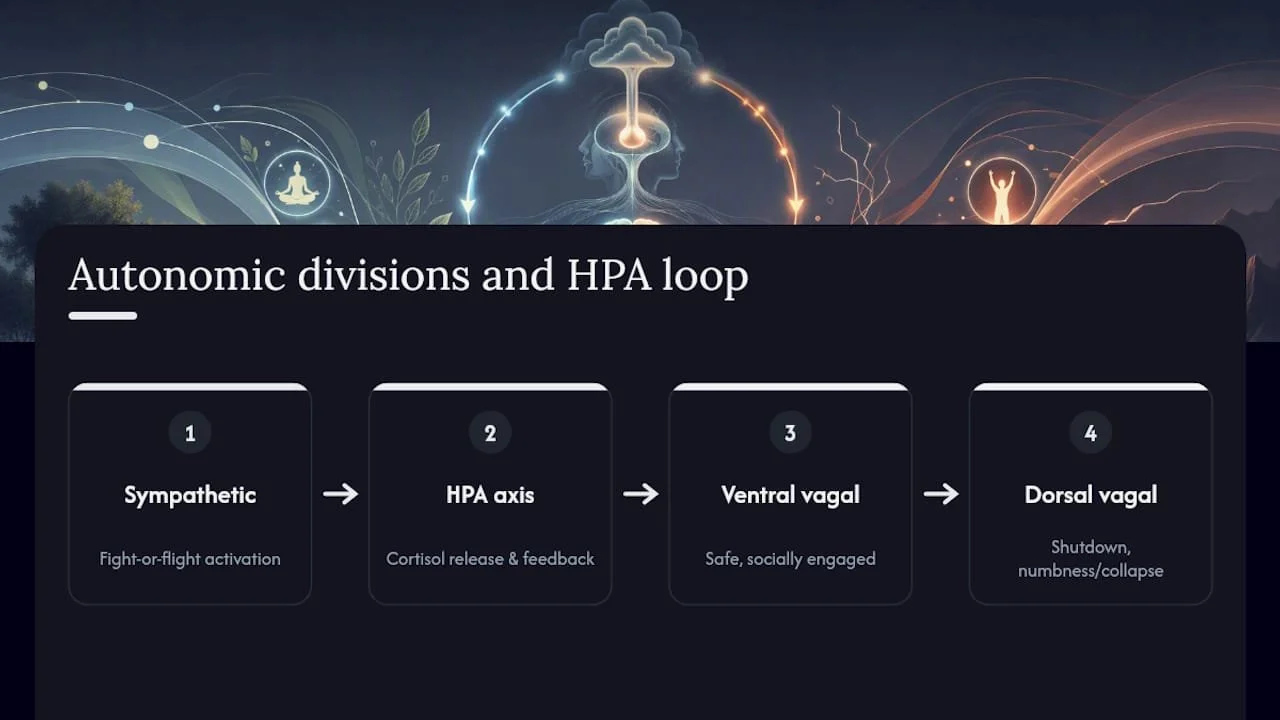
The vagus nerve is the wiring that makes recovery possible. Higher vagal tone means your body can shift out of stress mode efficiently. Layered on top is the HPA axis, the hormonal system that releases cortisol during stress and is supposed to shut itself off once the threat passes.
Dysregulation happens when activation consistently outpaces recovery. You never fully land back at baseline before the next stressor hits, so your system starts treating a mildly irritating email the same way it treats a real threat.
Signs Your Nervous System Might Be Dysregulated
The symptoms show up in three overlapping categories, and most people notice the physical ones first.

Physical signs include disrupted sleep, a resting heart rate that runs higher than it used to, tight shoulders or jaw, and digestive issues that flare with no dietary explanation.
Emotional signs tend to look like anxiety that has no obvious trigger, irritability over small things, sudden mood swings, or the opposite: a flat, numb feeling where nothing quite registers.
Cognitive and behavioral signs show up as brain fog, trouble focusing on a single task, and a pull toward avoidance, canceling plans, ignoring messages, or shutting down entirely when demands pile up.
One thing worth knowing: these signs overlap heavily with anxiety disorders and PTSD, which is why a clinician might treat the dysregulation and the diagnosis together rather than picking one lens. If your sleep, mood, and focus are all off at once, that clustering itself is a clue that your nervous system's baseline has shifted, not just that you're having a rough week.
Why the Nervous System Gets Stuck in the First Place
Modern life is full of low-grade sympathetic triggers. Notifications, rolling deadlines, and financial pressure rarely rise to the level of a real threat, but they still fire the same stress circuitry, over and over, with barely any recovery window between hits.
Early-life adversity changes the baseline before adulthood even starts. Growing up in an unpredictable or unsafe environment trains the HPA axis to run hotter, so the same adult stressor produces a bigger response than it would in someone without that history.
Traumatic brain injury and chronic immune activation belong in this conversation too, even though they get less attention. Both can alter HPA axis reactivity directly, and some TBI patients carry persistent neurobehavioral effects for an extended period afterward.
These factors compound. A person with early trauma and a demanding job isn't dealing with two separate stress loads; they're dealing with a system that reacts more intensely to begin with and gets fewer chances to recover, which sets up the exact feed-forward pattern that keeps dysregulation entrenched.
How to Calm a Dysregulated Nervous System Right Now
These techniques work because they act directly on the vagus nerve, the physiological brake for your stress response. None require special equipment.
Try the physiological sigh. Take a normal inhale through your nose, then a second short, sharp inhale on top of it, followed by a long, slow exhale through your mouth. Two or three rounds can noticeably lower physiological arousal within a minute or two.
Extend your exhale. Breathe in for four counts, out for six or eight. A longer exhale relative to the inhale directly engages the vagus nerve and slows heart rate.
Use the dive reflex. Splash cold water on your face, or hold a cold pack against your cheeks and eyes for 20 to 30 seconds. This triggers a mammalian reflex that drops heart rate almost immediately.
Run a body scan with progressive muscle relaxation. Tense each muscle group for five seconds, then release, working from your feet up to your face.
Ground yourself with the 5-4-3-2-1 method. Name five things you see, four you hear, three you feel, two you smell, one you taste. It pulls attention out of rumination and into the present.
Move for ten minutes. A brisk walk, some jumping jacks, even shaking out your arms and legs helps complete the stress cycle your body started but never finished.
Some people track their progress with HRV biofeedback, wearable-based training that shows your heart rate variability in real time so you can see, not just feel, when a technique is working.
Pro Tip: Pick one technique and use it the same way every time you notice your jaw clenching or your chest tightening. Repetition, not variety, is what teaches your nervous system to expect relief.
Long-Term Approaches That Change Your Baseline
Quick techniques manage the moment. Changing your baseline regulation is a different project, and it usually involves some combination of the following.
Therapy modalities matter and differ. CBT targets the thought patterns that keep sympathetic activation running; DBT builds tolerance for intense emotion without spiraling; EMDR directly processes the traumatic memories that often sit underneath chronic dysregulation.
HRV biofeedback, practiced consistently over weeks, trains your body to recognize and reinforce its own calming response.
Foundational habits count more than people expect. Regular aerobic exercise, consistent sleep timing, and steady nutrition all support a nervous system that can recover efficiently between stressors.
Transition rituals train safety. Passive rest, scrolling, TV, doesn't necessarily signal safety to your nervous system the way a deliberate ritual does: changing clothes after work, a short walk, five minutes of breathwork before dinner.
Co-regulation matters. Safe relationships, including a trauma-informed therapist, help your nervous system borrow stability until it can generate more of its own.
Self-help tools are genuinely useful, but for chronic or trauma-linked dysregulation, they tend to work best paired with structured clinical care rather than standing in for it. You can also read more about emotional dysregulation's causes and treatment if you suspect a deeper pattern is driving your symptoms.
How Long Does Nervous System Regulation Actually Take?
A physiological sigh can shift your state in under two minutes. Rebuilding your baseline is slower: expect weeks to months of consistent practice before your resting nervous system feels different.
Recovery speed depends on your trauma history, how well you're sleeping, whether stressors are ongoing, and any underlying medical issues. Track progress two ways: a subjective morning energy score (rate it one to ten) and objective markers like HRV or resting heart rate trends over time.
When to Get Professional Support
Certain signs mean it's time to loop in a clinician rather than manage this alone: a major drop in daily functioning, suicidal thoughts, severe dissociation, or shutdown episodes that don't lift.
A clinical evaluation typically leads to therapy (often CBT, DBT, or EMDR), sometimes a biofeedback referral, and occasionally medication when symptoms warrant it. Alvarado Therapy offers trauma-informed, bilingual care across California and New York, including EMDR intensives and online therapy for people who want structured support without a long commute. If your dysregulation traces back to trauma specifically, their PTSD and complex trauma program is built for exactly that.
Practitioner note: pairing immediate skills with long-term care
Use the quick tools for relief now, but don't mistake calm for cured. Dysregulation isn't a broken system, it's an adaptive one that needs more capacity, built through consistent practice and, often, therapy.
— Juiced
Sources
Can’t Calm Down? Learn How to Regulate Your Nervous System — UHealth
Review on experiential factors influencing HPA axis reactivity — PMC/NCBI
Stuck in survival mode: How to regulate your nervous system — Stanford Lifestyle Medicine
