
Anxiety After Loss for Adults: 3 Triage Steps to Stop Panic
Anxiety after loss is a normal grief reaction, not a sign that something is wrong with you. When panic hits, ground yourself first: name five things you see, slow your breathing, and tell someone you trust what's happening. If the fear doesn't loosen its grip, or you're having thoughts of harming yourself, that's the point to call a professional or a crisis line rather than wait it out.
TL;DR:
Grief-related anxiety is often triggered by physical hypervigilance, racing thoughts, and intrusive images, especially in sudden or traumatic losses.
Keeping consistent sleep patterns, engaging in daily movement, and writing about the loss help stabilize the nervous system and reduce anxiety over time.
Anxiety symptoms persisting beyond six to twelve months may indicate complicated grief or an anxiety disorder requiring professional treatment.
Therapy approaches like CBT, trauma-focused therapy, or EMDR are effective, especially when paired with medication for acute symptoms.
Immediate danger signs include thoughts of self-harm or severe symptoms, which require urgent intervention such as calling 988 or visiting an emergency room.
Alvaradotherapy
Support for Grief and Anxiety
Alvarado Therapy offers trauma-informed individual counseling and EMDR therapy for adults navigating grief, anxiety, and difficult life experiences.
Table of Contents
How grief triggers anxiety in the body and brain
Loss doesn't just break your heart. It rewires your sense of safety, and your nervous system responds like something dangerous is still in the room. The brain's threat detection network, centered in the amygdala, stays on alert after a major loss, scanning for the next blow. That's why grieving people report hypervigilance, racing thoughts, and intrusive images of the person or event they lost.
A few patterns show up again and again in the research and clinical literature:
Anticipatory grief raises panic risk. People who watched a loss coming, through a long illness or slow decline, often carry anxiety that started before the death and that doesn't fully resolve after.
Sudden or traumatic losses hit differently. Accidents, overdoses, suicide, and violent deaths tend to produce more intense anxiety and posttraumatic symptoms than an expected loss, according to a peer-reviewed review on trauma and grief.
A prior anxiety history matters. If you struggled with anxiety before this loss, you're more likely to see it intensify and linger now.
None of this means you're broken. It means your body is doing exactly what it evolved to do after a serious threat to your world.
Signs your anxiety is grief-related
Anxiety after loss rarely shows up as one clean symptom. It tends to spread across four areas: how you feel, what you think, what your body does, and how you act. Recognizing the pattern helps you name what's happening instead of just enduring it.
Emotional: waves of dread, sudden panic, fear that someone else you love will die too
Cognitive: intrusive images of the death or loss, trouble concentrating, replaying the same worries on a loop
Physical: heart palpitations, dizziness, nausea, chest tightness, disrupted sleep
Behavioral: avoiding reminders, pulling away from friends and family, drinking or using more than usual
One systematic review and meta-analysis found roughly half of people with prolonged grief also met criteria for a co-occurring anxiety condition. That overlap is common enough that clinicians now routinely screen for anxiety whenever grief looks stuck rather than treat the two as unrelated problems.
Coping strategies for anxiety after loss you can use today
Some tools work in the moment a panic wave hits. Others work because you repeat them daily until your nervous system starts trusting that the world is stable again. You need both.
For an anxiety spike right now:
Run the 5-4-3-2-1 grounding exercise. Name five things you see, four you can touch, three you hear, two you smell, one you taste. It pulls your brain out of the memory loop and back into the room.
Slow your breathing on purpose. Inhale for four counts, hold for four, exhale for six. The longer exhale is what actually calms the nervous system.
Tense and release major muscle groups. Progressive muscle relaxation, starting at your feet and working up, gives anxious energy somewhere to go.
For the days and weeks in between:
Keep a fixed sleep and wake time, even when sleep itself feels wrecked.
Move your body daily, a walk counts, since movement burns off stress hormones that panic leaves behind.
Give yourself one small, doable task each day instead of a full to-do list.
Journal or write an unsent letter to the person you lost. HelpGuide's coping resources point to this kind of processing as genuinely useful, not just symbolic.
Say the hard thing out loud to one person you trust before it curdles into isolation.
Pro Tip: Keep your grounding tool the same every time. Anxiety spikes are disorienting, and a familiar, repeatable script works faster than trying to remember a new technique mid panic.
If panic attacks are frequent or severe enough to disrupt sleep and daily function, a short course of medication prescribed by a doctor can take the edge off while therapy addresses the underlying grief. Medication alone rarely resolves grief anxiety long term, but it can buy you enough stability to do the deeper work.
When anxiety after loss needs professional care
Some anxiety fades on its own within weeks as the shock wears off. Anxiety that stays sharp, or gets worse, past the early months is a different story.
Timeline flag: grief symptoms that remain severe and unrelenting beyond about six to twelve months can point toward prolonged or complicated grief, which Mayo Clinic describes as grief that dominates daily functioning long after the loss.
Functional flag: you can't work, care for yourself or dependents, or leave the house without significant difficulty.
Safety flag: persistent panic attacks, or any thoughts of suicide, mean it's time to get help now, not later.
History flag: clinicians weigh how long symptoms have lasted, how much they impair daily life, and whether you had anxiety or trauma history before this loss.
If you're unsure whether what you're feeling qualifies, that uncertainty itself is a reasonable enough reason to book an appointment and ask.
Treatments that actually help with grief-related anxiety
Therapy for grief anxiety isn't one-size-fits-all, and the right fit depends on how the loss happened and how your symptoms show up.
CBT and grief-focused therapy are typically first-line treatment, targeting the anxious thought loops and avoidance patterns that keep panic going.
Trauma-focused approaches, including EMDR, help when the loss was sudden, violent, or otherwise traumatic and intrusive memories or flashbacks dominate the picture, an approach supported by trauma and grief research.
Medication can reduce acute symptoms short-term but works best paired with therapy rather than used alone.
Questions worth asking a therapist first: Do you have experience with grief specifically? Do you use a trauma-informed approach? Do you offer online sessions if in-person feels like too much right now?
Understanding what therapy actually does during grief can make that first call less intimidating.
If you feel unsafe right now
If you're having thoughts of suicide or facing severe medical symptoms, call 988 or your local emergency number immediately.
Remove access to anything you could use to hurt yourself.
Tell someone right now, in person, by phone, or by text. Don't wait until you feel ready.
Go to your nearest emergency department if symptoms feel medical or overwhelming.
Use a certified crisis text or call line for immediate support, and follow up with local urgent mental health services afterward.
The biological basis of anxiety after loss
Grief anxiety has a measurable physiology behind it, not just an emotional explanation. The amygdala, your brain's alarm system, ramps up activity after a major loss, while the prefrontal cortex, which normally regulates fear, has less bandwidth to keep it in check. That combination is why grieving people describe feeling both terrified and unable to think clearly at the same time.
Stress hormones play a role too. Cortisol and adrenaline surge during acute grief, priming your body for a threat that isn't actually in the room anymore. That's the biological reason your heart races when you smell a familiar cologne or drive past a hospital, your body is reacting to a memory as if it were happening now.
Sleep disruption compounds all of it. Grief often wrecks sleep architecture, and poor sleep independently worsens anxiety regulation, creating a loop where exhaustion feeds fear and fear feeds insomnia. Attachment research adds another layer: losing someone you were deeply bonded to disrupts a biological attachment system that evolved to keep you close to protective figures. Your nervous system, in a very real sense, is grieving the loss of a safety signal it relied on.
None of this is permanent wiring. The same plasticity that let your brain form that attachment lets it recalibrate over time, especially with the right support.
Normal grief anxiety versus an anxiety disorder
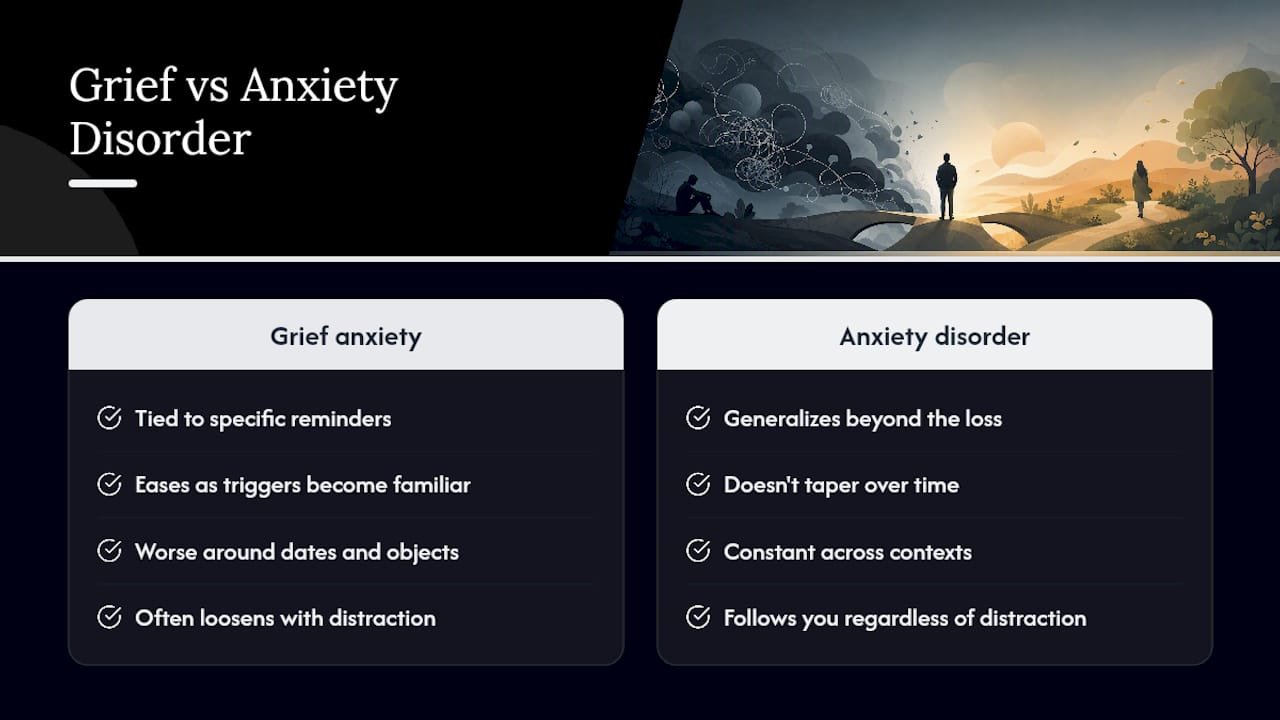
Most anxiety after loss is contextual. It's tied to specific reminders, anniversaries, or a photograph, and it tends to ease as those triggers become more familiar and less charged. That's the pattern clinical sources describe when they note that grief-related anxiety typically stays tethered to reminders of the loss rather than floating free of any cause.
An anxiety disorder looks different. The fear generalizes beyond the loss itself, showing up in situations that have nothing to do with the person or event you lost. It doesn't taper as time passes. It meets diagnostic thresholds for duration and impairment that clinicians use, generally weeks to months of persistent symptoms that interfere with work, relationships, or basic functioning, regardless of whether reminders are present.
The practical test: does the anxiety loosen its grip when you're distracted by something unrelated, or does it follow you everywhere regardless of context? Grief anxiety usually has some texture and rhythm to it, worse around dates, objects, and reminders, better on random Tuesday afternoons. An anxiety disorder tends to flatten that rhythm into a constant hum. If you can't tell which one describes you, that's exactly the kind of question a clinician is trained to sort out, not something you need to diagnose yourself.
How different types of loss shape anxiety
Not all losses produce the same anxiety fingerprint, and it helps to know what's typical for yours.
Death of a loved one often produces the clearest attachment-based anxiety, fear of further loss, hypervigilance about your own or others' health, and intrusive images if the death was sudden or witnessed.
Divorce or relationship breakup tends to generate anxiety centered on identity and future security, worry about being alone, financial instability, or co-parenting logistics, layered with grief for the relationship itself.
Job loss frequently produces anxiety tied to control and self-worth: racing thoughts about money, shame that shows up as avoidance of former colleagues, and sleep disruption driven by financial catastrophizing rather than mortality fears.
Losing a pet, a pregnancy, or a future you'd planned on gets dismissed too often, but the anxiety response can be just as intense because the attachment was real even if the loss doesn't fit a traditional mold.
The common thread across all of these: anxiety after loss is proportional to how much safety, identity, or attachment that loss disrupted, not to how "big" the loss looks from the outside.
Self-care, nutrition, sleep, and exercise for grief anxiety
Self-care during grief isn't a spa day. It's the boring infrastructure that keeps your nervous system from running on empty while it processes something enormous.
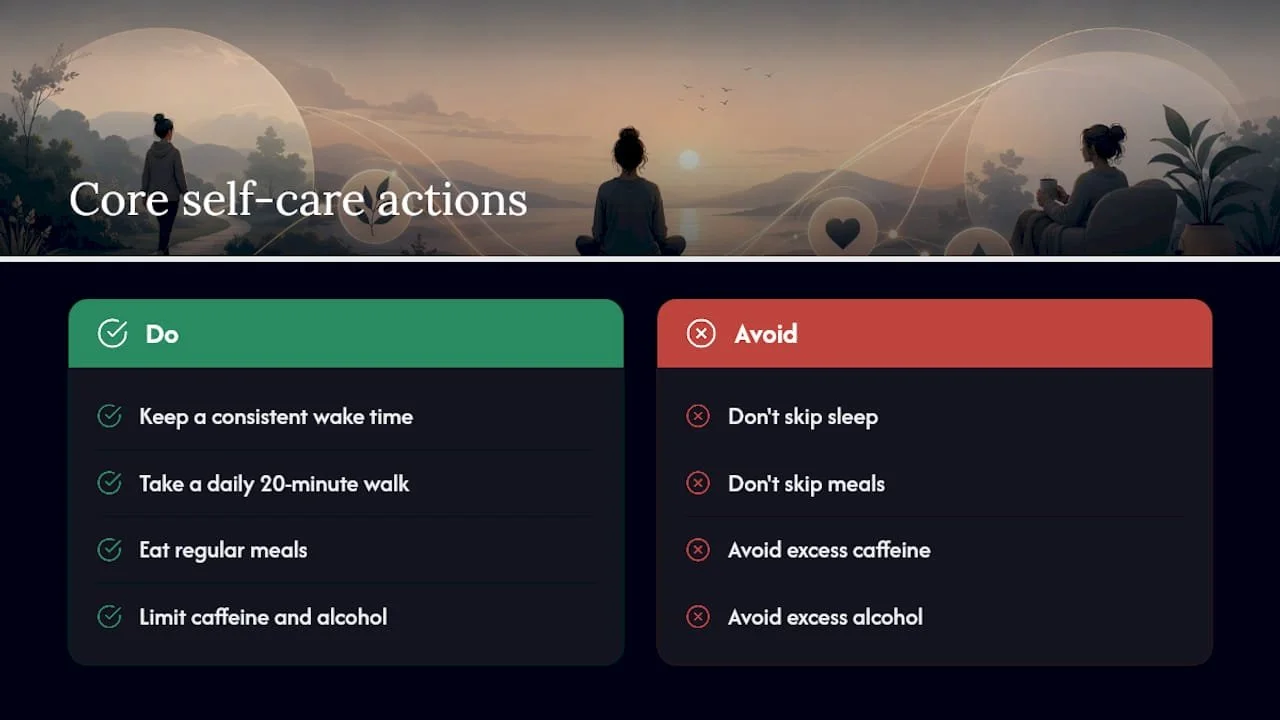
Sleep comes first because sleep deprivation directly amplifies anxiety and impairs the emotional regulation you need most right now. A consistent wake time, even on the days sleep feels impossible, does more for anxiety than any single relaxation technique.
Movement matters because exercise metabolizes the stress hormones that grief anxiety keeps producing. You don't need a gym routine. A daily 20 minute walk changes cortisol patterns enough to notice within a couple of weeks.
Nutrition during acute grief usually gets ignored entirely, but skipped meals and excess caffeine or alcohol both worsen anxiety symptoms directly, caffeine by mimicking panic sensations, alcohol by disrupting sleep quality hours after it wears off.
Readers juggling grief alongside new caregiving demands, a new baby, an aging parent, a sick partner, often burn out fastest because self-care gets deprioritized entirely. A practical self-care checklist built for exactly that kind of overload can help you build the habit even when grief makes everything feel secondary.
The long-term outlook for anxiety after loss
Most people's anxiety after loss softens significantly within the first year, even without formal treatment, as the nervous system recalibrates to a world that no longer contains the person, relationship, or role that was lost. That's the typical trajectory, not a guarantee, and it depends heavily on the type of loss, whether it was traumatic, and whether you had anxiety before it happened.
For the subset of people whose anxiety turns into prolonged grief or a diagnosable anxiety disorder, the outlook with proper treatment is still genuinely good. Trauma-focused therapies and grief-focused CBT both have strong track records for reducing symptoms, and most people see meaningful improvement within a matter of months of starting the right treatment, not years.
Recovery doesn't mean the anxiety vanishes completely or that grief stops mattering. It means the fear stops running the show. Reminders still ache, anniversaries still sting, but the constant hum of dread fades into something you carry rather than something that carries you.
A therapist's note on grief anxiety
Fear after loss isn't a character flaw or a failure to grieve "correctly." Naming it out loud, to a friend or a clinician, tends to shrink the shame that makes it feel unbearable in the first place. Good grief-focused therapy doesn't rush you toward closure. It builds safety first, teaches you to regulate the physical panic, and only then paces you through the harder emotional material, at a speed your nervous system can actually tolerate.
— Juiced
Getting professional support for grief-related anxiety
If grounding techniques and daily routines aren't cutting through the fear, working with a trauma-informed therapist can help you get unstuck. Therapists offer individual counseling, EMDR, and online sessions for clients across California and New York, with clinicians who treat grief and anxiety as connected, not separate problems.
A first appointment typically starts with a conversation about what's been happening, physically, emotionally, and practically, since the loss, so your therapist can build a plan around your specific symptoms rather than a generic script. There's no need to have language for what you're feeling before you show up. If EMDR or trauma-focused work feels relevant because the loss was sudden or traumatic, that gets explored too, along with practical questions about scheduling and insurance. You can read through what to expect in a first EMDR therapy session and reach out to book a consultation when you're ready to talk to someone.
Sources
For more on symptoms, treatment, and support: Mayo Clinic on complicated grief, HelpGuide's coping strategies, and bereavement support resources. If you're in crisis, call 988 immediately.
This article is general information, not a substitute for advice from a qualified doctor. Consult a qualified healthcare professional about your own circumstances before acting on anything here.
