
EMDR Session Length: When Clinicians Choose 60 vs 90 Minutes

Most EMDR sessions run 60 to 90 minutes, with the initial intake often closer to 50 minutes for history-taking. Most clients complete a focused course of EMDR in roughly 6 to 12 sessions delivered weekly, though single-incident trauma can resolve faster and complex or childhood trauma often takes longer. Some people choose an intensive format instead, compressing that timeline into a handful of extended days.
TL;DR:
Most EMDR sessions last 60 to 90 minutes, with active reprocessing typically taking 40 to 60 minutes within that timeframe.
Clients often complete 6 to 12 sessions for straightforward trauma, but complex or childhood trauma may require more than a dozen sessions.
Intensive formats, such as one- or three-day treatments, can condense months of weekly work but demand greater stamina and stabilization.
Progress appears gradually, evidenced by decreasing distress ratings and fewer intrusive memories, and may involve side effects like fatigue or vivid dreams.
Session length and total number depend on trauma complexity, stability, and personal goals, with clinical, personal, and logistical factors influencing pacing.
Alvaradotherapy
Explore EMDR Therapy Options
Alvarado Therapy offers EMDR therapy and EMDR Intensives for Californians healing from trauma, anxiety, grief, and related challenges.
Table of Contents
EMDR Sessions Length: What Happens During the Appointment
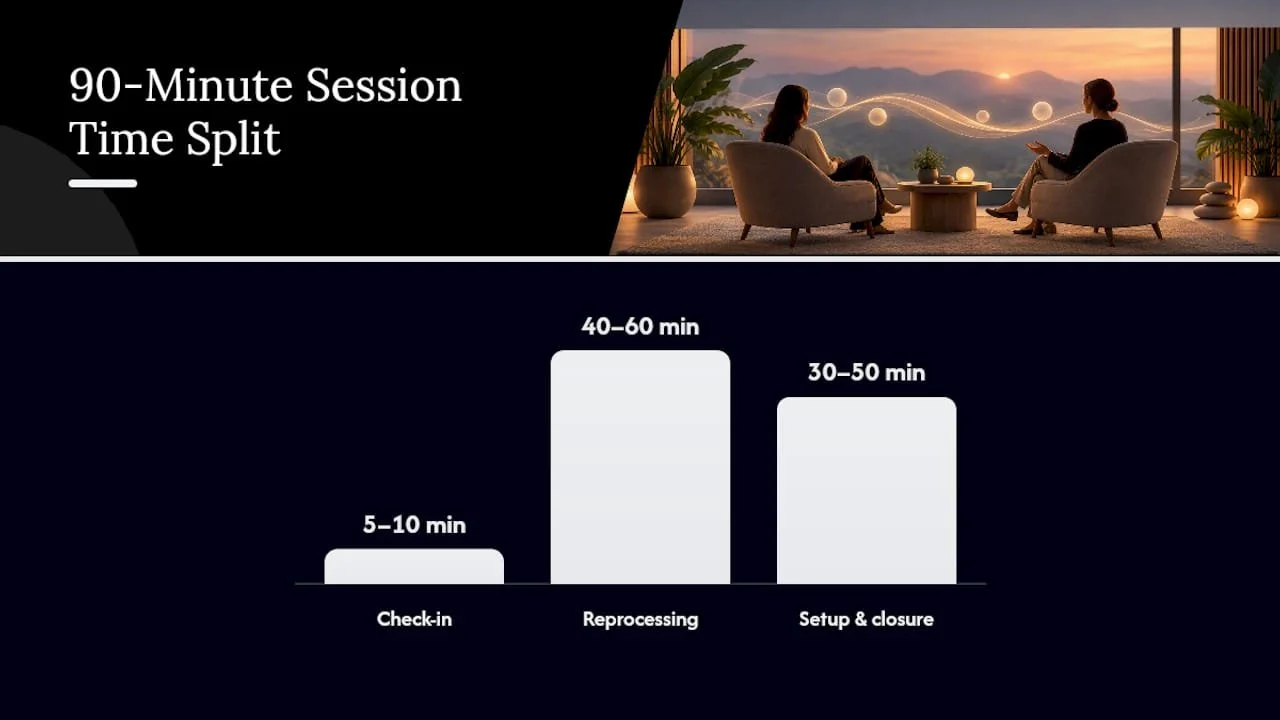
The clock on an EMDR session isn't spent entirely on eye movements. A 90-minute appointment breaks down into distinct phases, and knowing where the time goes helps explain why your therapist books the block they do.
Every session opens with a short check-in, usually 5 to 10 minutes, where you and your therapist review how the week went and check for any lingering activation from the last session. From there, the work depends on where you are in the eight-phase protocol: history-taking and preparation happen early in treatment, while later sessions spend most of their time in active reprocessing.
Check-in and symptom review: 5 to 10 minutes to assess stability and set the session agenda.
Preparation and target assessment (Phases 1 to 3): identifying the memory, image, negative belief, and body sensation tied to it.
Active reprocessing (Phase 4): the desensitization work itself, often the bulk of the appointment.
Installation, body scan, and closure (Phases 7 to 8): grounding you before you leave the room.
Pro Tip: If your session runs long because reprocessing is still active, that's normal. Clinicians deliberately build in buffer time because ending mid-process can leave a memory only partially resolved.
Clinical breakdowns suggest active reprocessing alone can take 40 to 60 minutes within a 90-minute slot, leaving the remaining 30 to 50 minutes split between check-in, setup, and closure. That's the math behind why 60-minute sessions often feel rushed once a client is deep in a target memory, and why many practices default to the longer block once active work begins.
How Many EMDR Sessions Do You Actually Need?
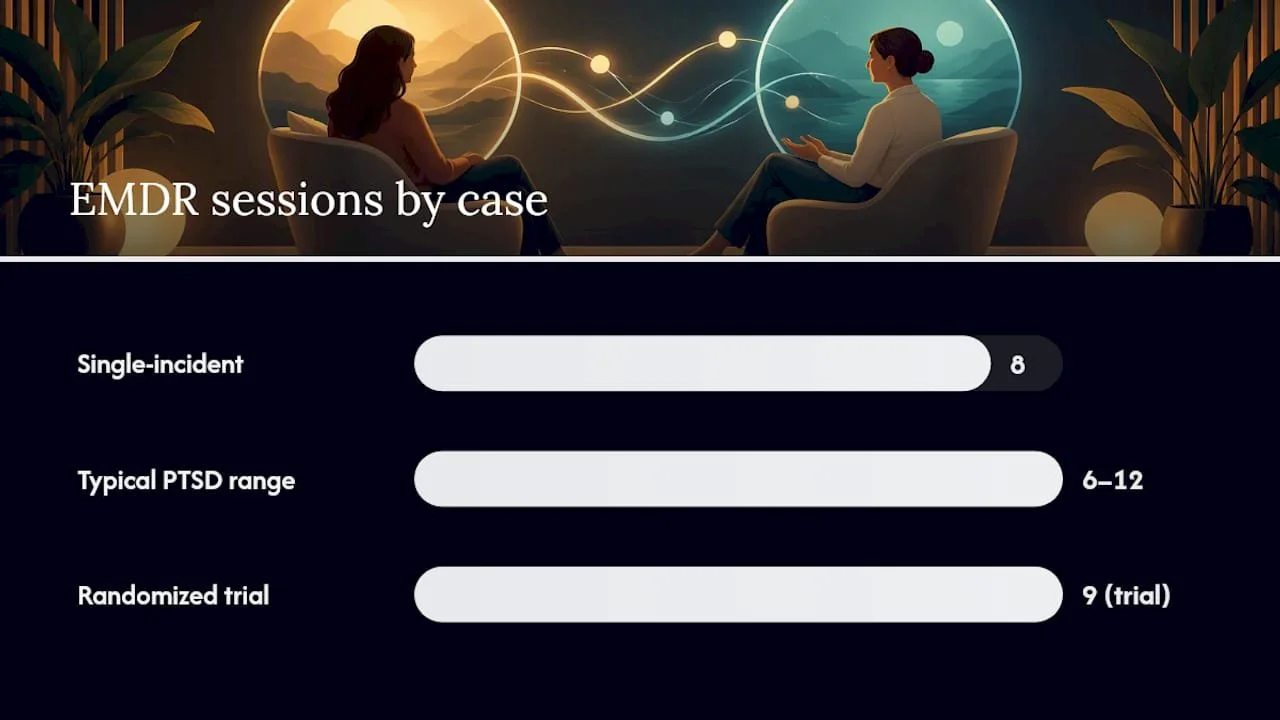
There's no universal number, but the ranges reported across guidelines and trials cluster in a fairly narrow band. For many PTSD cases, 6 to 12 sessions delivered one to two times weekly cover the full arc from history-taking to symptom resolution. The VA's clinical summary echoes this, describing EMDR as commonly administered weekly in sessions up to 90 minutes over roughly three months, though it notes real variability by patient needs.
Trial data backs up the lower end of that range for straightforward cases. One randomized protocol used nine weekly 60-minute sessions, with the very first session dedicated entirely to case conceptualization before any reprocessing began. Single-incident trauma, like a car accident or a single assault, tends to respond faster than trauma with multiple targets or years of accumulated experiences.
Single-incident trauma: often resolves within the 6 to 12 session range, sometimes faster with focused targets.
Complex or developmental trauma: frequently needs a longer stabilization phase before reprocessing even starts, extending the overall timeline well past a dozen sessions.
Comorbid conditions (dissociation, severe depression, active substance use) tend to slow the pace regardless of trauma type.
A closer look at benchmarks by trauma type shows just how wide that range can stretch. Someone processing a single frightening event might be functionally done in eight sessions. Someone unpacking a childhood marked by ongoing neglect may need dozens, not because EMDR is failing them, but because there's simply more material and more nervous system work to do before reprocessing can proceed safely.
Weekly, Twice-Weekly, or Intensive? Choosing a Schedule
Weekly sessions remain the default for good reason. They give you time to integrate each session's work before the next one, and most insurance and scheduling systems are built around that cadence. But weekly isn't the only option, and it isn't always the fastest path to relief.
Weekly sessions. The standard pace, well suited to most clients and to the reimbursement structures most insurance plans expect.
Twice-weekly sessions. Used for complex cases or in intensive outpatient settings where closer spacing helps maintain momentum between reprocessing targets.
Multi-day intensives. Instead of spreading treatment across months, a client works with a therapist for several hours a day across one to three consecutive days, essentially compressing months of weekly work into a short, focused window.
Pro Tip: If you're weighing an intensive, ask directly how many total reprocessing hours it includes. A 1-day intensive and a 3-day intensive aren't just different lengths; they're built for different levels of trauma complexity.
Evidence on massed formats suggests intensives can produce outcomes comparable to weekly delivery for many clients, which is why they've become a popular option for people who travel for care or want to avoid a monthslong commitment. The trade-off is intensity itself. Compressing that much processing into consecutive days demands more stamina and a stronger stabilization foundation going in, so intensives aren't automatically the right call for someone still building basic coping skills.
What Changes Your Session Length and Total Count
Two people with the same diagnosis can end up on very different timelines, and the reasons usually fall into three buckets: clinical, personal, and practical.
On the clinical side, trauma complexity is the biggest lever. A single traumatic memory processes differently than a childhood marked by repeated harm across years, simply because there are more targets to work through. Dissociation and comorbid diagnoses, like severe anxiety or a mood disorder, often mean more time is needed in Phase 2 stabilization before reprocessing even begins.
Number of target memories: more discrete events generally means more sessions, though not always proportionally.
Dissociation or emotional dysregulation: requires additional grounding and stabilization work before active reprocessing is safe.
Nervous system tolerance: some clients process quickly; others need more integration time between sessions.
Prior therapy experience: clients who've done stabilization work elsewhere sometimes move into reprocessing faster.
Insurance and scheduling limits: session caps or availability can shape pacing independent of clinical readiness.
Your goals matter too. Someone aiming to resolve a specific phobia or single incident is planning something very different from someone using EMDR as part of broader work on identity, relationship patterns, or long-standing self-worth issues. The research on EMDR effectiveness generally focuses on symptom reduction, but many clients continue past that point toward deeper, more open-ended change.
What to Expect Between Sessions, and When to Slow Down
Feeling tired after an EMDR session is common, and it doesn't mean anything went wrong. Reprocessing a difficult memory takes real cognitive and emotional effort, and vivid dreams or a temporarily flat mood in the day or two after are typical responses as your brain continues integrating the material.
Progress usually shows up gradually rather than all at once. Watch for lower distress ratings (what clinicians call SUDs, or Subjective Units of Distress) on the same memory across sessions, and fewer intrusive images or flashbacks showing up unprompted during your week. That pattern, more than any single dramatic breakthrough, is the real signal EMDR is working.
Normal aftereffects: fatigue, vivid or unusual dreams, mild mood shifts in the 24 to 48 hours after a session.
Signs of progress: decreasing distress on repeated targets, fewer unprompted intrusive memories, improved daily functioning.
Red flags to raise immediately: escalating instability, suicidal thoughts, or dissociation that doesn't resolve by the end of session.
Pro Tip: Keep a simple log between sessions, just a line or two on mood and sleep. It gives your therapist concrete data to adjust pacing instead of relying on memory alone.
Between-session activation is actually part of how EMDR works for many people, not a sign of failure. That said, if instability keeps climbing rather than settling, that's the moment to slow the pace, extend stabilization work, and revisit your safety plan with your therapist rather than push forward.
How Alvaradotherapy Schedules EMDR Sessions
Deciding between a 60-minute and 90-minute block usually comes down to where a client is in treatment. Early sessions focused on history and stabilization can work within a shorter window; once active reprocessing is underway, a 90-minute slot gives room to reach a stable stopping point instead of cutting off mid-memory.
Intensives get recommended in specific situations: a client traveling from outside the area, someone facing a licensing or immigration deadline, or a person who has done stabilization work already and is ready to move quickly on a defined set of memories. For ongoing complex trauma, weekly individual sessions typically remain the safer, steadier path.
Before your first appointment, it helps to ask a few direct questions:
How do you decide session length as treatment progresses?
What's your approach if I need to pause mid-reprocessing?
Would an intensive fit my situation, or am I better suited to weekly care?
How does insurance reimbursement affect session length or frequency here?
A Clinician's Note on Pacing and Safety
Pacing in EMDR should never feel like it's happening to you. The best sessions are collaborative: you and your therapist deciding together how fast to move, when to extend stabilization, and when you're ready to open up a harder memory. If a session ever feels too intense or too fast, that's worth saying out loud in the room, not powering through silently. A good therapist will slow down, adjust the target, or shift formats entirely if it means keeping the process safe. Bring your pacing questions to intake. Ask directly whether weekly care or an intensive fits your situation better. The answer should come from a conversation, not a default.
— Juiced
Ready to Start? EMDR Options at Alvaradotherapy
Clients can choose between ongoing weekly sessions or a compressed intensive format for trauma-informed EMDR care, allowing their schedule and trauma history to inform the pace of treatment rather than following a fixed calendar.

For clients who want steady, integrative progress, individual EMDR therapy follows the standard weekly rhythm, with 60 or 90-minute sessions adjusted as reprocessing deepens. For clients facing time constraints, travel distance, or a defined set of memories they're ready to work through quickly, Alvaradotherapy offers a 1-Day EMDR Intensive at 4 or 6 hours, priced at $1,500 and $2,250 respectively, and a 3-Day EMDR Intensive at $5,750. Intensives tend to fit single-incident trauma or clients who've already done stabilization work; ongoing complex trauma often benefits more from the steadier weekly pace. Sessions are available in person across Pasadena and Ventura or online throughout California, in both English and Spanish. Reach out to book a consultation and talk through which format fits your history and your timeline.
Sources
Eye Movement Desensitization and Reprocessing – Standard Pro
Eye Movement Desensitization and Reprocessing (EMDR) Therapy — APA
This article is general information, not a substitute for advice from a qualified doctor. Consult a qualified healthcare professional about your own circumstances before acting on anything here.
FAQ
Is EMDR Too Intense for Me?
EMDR is adaptable to your pace, and stabilization work happens before any difficult memory is directly processed. If you have significant dissociation or current instability, your therapist should slow down and build coping skills first rather than jumping into reprocessing.
How Do I Know if EMDR Is Working?
The clearest sign is a drop in your distress rating on a specific memory across sessions, along with fewer intrusive images or flashbacks showing up during your week. Progress in EMDR is usually gradual, not a single dramatic moment.
Is It Normal to Feel Exhausted After EMDR Therapy?
Yes, fatigue after a session is common and reflects the real cognitive effort of reprocessing a difficult memory. Vivid dreams or a temporarily flat mood in the following day or two are also typical and usually settle on their own.
What Happens When EMDR Goes Wrong?
EMDR carries real risk when a session ends mid-reprocessing or when stabilization work is skipped for someone with significant dissociation. That's why therapists deliberately schedule longer session blocks and prioritize a safety plan, so distress can be brought back down to a manageable level before you leave the room.
How Long Is a Typical EMDR Session?
Most EMDR sessions last 60 to 90 minutes, with the initial intake session often shorter, around 50 minutes, since it's focused on history-taking rather than active reprocessing.
