
Don't Call VOCA Therapy. 5 Item Intake Checklist for California Survivors

In California, "VOCA therapy" usually means counseling or victim assistance paid for or supported through Victims of Crime Act grants that flow through the California Governor's Office of Emergency Services (Cal OES) to local agencies. It is a funding source, not a clinical method. If you need help now, call VictimConnect at 855-484-2846, the Cal OES Victim Services Branch at 916-845-8506, or the California Attorney General's Victims' Services Unit at 877-433-9069 for a referral to a local provider.
TL;DR:
VOCA funding in California pays for crisis intervention, advocacy, counseling, and case management, but does not specify or dictate therapy techniques used by clinicians.
Survivors usually get referred through state or local agencies, with VictimConnect or the Cal OES Victim Services Branch offering the fastest, most direct routes to local VOCA-funded care.
It is essential to clarify whether services are grant-funded, free at the point of care, or eligible for reimbursement from CalVCB, especially since some agencies may try to bill for grant-covered services.
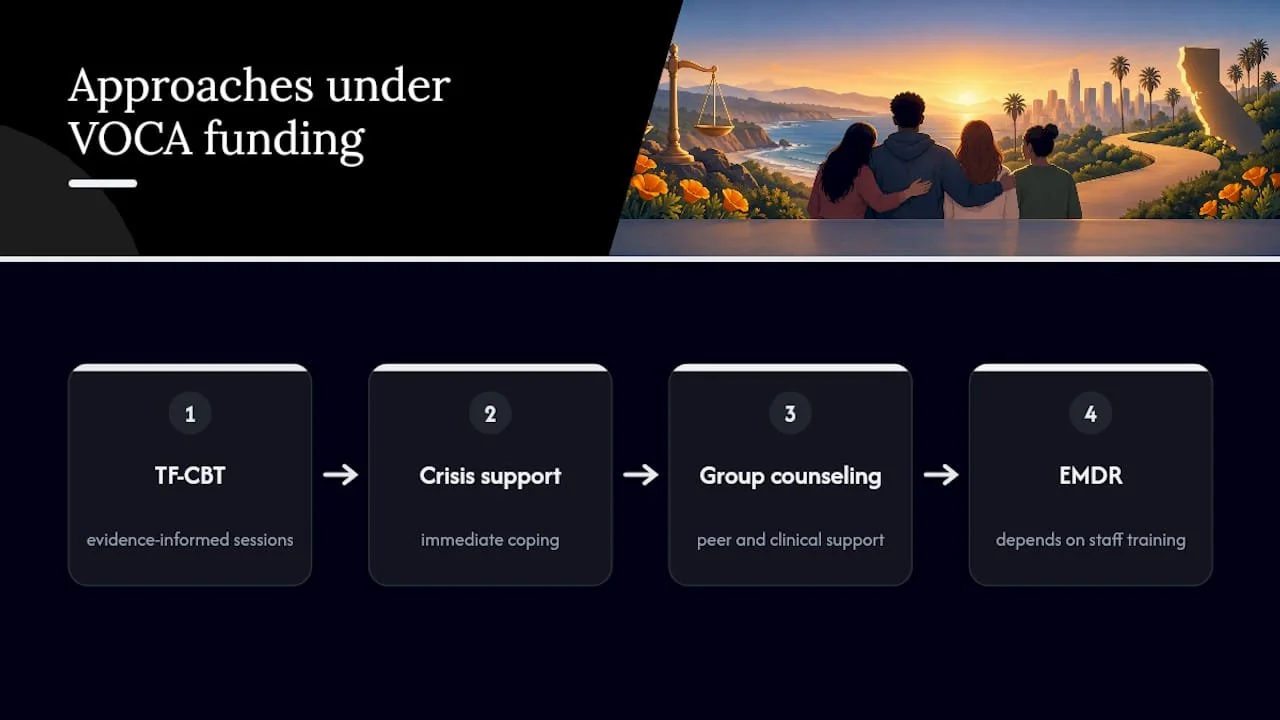
Counseling approaches under VOCA are typically trauma-focused, such as cognitive behavioral therapy, crisis stabilization, group therapy, or EMDR, depending on the provider’s training.
Undocumented survivors are protected in accessing VOCA-funded services, as agencies cannot deny assistance based on immigration status.
Alvaradotherapy
Get Trauma-Informed Support After Crime
Alvarado Therapy supports California survivors through trauma-informed care, including counseling and services for victims of crime.
Explore victims of crime support
Table of Contents
Which Therapeutic Approaches Do VOCA-Funded Programs Actually Use?
How Alvarado Therapy Supports Victims of Crime in California
What VOCA Funding Is and How It Works in California
VOCA stands for the Victims of Crime Act, and it is money, not a treatment. The Office for Victims of Crime (OVC) issues formula grants to states, and California then distributes that money as subgrants to community organizations, tribal programs, and public agencies that provide direct services to crime survivors. None of this money pays for a specific therapy technique. A clinician still chooses whether to use EMDR, cognitive behavioral approaches, or another method. VOCA just determines whether the appointment gets paid for.
Cal OES's Victim Services Branch administers the California side of this pipeline, and its guidance sets real ground rules for how subrecipients operate. One rule matters more than most survivors realize: subrecipients cannot deny grant-funded services based on immigration status. If you are undocumented and worried that seeking help will trigger some kind of immigration inquiry, that fear is not a reason to skip care.
VOCA dollars typically cover:
Crisis intervention and safety planning immediately after a crime
Advocacy through the criminal justice process, including court accompaniment
Individual and group counseling aimed at stabilization
Case management, referrals, and staff training at victim-service agencies
The scope and availability of these services differ by county and by which organization holds the grant, so what one agency offers in Los Angeles County may look different from a rural program in Butte County.
How to Find VOCA-Funded Counseling and Get Referred Fast
Most survivors never apply to VOCA directly. You do not fill out a federal form and wait for approval. Instead, you contact a referral line or a local agency, and staff there tell you what is available and whether it is grant-funded.
Here is the fastest path to an actual appointment:
Call or text VictimConnect at 855-484-2846. This is a confidential, 24/7 referral line, and staff can point you toward VOCA-supported counseling near your ZIP code.
Call the Cal OES Victim Services Branch at 916-845-8506. This state office oversees the subgrant network and can direct you to a subrecipient agency in your county.
Call the California Attorney General's Victims' Services Unit at 877-433-9069. This office is not an emergency line, but it connects survivors to tailored resources when other routes stall.
Contact your county's victim-witness assistance program, often housed inside the district attorney's office, especially if a police report or case number already exists.
Pro Tip: Have your county name ready before you call any referral line. Staff route calls geographically, and naming your county first shaves real time off the intake conversation.
One detail worth knowing before you dial: OVC and Cal OES specifically recommend VictimConnect and the state Victim Services Branch as the two most direct routes into local VOCA-funded care, ahead of searching provider directories cold.
VOCA Services vs. Victim Compensation vs. Private Pay
These are three separate financial paths, and mixing them up leads to confusion at intake. VOCA Victim Assistance funds providers, covering the cost of running counseling and advocacy programs. California's victim compensation program, run by the California Victim Compensation Board (CalVCB), reimburses individuals for eligible out-of-pocket crime-related expenses, including mental health treatment. A grant-funded appointment and a compensation reimbursement are not the same transaction, and a provider can be involved in one, both, or neither.
Because individuals do not apply directly for VOCA grants, the practical question at intake is narrower: is this specific appointment grant-funded, billable to insurance, or private pay? Ask that plainly. Before you commit to a provider, confirm:
Whether the session itself is free at the point of care because of VOCA funding
Whether CalVCB could reimburse costs if VOCA funding is not available or runs out
What documentation, such as a police report number, a claim needs
Whether the agency has capacity right now, since subrecipient funding is finite and some programs maintain waitlists
Cal OES guidance is explicit that agencies receiving VOCA subawards are not supposed to charge victims for services covered by that funding. If a program tries to bill you for something you were told was grant-funded, that is worth questioning directly with the agency's administrator.
A Short Intake Checklist Before Your First Appointment
Walking into an intake call prepared saves time and reduces the chance of a mismatch between what you need and what the provider offers. Before you contact any agency, gather this information:
A brief incident timeline. You do not need a polished narrative, just rough dates and what happened.
The county where the crime occurred, since that often determines which subrecipient agency handles your case.
A police report number, if one exists. Not having one usually does not disqualify you, but having it speeds things along.
Your preferred language, so the agency can match you with a bilingual clinician or arrange interpretation.
Any immediate safety concerns, which intake staff need to know before scheduling anything else.
Once you are on the phone, ask three direct money questions: Is this VOCA-funded? Is it free right now? Could CalVCB reimburse me if it is not? Also confirm whether telehealth is available, whether interpretation is included at no extra cost, and what happens if you miss a session, since policies on missed appointments and follow-up care vary by agency.
Which Therapeutic Approaches Do VOCA-Funded Programs Actually Use?
VOCA money does not specify a treatment model, so the clinical approach depends entirely on which agency holds the grant and who is on staff there. In practice, most VOCA-supported counseling programs in California lean on trauma-focused, evidence-informed methods because that is what victim-service training pipelines emphasize.
You will commonly find:
Trauma-focused cognitive behavioral therapy, which helps survivors process intrusive thoughts and rebuild a sense of safety through structured sessions. Crisis intervention and stabilization work, usually the first service offered after a crime and focused on immediate coping rather than long-term processing. Group counseling, common at community-based agencies serving domestic violence or sexual assault survivors, where shared experience does real work alongside clinical guidance. EMDR (Eye Movement Desensitization and Reprocessing), offered at some subrecipient agencies and widely used in private trauma practices, though its availability under VOCA funding depends on whether staff clinicians are trained in it.
That last point matters. A funding source cannot mandate a technique, so if you have a strong preference, ask directly whether the specific clinician assigned to you practices it. If an agency's VOCA-funded staff does not offer a method you want, that does not mean the method is unavailable in California. It means you may need to look at a private-pay or insurance-based provider for that particular approach.
Your Rights and Confidentiality Under VOCA-Funded Therapy
Confidentiality protections for VOCA-funded counseling generally mirror the same standards that apply to any licensed mental health treatment in California, including therapist-client privilege and HIPAA-related privacy rules where applicable. Grant funding does not weaken those protections, and it does not give Cal OES or OVC access to your clinical records.
Cal OES guidance builds in specific victim-centered protections on top of standard confidentiality rules. Services must be delivered in a trauma-informed way, meaning providers are expected to prioritize your sense of control and safety during sessions rather than treating you as a case file. Subrecipient agencies also cannot deny services based on immigration status, a protection that matters enormously for undocumented survivors who might otherwise avoid seeking help out of fear.
You also retain the right to ask who has access to your records, whether your information is shared with law enforcement (it generally is not, without your consent, outside mandated reporting situations), and whether participating in counseling is tied to your cooperation in a criminal case. It usually is not. VOCA-funded counseling exists to support your recovery regardless of whether you testify, press charges, or otherwise engage with the justice system. If a provider implies otherwise, that is worth raising with the Cal OES Victim Services Branch directly.
If You Do Not Qualify for VOCA-Funded Services
VOCA subrecipient capacity is finite, so waitlists happen, and some agencies serve narrower categories of crime than others. If a program tells you it cannot take your case, that is not the end of the road.
Start with CalVCB, since compensation eligibility rules differ from service-funding eligibility, and you may qualify for reimbursement even when a specific counseling program has no open slots. Next, call VictimConnect again and ask specifically for a private-pay or sliding-scale referral rather than a VOCA-funded one. Many victim-service advocates keep separate referral lists for exactly this situation. You can also ask your county's victim-witness program whether a different subrecipient agency nearby has capacity, since funding availability varies month to month.
Insurance-based therapy remains an option regardless of VOCA eligibility, and many trauma-focused clinicians in California accept both insurance and private pay for survivors who do not fit grant criteria. If cost is the barrier rather than availability, ask any provider directly about sliding-scale rates before ruling them out.
How Alvarado Therapy Supports Victims of Crime in California
Most survivors calling around for help are not looking for a lecture on grant mechanics. They want to know whether a real person will see them soon, and Alvarado Therapy's victims of crime services exist for exactly that reason: trauma-informed, bilingual counseling for adults across Pasadena, Ventura, and online throughout California.
Here is the honest version of how funding conversations go with a private practice like this one. If a VOCA-funded slot is not immediately available through a subrecipient agency, Alvarado Therapy can talk through alternate payment routes during a consultation, including insurance, private pay, or documentation that might support a CalVCB reimbursement claim for eligible sessions. Bring your county, any police report number, and your preferred language to that first conversation. It speeds things up on both ends.
What sets this practice apart is not a funding label. It is EMDR intensives built for survivors who want faster symptom relief than weekly sessions alone provide, delivered by clinicians who work in both English and Spanish. If VOCA coverage is not available at the moment you need it, that should not stall your recovery.
— Juiced
Book a Consultation With Alvarado Therapy
Alvarado Therapy provides individual counseling, EMDR intensives, and bilingual, identity-affirming support with sessions available in California.

Ask about VOCA coverage directly when you book. If a specific appointment cannot be grant-funded, Alvarado Therapy can walk you through what CalVCB reimbursement might cover and help you gather the documentation a claim typically needs. Before your first visit, jot down a rough timeline of what happened, your county, any police report number, and your preferred language, the same details any referral line would ask for.
If you are looking for concentrated trauma processing rather than an open-ended weekly commitment, the 3-Day EMDR Intensive is worth asking about during your consultation. For ongoing support, visit the Victims of Crime page or schedule a consultation to talk through what funding and care options fit your situation.
Sources
If your situation involves an active legal matter, such as a pending arrest or bail decision, resources like this bail overview can help you understand that separate process while you pursue counseling support.
This article is general information, not a substitute for advice from a qualified doctor. Consult a qualified healthcare professional about your own circumstances before acting on anything here.
FAQ
Is VOCA a Type of Therapy?
No. VOCA is federal funding distributed through Cal OES to local agencies, and it pays for services like counseling and advocacy rather than dictating a clinical method. The actual therapy approach depends on the clinician and agency providing care.
How Do I Apply for VOCA-Funded Counseling in California?
You generally do not apply to VOCA directly. Call VictimConnect at 855-484-2846 or the Cal OES Victim Services Branch at 916-845-8506, and staff will refer you to a local subrecipient agency with available capacity.
Can I Get VOCA Services if I'm Undocumented?
Yes. Cal OES guidance states that subrecipient agencies cannot deny grant-funded services based on immigration status. Immigration status should not be a barrier to seeking VOCA-supported counseling.
What's the Difference Between VOCA and CalVCB?
VOCA funds providers and programs, while CalVCB reimburses individual survivors for eligible out-of-pocket expenses, including some mental health costs. They run on separate eligibility rules and documentation requirements.
Does Alvarado Therapy Accept VOCA Funding?
Alvarado Therapy offers dedicated victims of crime services and can discuss VOCA coverage, CalVCB reimbursement, and private-pay options during a consultation. The practice's site provides information about available individual counseling and EMDR intensive services without specific pricing details.
