
56% Remission: Online EMDR Outcomes for Adults, Evidence Based

Online EMDR is effective for many adults dealing with PTSD, anxiety, and depression when a trained clinician delivers it over secure video. Peer-reviewed service evaluations and clinical trials show clinically meaningful improvement on standard measures like the PCL-5, CAPS-5, and GAD-7. The caveats matter just as much as the results: clients need proper screening for dissociation and suicidality, plus a private, stable place to do the work.
TL;DR:
Online EMDR produces symptom reductions comparable to in-person therapy, with effect sizes often above 1.4 in remote intensive treatments for PTSD.
Clients with severe dissociation or recent crises should prefer in-person care, as remote sessions can miss subtle cues and limit immediate safety interventions.
Effective remote bilateral stimulation methods include visual tracking tools, self-tapping, and audio tones, with larger screens offering a significant advantage over phone screens.
Proper screening for suicidality, dissociation, and environment stability is essential to determine if online EMDR is suitable for each client.
Concentrated remote EMDR intensives tend to show the largest effect sizes, with over half of participants losing their PTSD diagnosis within a month post-treatment.
Alvaradotherapy
Explore Online EMDR Support
Alvarado Therapy offers EMDR therapy and online care for California adults healing from trauma, PTSD, anxiety, grief, and relationship difficulties.
Table of Contents
Online EMDR Effectiveness: What the Studies Found
The strongest signal comes from a multi-method service evaluation of online EMDR delivered to people diagnosed with PTSD. Clients showed large reductions in symptoms with no meaningful difference in dropout rates or adverse events compared to in-person treatment. That parity on safety outcomes is arguably more important than the symptom scores themselves. It tells clinicians that moving to a screen doesn't quietly introduce new risks.
A separate study on remote intensive trauma-focused treatment reported an effect size of d = 1.42 pre-to-post on the CAPS-5, climbing to d = 1.70 at six months. Those are large numbers for a mental health intervention delivered entirely through a screen.
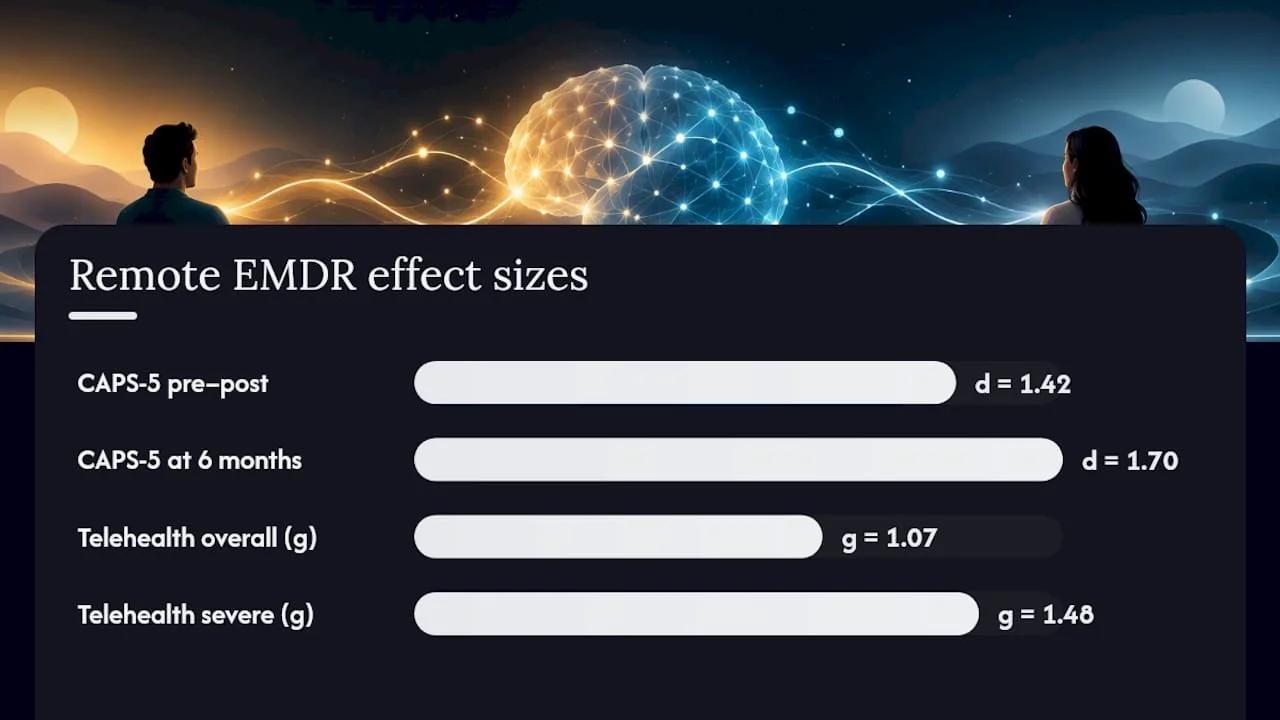
A broader look at telehealth programs combining live therapist sessions with digital support tools found effect sizes of g = 1.07 overall, jumping to g = 1.48 among clients who started with more severe PTSD symptoms, alongside completion rates that beat many internet-only programs according to a real-world telemental health evaluation.
Key findings across the research:
Symptom reductions on PCL-5, CAPS-5, and GAD-7 are consistent across multiple independent evaluations, not a one-off result.
Dropout and adverse-event rates for online EMDR closely track in-person treatment.
A systematic review of virtual EMDR trials confirms the pattern but flags a real gap: too few large randomized controlled trials, and follow-up windows that vary widely from study to study.
The numbers to remember: CAPS-5 effect sizes above 1.4 in remote intensive cohorts, and 56% of participants losing their PTSD diagnosis within a month of treatment ending. Small samples mean these figures deserve confidence, not certainty.
How Do Therapists Deliver EMDR Over Video?
The eight-phase EMDR protocol, the same history-taking, resourcing, desensitization, and installation sequence used in an office, stays fully intact online. Nothing about the underlying therapy model changes. What changes is the mechanics of bilateral stimulation (BLS), the alternating left-right sensory input that distinguishes EMDR from standard talk therapy, and how closely a therapist can observe subtle physical cues through a webcam.
Clinicians typically use one of these approaches for remote BLS:
On-screen visual tracking tools, where a moving dot or bar guides eye movement.
Therapist-guided self-tapping, where the client taps their own knees or shoulders in an alternating rhythm on cue.
Audio tones alternating between left and right earbuds or headphone channels.
Simple low-tech substitutes, like a client tracking a therapist's finger moved side to side on camera.
Screen size, camera angle, and a stable internet connection are not minor details here. A laggy connection can desynchronize audio tones from visual cues, and a therapist who can't see a client's hands or face clearly may miss early signs of distress.
Pro Tip: Use a laptop or external monitor rather than a phone screen for the visual tracking portion. A bigger screen makes eye-movement BLS noticeably easier to follow and reduces eye strain during longer sets.
Who Should Avoid Online EMDR?
Not every client is a good candidate for telehealth EMDR, and a competent clinician will screen for this before starting. Suitability depends less on diagnosis and more on stability, environment, and how the client responds to distress.
Situations that typically call for extra caution or in-person care instead:
Active suicidality or a recent crisis. Remote sessions make it harder to intervene quickly if a client's safety is in question.
Severe or chronic dissociation. Therapists have limited peripheral observation on video, so subtle dissociative cues are easier to miss remotely, and clinicians often prefer a hybrid or in-person approach for these clients.
An unstable or non-private environment. Shared housing, unpredictable interruptions, or no safe room to process trauma work in.
Where telehealth does proceed, clinicians build in specific safeguards: a documented emergency contact in the client's own location, clear pause-and-ground protocols if a client becomes overwhelmed, and a tech fallback (usually a phone call) if video drops mid-session.
Is Online EMDR as Effective as In-Person Treatment
For most adult presentations, the evidence points to rough parity rather than a clear advantage for either format. Multiple service evaluations and trials since 2020 report comparable outcomes on PTSD, anxiety, and depression measures whether EMDR happens in an office or over video.
That said, "comparable" is not the same as "identical," and the exceptions are worth knowing:
Clients with severe dissociative symptoms tend to do better with in-person containment, where a therapist can physically ground them if needed.
Some smaller trials in specific populations, including certain frontline healthcare worker cohorts dealing with acute pandemic-era fear responses, showed mixed results for remote delivery, though these findings are context-dependent rather than a broad strike against telehealth.
Technical interruptions and reduced observation of physiological cues remain real trade-offs, even in evaluations showing strong overall outcomes for telehealth programs.
What the research doesn't yet answer: long-term durability beyond six to twelve months, and how outcomes hold up in large, randomized samples rather than the smaller cohorts most current studies rely on. Anyone citing online EMDR as flatly "just as good" as in-person care is overstating what a handful of mid-sized studies can prove. The direction of the evidence is encouraging. The sample sizes are not yet large enough to call it settled.
What Are Blended Care and Remote EMDR Intensives?
Blended care pairs live therapist sessions with digital tools clients use between appointments, things like symptom trackers, psychoeducation modules, or guided practice exercises. Evidence from real-world telehealth programs suggests this combination improves both retention and outcomes compared to therapy alone or self-guided apps.
Remote EMDR intensives, concentrated multi-hour or multi-day sessions instead of once-weekly appointments, show some of the largest effect sizes in the current research, though cohorts remain small.
Before enrolling in either model, ask a provider:
What follow-up measurement do they use (PCL-5, CAPS-5) and at what intervals?
Are digital modules supervised by a licensed clinician, or self-directed with no oversight? Unsupervised EMDR apps are not currently recommended for independent use.
What are the clinician's credentials and telehealth-specific training?
How to Prepare for a Safe, Effective Online EMDR Session
A little preparation goes a long way toward making a remote session feel as contained as an in-office one.
Test your tech beforehand. Confirm stable internet, working audio and video, and keep a charged phone nearby as backup if the call drops.
Set up your space. Choose a private room, silence notifications, and remove likely interruptions before the session starts.
Build in buffer time. Give yourself 15 to 20 minutes before and after the session, EMDR processing can surface emotion that needs a few minutes to settle before you jump back into your day.
Ask the right questions upfront. Confirm your clinician's license, their telehealth-specific EMDR training, and what their crisis plan looks like if you become overwhelmed mid-session.
Pro Tip: Keep a grounding object, a textured stone, a scented lotion, something tactile, within arm's reach during sessions. If a session becomes too intense, your therapist can guide you to use it as a quick sensory anchor back to the present moment.
Why Trust This Guide on Online EMDR
This guide draws on peer-reviewed service evaluations and clinical trials published through PubMed Central, not marketing claims from app developers or wellness blogs. A bilingual practice with licensed clinicians offers EMDR intensives and individual EMDR therapy both in person and online. For deeper background, see this breakdown of EMDR treatment effectiveness and how bilateral stimulation works in practice.
A Clinician's View on Choosing Online vs In-Person EMDR
Accessibility is the real win here. Online EMDR lets someone in a rural area, or a parent who can't arrange three hours of childcare, get trauma treatment they'd otherwise skip entirely. But accessibility isn't the same as universal fit. If you have a history of severe dissociation or you're currently in crisis, say that plainly in a screening call before you book anything. A good clinician will tell you honestly whether video works for your situation or whether starting in-person makes more sense.
— Juiced
Ready for Clinician-Led Online EMDR? Here's What to Expect
This service offers what a self-guided app or an unsupervised online program never can: a licensed, bilingual clinician who screens you properly before a single BLS set begins. That screening call is the difference between guessing whether telehealth EMDR fits your situation and knowing it does, before you spend a dollar or an hour.

A typical path starts with an initial consultation where a clinician reviews your history, screens for the contraindications covered above, and builds a safety plan specific to your situation. From there, you can choose ongoing individual EMDR therapy delivered online, or, if you want faster symptom relief through concentrated sessions, an EMDR intensive ranging from a focused 4-hour single day at $1,500 up to a full 3-day intensive at $5,750. Both formats include the same screening and safety protocols outlined throughout this guide. Book a consultation to find out which format fits your history and your schedule.
Primary Sources on Online EMDR Effectiveness
Multi-method service evaluation of online EMDR for PTSD: the core real-world outcomes and safety data.
Remote intensive trauma-focused treatment study: effect sizes for concentrated remote programs.
Telemental health program evaluation: blended care outcomes and completion rates.
EMDR telehealth clinician guide: protocol and platform standards.
This article is general information, not a substitute for advice from a qualified doctor. Consult a qualified healthcare professional about your own circumstances before acting on anything here.
Sources
The effectiveness of a remote intensive trauma-focused treatment programme for PTSD
Real-world evaluation of an evidence-based telemental health program for PTSD symptoms
FAQ
Is EMDR Effective in Telehealth?
Yes, for most adult clients when a licensed clinician delivers it over secure video with proper screening. Service evaluations report symptom reductions on PTSD and anxiety measures comparable to in-person treatment, with similar dropout and safety outcomes.
Does EMDR Actually Work for Complex PTSD?
EMDR shows strong outcomes for PTSD generally, including in remote intensive formats where 56% of participants no longer met diagnostic criteria within four weeks. Complex, chronic presentations with severe dissociation often benefit from additional stabilization work and closer clinical observation, which some clinicians prefer to conduct in person before or alongside remote sessions.
Why Do Some Therapists Have Reservations About EMDR?
Some clinicians remain cautious because large, long-term randomized trials are still limited compared to more established therapies like cognitive processing therapy, a gap the research itself acknowledges. Others simply haven't received EMDR-specific training, since it requires certification beyond a general therapy license.
Why Did Sandra Bullock Do EMDR?
Sandra Bullock has publicly discussed using EMDR therapy to process trauma, part of a broader wave of public figures crediting the approach with helping them work through distressing experiences. Her account reflects a personal experience rather than clinical data, but it mirrors what service evaluations report: many adults see meaningful symptom relief with trained EMDR clinicians.
What Does Online EMDR Cost at Alvarado Therapy?
Individual online EMDR therapy pricing is available directly through Alvarado Therapy's consultation process. EMDR intensives are priced at 1,500 USD for a 4-hour single day, 2,250 USD for a 6-hour single day, or 5,750 USD for a full 3-day intensive.
