

Bilateral stimulation, or BLS, is alternating left-right sensory input, delivered through eye movements, tones, or taps, that EMDR therapists use to help the brain reprocess traumatic memories. It's a core, structured component of EMDR, not an optional add-on, and EMDR itself is supported by clinical trials and treatment guidelines as a frontline PTSD treatment. Clinically, BLS is best delivered by a trained therapist, though a few low-intensity self-practices can help you prepare for or supplement sessions safely.
TL;DR:
Bilateral stimulation modalities include visual, auditory, and tactile options, with choice based on client comfort, physical limitations, and session format.
Scientific evidence shows BLS influences brain activity patterns associated with calmer states, but its precise role in trauma processing remains under research.
EMDR is a proven, often shorter course PTSD treatment, but the specific contribution of BLS compared to other components is still being studied.
Emotional reactions like crying or dissociation during BLS are normal, and therapists manage these with grounding techniques and structured pacing.
Self-directed BLS exercises can help with trauma-related regulation but should not replace professional therapy for complex trauma processing.
Alvaradotherapy
Explore EMDR Therapy With Support
Alvarado Therapy offers trauma-informed EMDR therapy online throughout California, with care available in English and Spanish.
Table of Contents
What Is Bilateral Stimulation in EMDR Therapy?
BLS refers to any rhythmic, alternating left-right input a therapist uses while you hold a distressing memory in mind. The idea is simple on the surface: engage both sides of your attention or body in a steady rhythm while your brain works through something it got stuck on. In practice, therapists choose from three main modalities, and the choice usually comes down to your comfort, any physical limitations, and whether you're meeting in person or online.
Visual BLS is the classic version most people picture: a therapist moves two fingers back and forth, or you track a light bar or an on-screen dot moving side to side. Therapists typically run each bilateral stimulation set for a moderate duration before pausing to check in.
Auditory BLS uses alternating tones through headphones, one ear then the other. This modality has become popular for telehealth sessions because it doesn't require a webcam angle wide enough to show hand movements or a screen tool.
Tactile BLS relies on alternating taps, either from a therapist tapping your hands or knees, or from small vibrating "tappers" you hold, one in each hand, that pulse left then right. Some therapists teach clients a self-tapping variation for use between sessions or during telehealth work.
Each modality has trade-offs worth discussing with your clinician:
Visual BLS may be uncomfortable for people with certain vision impairments, migraines, or a seizure history involving visual triggers.
Auditory BLS is the easiest to adapt for telehealth but requires decent headphone audio quality.
Tactile BLS works well when eye contact or screen focus feels overwhelming, and it's often the gentlest entry point for anxious clients.
No modality has been shown to consistently outperform the others. Your therapist will typically test a couple of options in an early session and adjust based on what feels tolerable and effective for you.
How Does Bilateral Stimulation Work in the Brain?
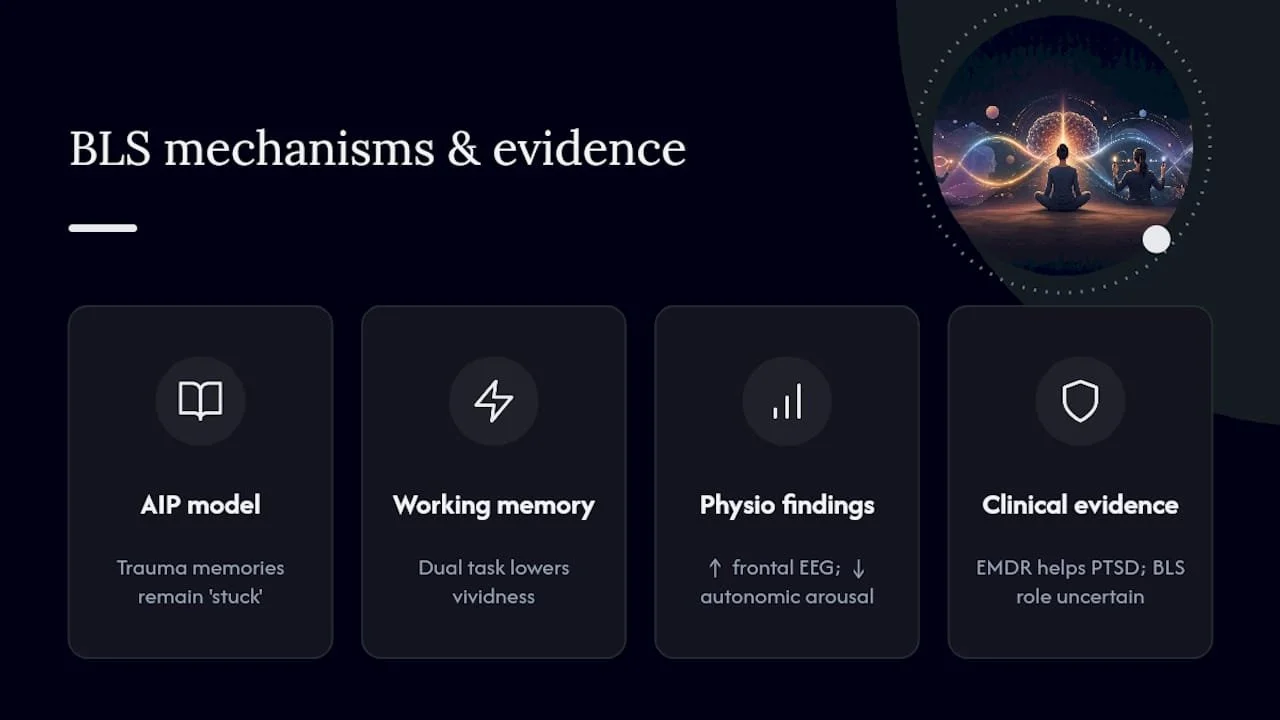
The leading explanation is the Adaptive Information Processing model, which treats trauma memories as "stuck" in the nervous system, stored with the original sensory and emotional charge instead of being filed away as past events. BLS is thought to act as a catalyst that helps the brain's natural processing system get unstuck and move that memory toward resolution.
A related theory, sometimes called EMDR 2.0, proposes that BLS works partly by taxing working memory. Holding a traumatic image in mind while also tracking a moving light or alternating tone forces the brain to split its attention, which may reduce the vividness and emotional intensity of the memory over repeated sets. Early experimental work on this approach suggests it might require fewer sets to reach the same effect, but it hasn't been shown to outperform standard EMDR in larger trials, so treat it as a promising variant rather than a proven upgrade.
By the numbers: A 2025 psychophysiological study found that BLS, whether visual or tactile, was linked to increased frontal EEG activity and decreased autonomic arousal during processing, a pattern consistent with the brain shifting into a calmer, more regulated state while working through difficult material.
Separately, near-infrared spectroscopy (NIRS) research on tactile BLS found increased activity in temporal brain regions alongside decreased prefrontal activation, a pattern the researchers linked to reduced negative affect and easier access to memory content. Neither finding proves exactly why BLS works. Both point toward BLS doing something measurable to how the brain handles emotional memory in real time, which is more than can be said for a lot of talk-therapy techniques.
Where the evidence is genuinely strong is on EMDR as a whole. Systematic reviews and clinical guidelines consistently rank EMDR as an effective, often shorter-course treatment for adult PTSD, with favorable cost-effectiveness compared to some alternatives. The exact contribution of BLS itself, separate from exposure and reprocessing, remains an active research question rather than a settled fact. You can read more on what the research shows about EMDR's effectiveness for a fuller picture of the trial data.
Is Bilateral Stimulation Safe? Risks and Red Flags
BLS is safe for the vast majority of clients when it's delivered by a trained EMDR therapist, but that doesn't mean it's always comfortable. Reprocessing a traumatic memory tends to bring up real emotion, and that's expected, not a sign something went wrong.
Common reactions during and after BLS sets include:
Crying or sudden waves of sadness, anger, or fear as a memory surfaces
Brief dissociation or a "spacey" feeling, especially with complex trauma
Fatigue, vivid dreams, or a short-term uptick in distress between sessions
Trained therapists manage these with grounding techniques, careful pacing (called titration), and a structured closure process at the end of every session so you don't leave in an activated state.
A few conditions call for extra caution and clinician clearance before starting BLS work: active seizure disorders, especially with visual BLS; active psychosis; uncontrolled mania; and acute intoxication or severe dissociative disorders that haven't been stabilized. None of these mean EMDR is off the table, but they mean the pacing and modality need a clinician's judgment, not a self-help app.
Pro Tip: If you're nervous about strong emotional reactions, ask your therapist about a "stop signal" you can use mid-set, like raising a hand. Most EMDR-trained clinicians build this into session one, and knowing you have an exit valve often reduces anxiety about the process itself.
How Long Does a Typical EMDR Session Last?
A standard EMDR session runs 60 to 90 minutes, and a full course of treatment often involves several sessions, individualized to the client's needs, though this varies widely depending on the complexity of the trauma being treated. Within each BLS set, therapists typically run 20 to 40 seconds of stimulation before pausing to ask what you noticed, then adjust pacing based on your response.
A session generally moves through a consistent sequence:
Preparation: building rapport, teaching grounding skills, and explaining what to expect.
Assessment: identifying the target memory, negative belief, and desired positive belief.
Desensitization: running BLS sets while you hold the memory in mind, tracking shifts in distress.
Installation: reinforcing a more adaptive belief once distress has dropped.
Body scan: checking for residual physical tension tied to the memory.
Closure and reevaluation: stabilizing before ending, then reviewing progress at the next session.
Unlike some trauma therapies, EMDR doesn't rely heavily on between-session homework, which is part of why many clients complete treatment in fewer sessions. Telehealth sessions follow the same structure, with screen-based visual tracking, audio tones through headphones, or guided self-tapping standing in for in-person hand movements. For a fuller walk-through of each phase, see this step-by-step EMDR therapy guide.
Safe Self-Directed Bilateral Stimulation Exercises
None of these replace clinical EMDR, but they're low-intensity ways to get familiar with the sensation of BLS or to calm your system between sessions.
Self-tapping: Cross your arms over your chest and tap your shoulders or upper arms alternately, left, right, left, at a slow, steady pace for 20 to 30 seconds. Notice your breathing and body tension rather than any specific memory.
Gentle visual tracking: Hold a finger or pen at arm's length and move it slowly side to side while your eyes follow, keeping your head still. Ten to fifteen slow passes is plenty for a calming exercise; this isn't the same as trauma-focused desensitization.
Bilateral audio tones: Use a simple alternating-tone track through headphones at low volume for a minute or two when you need to refocus, not process anything distressing.
Stop immediately if you feel flooded, dizzy, or increasingly distressed rather than calmer, and jot down what came up. Bring those notes to your therapist. This is exactly the kind of detail that helps a clinician tailor pacing to you, and it's covered in more depth in this overview of EMDR techniques for trauma healing.
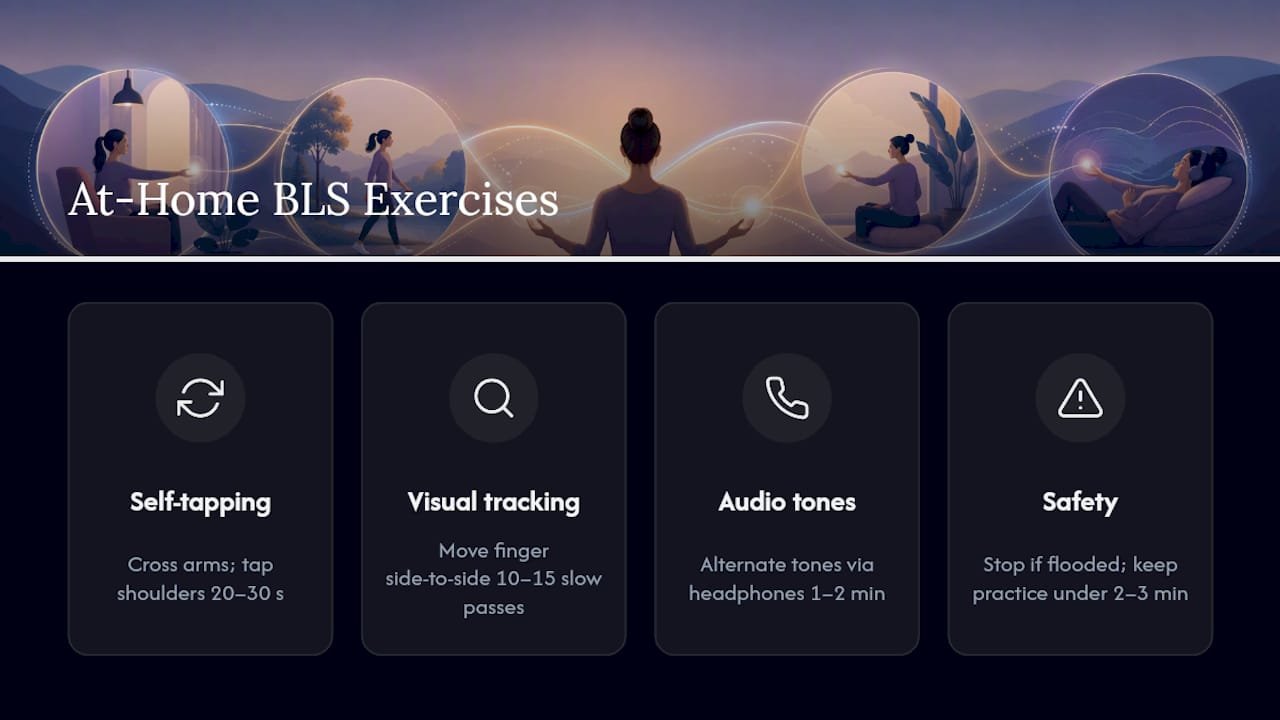
Pro Tip: Keep any self-directed practice under two or three minutes and completely separate from your most distressing memories. These exercises are for regulation and familiarity, not for doing your own trauma processing outside session.
A Clinician's View on Choosing the Right BLS Approach
Most people researching bilateral stimulation want to know if it's real science or wellness marketing dressed up in clinical language. It's neither, exactly. The honest answer is that BLS has a growing, genuinely interesting neurophysiological evidence base, and EMDR as a whole has strong outcome data, but the specific mechanistic role of BLS is still being worked out by researchers. That nuance gets flattened in a lot of consumer content, and it shouldn't be.
EMDR-trained clinicians select a modality, visual, auditory, or tactile, based on what a client can tolerate, not on a fixed protocol. Pacing gets adjusted session to session, and cultural context matters: a bilingual therapist working with a Spanish-speaking client on immigration-related trauma paces very differently than one working with a first responder on a single-incident PTSD case. BLS is a tool inside a larger clinical relationship, not a standalone technique you can lift out and DIY your way through complex trauma.
If you're looking for real BLS work, seek a licensed EMDR-trained therapist rather than an app promising the same results alone.
— Juiced
Start EMDR Therapy With Bilateral Stimulation Online
If you've read this far, you already know BLS isn't something to experiment with alone when real trauma is involved, and Alvarado Therapy is built around exactly that gap. Online EMDR therapy is available across California and New York, including EMDR intensives for people who want concentrated progress instead of a slow weekly drip, and bilingual English-Spanish sessions for clients who need to process trauma in the language it happened in.
People dealing with PTSD, childhood trauma, grief, or relationship strain tend to benefit most, and coming to a first consultation with a rough timeline of what happened, current symptoms, and any prior therapy history helps your clinician plan modality and pacing faster. If you're ready to see whether EMDR fits your situation, read what to expect from online EMDR therapy or go ahead and schedule a consultation to talk through your specific case with a licensed therapist.
This article is general information, not a substitute for advice from a qualified doctor. Consult a qualified healthcare professional about your own circumstances before acting on anything here.
Sources
Bilateral stimulation differential effects in EEG and peripheral physiology - BJ Psych Open (2025)
Clinical and cost‐effectiveness of EMDR for PTSD in adults - systematic review (2025)
FAQ
Does Bilateral Stimulation in EMDR Really Work?
EMDR as a whole is backed by randomized controlled trials and clinical guidelines for PTSD, and BLS specifically is linked to measurable EEG and NIRS changes during processing, though the exact mechanism of BLS alone is still being studied.
Why Is There Controversy Around EMDR?
The debate centers on whether BLS itself adds unique value beyond standard exposure and reprocessing techniques used in other trauma therapies, since researchers haven't fully isolated its individual contribution from the rest of the protocol.
How Long Should a Bilateral Stimulation Set Last?
In clinical sessions, therapists typically run BLS sets of 20 to 40 seconds at a time, pausing between sets to check in before continuing.
Do You Cry During EMDR Therapy?
Crying and other strong emotional reactions are common and expected during EMDR, and trained therapists build in grounding and closure techniques specifically to help you manage and settle those reactions before ending a session.
