
Call 988 for a mental health crisis, emotional breakdown, or suicidal thoughts. Call 911 when there's an immediate threat to life, a fire, or a crime in progress. The 988 Suicide and Crisis Lifeline is free, confidential, and rarely brings police to your door. If you're unsure whether someone is in physical danger, call 911.
TL;DR:
988 is primarily for emotional crises and does not have dispatch capability to send emergency services unless there is an imminent physical danger.
Call 911 immediately if there is active violence, unconsciousness, serious injuries, or open flames, as these require rapid police or medical response.
988 counselors only escalate to emergency services when there's imminent risk, such as active overdose or suicide attempt, and most contacts involve de-escalation and resource referral.
The effectiveness of locating callers on 988 varies, as it relies on caller-reported addresses, unlike 911's advanced geolocation features.
Public familiarity with the differences between 988 and 911 is growing slowly; rehearsing specific scenarios can help make the right choice automatic during crises.
Alvaradotherapy
Find Support After a Crisis
Alvarado Therapy offers trauma-informed counseling and EMDR therapy for California adults seeking ongoing mental health support.
Table of Contents
988 vs 911: How the Two Systems Actually Differ
The two numbers exist for different jobs. 988 connects you with trained crisis counselors by call, text, or chat, around the clock, and it's built specifically for emotional and behavioral crises. 911 routes you to a local dispatch center that sends police, fire, or EMS when someone's physical safety is at risk right now.
The FCC designated 988 as the nationwide three-digit dialing code for the Lifeline network, requiring phone carriers to route those calls and texts automatically. SAMHSA oversees and funds the Lifeline itself, while NENA supports the patchwork of local 911 call centers, known as PSAPs, that handle dispatch.
The practical differences show up fast once you're on the line:
988 counselors listen, de-escalate, and connect you to local mental health resources; they don't dispatch vehicles by default.
911 dispatchers triage the call and can send police, fire crews, or paramedics within minutes.
988 offers dedicated routing for veterans, Spanish-language speakers, and callers who need ASL video access.
911 depends on your local PSAP's technology, which varies in how precisely it can locate you.
Both are free and available everywhere in the United States, but they were never meant to be interchangeable.
When to Call 988 vs. 911: Real Scenarios
The hardest part isn't knowing the rule. It's applying it when you're scared, exhausted, or watching someone you love to unravel in front of you.
Call 988 when:
Someone is having suicidal thoughts but isn't in the middle of an attempt.
A person is in acute emotional distress, panic, or a mental health spiral and needs someone to talk them down.
Someone is struggling with substance use and needs support, not paramedics.
Call 911 when:
Someone has overdosed and needs immediate medical intervention.
There's active violence, a weapon involved, or ongoing danger to others.
Someone is unconscious, badly injured, or a fire is in progress.
The SAMHSA fact sheet on key differences lays out these use cases plainly, and the Colorado Office of School Safety offers a simple tiebreaker: if immediate physical harm is possible, or you genuinely can't tell, call 911. Dispatchers can triage and redirect resources faster than a caller second-guessing themselves.
Pro Tip: If you're a parent, partner, or clinician building a safety plan, rehearse both scenarios out loud with the at-risk person before a crisis happens. Saying "if this happens, I call 988; if that happens, I call 911" out loud, in advance, makes the decision automatic instead of paralyzing.
What Happens When You Actually Call
A 988 call usually starts with a counselor listening, asking a few grounding questions, and working through de-escalation before anything else happens. SAMHSA reports that only a small share of 988 contacts ever require 911 involvement, and counselors escalate only when there's imminent risk, an active attempt underway, or a suspected overdose.
What you should expect from each system:
988: a conversation first, referrals to local resources second, and law enforcement only as a last resort.
911: rapid triage, then dispatch of whichever combination of police, fire, or EMS the situation calls for.
988 escalation isn't sprung on you. Counselors typically tell you they're looping in emergency services and often stay on the line.
911's ability to pinpoint your location, known as E911, still varies by carrier and device, so be ready to state your address out loud.
If you dial 911 by accident, stay on the line. Hanging up can trigger a callback or even a welfare check, which wastes dispatcher time better spent on someone else's emergency.
How 988 and 911 Work Together
These aren't competing systems. They're built to hand off to each other when a situation shifts from emotional crisis to physical danger. A 988 counselor who hears an active threat will coordinate with local 911 dispatch rather than leave a caller stranded.
Funding and oversight stay separate, though. SAMHSA runs and funds the 988 network at the federal level, while 911 operations sit with the FCC and a mix of state and local PSATs. That split explains why 988 feels uniform nationwide while 911 response quality can vary block to block.
A few things worth knowing about how the systems interact:
Both aim for what SAMHSA calls whole-person care: de-escalate first, dispatch only when necessary.
Next Generation 911 (NG911) upgrades are rolling out to improve location accuracy and allow texts, photos, and video, but adoption varies by jurisdiction.
The old 10-digit National Suicide Prevention Lifeline number still works and routes to the same 988 network.
Local resource linkage, meaning follow-up referrals after the call ends, is where 988's real value shows up over time.
Practical Steps to Prepare Before a Crisis
Being ready before the phone rings matters more than most people realize. Have a few basics on hand: your address, a short description of what's happening, whether weapons or substances are involved, relevant medical conditions, and whether you or the person in crisis needs Spanish or ASL support.
Clinicians building safety plans should treat the choice between 988 and 911 as something to rehearse, not assume. The Ohio Department of Mental Health's practical guide recommends walking through specific scenarios during sessions so the decision isn't made cold, under stress.
Most people worry that calling 988 means police showing up, but many find the best phone psychic service for anxiety and uncertainty offers a helpful emotional-support alternative. It usually doesn't. Counselors are trained to find the least restrictive path forward, and dispatch is the exception, not the rule.
Pro Tip: Turn a single 988 call into ongoing support by asking the counselor directly for local referrals, then follow up with a licensed clinician within a few days. A trauma assessment done early can catch patterns a crisis line simply isn't built to address.
The History Behind the 988 Number
988 didn't exist as a nationwide number until fairly recently. The Lifeline itself traces back to 2005 under its original 10-digit number, but callers had to remember a full phone number during a crisis, which created real friction.
Congress passed the National Suicide Hotline Designation Act in 2020, directing the FCC to designate 988 as the new three-digit code, mirroring how 911 became the universal emergency shorthand decades earlier. Carriers had until July 16, 2022, to activate routing, which is the date most people associate with 988's official launch.
Text and chat functionality rolled out on a slightly different timeline, since it required separate technical build-out across carriers. Veteran-specific routing, Spanish-language support, and video relay for ASL users were added as the network matured rather than all launching on day one.
The rollout wasn't instant nationwide capacity. Local call centers, many of which already ran the original Lifeline network, had to scale staffing to handle a volume spike that public health officials largely expected and got. That's the practical difference between 988 and 911: 911 has had over half a century to build out infrastructure and public habit, while 988 is still in its early years of building both.
Where 988 Falls Short Compared to 911
988 isn't a replacement for 911, and it was never designed to be one. The clearest gap is dispatch capability. 988 counselors can talk someone through a crisis and connect them to resources, but they can't send a car, an ambulance, or a fire truck. If a caller genuinely needs a physical response, that has to route through 911 or local emergency services.
Staffing capacity is another real limitation. Call volume surged after the 2022 launch, and some local crisis centers have struggled to keep wait times low, particularly during peak hours or regional surges tied to news events. Text and chat response times can lag behind call response times in some areas.
Coverage also isn't perfectly uniform. Rural areas may have fewer local mental health resources for 988 counselors to refer callers to, even if the phone line itself connects instantly. A counselor can listen and stabilize, but the promised handoff to "local resources" only works as well as those resources actually exist nearby.
Location detection is weaker on 988 than on 911's E911 system, since 988 wasn't built around geolocation the way emergency dispatch was. That matters less for de-escalation calls but becomes relevant fast if a situation turns dangerous and counselors need to loop in local responders quickly.
Why So Many People Still Don't Know the Difference
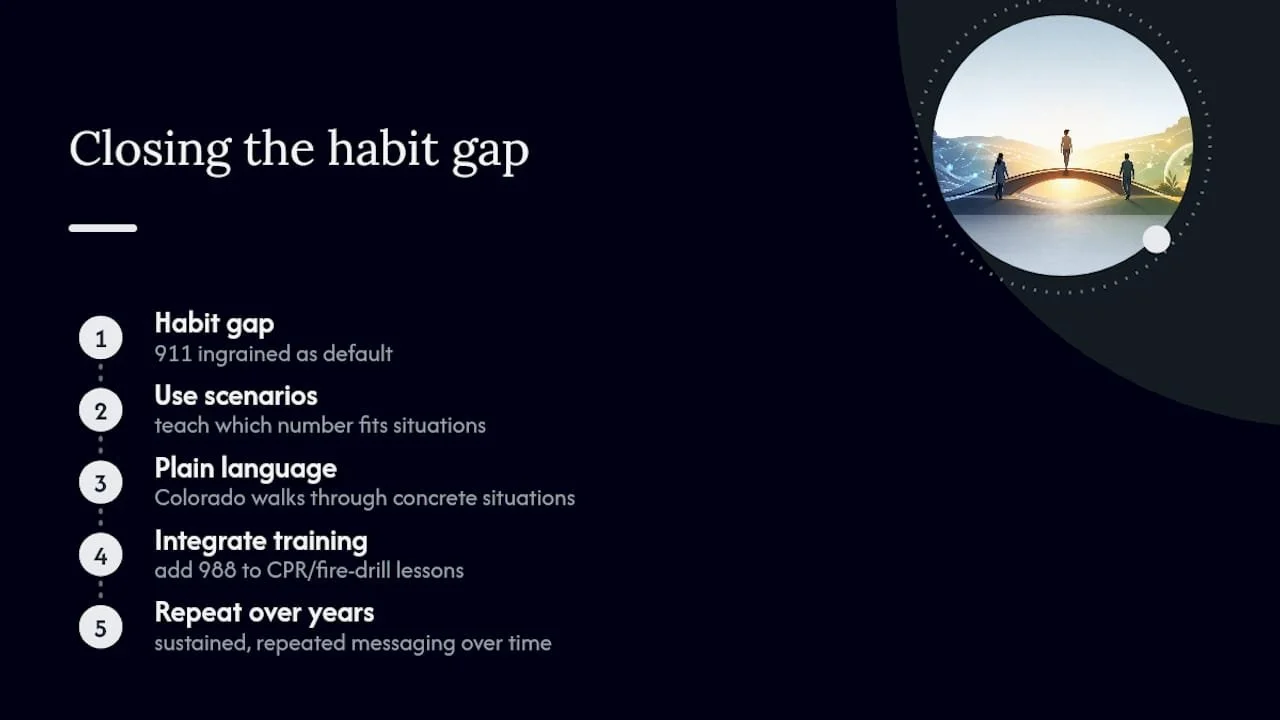
Confusion between 988 and 911 isn't a knowledge gap so much as a habit gap. For decades, 911 was the only number anyone learned for any kind of emergency, mental health included. Rewiring that instinct takes sustained, repeated messaging, not a single ad campaign.
Peer-reviewed research on 911 and 988 use found real overlap in how people decide which number to dial during a mental health crisis, along with meaningful uncertainty about what each system can actually do. That uncertainty is exactly why public health agencies keep pushing scenario-based education rather than a one-line slogan.
State and local agencies have leaned into plain-language guidance to close that gap. The Colorado Office of School Safety's briefing is a good example: instead of abstract definitions, it walks through concrete situations and tells readers exactly which number fits.
Schools, employers, and clinicians are increasingly folding 988 education into existing safety training, treating it the same way CPR or fire-drill knowledge gets taught. That repetition, not a single memorable fact, is what eventually makes the 988 vs. 911 distinction second nature. Expect that education curve to keep extending for years, since public habits around emergency numbers change slowly by design.
How 988 Gets Paid For
988 runs on a mix of federal and state funding rather than a single budget line. SAMHSA distributes federal grants to the network of local and regional crisis centers that actually answer the calls, texts, and chats.
States have also stepped in with their own funding mechanisms. Several have passed legislation adding small telecom fees, similar in concept to how 911 has long been funded through phone-bill surcharges, to support call center staffing and technology upgrades. The exact funding structure varies by state, so the stability of local response capacity isn't identical everywhere.
That funding split explains some of the coverage unevenness mentioned earlier. A well-funded state crisis center network can staff more counselors and shorten wait times, while a center relying more heavily on federal grants alone may face tighter capacity during surges. It's worth understanding that 988's national branding masks a genuinely local funding patchwork underneath.
A Practitioner's Note on Why Simple Rules Save Lives
Clear rules reduce harm. When people hesitate, unsure which number to dial, seconds matter, and hesitation itself can escalate a crisis. Memorize both numbers, put them in every safety plan, and know that calling 988 doesn't mean police are coming. It means someone trained is listening.
— Juiced
After the Crisis: What Ongoing Care Looks Like
988 and 911 handle the moment. What happens in the weeks after a crisis is where real healing actually starts, and that's a different kind of support entirely. Trauma-informed, bilingual therapy in English and Spanish, including online EMDR sessions, is available to clients in California and New York.
This isn't crisis response. If you or someone you love is in immediate danger, call 988 or 911 first, always. But once things stabilize, ongoing therapy is what turns a single crisis call into lasting change, whether that's processing trauma through EMDR, working through grief, or rebuilding a relationship strained by crisis after crisis. Alvarado Therapy's what to expect page walks through how sessions work, from the first consultation onward, and online booking makes starting that follow up care straightforward rather than one more thing to figure out during an already hard week.
This article is general information, not a substitute for advice from a qualified doctor. Consult a qualified healthcare professional about your own circumstances before acting on anything here.
Sources
Understanding factors associated with 911 and 988 use in mental health crises - PMC
988 and 911: Getting the right support in a crisis - Office of School Safety (Colorado)
FAQ
Why call 988 instead of 911?
Call 988 when the crisis is emotional or psychological, such as suicidal thoughts or a panic episode, because trained counselors can de-escalate without involving police in most cases.
What is the difference between 988 and 911?
988 connects you to mental health crisis counselors by call, text, or chat; 911 dispatches police, fire, or EMS for immediate physical emergencies.
Does 988 still work in the US?
Yes, 988 is fully active nationwide, and the older 10-digit Lifeline number still works and routes to the same network.
Why did America choose 911 instead of 999?
The United States adopted 911 as a short, easy-to-dial code distinct from other countries' emergency numbers, chosen partly for technical reasons tied to rotary phone systems at the time.
Can 988 replace 911 in an emergency?
No. 988 has no ability to dispatch police, fire, or EMS, so any situation involving immediate physical danger still requires calling 911.
