
Therapy Across State Lines: What Clinicians and Clients Must Know

The verdict is simple: therapy across state lines is legal only when the clinician holds authorization to practice in the state where the client is physically sitting, not where the clinician's office is. This is the place-of-service rule, and it governs every telehealth session regardless of where the clinician's license was originally issued.
Before your next session with an out-of-state client, do three things:
Confirm the client's physical location at the start of the session, out loud, every time.
Verify you hold a license, compact privilege, or telehealth registration valid in that exact state.
Document that verification in the chart, along with the client's stated location and consent.
Pro Tip: Call your malpractice carrier before you start seeing clients in a new state. Some policies exclude coverage for sessions delivered without proper authorization in the client's location, which means one undocumented session could leave you personally exposed.
Key Takeaways
Therapy across state lines is legal only when the clinician holds a license, compact privilege, or registration valid in the state where the client is physically located during the session.
| Point | Details |
|---|---|
| Place-of-service governs everything | The session legally occurs where the client sits, not where the therapist is licensed. |
| Compacts are the fastest lane | The Counseling Compact, PSYPACT, and Social Work Licensure Compact speed up multistate practice for eligible professions. |
| Telehealth registration has hard limits | States like Florida and Colorado allow remote-only registration but bar any in-person services. |
| Document every session's location | Timestamp the client's stated location and authorization proof in the chart, every time. |
| Alvarado Therapy verifies before booking | Online EMDR and trauma therapy are available to eligible California and limited New York clients after an eligibility check. |
This article is general information, not a substitute for advice from a qualified doctor. Consult a qualified healthcare professional about your own circumstances before acting on anything here.
Table of Contents
How Licensure and the Place-of-Service Rule Work for Therapy Across State Lines
What Are the Lawful Pathways for Therapy Across State Lines?
Can Temporary Practice Laws or Emergency Exceptions Cover a Session?
What Should Clinicians Check Before Every Out-of-State Telehealth Session?
What Do Licenses, Compacts, and Registrations Cost and How Long Do They Take?
What Should Clients Verify Before Booking an Out-of-State Therapist?
Where to Verify Compact Membership and State Licensing Rules
How Licensure and the Place-of-Service Rule Work for Therapy Across State Lines
Mental health licensure in the United States is a state function. There is no federal mental health license, and no federal agency issues one. Each state board (of psychology, counseling, social work, or marriage and family therapy) sets its own rules for who can practice within its borders, and that authority does not stop at the telehealth login screen.
The place-of-service doctrine is what makes this complicated for remote care. A session is treated as occurring in the state where the client is located, not where the therapist is sitting. If your client drives to a lake house in a different state for the weekend and logs on from there, the session legally occurred in that state. Therapists generally cannot practice across state lines unless they hold a license or other authorization in that exact jurisdiction.
Pandemic-era waivers that temporarily suspended these rules have mostly expired. HHS telehealth guidance now lists five legitimate pathways: full licensure, temporary practice laws, licensure reciprocity, interstate compacts, and telehealth-only registration where a state offers it.
Compact membership has grown quickly enough that "check the compact site first" has become standard advice rather than an edge case. Here's what changed the landscape:
Multiple professions now have dedicated compacts covering counselors, psychologists, and social workers.
States are still joining compacts on a rolling basis, so a "no" today can become a "yes" within a legislative cycle.
The compacts do not replace state licensing boards; they create a faster lane through them.
What Are the Lawful Pathways for Therapy Across State Lines?
Four real options exist, and they are not interchangeable. Picking the wrong one for your profession or caseload wastes time and money.
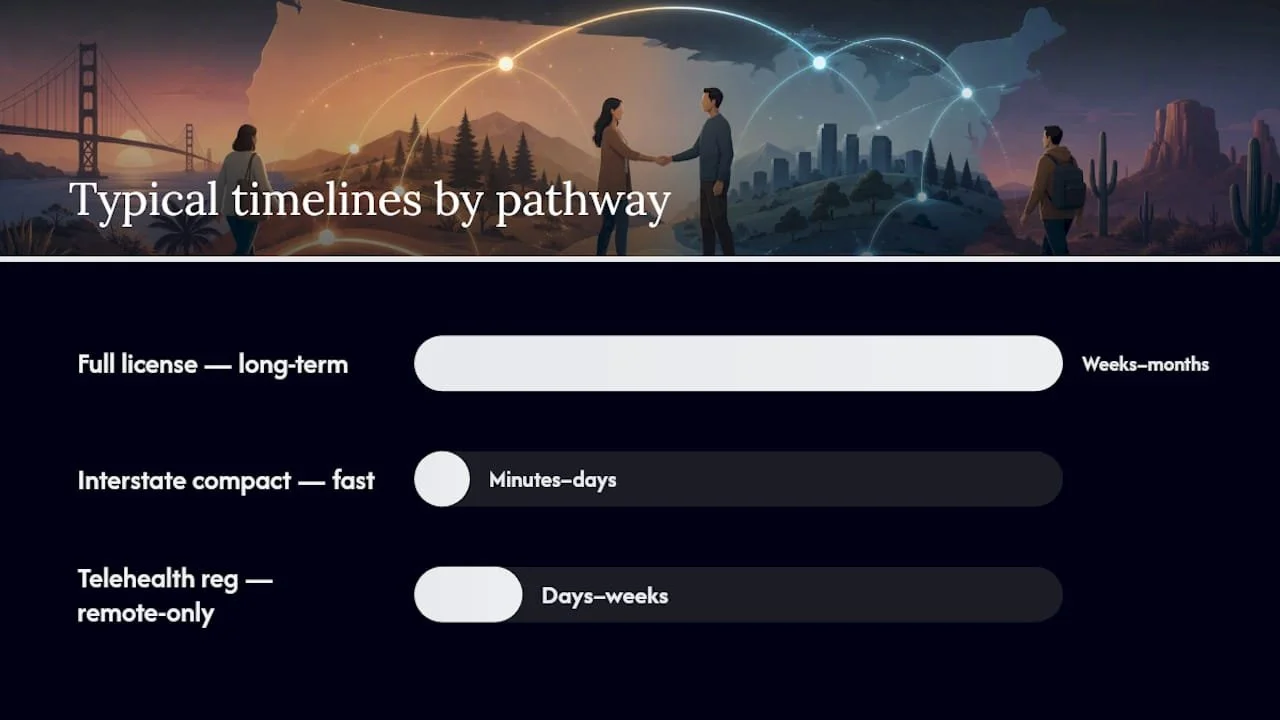
Full licensure by endorsement means applying for a standalone license in the client's state. Most boards require a background check, a jurisprudence exam specific to that state, an application fee, and proof of your existing license in good standing. It is the slowest option but the most durable, since it never expires when compact rules shift.
Interstate compacts are faster once your profession has one and both states participate. The Counseling Compact lets licensed professional counselors who live in a member state obtain a practice privilege in other member states without a second full license. Seven states were live at launch, with others rolling in on an ongoing basis. PSYPACT does the same for psychologists, and the Social Work Licensure Compact extends the model to clinical social workers. Marriage and family therapists are the outlier here. There is currently no national compact for LMFTs, so they typically rely on endorsement or state-specific temporary permits.
Telehealth-only registration exists in a handful of states, including Florida, Arizona, Vermont, Colorado, and Delaware. These registrations usually require an unrestricted home-state license and a clean disciplinary record, but they come with a hard limit: no local office, and no in-person services in that state, ever.
| Pathway | Typical timeline | Best for |
|---|---|---|
| Full license by endorsement | Weeks to several months | Clinicians building a long-term caseload in a new state |
| Interstate compact privilege | Minutes to days once approved for the compact | Counselors, psychologists, and social workers in member states |
| Telehealth-only registration | Days to a few weeks | Clinicians who need occasional remote-only coverage in a specific state |
A federal review from ASPE found that compacts ease cross-state practice but still face legislative and technical friction. Adoption timelines vary by state, and panelists recommended better data systems and national-scale portability. Translation: verify current status every time, because "current" changes.
Pro Tip: Bookmark your profession's compact commission site and the client's state board page together. A five-minute check before intake beats a licensing complaint six months later.
Can Temporary Practice Laws or Emergency Exceptions Cover a Session?
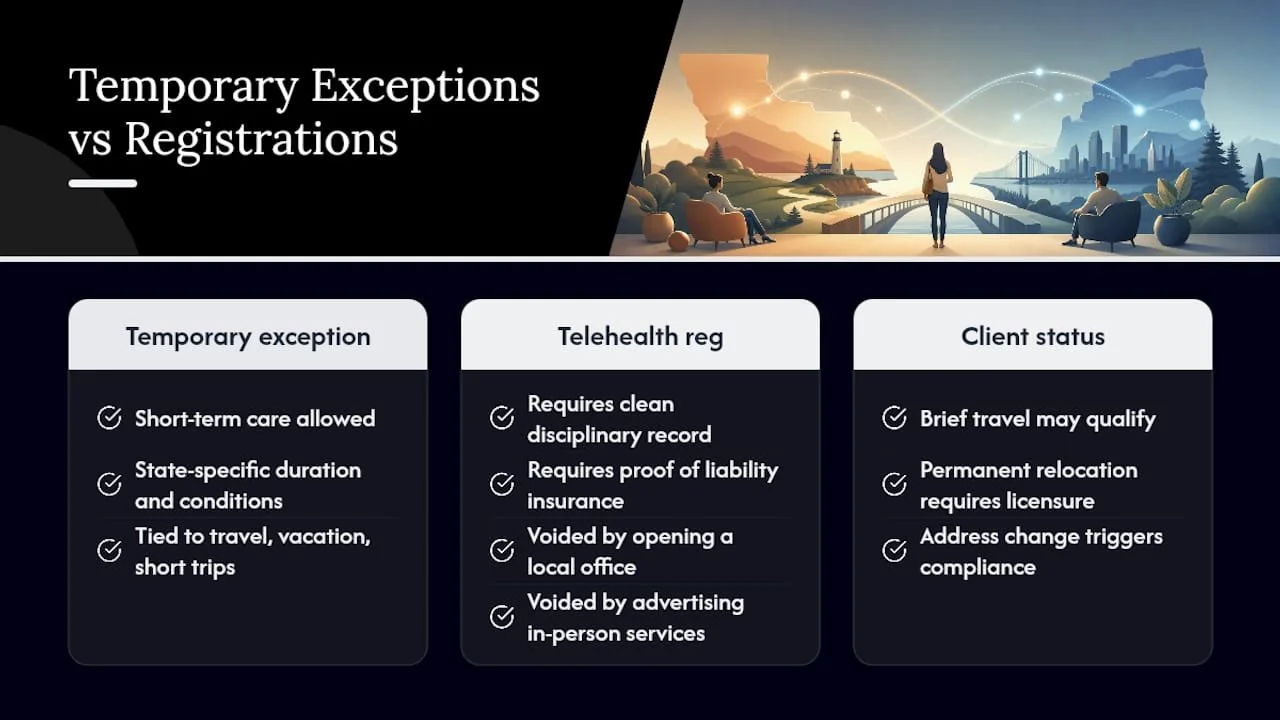
Sometimes, but the window is narrow and state-specific. Many states allow a licensed clinician to provide short-term care to a client who is temporarily out of state, often tied to vacation, brief travel, or a short business trip. APA Services guidance confirms these temporary practice laws exist for psychologists, but the allowed duration and conditions differ by jurisdiction, so you cannot assume a rule from one state applies in the next.
Telehealth registration operates under similar fragility. Boards typically require a clean disciplinary record and proof of liability insurance, and certain actions void the registration instantly: opening a local office, advertising in-person services, or establishing what looks like a permanent practice presence in that state.
A client who is traveling for two weeks and a client who has permanently relocated are legally different cases the moment they log into your platform. One may fall under a temporary exception. The other requires a real pathway, starting the day they moved, not the day you notice their address changed.
Treat every change of address as a compliance trigger, not an administrative footnote.
What Should Clinicians Check Before Every Out-of-State Telehealth Session?
Run this sequence before you click "start session," not after:
Ask the client to state their current city and state on camera, and log it with a timestamp.
Cross-check that location against your active license, compact privilege, or telehealth registration for that state.
Confirm your informed consent form names that state's jurisdiction and includes a local crisis plan (nearest emergency room, local crisis line, an emergency contact who lives nearby).
Verify the client's insurance plan covers telehealth delivered from that state, or confirm private-pay terms.
File the location confirmation and authorization proof in the chart note for that date.
A simple script works better than winging it: "Before we start, can you confirm the city and state you're in right now? I want to make sure I'm able to see you there today." Write the answer down verbatim.
Store a screenshot or PDF of your license, privilege, or registration for each state you serve.
Keep a running log of compact membership status, since states join on a rolling basis.
Note payer credentialing status per state if you bill insurance.
Pro Tip: Chart the client's stated location in the same note where you document consent, not in a separate administrative file. If a board ever asks for proof, you want it in one place, timestamped, and impossible to argue with.
How Do Common Scenarios Like Travel and Moving Get Handled?
Real caseloads are messy. Here is how the rules actually apply.
Client traveling temporarily: A short trip (days to a couple of weeks) may qualify under a temporary practice exception, but check the specific state's rule and duration limit before the session, not during it.
Client moving permanently: The moment a client establishes a new home state, temporary exceptions stop applying. Start pursuing a license, compact privilege, or registration immediately, or refer the client to a colleague who already holds one.
College students: A student who splits time between a home state and a school state needs a plan at the start of each semester. Decide in advance which state's authorization covers which months, and document the switch.
Border residents and split-time households: Clients who live near a state line or split time between two homes need the same location confirmation at every single session, since their situation can change week to week.
What Do Licenses, Compacts, and Registrations Cost and How Long Do They Take?
Costs vary by state and profession, but the pattern is consistent across pathways.
Full licensure by endorsement usually involves an application fee, a background check fee, and sometimes a jurisprudence exam fee, layered on top of weeks to months of processing time.
Compact privileges, once your profession has a live compact and both states participate, tend to move from days down to nearly instant approval through the compact's online system.
Telehealth-only registration sits in between: faster than full licensure, but still requiring document submission and a review window of days to a few weeks.
If you plan to bill insurance in the new state, add payer credentialing time on top of any of these paths. Credentialing with a new insurance panel routinely adds weeks beyond the licensure timeline itself, and a signed license does not guarantee an active reimbursement contract. The ASPE report flags this administrative lag as one of the persistent barriers to smooth interstate practice, even where compacts exist.
What Should Clients Verify Before Booking an Out-of-State Therapist?
Clients often seek specialized providers across state lines for trauma-focused care, niche modalities, or bilingual services they cannot find locally. That is a legitimate reason to look outside your home state, but protect yourself first.
Ask the provider directly: "Are you authorized to treat me in the state I live in right now?"
Look up the clinician's license number on your state board's public verification page and check for any disciplinary history.
Ask how emergencies get handled: who do you call locally if you're in crisis at 2 a.m., and does the provider have a plan for your specific area?
Confirm with your insurer, before the first session, whether an out-of-state telehealth visit is covered or billed as out-of-network.
Where to Verify Compact Membership and State Licensing Rules
Check these sources directly rather than relying on a provider's word alone:
Counseling Compact for counselor privilege status and member states.
HHS telehealth licensure guidance for a plain-English overview of every legal pathway.
Your state's licensing board website for individual license verification and disciplinary records, such as Florida's Counseling Compact notice, which models how states publish membership updates.
A consent framework like Consent to Telehealth for building jurisdiction-specific language into your intake paperwork.
Check compact membership first, then confirm the individual license or privilege ID, and save a screenshot for your records before the first session.
A Note From Alvarado Therapy on Interstate Telehealth
Alvarado Therapy provides trauma-informed care, including EMDR, primarily to clients physically located in California, with limited online services available to eligible clients in New York. We verify authorization before scheduling any remote session, and we do not offer care where we lack it.
If you're unsure whether you qualify for online sessions from your current location, our consultation page is the fastest way to check. Bilingual, identity-affirming care remains available in English and Spanish for every eligible remote client.
Can Alvarado Therapy Support Your Move to Online Trauma Therapy?
If you've read this far, you already know that finding a therapist across state lines means checking licensure first and everything else second. That's exactly the order Alvarado Therapy follows before booking anyone into an online EMDR or trauma therapy session.
Alvarado Therapy offers trauma-informed individual counseling, EMDR intensives, and PTSD and complex trauma treatment to clients physically located in California, with limited online services for eligible clients in New York. Every session runs on the same location check outlined above, so you're never left wondering whether your care is properly authorized. Couples working through relationship strain can also access online couples therapy under the same eligibility framework.
If you're a California or New York resident looking for bilingual, culturally responsive trauma care, book a consultation to confirm eligibility and get matched with the right clinician before your first session.
Sources
Can Therapists Practice Across State Lines: Rules and Options - LegalClarity
Barriers and opportunities for improving interstate licensure portability - ASPE (HHS)
What to know about doing telehealth in a different state - APA Services
