
EMDR for Attachment Trauma: What Adults Should Know

Yes, EMDR can treat attachment trauma, and a growing body of clinical research backs that up. Standard EMDR (Eye Movement Desensitization and Reprocessing) works by helping the brain reprocess stuck memories through its natural Adaptive Information Processing (AIP) system, and that includes the early relational memories that shaped how you connect with others. When a clinician layers in attachment-focused adaptations, such as Laurel Parnell's Attachment-Focused EMDR (AF-EMDR), the treatment goes further: it specifically targets the internal working models, those unconscious rules about whether people are safe, that formed before you had words for what was happening to you.
Here's the short version of why this works. Attachment wounds live in implicit memory, meaning they show up as gut reactions and relationship patterns rather than clear narratives. The EMDR International Association (EMDRIA) recognizes that reprocessing these early, often preverbal experiences can shift how the nervous system responds to closeness, conflict, and abandonment fears in the present.
If you're considering this path, take three steps before your first session. First, run a basic safety check: are you currently in crisis, using substances to cope, or experiencing active suicidal thoughts? If so, stabilization work needs to happen before any reprocessing begins. Second, vet your clinician specifically for attachment-focused training, not just general EMDR certification. Third, if you notice dissociation, severe self-harm urges, or an inability to function day to day, seek a multidisciplinary team rather than EMDR alone.
Quick fact: A pilot study of adults who completed an average of 15 EMDR sessions found measurable decreases in attachment insecurity. The strongest gains were linked to the quality of the therapeutic relationship itself.
Key Takeaways
EMDR, particularly when adapted through attachment-focused protocols like AF-EMDR, AFTT-A, or Temporal Integration, can meaningfully reduce attachment insecurity when paired with adequate preparation and a strong therapeutic relationship.
| Point | Details |
|---|---|
| EMDR can address attachment trauma | Pilot and case study research shows decreased attachment insecurity after a course of EMDR treatment. |
| Preparation phase runs longer | Attachment cases typically need extended stabilization work before reprocessing begins safely. |
| Adaptations matter | AF-EMDR, AFIT-A, and Temporal Integration each target attachment wounds differently than standard EMDR. |
| Vet your clinician carefully | Ask about EMDRIA certification, attachment-specific training, and dissociation protocols before starting. |
| Evidence is promising but limited | Most supporting studies use small samples, so realistic expectations matter alongside hope. |
| Alvaradotherapy offers a specialized path | Bilingual, attachment-trained clinicians provide individual EMDR, intensives, and couples therapy across California and New York. |
Table of Contents
What Is Attachment Trauma and How Does It Show Up in Adults?
What Should You Expect During Attachment-Focused EMDR Treatment?
What Does the Research Actually Say About EMDR and Attachment?
How Do You Find a Qualified EMDR Therapist for Attachment Trauma?
What Is Attachment Trauma and How Does It Show Up in Adults?
Attachment trauma is different from the single-incident trauma most people picture when they hear the word PTSD. It doesn't come from one car accident or one assault. It comes from a repeated pattern, an absent parent, a caregiver who was frightening or unpredictable, chronic emotional neglect, that teaches a developing brain that connection itself is unreliable or dangerous. A review on the clinical outcomes of attachment trauma frames it as a distinct clinical construct: it produces emotion dysregulation, dissociation, and a kind of chronic mistrust of other people's motives that spreads across every relationship, not just the original one.
Attachment theory sorts the resulting patterns into four broad styles, and most adults recognize themselves somewhere in this list:
Secure attachment: comfortable with closeness and independence, generally trusts that others will be responsive.
Anxious/preoccupied attachment: craves closeness but fears abandonment, often reads neutral behavior as rejection.
Avoidant/dismissive attachment: values independence to the point of discomfort with intimacy, tends to shut down emotionally under stress.
Disorganized attachment: wants closeness and fears it simultaneously, often the result of a caregiver who was both a source of comfort and a source of fear.
These patterns rarely stay confined to childhood. Anxious attachment tends to resurface as jealousy or hypervigilance in romantic relationships. Avoidant attachment shows up as emotional withdrawal the moment a partner asks for more closeness. Disorganized attachment often produces a push pull pattern that confuses both people in the relationship. None of this is a character flaw. It's a nervous system doing exactly what it learned to do.
What's easy to miss is how often attachment trauma hides inside physical complaints rather than emotional ones. People with insecure attachment styles report higher rates of chronic somatic symptoms, unexplained fatigue, gut issues, tension headaches, that never quite resolve through medical treatment alone. If you've spent years chasing physical symptoms with no clear answer, an unprocessed attachment wound is worth considering.
How Does EMDR Work for Attachment Trauma?
EMDR rests on a simple premise: the brain has a built in system for processing distressing experiences, but sometimes a memory gets stuck, unprocessed, still firing the same emotional and physical alarm decades later. This is Francine Shapiro's Adaptive Information Processing (AIP) model, and it treats attachment memories as legitimate targets in exactly the same way it treats a car accident or an assault. The theory holds that when you reprocess an early representative memory, say, a moment of being ignored or frightened by a caregiver, the associated beliefs about yourself and others can shift too.
EMDR follows eight phases, and for attachment work, the early phases carry more weight than they do in single-incident trauma treatment:
History taking — mapping attachment patterns and relational history, not just discrete traumatic events.
Preparation — building coping skills and a sense of safety, often extended for attachment cases.
Assessment — identifying the target memory, negative belief, and desired positive belief.
Desensitization — bilateral stimulation while the client holds the memory in mind.
Installation — strengthening the positive belief that replaces the old one.
Body scan — checking for residual physical tension tied to the memory.
Closure — stabilizing the client at the end of each session.
Reevaluation — reviewing progress and identifying new targets.
Standard EMDR and its attachment-focused cousins share this framework, but they diverge sharply in emphasis. AF-EMDR, developed by Laurel Parnell, weaves in resource installation and imaginal reparenting throughout the process. AFTT-A (EMDR and Attachment-Focused Trauma Therapy for Adults), detailed in a 2022 Springer clinical volume, offers structured, scriptable protocols that blend attachment-specific preparation work with traditional reprocessing. Sandra Paulsen's Temporal Integration approach goes a step further, addressing preverbal attachment injuries, wounds formed before a child had language, using specialized techniques that don't rely on verbal memory recall at all.
| Approach | Focal target | Pacing | Use of resources | Relational emphasis |
|---|---|---|---|---|
| Standard EMDR | Discrete traumatic events | Faster, often 3–12 sessions | Minimal, as needed | Low to moderate |
| AF-EMDR (Parnell) | Attachment ruptures, relational patterns | Extended preparation phase | Heavy use of resource installation | High, therapist as secure base |
| AFTT-A (Springer, 2022) | Structured attachment scripts across the lifespan | Protocol driven, methodical | Built in attachment resourcing scripts | High, integrates parts work |
| Temporal Integration (Paulsen) | Preverbal, developmental wounds | Slow, often nonverbal | Somatic and imagery-based resourcing | Very high, focuses on early caregiver bonds |
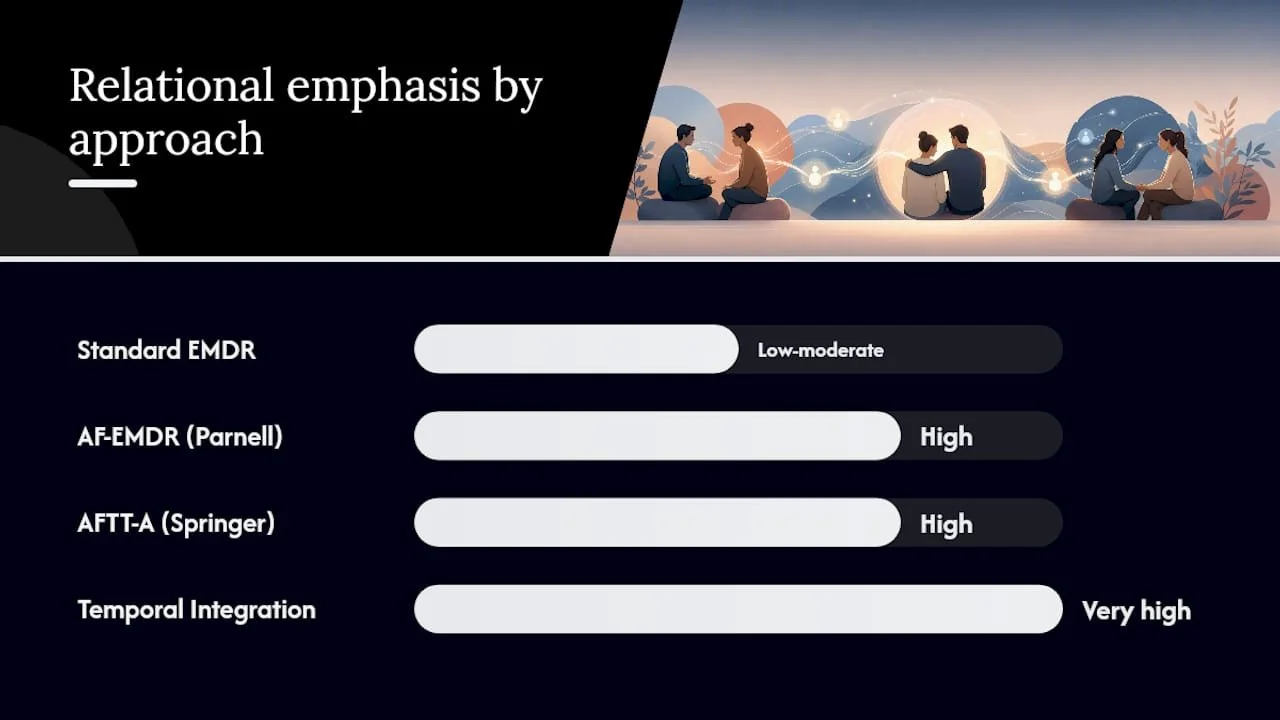
In practice, clinicians targeting attachment trauma work through three layers: the earliest representative memory of the relational wound, the current situations that still trigger the old fear response, and a future template that rehearses a new, more secure way of responding. That third piece matters more than people expect. It's not enough to defuse the old memory. You also need to practice what secure connection actually feels like going forward.

Why Does the Therapeutic Relationship Matter So Much Here?
Rapport isn't a warm-up act before the real work starts. With attachment trauma, the relationship between you and your therapist often is part of the treatment. If your attachment style is avoidant, you might minimize distress or resist emotional check-ins early on. If it's anxious, you might over-monitor your therapist's reactions, reading a neutral expression as disapproval. If it's disorganized, you might oscillate between trusting the process completely and wanting to bolt from the room. A skilled clinician expects this and builds the pacing around it rather than pushing you toward reprocessing before you're ready.
That's why Phase 2 preparation tends to run longer for attachment cases than it does for single-incident trauma. Clinicians commonly use a handful of stabilization tools before any bilateral stimulation begins:
Resource installation: identifying and strengthening internal or imagined sources of safety and strength.
Grounding techniques: sensory based exercises that anchor you in the present moment.
Safe place imagery: a mental refuge you can return to if a session gets overwhelming.
Self-compassion practices: countering the harsh inner critic that often accompanies attachment wounds.
Attachment trauma rarely announces itself directly. It shows up as a pattern you've repeated in every relationship without quite knowing why, and the therapy has to move slowly enough to let you actually notice that pattern before asking you to change it.
Pro Tip: Before committing to a course of treatment, ask a prospective therapist directly: "How do you decide when a client is ready to move from preparation into reprocessing, and what's your plan if I dissociate mid-session?" A clinician with real attachment-focused training will have a specific, concrete answer, not a vague reassurance.
Watch for warning signs that suggest you need more support than EMDR alone can offer right now. Active substance dependence, unmanaged psychiatric symptoms, or a level of dissociation that disrupts daily functioning usually call for medical stabilization, substance treatment, or DBT skills training running alongside or before EMDR begins.
What Should You Expect During Attachment-Focused EMDR Treatment?
Your first sessions won't involve any eye movements at all. A clinician assesses your attachment history, screens for dissociation, and gauges your current capacity to regulate strong emotion. This groundwork determines the entire pace of treatment, and rushing it is one of the most common mistakes in EMDR work with complex presentations.
A typical session targeting an attachment memory follows a rhythm: check in on your current state, briefly revisit the target memory and the belief attached to it, do a set of bilateral stimulation, pause to notice what shifted, repeat until the distress settles, then close with a grounding exercise so you leave regulated rather than raw. The step by step structure of EMDR sessions generally holds steady across targets, though attachment work often needs more closure time built in.
Timelines vary widely depending on complexity. A single relational rupture in an otherwise securely attached adult might resolve in 6 to 12 sessions. Moderate attachment trauma, chronic but non-abusive neglect, for instance, often runs 15 to 25 sessions, consistent with the session count observed in the pilot study on attachment security changes. Complex or disorganized attachment trauma, especially where dissociation is present, can take a year or more of steady work, sometimes longer when other issues need concurrent treatment.
Clinicians frequently pair EMDR with other approaches rather than treating it as a stand-alone fix. Couples therapy often runs concurrently when attachment wounds are actively straining a current relationship. Medication management may support mood stabilization during the harder phases of reprocessing. Some practices also offer EMDR intensive formats, condensed multi-day sessions that can accelerate progress for people who've already done solid stabilization work and want to move faster than a weekly session schedule allows.
What Does the Research Actually Say About EMDR and Attachment?
The evidence here is genuinely encouraging, but it's not without gaps, and you deserve the honest picture rather than the marketing version. A pilot study following adults through an average of 15 EMDR sessions found measurable reductions in attachment insecurity, though the improvements were partly tied to the strength of the therapeutic alliance rather than the reprocessing technique in isolation. A separate set of three adult case studies documented shifts toward more secure attachment status after EMDR treatment, describing improved narrative coherence when clients talked about their early memories, a sign the AIP model was doing what it's designed to do.
More recent controlled research adds weight to the attachment-focused approach specifically. A randomized controlled trial with 50 adolescents compared an attachment-based EMDR protocol against standard EMDR for bullying-related trauma and found the attachment-focused version produced faster, larger symptom reductions. The study's authors were candid that larger and more demographically varied samples are still needed before drawing firm conclusions.
A few gaps are worth naming honestly:
Most attachment-specific EMDR studies use small samples, which limits how confidently the findings generalize.
Long-term follow-up data (measuring attachment security years after treatment ends) is still sparse.
Few trials directly compare AF-EMDR, AFTT-A, and Temporal Integration against each other, so it's hard to say definitively which adaptation works best for which presentation.
If you're evaluating a treatment plan, ask your clinician how they'll measure progress beyond "feeling better", whether through validated attachment measures, symptom checklists, or structured self-reports, and what a realistic timeline looks like given your specific history. Evidence quality should shape your expectations, not just your hope.
How Do You Find a Qualified EMDR Therapist for Attachment Trauma?
Not every EMDR-trained clinician has the specific skill set attachment work demands. Basic EMDR certification teaches the eight-phase protocol, but attachment-focused adaptations require additional training that not every practitioner pursues. Ask these questions before committing to treatment:
Are you certified through EMDRIA, and have you completed EMDR Basic and Advanced Training?
Have you completed specific training in AF-EMDR, AFTT-A, or Temporal Integration?
How do you typically pace the preparation phase for clients with complex attachment histories?
What's your protocol if I start to dissociate during a session?
Do you regularly consult with a supervisor or peer consultation group?
Have you worked with clients whose presentation resembles mine (disorganized attachment, complex PTSD, etc.)?
Do you offer or coordinate care with couples therapy if my relationship is affected?
What telehealth or intensive format options do you offer if weekly sessions don't fit my situation?
Certain red flags should make you pause. Be cautious of any therapist who wants to move straight to reprocessing without a real preparation phase, who has no clear plan for managing dissociation, or who never mentions ongoing consultation or supervision as part of their practice. Attachment trauma work is specialized enough that isolation from peer input is a genuine liability, not just a minor gap.
Positive trust signals look like the opposite: active EMDRIA membership, documented training in one or more attachment-focused adaptations, willingness to describe (without breaching confidentiality) how they've handled similar cases, and, where relevant, bilingual or culturally attuned care that matches your background. A brief consultation call is the right place to ask about insurance coverage, telehealth availability, and whether an intensive format makes sense given your timeline and goals. For a broader look at how relational trauma operates outside the EMDR framework specifically, this overview of complex trauma is a useful plain-language companion resource.
How Clinicians Actually Structure This Work
The single biggest mistake in treating attachment trauma with EMDR is moving too fast. A clinician who understands attachment work builds the treatment plan collaboratively, checking in constantly about whether the pace feels tolerable rather than assuming a standard protocol will fit every client's nervous system. Parts work and inner-child focused imagery often show up alongside standard reprocessing, not because it's trendy, but because attachment wounds frequently involve a younger, still-frightened part of the self that needs direct acknowledgment before it can update its beliefs about safety.
The relationship itself becomes a working laboratory. If a client's pattern is to distrust anyone who gets close, the therapeutic relationship offers a live, low-stakes place to notice that pattern and experience something different: consistency, follow-through, a lack of punishment for expressing need. That corrective experience doesn't replace reprocessing work, but it reinforces it in a way that talk alone rarely accomplishes.
Accessibility matters just as much as technique. Bilingual care in English and Spanish removes a real barrier for many clients who'd otherwise have to describe their most painful memories in a second language. Cultural attunement matters too, particularly for clients navigating identity alongside attachment wounds, or for those who also need immigration-related psychological evaluations as part of a broader legal or family process. Licensure and geography still matter practically: a therapist needs to be licensed in the state where you're located, whether you're meeting in person or online, and Alvaradotherapy structures its care around exactly this combination of clinical specialization and practical accessibility for clients across California and New York.
Ready to Start Healing Attachment Trauma With EMDR?
If you've read this far, you probably recognize some of these patterns in your own life, and reading about them only goes so far. Alvaradotherapy offers individual EMDR therapy, EMDR intensives for clients who want concentrated progress in a shorter window, and couples therapy for when attachment wounds are actively straining a current relationship. Care is available in English and Spanish, with licensed clinicians serving clients across California and New York, in person in Pasadena and Ventura or entirely online.

What sets this apart from simply searching "EMDR therapist near me" and hoping for the best is specificity: clinicians here are trained in attachment-focused adaptations, not just standard EMDR protocol, which matters enormously given how much pacing and preparation this work actually requires. If your history includes complex relational wounding rather than a single traumatic event, that distinction in training is exactly what you should be screening for anyway.
The next step is straightforward. Visit the what to expect page to understand the intake process, or review the PTSD and complex trauma service page if your presentation includes broader trauma symptoms alongside attachment concerns. When you're ready, schedule a consultation to ask your own questions about pacing, credentials, and whether this approach fits your situation. Confirm licensure for your state and treatment modality fit before your first session.
Sources
This article is general information, not a substitute for advice from a qualified doctor. Consult a qualified healthcare professional about your own circumstances before acting on anything here.
