
Alexithymia and Trauma: What People With PTSD Need to Know

Alexithymia commonly co-occurs with trauma and often mediates how early traumatic experiences disrupt emotion regulation and worsen PTSD presentations. Put simply: many people who have been through trauma find themselves unable to name, describe, or even locate their feelings, and that difficulty is not a character flaw or lack of effort. It is a measurable psychological pattern with real consequences for how symptoms show up and how well therapy works.
A 2026 Frontiers mediation study found a significant indirect effect linking early trauma to emotion-regulation difficulties through alexithymia (β = 0.15, 95% CI [0.04, 0.31]), confirming that alexithymia is not just a side effect of trauma but an active pathway through which trauma disrupts emotional functioning. The standard research instrument for measuring this is the Toronto Alexithymia Scale (TAS-20), and the therapies most commonly adapted for this combination include EMDR, DBT skills training, mindfulness-based approaches, and compassion-focused interventions.
Key implications at a glance:
Difficulty labeling or describing feelings, even when distress is high
Therapy engagement challenges: clients may appear flat or unmotivated when they are actually overwhelmed
Standard trauma processing may need to be preceded by interoceptive awareness and emotion vocabulary work
Relationships suffer because emotional signals are hard to send and read
With the right treatment sequencing, alexithymia is often modifiable, not permanent
Prevalence signal: A peer-reviewed review on PubMed Central documents that alexithymia frequently co-occurs with PTSD and links it to more severe symptom clusters and poorer treatment engagement when not specifically addressed.
Key Takeaways
Alexithymia is a common, often modifiable consequence of trauma that actively mediates the path from early traumatic experiences to emotion-regulation difficulties and more severe PTSD, and it requires specific assessment and treatment adaptations to address effectively.
| Point | Details |
|---|---|
| Alexithymia mediates trauma's impact | A 2026 Frontiers study found a significant indirect effect (β = 0.15) linking early trauma to emotion-regulation difficulties through alexithymia. |
| TAS-20 is the standard screening tool | Scores of 61 or above on the 20-item scale indicate probable alexithymia across three subscales: DIF, DDF, and EOT. |
| Treatment sequencing matters most | Build interoceptive awareness and emotional vocabulary before trauma memory processing; standard exposure pacing often needs to be extended. |
| Relationships need explicit strategies | Partners benefit from cue-based requests and structured check-ins rather than implicit emotional expectations. |
| Alvaradotherapy offers adapted care | Bilingual, paced EMDR and trauma-focused therapy in California and New York, organized around stabilization before processing. |
Table of Contents
How trauma produces alexithymia: developmental, neurobiological, and dissociative pathways
How alexithymia changes PTSD presentation and treatment response
Evidence-based treatments and therapy adaptations when alexithymia meets trauma
How alexithymia affects relationships and everyday functioning
Can alexithymia be changed after trauma? Prognosis and recovery
A clinician's perspective: what actually changes in trauma-informed sessions
Trauma-informed care for alexithymia: how Alvaradotherapy can help
What alexithymia actually is, and how clinicians define it
Alexithymia is a personality trait characterized by marked difficulty identifying feelings, describing those feelings to others, and a tendency to focus attention outward on external events rather than inner emotional experience.
The three core features clinicians look for are: difficulty identifying feelings (DIF), difficulty describing feelings (DDF), and externally oriented thinking (EOT). A fourth feature, limited fantasy life or reduced imaginative processing, is sometimes included in broader definitions. These are not the same thing as emotional suppression, where someone feels something and consciously holds it back. With alexithymia, the feeling often does not get consciously registered at all.
Clinicians also distinguish between trait alexithymia, a relatively stable characteristic that predates or exists independently of any single stressor, and state alexithymia, which can emerge in response to overwhelming stress or trauma and may be more reversible. This distinction matters for treatment planning because state presentations tend to respond faster to targeted skills work.
How alexithymia can look in daily life:
Describing emotions in purely physical terms ("my chest is tight" rather than "I'm anxious")
Difficulty answering "how do you feel?" without defaulting to "fine" or "I don't know"
Confusing hunger, fatigue, or physical tension with emotional states
Seeming detached or robotic in conversations about personal experiences
Struggling to identify what triggered a mood shift
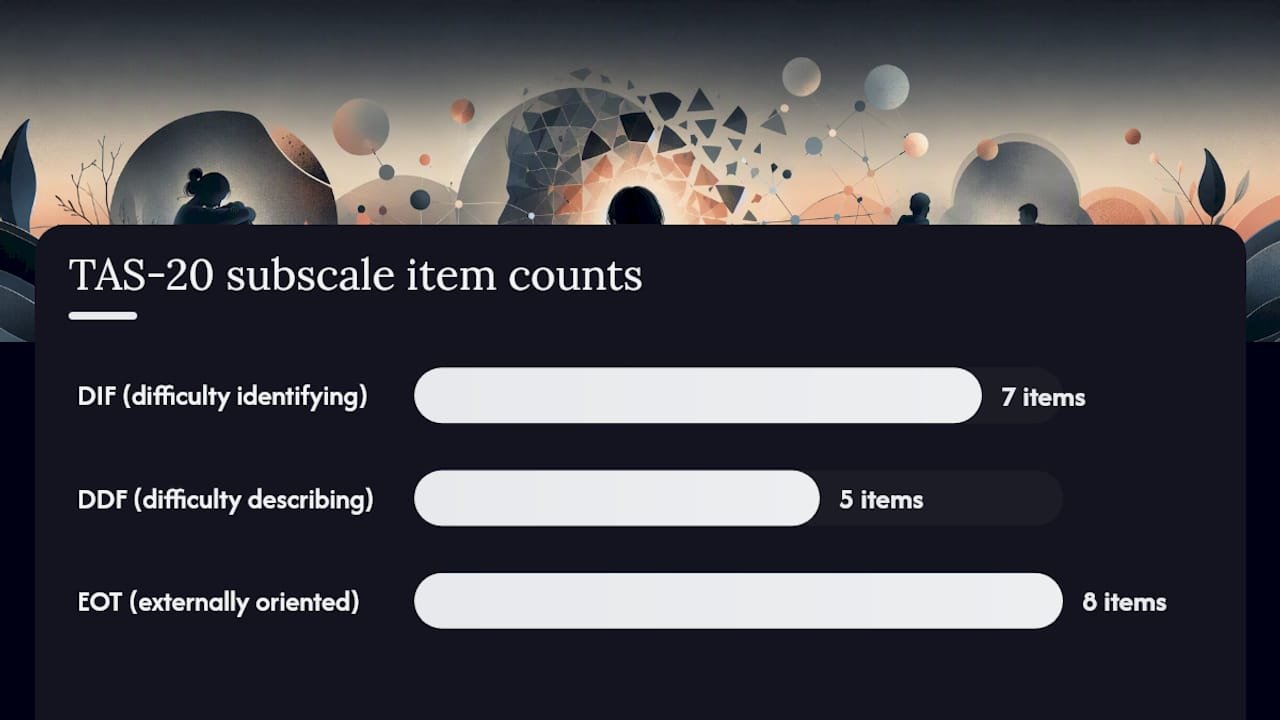
The Toronto Alexithymia Scale (TAS-20) is the most widely used research and clinical screening instrument. It contains 20 items across three subscales: DIF (seven items), DDF (five items), and EOT (eight items). Scores of 61 or above are typically classified as alexithymia; scores of 52 or below suggest its absence. The TAS-20 does not diagnose; it flags a pattern that warrants clinical follow-up.
Prevalence in trauma samples: The Frontiers 2026 mediation study reported a notably elevated alexithymia prevalence in their young adult sample with early trauma histories, higher than typical general population estimates.
Assessment approaches compared
| Method | What it measures | Administration | Clinical usefulness |
|---|---|---|---|
| TAS-20 | DIF, DDF, EOT subscales | Self-report, 5–10 min | Standardized screening; tracks change over time |
| Clinical interview | Emotional vocabulary, narrative coherence, affect labeling | Clinician-led | Captures nuance; sensitive to cultural and language factors |
| Physiological/behavioral markers | Interoceptive accuracy, heart-rate variability, skin conductance | Lab or wearable | Reveals discordance between body and self-report |
How trauma produces alexithymia: developmental, neurobiological, and dissociative pathways
Trauma does not just cause distress. In many cases, it rewires how the brain and body process emotional information in the first place.
The core claim here is that trauma-related alexithymia typically develops through three overlapping pathways: disrupted early attachment, reduced reflective functioning, and emotion suppression as an adaptive defense. A 2026 Springer article presents evidence that long-term attachment disruptions and declines in reflective functioning are associated with higher alexithymia, framing the condition as an adaptive developmental response rather than a fixed incapacity. A child who grows up in an environment where expressing feelings is unsafe learns, very efficiently, to stop tracking them.
Reflective functioning, the capacity to understand one's own and others' mental states, depends on early caregiving relationships. When those relationships are frightening, unpredictable, or emotionally unavailable, reflective functioning does not develop fully. The result is an adult who can describe what happened but struggles to say what it meant or how it felt.
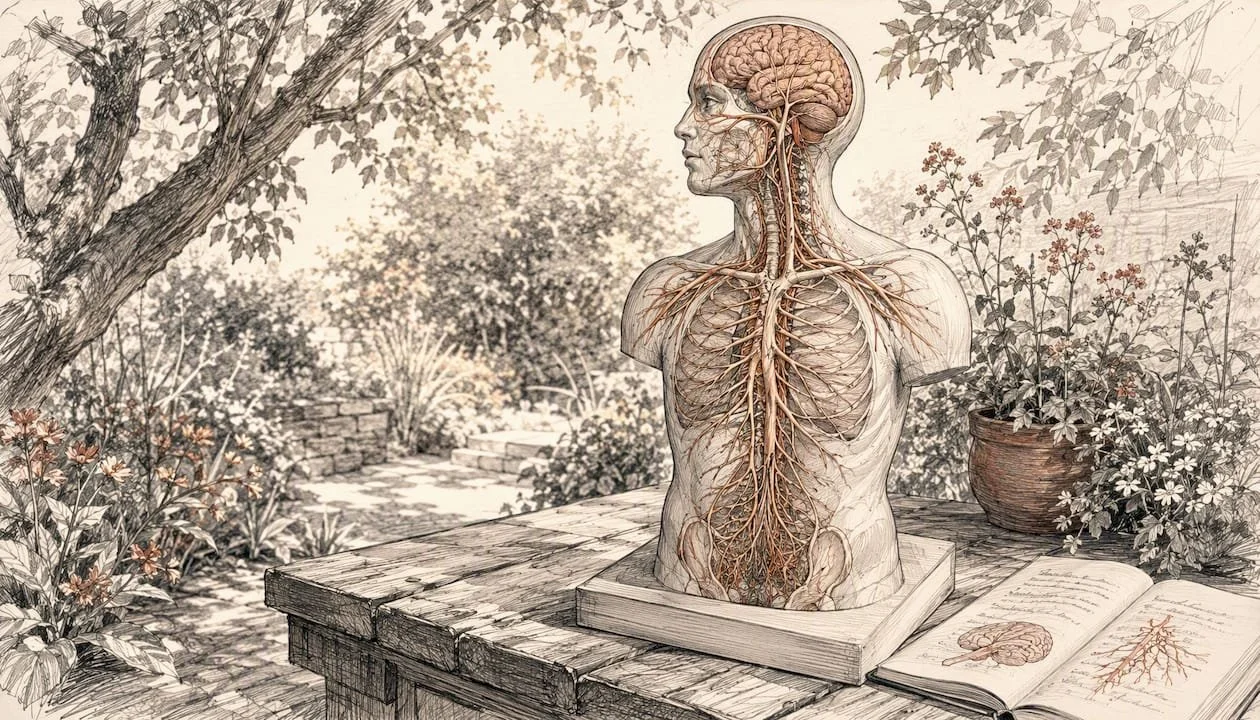
Neurobiologically, chronic trauma exposure is associated with altered interoceptive processing, the brain's ability to read signals from inside the body. Research on interoceptive accuracy and alexithymia suggests that people with alexithymia have reduced awareness of internal bodily states, which explains why they often confuse physical sensations with emotions or miss emotional signals entirely. A meta-analytic review linking child maltreatment to higher alexithymia rates supports early trauma as a significant vulnerability factor for this pattern.
Dissociation and emotional numbing overlap with alexithymia but are not the same thing. Dissociation involves a disruption in the continuity of consciousness or identity. Emotional numbing, common in PTSD, is a blunting of emotional responsiveness. Alexithymia is more specifically about the cognitive processing of emotion: the inability to label and articulate what is felt. All three can coexist, and in complex trauma presentations, they often do.
What this means practically:
Alexithymia in trauma survivors is often a learned survival strategy, not a personality defect
Early attachment history is a key clinical question when alexithymia is present
Neurobiological changes mean that body-based interventions often reach clients faster than purely verbal ones
Dissociation and alexithymia need to be assessed separately; treating one does not automatically resolve the other
A 2026 MDPI study of 332 participants found that alexithymia was associated with higher PTSD symptoms via pathways involving lower self-compassion and poorer emotion regulation, suggesting that the damage is not just to emotional awareness but to the self-protective capacity that makes healing possible.
How alexithymia changes PTSD presentation and treatment response
Alexithymia tends to be associated with greater PTSD severity, poorer emotion regulation, and different therapy engagement patterns than PTSD without it.
The symptom picture looks different. Rather than the vivid emotional flooding many people associate with PTSD, someone with alexithymia and PTSD may present with high subjective distress but flat affect, physical complaints without clear emotional narrative, and difficulty explaining what is wrong. Research published in Psychological Medicine found that trauma-exposed adults with alexithymia showed emotion response discordance: reduced physiological markers paired with elevated subjective distress. That mismatch matters because standard exposure-based therapies rely partly on physiological habituation, which may not occur in the expected way.
Specific ways alexithymia alters the PTSD picture:
Blunted emotional labeling despite high internal distress
Hyperarousal that the person cannot name or explain
Somatic complaints (headaches, GI symptoms, fatigue) that mask emotional content
Reduced empathy signaling, which strains relationships and social support
Poor habituation during exposure work, because the emotional response is not being processed in the usual way
Risk of being misread by clinicians as resistant, flat, or unmotivated
Treatment implications are significant. Talk therapy that relies on emotional reflection and narrative coherence moves slowly when a client cannot access emotional language. Stabilization phases need to be longer. Exposure work may need to be paced more carefully. The NCBI trauma-informed care overview emphasizes that common post-trauma reactions, including emotional numbing and detachment, require stabilization and titration before deeper processing, a principle that applies with particular force when alexithymia is present.
Pro Tip: Before beginning trauma memory processing with an alexithymic client, spend dedicated sessions building emotional vocabulary and interoceptive awareness. Naming a sensation in the body ("tight," "heavy," "buzzing") is a legitimate first step toward emotional labeling, and it is often more accessible than asking "how do you feel?"
The PubMed Central review documents that alexithymia links to more severe PTSD symptom clusters and raises specific concerns about treatment engagement, particularly in therapies that assume clients can readily identify and articulate emotional states.
How clinicians assess alexithymia in trauma-exposed clients
The TAS-20 is the standard research instrument, but good clinical assessment of alexithymia in trauma-exposed clients draws on multiple sources.
Common assessment elements:
TAS-20 subscales: DIF, DDF, and EOT scores, with a total score threshold of 61 for probable alexithymia
Clinical interview markers: sparse emotional vocabulary, concrete descriptions of events without affective content, difficulty answering "what did you feel when that happened?"
Screening questions a client might encounter: "When you feel upset, can you usually tell whether you are sad, frightened, or angry?" or "Do you often have physical sensations that you find hard to explain?"
Observation of interoceptive accuracy: Does the client notice body signals during session? Do they describe physical states when asked about emotions?
Collateral reports: Partners or family members often notice emotional flatness or communication difficulties before the client does
Cultural and language factors deserve explicit attention. Alexithymia expression varies across cultures; some cultural norms discourage emotional disclosure in ways that can look like alexithymia on a Western-normed scale. Vocabulary for emotional states differs across languages, and a client assessed in their second language may score higher on alexithymia measures simply because they lack the emotional vocabulary in that language. Bilingual assessment matters: a client who can describe feelings in Spanish but not in English is not alexithymic, they are under-resourced in the assessment language.
Example clinical interview questions:
"When something stressful happens, what do you notice first, in your body or in your thoughts?"
"Can you describe what anger feels like for you, physically?"
"When you are upset, do you usually know what you are upset about?"
"Do you find it hard to put feelings into words, even when you know something is wrong?"
"How do other people usually know when you are having a hard time?"
These questions are not diagnostic on their own, but the pattern of answers, especially concrete, event-focused responses with minimal affective content, is clinically informative.
Evidence-based treatments and therapy adaptations when alexithymia meets trauma
No single therapy is uniquely required, but the evidence and clinical practice converge on a clear principle: trauma-focused treatments work best when combined with preparatory skills training and careful pacing.
EMDR (Eye Movement Desensitization and Reprocessing) has strong evidence for PTSD and is adaptable for alexithymia. The body-based, bilateral stimulation component can access emotional material that verbal processing cannot reach. For alexithymic clients, EMDR often works better when the preparation phases are extended and sensation-based language is used throughout. A comparison of EMDR and talk therapy approaches shows why the body-forward nature of EMDR gives it an advantage here: it does not require the client to have a ready emotional narrative.
Trauma-focused CBT (TF-CBT) provides structured psychoeducation and cognitive restructuring that can help clients build emotional vocabulary systematically. Its limitation with alexithymia is that it assumes some capacity for emotional identification; adaptations typically involve adding explicit emotion-labeling exercises before the cognitive work begins.
DBT (Dialectical Behavior Therapy) skills modules, particularly emotion regulation and distress tolerance, are well-suited to alexithymia because they teach emotional awareness as a skill rather than assuming it. The "observe and describe" exercises in DBT's mindfulness module directly target the DIF and DDF deficits that define alexithymia.
Mindfulness-based therapies build interoceptive awareness gradually, which addresses the neurobiological underpinning of alexithymia. Body scan practices, in particular, train attention to physical sensations without requiring immediate emotional labeling, making them a low-threat entry point.
Compassion-focused interventions address the self-compassion deficit that the MDPI 2026 study identified as a key pathway between alexithymia and PTSD severity. When clients cannot feel their emotions, they often also cannot extend kindness toward themselves for struggling. Compassionate therapy approaches that build self-compassion alongside emotional awareness tend to produce more durable gains.
Practical therapy adaptations for alexithymic trauma clients:
Extended stabilization before any trauma memory processing
Sensation-based language first ("where do you feel that in your body?") before emotional labeling
Stepwise exposure titration, shorter windows, more frequent grounding
Explicit emotion-labeling exercises using feeling wheels or body maps
Interoception training: noticing heartbeat, breath, muscle tension as data
Integrated self-compassion practice woven into every phase
Pro Tip: Sequence matters more than modality. Build interoceptive safety first, then emotional vocabulary, then memory processing. Clients who can say "I notice tightness in my chest and I think that might be fear" are ready for trauma work in a way that clients who can only say "I feel nothing" are not.
Three exercises clients can expect in adapted trauma therapy:
Grounding with sensation naming: Five things you can feel physically right now, described without emotional labels (rough, warm, heavy).
Body mapping: Drawing or pointing to where different emotional states live in the body, building a personal interoceptive map over several sessions.
Micro-interoception: Noticing one internal signal (heartbeat, breath rate, jaw tension) for 30 seconds and describing it in neutral, physical terms before any emotional interpretation.
Clinical reviews indicate that alexithymia can moderate treatment outcomes, with higher alexithymia predicting slower progress in standard exposure-based protocols. The gap in the research is longitudinal data on adapted protocols specifically designed for this combination. What exists is promising but not yet definitive.
How alexithymia affects relationships and everyday functioning
Alexithymia often undermines emotional intimacy because people affected by it struggle to signal feelings and read others' cues, and their partners frequently experience this as coldness or indifference.
The experience from the outside can be genuinely painful. A partner who reaches for emotional connection and receives a blank look or a change of subject can start to feel invisible, even when the person with alexithymia is not intentionally withholding. Trauma and emotional intimacy are deeply intertwined: the same adaptive shutdown that protected someone during trauma now blocks the emotional exchange that sustains close relationships.
Common relationship patterns when alexithymia is present:
Partners feeling unseen or emotionally abandoned
Conflict escalating because ambiguous emotional signals get misread as hostility or disinterest
Reduced empathy signaling, not because empathy is absent but because it is not expressed in recognizable ways
The person with alexithymia feeling blamed for something they do not understand
Intimacy attempts that feel one-sided, leading to withdrawal on both sides
Practical strategies make a real difference. Couples who shift from implicit emotional expectations to explicit, structured communication tend to do better. That means stating needs directly ("I need you to tell me when you're upset rather than going quiet"), using structured emotional check-ins at predictable times, and reframing emotional flatness as a processing difference rather than a relational failure.
Emotionally Focused Couples Therapy (EFT) can be adapted for alexithymia by slowing the pace, using more psychoeducation about the condition, and building explicit emotional vocabulary as part of the couples work rather than assuming it is already present.
Pro Tip: If you are a partner of someone with alexithymia, use cue-based requests rather than expecting emotional reading. "When I cry, I need you to sit with me, not fix it" is more useful than "you should know what I need." Explicit requests are not a sign of a broken relationship; they are a workaround for a real processing difference.
Can alexithymia be changed after trauma? Prognosis and recovery
Alexithymia is often a modifiable, adaptive response. Many people improve meaningfully with trauma-informed interventions that increase interoceptive awareness and build emotional vocabulary, particularly when treatment is well-sequenced and adequately dosed.
The Springer 2026 article frames alexithymia as an adaptive developmental response rather than an immutable deficit, which has direct implications for prognosis: if it developed in response to relational and environmental conditions, it can, at least partially, be repaired through relational and skills-based treatment. The key predictors of better outcomes include earlier age at intervention, stronger therapeutic alliance, fewer co-occurring conditions, and sufficient treatment dose.
The Frontiers 2026 mediation study showing that alexithymia mediates the path from early trauma to emotion-regulation difficulties also implies that targeting alexithymia directly can interrupt that pathway, improving emotion regulation even when the original trauma cannot be undone.
Recovery markers to track:
Increased ability to label emotions with specific words rather than "fine" or "I don't know"
Reduced discordance between physical sensations and emotional awareness
Greater tolerance for sitting with a feeling without immediately deflecting
Improved capacity to describe emotional experiences to others
Partners or family members noticing more emotional availability
A rough treatment sequence that fits the evidence: stabilization and safety first, then interoceptive and emotion-labeling skills, then trauma memory processing, then consolidation and relapse prevention. The trauma recovery workflow that trauma-informed practices use maps closely onto this sequence.
Some trait-like alexithymia, particularly when it has neurodevelopmental contributors or has been present since early childhood, may not fully resolve. The goal in those cases shifts from elimination to management: building enough emotional vocabulary and self-awareness to function well in relationships and therapy, even if full emotional fluency remains out of reach.
A clinician's perspective: what actually changes in trauma-informed sessions
The central clinical stance is this: safety and emotional tolerance come before expression. Pushing a client to name or process feelings before they have the capacity to tolerate them does not accelerate healing; it usually produces shutdown or dropout.
In practice, the early sessions with an alexithymic trauma client often look less like therapy and more like patient, collaborative exploration. A clinician might spend three or four sessions just helping a client notice that their jaw tightens in certain conversations, or that they feel "something" in their stomach before a difficult phone call. These are not small wins. They are the foundation on which everything else is built.
Tracking progress with alexithymic clients requires different markers than standard PTSD treatment. Symptom scales alone miss the real movement. A client who can now say "I think I'm anxious" instead of "I don't know, I just feel weird" has made a clinically significant shift, even if their PTSD Checklist score has not moved yet. Clinicians who miss this tend to conclude the treatment is not working when it actually is.
Pro Tip: In early sessions, prioritize interoceptive naming over emotional labeling. Ask "what do you notice in your body right now?" before "how do you feel?" The body is often more accessible than the emotional concept, and naming a sensation is a genuine first step toward naming a feeling.
Alvaradotherapy's trauma-informed, bilingual services are organized around exactly this kind of pacing. Clinicians work in both English and Spanish, which matters because emotional vocabulary is language-specific, and a client who cannot find the word for a feeling in their second language is not alexithymic, they are linguistically under-resourced. The trauma-informed therapy approach at Alvaradotherapy builds stabilization and skills before processing, which is the sequence the evidence supports for this population.
Trauma-informed care for alexithymia: how Alvaradotherapy can help
If alexithymia has made trauma therapy feel stalled or impossible, the problem is usually sequencing, not the person. Paced, trauma-informed treatment that builds emotional awareness before pushing into memory processing can change the trajectory.
Alvaradotherapy offers exactly this kind of care: EMDR therapy and trauma-focused treatment for PTSD and complex trauma, with session pacing adapted to where each client actually is, not where standard protocols assume they should be. The practice serves clients in English and Spanish, online throughout California and New York, with EMDR Intensives available for those who want to move through stabilization and processing more efficiently.
Practical next steps if you recognize alexithymia in yourself or a loved one:
Use the TAS-20 as a starting point for self-screening, then bring the results to an intake appointment
In your first sessions, expect psychoeducation about emotional processing and body-based awareness work before any trauma memory processing begins
Ask your clinician explicitly about their approach to alexithymia and whether they adapt pacing and language accordingly
If relationships are affected, couples therapy that incorporates psychoeducation about alexithymia can help both partners understand what is happening
Book a consultation with Alvaradotherapy to talk through your situation and find out what a paced, adapted treatment plan would look like for you.
Sources
These sources represent the strongest peer-reviewed and authoritative evidence on alexithymia and trauma. Each addresses a distinct dimension of the topic.
Emotion response disconcordance among trauma-exposed adults: the impact of alexithymia
Alexithymia and Symptoms of Post-Traumatic Stress Disorder (full-text review)
Attachment, reflective functioning and the development of alexithymia (Springer, 2026)
This article is general information, not a substitute for advice from a qualified doctor. Consult a qualified healthcare professional about your own circumstances before acting on anything here.
