
Trauma and Emotional Intimacy: Healing Your Connection

TL;DR:
Trauma impairs the core elements necessary for emotional intimacy, such as trust and safety. Healing involves establishing felt safety, practicing nervous system regulation, and fostering paced vulnerability and mentalization. Partners support recovery by validating, respecting pacing, and engaging in trauma-informed therapy together.
Trauma and emotional intimacy are fundamentally linked. Trauma, especially complex trauma (C-PTSD), disrupts the core elements that make closeness possible: trust, safety, and the willingness to be vulnerable. Emotional intimacy is defined as the capacity to share your inner world with another person and feel genuinely received. When trauma rewires the nervous system to treat closeness as a threat, that capacity breaks down. Research from 2025–2026 confirms that C-PTSD impairs relationship quality by disrupting attachment and emotional regulation. The good news is that healing is possible, and the path forward is clearer than most people realize.
How does trauma affect emotional intimacy?
Trauma teaches the nervous system one lesson above all others: closeness is dangerous. That lesson gets encoded in the body and the brain, then replayed in every relationship that follows. Understanding this mechanism is the first step toward changing it.

People with trauma histories often experience fear of vulnerability and emotional avoidance as core symptoms. Emotional numbness, hypervigilance, and deep distrust create walls that feel protective but block genuine connection. A person may desperately want closeness while simultaneously doing everything to prevent it.
The impact of trauma on relationships is especially pronounced when the original wound came from a caregiver or romantic partner. Childhood relational neglect disrupts attachment patterns that carry directly into adult partnerships. The result is a nervous system that cannot easily distinguish between a safe partner and a threatening one.
Common intimacy challenges after trauma include:
Emotional shutdown during conflict or moments of closeness
Difficulty expressing needs without fear of rejection or punishment
Testing behaviors that push partners away to confirm abandonment fears
Dissociation during physical or emotional intimacy
Chronic self-protection that reads to partners as coldness or indifference
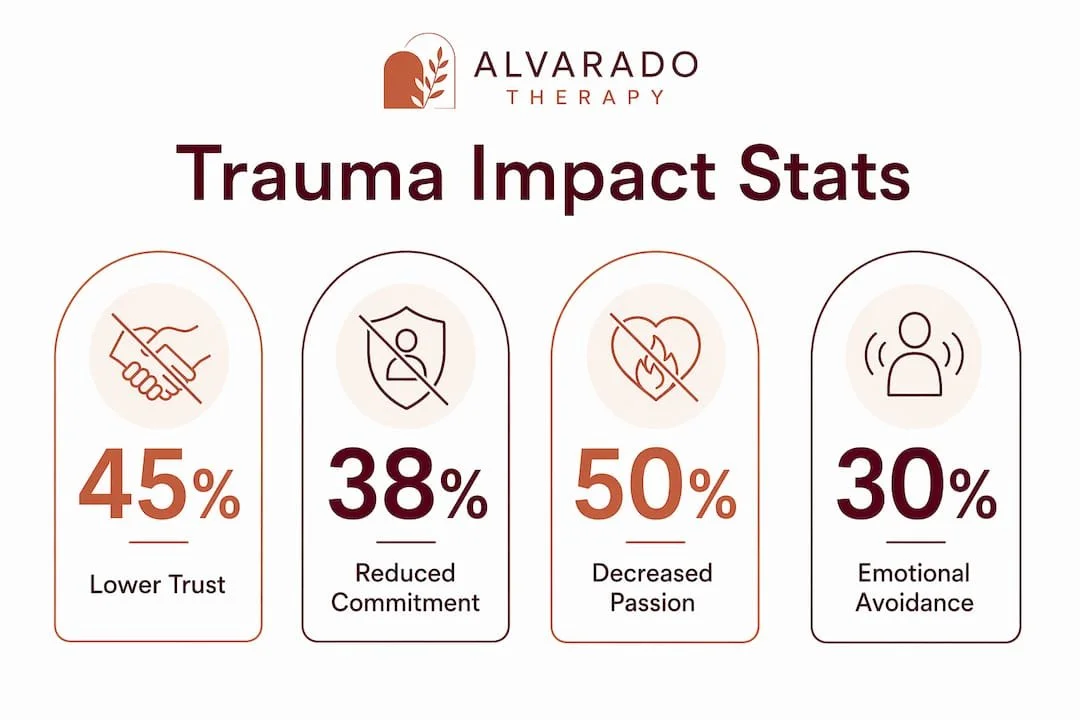
Studies confirm that C-PTSD symptoms lower trust, commitment, and passion in romantic relationships. That finding matters because it names the problem precisely. This is not a character flaw or a lack of love. It is a measurable symptom with a treatable cause.
Pro Tip: If you notice yourself pulling away right when a relationship feels safest, that is a trauma response, not a sign the relationship is wrong. Name it out loud to your partner: "I'm feeling the urge to withdraw, and I think it's fear, not you."
What psychological mechanisms drive the disconnect?
Two factors stand out in recent research as the primary mediators between trauma and relationship quality: mentalization and playfulness. Both are less obvious than communication skills or conflict resolution, and both are more powerful.
Mentalization is the ability to understand your own mental states and accurately read your partner's. It is the skill that lets you say, "She went quiet because she's hurt, not because she's done with me." Trauma reduces mentalization capacity, leading to relational misunderstandings that logic alone cannot fix. When you cannot accurately read another person's intentions, every ambiguous moment becomes a threat.
Playfulness is the second mechanism, and it surprises most people. Shared laughter, lighthearted teasing, and spontaneous fun lower defenses in ways that serious conversation cannot. Mentalization and playfulness together boost adaptive relational functioning and reduce conflict in trauma survivors. Playfulness creates connection through the body and the moment, bypassing the cognitive loops that trauma keeps running.
| Mechanism | What it does | How trauma disrupts it |
|---|---|---|
| Mentalization | Reads self and partner's inner states accurately | Trauma creates hypervigilance and misreads neutral cues as threats |
| Playfulness | Builds nonverbal bonding and lowers emotional defenses | Chronic stress and shame make spontaneity feel unsafe |
| Nervous system regulation | Keeps the body calm enough to stay present | Trauma locks the body in fight, flight, or freeze responses |
Nervous system dysregulation is the third piece. When the body is stuck in a threat state, emotional availability becomes physically impossible. You cannot think your way into presence when your brainstem is running a survival program. This is why talk therapy alone often falls short for trauma survivors working on emotional connection after trauma.
What are trauma-informed approaches to rebuilding intimacy?
Rebuilding emotional intimacy after trauma is not about pushing through fear. It is about creating the conditions where fear gradually loses its grip. That process has a specific order.
Establish felt safety first. A trauma-trained therapist provides the attuned relationship that re-wires the nervous system to experience closeness as safe rather than threatening. This is not a metaphor. The therapeutic relationship is the mechanism. Without felt safety, no technique works.
Add somatic practices alongside talk therapy. Professional guidelines recommend combining somatic and conventional therapies for complex trauma recovery. Breathwork, yoga, and acupuncture regulate the nervous system at the body level. These are not optional add-ons. For many trauma survivors, they are the primary entry point.
Practice paced vulnerability. Intimacy rebuilds in small, repeated moments of risk and repair. Share one honest feeling. Notice whether the response is safe. Repeat. This is not a linear climb. It is a practice of accumulating evidence that closeness does not always lead to harm.
Build self-awareness around triggers. Know your specific triggers before they hijack a conversation. Common ones include a partner's silence, raised voices, physical touch during conflict, and perceived criticism. Name them in advance so your partner is not left guessing.
Use couples therapy as a structured container. Trauma-informed couples therapy gives both partners a guided space to practice repair without the conversation escalating past the point of return. The therapist holds the safety so neither partner has to.
Protect against retraumatization. Boundaries are not walls. They are the conditions under which genuine closeness becomes possible. Rushing intimacy before safety is established does not build trust. It confirms the fear.
Pro Tip: Courage in trauma recovery is not the absence of fear. It is taking one small, honest step toward your partner while the fear is still present. Tenderness in repair matters more than perfection in communication.
How can partners support someone healing from trauma?
Partners of trauma survivors carry a specific and often misunderstood role. The most common mistake is believing that love alone will heal the wound. Expecting a relationship to repair childhood neglect without additional support risks triggering abandonment rage and deep relational disappointment. That is not a failure of love. It is a structural mismatch between what love can offer and what trauma recovery requires.
The partner's actual role is collaborative repair, not rescue. That distinction changes everything about how you show up.
Behaviors that help intimacy repair:
Validate without fixing. "That sounds really hard" lands better than "Here's what you should do."
Respect pacing. If your partner needs to slow down or step back, treat that as information, not rejection.
Stay consistent. Predictability is safety for a trauma survivor. Reliability over time builds the evidence base that closeness is not dangerous.
Name your own feelings clearly. Vague emotional signals are harder for a trauma survivor to read. Direct, calm expression reduces the guesswork that triggers hypervigilance.
Behaviors that hinder intimacy repair:
Pressuring your partner to "just trust you" before trust has been earned through experience
Interpreting emotional withdrawal as a personal attack
Threatening to leave during conflict, even as a frustrated expression
Minimizing the impact of past trauma because it happened before you
PTSD effects on relationships affect both people in the partnership. Partners benefit from their own support, whether through individual therapy or psychoeducation about trauma responses. You cannot pour from an empty container, and secondary traumatic stress is real.
Key Takeaways
Trauma and emotional intimacy are inseparable: healing one requires directly addressing the other through relational safety, mentalization, and consistent, paced repair.
| Point | Details |
|---|---|
| Trauma disrupts core intimacy | C-PTSD lowers trust, commitment, and passion by impairing attachment and emotional regulation. |
| Mentalization and playfulness heal | These two mechanisms reduce conflict and rebuild connection more effectively than communication skills alone. |
| Felt safety comes first | Nervous system regulation through therapy and somatic practices must precede deeper emotional vulnerability. |
| Partners cannot fix trauma alone | Collaborative repair with professional support prevents abandonment rage and relational burnout. |
| Healing is non-linear | Revisiting old feelings signals deepening capacity, not regression, and requires patience and self-compassion. |
What I've learned watching people rebuild intimacy after trauma
The most common thing I see people get wrong is treating intimacy recovery as a destination. They set a goal: "I want to feel close to my partner." Then they measure every week against that goal and conclude they are failing when the feelings are inconsistent. That framing makes healing harder.
Healing trauma is non-linear. Revisiting grief or anger does not mean you have gone backward. It means you are returning to that place with more capacity than before. That is the spiral nature of recovery. The second time you feel that old fear, you have more tools, more self-awareness, and more evidence that you survived it the first time.
What accelerates progress is not willpower. It is relational safety combined with mentalization practice. When clients start accurately reading their partner's intentions instead of defaulting to threat assumptions, the relationship changes fast. Playfulness is the shortcut most people ignore. A shared laugh during a hard week does more for intimacy than a two-hour processing conversation.
The hardest thing to hold onto is realistic expectations. Healing takes time, and the timeline is not yours to control. What you can control is showing up consistently, getting professional support, and treating setbacks as information rather than proof that you are broken. You are not broken. You are healing.
— Juiced
Alvaradotherapy's approach to trauma and intimacy healing
Alvaradotherapy specializes in exactly the kind of care this article describes. The practice offers online EMDR trauma therapy for adults across California, with licensed therapists trained in complex trauma, PTSD, and relationship difficulties. EMDR directly targets the nervous system patterns that keep trauma responses active in close relationships.
For adults working on complex trauma and intimacy, Alvaradotherapy provides individual therapy, couples therapy, and EMDR Intensives in both English and Spanish. The practice serves clients in Pasadena, Ventura, and online throughout California. If you are ready to take the next step, a free consultation is available to help you find the right fit.
FAQ
What is the connection between trauma and emotional intimacy?
Trauma disrupts the trust, safety, and vulnerability that emotional intimacy requires. Complex PTSD symptoms directly lower relationship trust, commitment, and passion by impairing attachment and emotional regulation.
How does childhood trauma affect adult relationships?
Childhood relational trauma creates insecure attachment patterns that carry into adult partnerships. These patterns show up as fear of abandonment, emotional shutdown, and difficulty trusting a partner's intentions.
Can you rebuild emotional intimacy after trauma?
Yes. Rebuilding intimacy after trauma requires felt safety, nervous system regulation, and paced vulnerability. Trauma-informed therapy, including EMDR and mentalization-based approaches, produces measurable improvements in relationship quality.
What role does mentalization play in trauma recovery?
Mentalization is the ability to accurately read your own and your partner's mental states. Trauma reduces this capacity, causing misunderstandings that logic cannot resolve. Rebuilding mentalization is one of the most direct paths to improving intimacy.
How can a partner help someone healing from trauma?
Partners help most by staying consistent, validating without fixing, and respecting pacing. Pressuring trust or interpreting withdrawal as rejection actively hinders recovery. Couples therapy gives both partners a structured space to practice repair safely.
