
Boundaries After Betrayal: Safety-First Scripts and Steps

Put safety-first boundaries in place right now. That's the single most important thing you can do in the hours after discovering a betrayal. Not a conversation about the future of the relationship, not a demand for a full explanation, and not a decision about whether to stay or leave. Before any of that, you need a structure that makes you feel physically and emotionally safe enough to think clearly.
Here's a short checklist you can act on tonight:
Pause physical intimacy until you've had time to process and, if needed, get tested.
Separate financial access temporarily: move personal funds to a solo account, change passwords on shared accounts, and review recent transactions.
Request no contact between your partner and the affair partner, in writing if possible.
Ask for basic transparency measures: location sharing, open phone access, or a check-in schedule, depending on what feels manageable.
Tell one trusted person what happened so you're not carrying this alone.
Each of these actions targets a specific safety domain. Pausing intimacy protects your physical health. Separating finances prevents further harm while you're still in shock. Requesting no contact removes the active threat. Transparency measures give your nervous system something concrete to hold onto instead of spinning in worst-case scenarios.
Key Takeaways
Boundaries after betrayal work when they're specific, consistently enforced, and grounded in your own safety needs rather than in punishing your partner.
| Point | Details |
|---|---|
| Safety comes first | Start with digital, contact, and physical boundaries immediately after discovery. |
| Use the four-part formula | Frame every boundary as: partner behavior → your thought → your feeling → what would help. |
| Consequences make it real | A boundary without a stated, enforced consequence functions as a suggestion. |
| Check in at 2 weeks, 6 weeks, 3 months | Use these milestones to assess consistency and adjust boundaries as trust builds. |
| Alvaradotherapy supports this work | Individual EMDR, EMDR Intensives, and couples therapy are available online in CA and NY. |
Table of Contents
When to involve a therapist and what trauma-informed care looks like
Self-care and safety planning while boundaries are still new
Why boundaries after betrayal are really about safety
Most people think of boundaries as rules they impose on a partner. After betrayal, that framing gets you into trouble fast. Boundaries after infidelity are primarily about restoring your own safety, not controlling what your partner does.
That distinction matters because betrayal doesn't just hurt emotionally. It dysregulates your nervous system. Hypervigilance, intrusive thoughts, sleep disruption, and a hair-trigger startle response are all common after discovering an affair. Your brain has registered a threat, and it's scanning constantly for the next one. Boundaries give that threat-detection system something real to work with.
There are two kinds of boundaries worth separating here.
Internal boundaries govern your own responses: when you walk away from a conversation that's escalating, how you manage a trigger before you react, what self-care practices you protect as non-negotiable. These are about regulating yourself, not the other person.
External boundaries govern what you allow in your shared space: whether your partner has contact with the affair partner, what information you need access to, how much physical closeness you're comfortable with right now. These boundaries protect emotional and physical safety and are not meant to punish. They create the conditions under which healing becomes possible.
Pro Tip: When introducing a safety-focused boundary, lead with what you need rather than what your partner did wrong. "I need to know where you are in the evenings right now" lands very differently than "You have to tell me where you are because you lied." Same request, completely different dynamic.
Concrete boundary categories with scripts you can use today
Setting boundaries after cheating works best when you get specific. Vague requests ("I need more honesty") are hard to measure and easy to sidestep. Category-by-category boundaries give both of you something concrete.
The four-part formula that makes scripts work: partner behavior → your thought → your feeling → what would help. Scripts built this way center your experience rather than accusing, which reduces defensiveness and makes the conversation more likely to go somewhere useful.
Digital and phone access
No deleted messages or apps without telling you first.
Shared location on during work hours for a defined period.
Phone accessible when you ask to see it.
Script: "When I can't reach you and you don't respond for hours, I start thinking something is being hidden from me, and I feel panicked. What would help me right now is knowing you'll respond within 30 minutes when I reach out."
Contact with the affair partner
Zero contact, or contact only through you, for a defined period.
Any unavoidable contact (shared workplace) disclosed in advance.
Script: "When I find out you've been in contact without telling me, I feel like the ground disappears. What would help is knowing about any contact before it happens, even if it seems minor."
Physical and sexual boundaries
No pressure for physical intimacy until you've both agreed you're ready.
STI testing before resuming sexual contact.
Right to withdraw from physical closeness at any time without explanation.
Financial transparency
Shared access to bank and credit card statements.
No large purchases without mutual agreement for a defined period.
Separate personal account maintained in your name.
Communication rules
No discussions about the affair after 9 PM or when either person has been drinking.
A "pause" signal both partners agree to use when a conversation is escalating.
Weekly check-in scheduled at a neutral time.
Children, family, and social boundaries
Agreement on what to tell children, and who tells them.
Mutual decision on which family members are informed.
No discussing the affair with mutual friends without consent.
The table below helps you decide where to start. Prioritize the category with the highest safety impact and the most reversibility.
Start with digital, contact, and physical boundaries. They're high-impact, adjustable as trust builds, and give you immediate, measurable relief.
How to introduce, negotiate, and document boundaries
A boundary conversation is not a fight. It's a structured request. Here's a repeatable sequence.
Prepare alone first. Write down the specific behavior you need to address, your thought about it, how it makes you feel, and what would help. Use the four-part formula as your template.
Choose the right moment. Not when either of you is flooded with emotion, not late at night, not right after another argument. Ask: "Can we talk about something important? I need about 20 minutes."
State the boundary using your script. Read it if you need to. Staying with your written words keeps you from being pulled into a reactive exchange.
Invite a response, not a debate. "I'm not asking you to agree with how I feel. I'm asking whether you can meet this need." Your partner can ask clarifying questions; they don't get to argue that your feeling is wrong.
Negotiate what's adjustable. Some boundaries are non-negotiable (no contact with the affair partner, STI testing). Others have room for discussion (the exact form of transparency, the check-in schedule). Know which is which before you sit down.
Write it down. A shared note, a document, or a statement made in front of a therapist all work. The act of writing it removes the "I never agreed to that" loop later.
A simple agreement template looks like this:
For a healthy boundaries workflow that includes printable templates, Alvarado Therapy's blog has a practical guide you can work through on your own or with a therapist.
When a conversation starts to escalate, use the pause signal you agreed on. Say: "I need 20 minutes. I'll come back." Then actually come back.
How to enforce boundaries and track progress over time
A boundary without a stated consequence is a suggestion. Your partner may genuinely want to respect your limits, but without a clear consequence, the cost of slipping is zero. Consequences aren't punishments. They're the specific action you'll take to protect your own safety if the boundary is crossed.

When a boundary is violated, respond calmly and specifically the first time: "That crossed the boundary we agreed on. I'm going to [consequence] now." Then follow through. Inconsistency is the fastest way to teach a partner that your limits are negotiable.
A structured, trauma-informed approach includes identifying non-negotiables, clearly communicating them, defining consequences, and following through consistently. The consistency is what rebuilds felt safety, not the boundary itself.
A practical timeline for check-ins:
2 weeks: Are the immediate safety boundaries in place and being respected? Is your nervous system settling even slightly? If not, this is a signal to bring in a therapist now.
6 weeks: Has your partner been consistent? Are you starting to see transparency measures working? This is a good point to review which boundaries still feel necessary and which might be adjusted.
3 months: Is there a pattern of reliability? Are you able to have conversations about the affair without complete dysregulation? At this stage, many couples begin working on rebuilding trust more actively, often with clinical support.
That figure underscores why consistent, enforced boundaries aren't optional extras. They're the foundation of nervous-system recovery.
Watch for these warning signs that repair is stalling: repeated boundary violations with no change in behavior, minimizing or blaming language from your partner, refusal to engage in any transparency measures, or your own sense of safety getting worse rather than better over time. Any of these is a signal to escalate to clinical support or to seriously consider separation.
When to involve a therapist and what trauma-informed care looks like
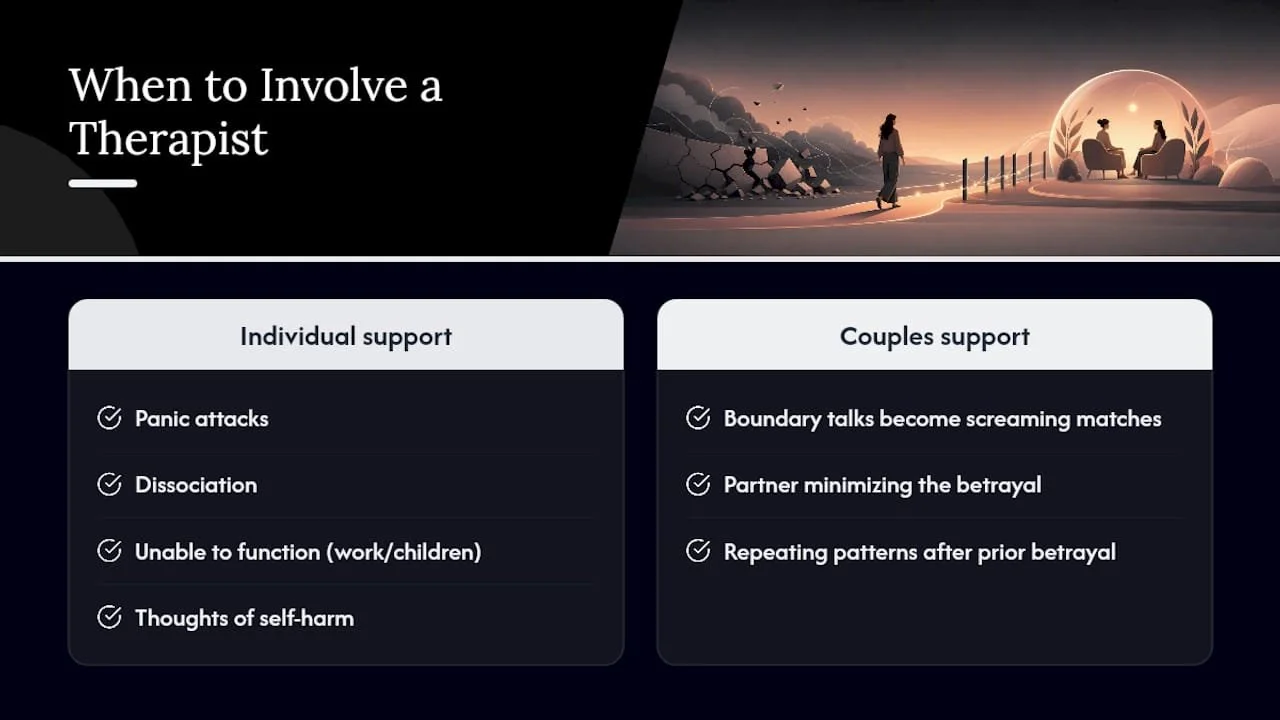
Some situations call for a therapist from day one. Bring in individual support immediately if you're experiencing panic attacks, dissociation, inability to function at work or with your children, or thoughts of self-harm. Bring in couples support if every boundary conversation turns into a screaming match, if your partner is minimizing the betrayal, or if you've been through this before and the same patterns are repeating.
Trauma-informed modalities that specifically help with betrayal recovery:
EMDR (Eye Movement Desensitization and Reprocessing) targets the traumatic memory itself, reducing the intrusive replaying that makes it hard to stay present in conversations. For betrayal trauma, EMDR can help you process the discovery without being retraumatized every time you think about it.
IFS (Internal Family Systems) helps you understand the different parts of yourself that are activated after betrayal: the part that wants to leave, the part that wants to stay, the part that's furious, the part that blames itself. Working with those parts reduces internal conflict and makes boundary conversations less chaotic.
Trauma-informed couples therapy is different from standard couples counseling. It paces the work around safety first, doesn't push for forgiveness before the betrayed partner is ready, and treats the discovery as a traumatic event rather than a communication problem.
Alvarado Therapy offers individual EMDR, EMDR Intensives, and couples therapy specifically for betrayal recovery, available online throughout California and New York. Their trauma-informed recovery guide is a strong starting point if you're not yet ready to book a session.
Therapy typically begins with a focus on nervous-system regulation: grounding skills, pause routines, and self-soothing practices. Once those are in place, therapy that focuses first on regulation increases the success rate of boundary conversations by reducing reactivity during negotiations. Most people working through betrayal trauma see meaningful stabilization within 8–12 sessions of individual work, with couples work running parallel or following.
Self-care and safety planning while boundaries are still new
The first weeks after betrayal are when boundaries are most likely to be tested, and when you're least resourced to hold them. A basic self-care and safety plan isn't soft. It's structural.
Daily self-care checklist:
Sleep at consistent times, even if sleep is broken. Avoid screens for 30 minutes before bed.
Eat something at regular intervals. Betrayal trauma suppresses appetite; eating anyway keeps your nervous system from compounding stress.
Limit alcohol. It lowers the threshold for reactive conversations.
Use one grounding practice daily: box breathing, a 5-minute walk outside, or the 5-4-3-2-1 sensory technique.
Identify your top three triggers (a specific phrase, a time of day, a location) and have a plan for each.
Basic safety plan:
Name two people you can call at any hour.
Decide in advance under what circumstances you will leave the home for the night, and where you'll go.
Store important documents (ID, financial records, insurance) somewhere only you can access.
Change passwords on personal email, banking, and social accounts.
If you share devices, review location-sharing and account-access settings.
Journal prompts for before you respond to a trigger:
What am I feeling in my body right now?
What story am I telling myself about what just happened?
What do I actually need in this moment?
What's the most grounded response I can give?
For readers navigating betrayal that involves controlling or narcissistic dynamics, Prism Counseling's narcissistic abuse recovery resources offer additional support specifically for those situations.
Building a support network means being selective. You don't need ten people who know. You need two or three who can hold information without taking sides, who won't push you toward a decision before you're ready, and who will show up consistently. Tell them specifically what you need: "I need you to listen without telling me what to do" is a complete and reasonable request.
What clinicians actually see work, and what gets in the way
The most common mistake I see is building walls instead of boundaries. After betrayal, the urge to shut everything down is understandable. But walls eliminate harm by also blocking connection, while boundaries invite reconnection on terms that protect you. A wall says "I'm done." A boundary says "Here's what I need to feel safe enough to keep going." Those are very different positions, and conflating them tends to stall the process.
The second most common mistake is vague language. "I need you to be more honest" is not a boundary. "I need to see your phone when I ask, without a delay" is. Vague requests can't be enforced, and when they're inevitably not met, the betrayed partner feels worse, not better.
Inconsistent follow-through is the third pattern that derails recovery. If a consequence is stated and then not applied, the boundary loses all structural weight. The partner learns that violations are survivable, and the betrayed person learns that their own limits don't hold. Both of those lessons make things harder.
What consistently helps: clear, specific language; consequences that are immediate and directly protective; and short-term individual therapy to build regulation skills before attempting the harder couples conversations. Clients who do even four to six sessions of individual work first tend to have more productive couples sessions because they're not flooding every time the topic comes up.
One practical tip you can use right now: before any boundary conversation, spend two minutes doing slow exhale breathing (inhale for four counts, exhale for six). It activates the parasympathetic nervous system and measurably lowers your reactivity threshold. It sounds small. It changes the conversation.
Alvarado Therapy supports healing after betrayal
Betrayal trauma is one of the most disorienting experiences a person can go through, and trying to set and hold boundaries while your nervous system is in crisis is genuinely hard. Alvarado Therapy offers trauma-informed individual therapy, EMDR Intensives, and couples therapy specifically designed to support people rebuilding safety after infidelity.

EMDR helps process the traumatic memory of discovery so it stops hijacking your present. Couples therapy creates a structured, clinician-held space for the boundary conversations that are too charged to have alone. Both services are available online throughout California and New York, with bilingual English-Spanish care available.
Find out what to expect in a first session, or book a consultation to talk through which service fits your situation. You don't have to have it figured out before you reach out.
Sources
After Your Partner Cheated: Setting Healthy Boundaries | Psychology Today
Setting Healthy Boundaries After Betrayal Trauma | ABC Counseling
This article is general information, not a substitute for advice from a qualified doctor. Consult a qualified healthcare professional about your own circumstances before acting on anything here.
