
Healing From Betrayal: A Trauma-Informed Recovery Guide

What does healing from betrayal actually look like?
Healing from betrayal is the process of recovering emotional safety and personal identity after someone you trusted violated that trust in a significant way. It is not about returning to who you were before, and it is not about forcing forgiveness on a timeline that feels wrong. Recovery means gradually integrating what happened into your life story so it no longer controls how you feel, think, or connect with others.
The process is rarely linear. You will have good days and hard days, and both are part of the work. What matters most in the early stages is creating enough stability to function, not solving everything at once.
First steps to start your recovery:
Name what happened. Calling it a betrayal, and acknowledging the pain it caused, is the foundation everything else builds on.
Create physical and emotional safety by limiting contact with the person who hurt you when needed.
Reach out to at least one trusted person, whether a friend, family member, or therapist.
Resist the pressure to make major relationship decisions in the first weeks.
Begin small self-care practices: sleep, food, movement, and moments of quiet.
Why betrayal trauma cuts so deep
Betrayal trauma is a specific type of psychological injury that occurs when someone you depend on for safety or survival violates your trust. The concept, developed through betrayal trauma theory, explains why this kind of wound feels different from other painful experiences. When a stranger harms you, your threat system activates and you can move away. When the person who harmed you is also someone you love or need, the nervous system faces a conflict it was never designed to resolve cleanly.
Why your body reacts the way it does
Your brain processes betrayal as a genuine threat to survival. The result is often hypervigilance, intrusive thoughts, difficulty sleeping, and emotional swings that feel out of proportion to everyday situations. These are not signs of weakness. They are signs that your nervous system is doing exactly what it was built to do after a serious rupture in attachment.

The emotional fallout tends to include grief, rage, shame, confusion, and a destabilizing loss of self-worth. Many people also question their own perception: "How did I miss this?" That self-doubt is one of the most painful parts of overcoming betrayal trauma, and it is also one of the most common.
How to start processing what happened
The single most effective early move is to stop avoiding your emotions and start naming them. Labeling emotions decreases their intensity and improves your ability to cope with them. Anger, shame, grief, and fear all become slightly more manageable the moment you can say, "This is what I am feeling right now."
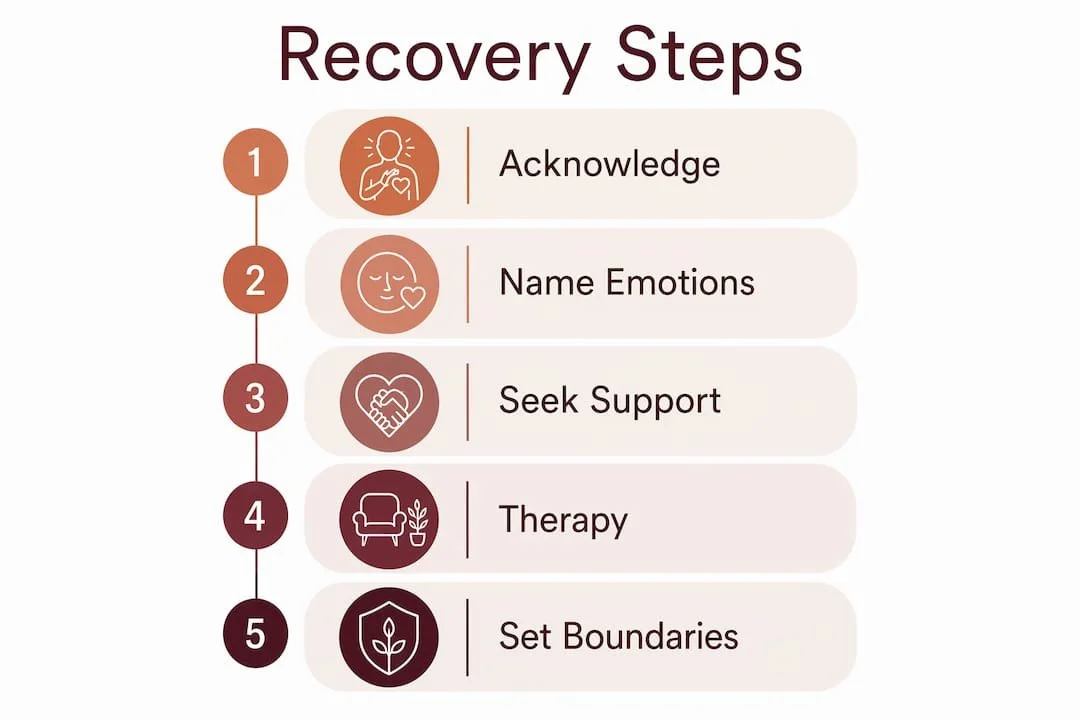
Journaling is one of the most accessible tools for this. Writing without editing yourself creates distance between you and the emotion, which makes it easier to observe rather than be consumed by it. Mindfulness practices, including body scans and grounding exercises, help regulate the nervous system when emotions spike. Neither requires a therapist to start, though both work better when combined with professional support.
Practical tools for early emotional processing:
Write freely in a journal for 10–15 minutes daily, without worrying about grammar or structure.
Practice the 5-4-3-2-1 grounding technique when intrusive thoughts spike.
Set one clear boundary each week, even a small one, to rebuild your sense of agency.
Identify two or three people you can contact when you feel overwhelmed.
Limit social media exposure to the person who hurt you, including mutual connections' posts.
Pro Tip: Self-compassion and emotional honesty are not opposites. You can acknowledge how badly something hurt while also treating yourself with the same gentleness you would offer a close friend in the same situation. Forcing yourself to "be strong" too early often delays processing, not accelerates it.
Building a support network and using emotional regulation techniques are among the most effective ways to stabilize the nervous system in the early weeks after betrayal. Safety comes before processing.

Which therapies actually help with betrayal trauma?
Trauma-informed therapy is the most reliable path through betrayal trauma, particularly when symptoms are persistent or interfering with daily life. Several evidence-based modalities have strong track records with this type of wound.
EMDR (Eye Movement Desensitization and Reprocessing) works by helping the brain reprocess traumatic memories so they lose their emotional charge. Rather than talking through the event repeatedly, EMDR uses bilateral stimulation to help the nervous system file the memory differently. EMDR reduces emotional distress by targeting the way traumatic memories are stored, which is why it tends to produce results faster than traditional talk therapy for trauma.
Emotion-Focused Therapy (EFT) and Cognitive Behavioral Therapy (CBT) complement EMDR by addressing the thought patterns and emotional regulation deficits that betrayal often creates. EFT helps you access and work through core emotions rather than suppress them. CBT helps you identify and restructure the distorted beliefs that form after betrayal, things like "I can never trust anyone" or "I should have known better."
Trauma-informed therapy as a broader framework ensures that every intervention accounts for the nervous system's state. A trauma-informed therapist will not push you to process memories before you have enough stability to handle it.
| Therapy | Primary focus | Best suited for |
|---|---|---|
| EMDR | Reprocessing traumatic memories | Intrusive thoughts, flashbacks, emotional flooding |
| EFT | Emotional access and regulation | Suppressed grief, relational wounds, attachment injuries |
| CBT | Cognitive restructuring | Negative self-beliefs, anxiety, distorted thinking patterns |
| Trauma-informed therapy | Nervous system stabilization | All phases of betrayal trauma recovery |
- Work with a therapist who specializes in trauma, not just general counselling.
- Ask directly whether your therapist uses trauma-informed approaches before committing.
- EMDR intensives, which compress multiple sessions into a shorter period, can accelerate progress for those with limited time.
- Couples therapy is worth considering if both partners are committed to repair, but individual therapy should come first.
Forgiveness, boundaries, and rebuilding trust
Forgiveness in trauma recovery does not mean excusing what happened or reconciling with the person who hurt you. It means releasing the emotional grip the betrayal has on your daily life. That release tends to come late in the healing process, not early, and it cannot be forced.
Transparency and consistent accountability rebuild trust more effectively than simply avoiding further harm. If you are attempting to repair a relationship, the person who caused the betrayal needs to communicate openly about their struggles before missteps happen again, not after. Trust is rebuilt through repeated small actions over time, not through a single conversation or apology.
Key practices for forgiveness and trust restoration:
Distinguish between forgiving the person and condoning the behavior. They are separate decisions.
Set explicit boundaries about what you need to feel safe, and communicate them clearly.
Identify your triggers and create a plan for managing them before they escalate.
Give yourself permission to choose not to reconcile. Moving on is a valid form of healing.
If rebuilding the relationship, use a practical trust-rebuilding guide to structure the process.
Managing triggers is an ongoing part of this phase. A song, a location, or a mutual friend's name can activate the same nervous system response as the original event. Recognizing your triggers and having a grounding strategy ready reduces their power over time.
How long does recovery actually take?
Full recovery from betrayal trauma typically takes between 2 to 5 years, with significant symptom reduction for most people occurring around 18 months to 2 years. The initial 18 to 24 months are mainly devoted to calming the nervous system, managing hypervigilance, and reducing intrusive thoughts, while forgiveness and major relationship decisions tend to happen later.
Healing does not mean returning to your pre-betrayal self. Therapists note that those who see recovery as a transformation process tend to develop greater resilience over time. The aim is to integrate what happened in a way that adds wisdom rather than just emotional scar tissue.
Pro Tip: Track your progress in weeks and months, not days. Betrayal trauma recovery moves in waves. A hard week does not erase the ground you have covered. Keeping a brief weekly note about what felt slightly easier than the week before gives you concrete evidence of movement when it is hard to feel it.
Progress often shows up quietly: sleeping a full night, going an hour without thinking about it, laughing at something and meaning it. Those moments are data points, not flukes.
Navigating mutual connections after betrayal
One of the least-discussed complications of betrayal is what happens to shared social circles. Friends, family members, and colleagues who know both you and the person who hurt you become complicated terrain. You may feel pressure to protect them from the truth, or you may feel abandoned when they stay neutral.
You do not owe anyone a full account of what happened. Decide in advance what you are willing to share and with whom, and stick to that boundary. Some mutual connections will choose sides; others will try to stay in the middle. Neither response is entirely within your control, and spending energy trying to manage their reactions delays your own recovery.
It helps to identify which relationships in your shared network genuinely feel safe and which ones carry too much association with the betrayal to be useful right now. Temporarily stepping back from certain social contexts is not avoidance. It is triage. You can revisit those connections when you have more stability, and by then you will have a clearer sense of who actually showed up for you.
Ready to work with a trauma-informed therapist?
Alvaradotherapy offers EMDR therapy and trauma-informed care for individuals working through betrayal trauma, PTSD, and complex relational wounds. Licensed therapists serve clients across Pasadena, Ventura, and online throughout California, with care available in both English and Spanish. If you are ready to move from surviving to recovering, schedule a consultation to find the right fit.
Key Takeaways
Healing from betrayal trauma is a gradual, multi-phase process that typically spans between 2 to 5 years. Most people notice substantial reduction in acute suffering around 18 months to 2 years, and professional therapy, especially EMDR, can significantly accelerate recovery.
| Point | Details |
|---|---|
| Name the trauma first | Acknowledging the betrayal as a real injury is the foundation of every recovery step that follows. |
| Stabilization before processing | The first 18–24 months focus on calming the nervous system, not on forgiveness or relationship decisions. |
| EMDR leads the therapy options | EMDR reprocesses traumatic memories at the neurological level, reducing emotional distress faster than talk therapy alone. |
| Full recovery takes 2–5 years | Most people experience a significant decrease in pain by 18 months to 2 years; full integration may take several years and is unique to each individual. |
| Forgiveness is release, not reconciliation | Releasing the emotional charge of betrayal is a personal act that does not require repairing the relationship. |
