
Healing Through Counseling: A Complete Guide to Recovery

Counseling works. Not as a vague promise, but as a structured, evidence-based process where trained therapists help people process trauma, regulate overwhelming emotions, and build the psychological resilience to live differently. Healing through counseling draws on approaches like EMDR, Emotion Focused Therapy, and cognitive-behavioral techniques, all delivered within a therapeutic relationship that research consistently identifies as the most powerful driver of change. The process is rarely linear. It asks something real of you. But the outcomes, from reduced anxiety and trauma symptoms to stronger relationships and a clearer sense of self, are well-documented and achievable.
What makes counseling different from simply talking to a trusted friend is the structure behind it. A licensed therapist brings evidence-based techniques and clinical training to every session, tailoring interventions to your specific history, nervous system, and goals. Your own readiness and motivation matter enormously too. Client factors like self-awareness, openness to change, and lived experience contribute significantly to how counseling unfolds. The short version: therapy is a partnership, not a prescription.
Here is what that partnership actually looks like, from the first session to lasting change.
Counseling addresses trauma, grief, anxiety, relationship difficulties, and complex emotional pain through structured, goal-driven sessions.
EMDR and Emotion Focused Therapy are two of the most well-supported approaches for emotional healing.
The therapeutic relationship, characterized by warmth, empathy, and genuine collaboration, predicts outcomes more reliably than any single technique.
Healing is iterative and cyclical, not a straight line from distress to recovery.
Individualized treatment plans and client motivation are both central to success.
What does the emotional healing process in counseling actually look like?
Emotional healing in counseling follows a recognizable arc, even though the pace and path differ for every person. Most therapists work through several overlapping phases rather than a rigid sequence.
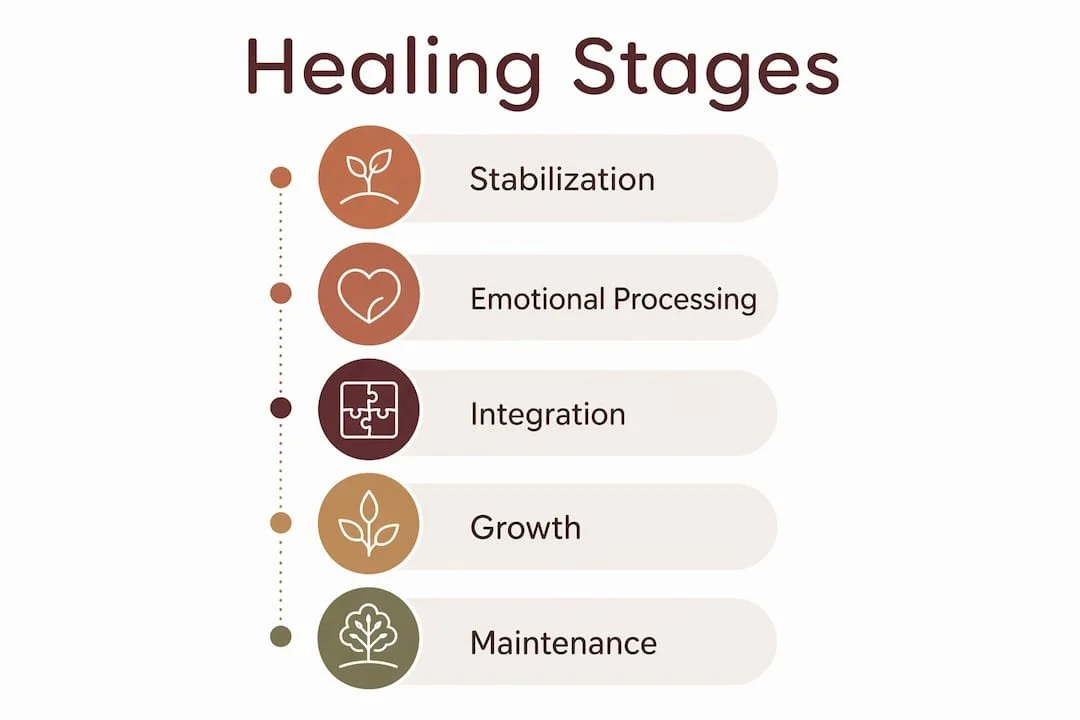
Safety and stabilization come first. Before any deep processing begins, a good therapist focuses on building trust and equipping you with nervous system regulation skills. Trauma counseling typically starts here, using grounding techniques and coping strategies to make sure that processing difficult material does not become retraumatizing. This phase is not a detour. It is the foundation everything else rests on.
Emotional processing follows at a tolerable pace. Once stabilization is solid, therapy moves into the harder work: naming what happened, sitting with difficult feelings, and beginning to make sense of them. This is where affective differentiation becomes central. A meta-analysis published in the Journal of Consulting and Clinical Psychology found that helping clients distinguish between emotion-eliciting triggers and their own affective responses was one of the most consistent mechanisms of improvement across therapy types, with experiencing in psychotherapy for depression showing a correlation of r = .44 with positive outcomes.

Skill-building runs parallel to processing. Clients learn practical tools for managing anxiety, setting boundaries, and regulating emotional responses between sessions. The work done outside the therapy room, practicing a grounding technique daily or using a new communication script with a partner, often accelerates change faster than the sessions themselves.
Integration is the final, ongoing phase. New ways of thinking and responding get woven into daily life, relationships, and identity. Healing in therapy is cyclical by nature, with emotional regulation skills practiced between sessions being as critical as in-session work. Progress is not always visible week to week. Sometimes you circle back to earlier material with new tools and see it differently.
Safety and trust-building with the therapist
Grounding and nervous system regulation skills
Gradual processing of trauma, grief, or emotional pain
Developing coping strategies and psychological flexibility
Integrating new skills into relationships and daily life
Recognizing setbacks as part of the process, not evidence of failure
How does a counselor actively support your healing?
The counselor's role is less about delivering techniques and more about creating the conditions where change becomes possible. Therapeutic warmth, empathy, and genuine care act as a psychological safe harbor, a place where you can bring the parts of yourself you have kept hidden and find them met with understanding rather than judgment.
That relationship is not incidental to the therapy. Research is clear that the therapeutic relationship predicts success more reliably than any specific technique. A skilled counselor uses this relationship as the vehicle through which every intervention is delivered, whether that is EMDR processing, Emotion Focused Therapy work, or cognitive restructuring. The bond between therapist and client is especially predictive of outcomes when a person has low social support outside of therapy.
Good counselors also adapt. They bring cultural responsiveness and identity-affirming care into every session, recognizing that healing looks different across communities, backgrounds, and lived experiences. A bilingual therapist working with a Spanish-speaking client, for example, is not just translating words. They are honoring the cultural context that shapes how that person understands distress and recovery.
Creating a warm, empathetic, and genuine therapeutic relationship
Selecting evidence-based approaches matched to your specific needs
Supporting psychological flexibility and emotional awareness
Empowering your inherent capacity for growth rather than "fixing" you
Balancing stabilization and processing, especially in trauma work
Incorporating your cultural values, identity, and lived context into care
Pro Tip: When evaluating a potential therapist, pay attention to how you feel after the first session. A sense of being genuinely heard, even if the session was uncomfortable, is a stronger predictor of fit than credentials alone.
What challenges should you expect during the healing process?

Therapy is not uniformly comfortable, and knowing that ahead of time helps. The most common challenge people encounter is the discomfort of actually feeling what they have spent years avoiding. Processing grief, trauma, or deep shame means those emotions have to surface before they can shift.
Feeling emotionally exhausted after a session is normal, especially early on. The Mayo Clinic notes that intense emotional discussions in therapy can leave people feeling physically drained. That is not a sign something went wrong. It is often a sign that real work happened.
Feeling stuck is another common experience, particularly in trauma work. Progress in counseling is rarely a steady upward climb. There are weeks where nothing seems to move, and weeks where a single session reshapes how you see years of your life. Setbacks and emotional relapses are part of the process, not evidence that therapy is failing.
Finding the right therapist can itself be a barrier. Mistrust, stigma around mental health care, or simply not clicking with the first person you see can delay the start of meaningful work. If a therapist does not feel like a good fit after a few sessions, that is worth naming directly. Switching therapists is not giving up. It is advocating for the quality of care you deserve.
Emotional discomfort and vulnerability during processing
Feeling overwhelmed or temporarily stuck, especially in trauma work
Therapy requires patience; deep change does not happen in a few sessions
Setbacks and emotional relapses are normal, not failures
Barriers like stigma, mistrust, or difficulty finding the right therapist
Pacing and stabilization skills help manage the harder stretches
What lasting benefits does counseling actually deliver?
The outcomes of sustained counseling work go well beyond symptom reduction. Psychotherapy goals, as defined by the National Institute of Mental Health, include gaining relief from symptoms, maintaining or enhancing daily functioning, and improving quality of life. In practice, people who engage seriously with therapy often describe changes that touch every area of their lives.
Emotional regulation improves in concrete, measurable ways. Anxiety spikes become less frequent and less intense. Trauma triggers lose their grip. People who once felt hijacked by their emotions develop the capacity to pause, name what they are feeling, and choose a response rather than react automatically.
Relationships change too. Counseling often surfaces patterns that have been driving conflict for years, the pursue-withdraw cycle in a partnership, the way childhood attachment wounds show up in adult friendships. Once those patterns are visible, they become workable. Communication improves. Boundaries get clearer. Emotional safety in close relationships deepens.
Psychological flexibility is one of the most durable outcomes therapists aim for. Rather than eliminating all distress, the goal is to help you stay present and engaged with life even when things are hard. That capacity, to hold difficulty without being defined by it, tends to outlast any specific symptom relief.
Improved emotional regulation and stress response
Greater psychological flexibility and resilience
Enhanced self-awareness and self-compassion
Stronger interpersonal relationships and communication
Reduction in symptoms like anxiety, depression, and trauma triggers
Increased life satisfaction and a renewed sense of hope
Which evidence-based therapies drive the deepest emotional healing?
Several therapeutic approaches have strong research support for emotional healing. The most effective counselors do not rigidly apply a single method. They draw from multiple modalities based on what a client actually needs.
EMDR therapy
Eye Movement Desensitization and Reprocessing, or EMDR, is one of the most well-researched approaches for trauma and PTSD. It works by helping the brain reprocess distressing memories so they lose their emotional charge. EMDR appears in major PTSD treatment guidelines as a recommended option, and its use has expanded beyond single-incident trauma to address chronic stress, relationship wounds, and anxiety driven by earlier experiences. Alvaradotherapy's EMDR treatment research details how the approach works and what the evidence shows about outcomes.
Emotion Focused Therapy (EFT)
EFT is built on the premise that emotions are not problems to be managed but information to be understood. The International Society for Emotion Focused Therapy describes EFT as an empirically supported humanistic treatment that views emotions as centrally important in human functioning and therapeutic change. Rather than suppressing or bypassing difficult feelings, EFT helps clients move from avoiding emotions to naming, accepting, and transforming them, which is crucial for adaptive coping. The result is not just symptom relief but a fundamentally different relationship with your own emotional life.
Cognitive-behavioral techniques
Cognitive-behavioral therapy (CBT) targets the connection between thoughts, feelings, and behaviors. It is particularly effective for anxiety disorders, depression, and patterns of thinking that keep people stuck. CBT is skills-based and often produces visible change relatively quickly, which makes it a useful complement to deeper processing work.
Psychodynamic therapy
Psychodynamic approaches focus on unconscious patterns, early relational experiences, and how the past shapes present behavior. Research on psychodynamic therapy shows that focusing on affective experiences helps clients integrate emotions into conscious awareness, leading to better emotional regulation and interpersonal functioning.
| Therapy approach | Primary focus | Best suited for |
|---|---|---|
| EMDR | Reprocessing traumatic memories | PTSD, trauma, anxiety driven by past events |
| Emotion Focused Therapy (EFT) | Transforming emotional experience | Depression, grief, relationship difficulties |
| Cognitive-behavioral therapy (CBT) | Changing maladaptive thoughts and behaviors | Anxiety disorders, depression, phobias |
| Psychodynamic therapy | Unconscious patterns and relational history | Long-standing emotional issues, identity concerns |
| Trauma-informed therapy | Safety, stabilization, and paced processing | Complex trauma, PTSD, childhood abuse |
- EMDR is effective for trauma, PTSD, and anxiety rooted in distressing memories.
- EFT helps clients access and transform emotions rather than avoid them.
- CBT addresses maladaptive thought patterns with practical, skill-based tools.
- Psychodynamic therapy explores unconscious patterns and early relational wounds.
- Culturally responsive adaptations maximize relevance and safety for diverse clients.
- Flexible, client-centered delivery outperforms rigid protocol adherence.
Self-help and complementary practices that strengthen your counseling work
What happens between sessions matters as much as the sessions themselves. Counseling gives you tools. Using those tools consistently in daily life is where the real consolidation happens.
Grounding practices are among the most transferable skills from therapy to everyday life. A simple 5-4-3-2-1 sensory exercise, naming five things you can see, four you can feel, three you can hear, two you can smell, and one you can taste, can interrupt a trauma response or anxiety spiral in under two minutes. Consistency matters more than duration. Sixty seconds of slow breathing practiced daily builds more nervous system resilience than a twenty-minute session done once a week.
Journaling and narrative work support the processing that happens in session. Writing about what triggered you, what you felt in your body, and what helped even slightly gives your therapist concrete material to work with and helps you track your own patterns over time. The role of storytelling in mental health recovery is well-documented. Putting experience into words, whether on paper or in conversation, is itself a form of emotional processing.
Physical movement regulates the nervous system in ways that talk alone cannot. Walking, yoga, swimming, or any rhythmic physical activity helps discharge the physiological arousal that trauma and chronic stress leave in the body. Many trauma-informed therapists actively encourage movement as a complement to in-session work.
Social connection reinforces the relational skills built in therapy. Practicing new communication patterns with a trusted friend, or simply allowing yourself to be supported rather than isolated, extends the healing work beyond the therapy room. Building a coping skills toolkit that includes both solo practices and relational ones gives you more options when stress peaks.
Sleep, nutrition, and reducing substance use are not glamorous additions to a healing plan, but they directly affect emotional regulation capacity. A nervous system running on poor sleep and high caffeine has far less room to process difficult emotions than one that is adequately resourced.
How do you know if counseling is actually working?
Progress in therapy is often subtle before it becomes obvious. Counseling success is measured by improved daily functioning and emotional regulation, not by the total absence of symptoms. That distinction matters practically: if you are waiting to feel "fixed" before you decide therapy is working, you may miss the real signs of change.
Functional improvements are usually the first indicators. You sleep better. Conflicts with your partner de-escalate faster. You notice a trigger before it takes over rather than after. These shifts in daily behavior often precede any dramatic change in how you feel about yourself.
Emotional range expands. Early in therapy, many people describe feeling numb, flat, or stuck in one emotional register, usually fear, anger, or grief. As healing progresses, the emotional palette widens. You can feel sad without being consumed by it. You can feel angry and still choose how to respond.
Self-awareness deepens. You start to recognize your own patterns, the story you tell yourself when you feel rejected, the physical sensation that precedes an anxiety spike, the way you shut down when a conversation gets too close to something painful. That recognition is not just insight. It is the beginning of choice.
Tracking progress formally can help. A brief weekly log noting mood, sleep quality, and one situation you handled differently than you would have six months ago gives both you and your therapist a concrete record to work from. Many therapists use validated measures like the PHQ-9 for depression or the PCL-5 for PTSD symptoms to track change over time. These tools are not the whole picture, but they anchor subjective experience in something measurable.
Healing through counseling also shows up in your relationships. You set a boundary you would have avoided before. You ask for help without the usual shame. You stay present in a difficult conversation instead of shutting down or escalating. Those relational shifts, small as they may seem in the moment, are among the most durable signs that the work is taking hold.
Pro Tip: Ask your therapist to review your goals together every six to eight weeks. Revisiting what you came in for and measuring it against where you are now keeps the work focused and gives you concrete evidence of movement.
Ready to begin your healing process?
Alvaradotherapy is a trauma-informed practice serving clients across Pasadena, Ventura, and online throughout California. The licensed therapists at Alvaradotherapy specialize in EMDR, individual counseling, couples therapy, and support for those navigating PTSD, complex trauma, grief, and anxiety. Care is available in both English and Spanish, with a strong commitment to culturally responsive, identity-affirming therapy.
If you are ready to explore what EMDR trauma therapy looks like in practice, or if you want to understand your options for PTSD and complex trauma treatment, Alvaradotherapy offers a clear, supportive path forward. The first step is a consultation, not a commitment.
Key Takeaways
Healing through counseling is a structured, evidence-based process that unfolds across stages, from stabilization and emotional processing to skill-building and integration, driven more by the quality of the therapeutic relationship than by any single technique.
| Point | Details |
|---|---|
| Therapeutic relationship drives outcomes | Research shows the counselor-client bond predicts success more reliably than specific techniques. |
| Healing is cyclical, not linear | Progress involves setbacks; emotional regulation practiced between sessions is as critical as in-session work. |
| Stabilization precedes processing | Trauma counseling begins with grounding and nervous system regulation before deeper processing begins. |
| Psychological flexibility is the goal | Effective therapy builds the capacity to stay engaged with life amid difficulty, not just reduce symptoms. |
| Progress shows in daily functioning | Improved emotional regulation, sleep, relationships, and self-awareness are the real indicators of change. |
