
Immigration Evaluation Process 2025: Your Complete Guide

What the 2025 immigration evaluation process actually involves
A psychological immigration evaluation is a forensic mental health assessment conducted by a licensed professional to document emotional, psychological, and hardship factors relevant to your immigration case. It is not therapy. The evaluator's job is to produce an objective clinical opinion that USCIS adjudicators can use when deciding your application.
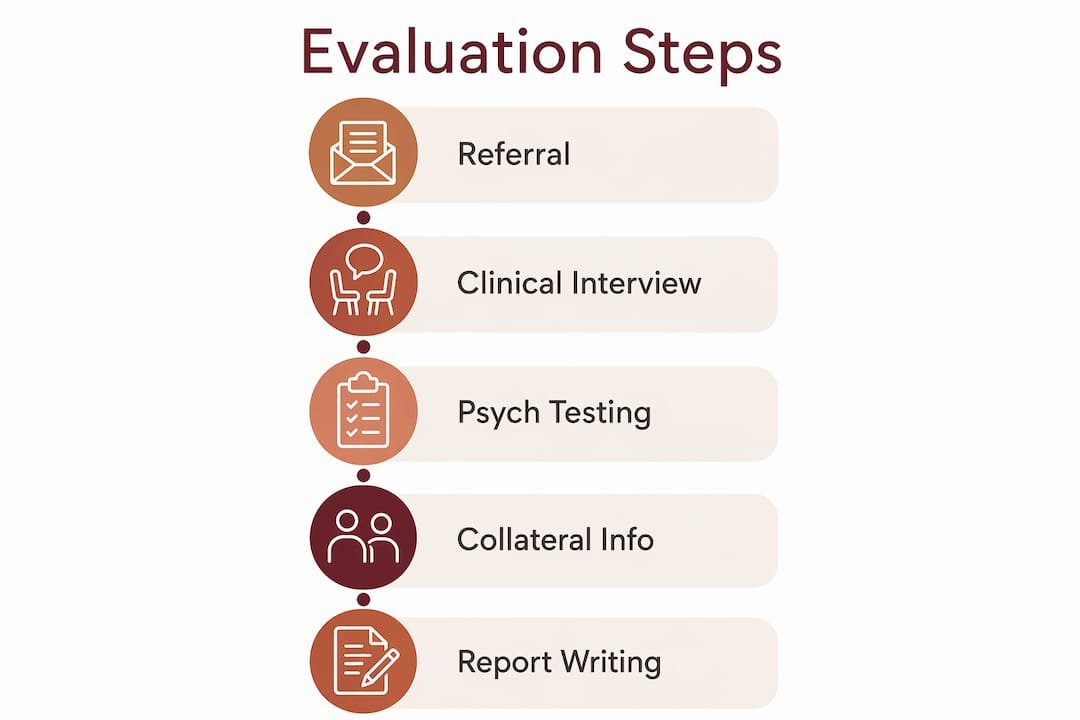
The 2025 immigration evaluation process typically moves through these core stages:
Referral and intake: Your immigration attorney identifies the need and submits referral questions to the evaluator.
Clinical interview: A licensed psychologist, clinical social worker, or psychiatrist conducts one or more structured interviews covering personal history, trauma, family circumstances, and immigration background.
Psychological testing: Standardized instruments assess conditions such as PTSD, anxiety, and depression where clinically indicated.
Collateral review: The evaluator reviews supporting documents including medical records, financial statements, and school records.
Report writing: The evaluator integrates all findings into a written report that connects clinical symptoms to the legal standard at issue, such as extreme hardship.
Submission: Your attorney incorporates the report into the broader application package for USCIS.
Written reports typically take one to two weeks to prepare after clinical sessions. With USCIS processing averaging around 8 months in 2025, a thorough, well-documented evaluation can meaningfully strengthen your position during that wait.
What an immigration evaluation actually includes, step by step
Understanding each component helps you show up prepared and reduces the anxiety of not knowing what to expect.
Clinical interview
The interview is the foundation of the evaluation. Expect the evaluator to ask about your childhood, family relationships, immigration history, experiences of violence or persecution, and how your current situation affects your daily functioning. This is not a casual conversation. The evaluator is building a clinical picture that must hold up to legal scrutiny, so answers need to be detailed and honest.

Evaluators use trauma-informed interviewing and culturally responsive methods throughout this process. That means they are trained to recognize how cultural background, language barriers, and past trauma can shape how someone communicates distress. A skilled evaluator adjusts their approach accordingly rather than applying a one-size-fits-all framework.
Psychological testing
Not every evaluation requires formal testing, but many do. Standardized instruments help the evaluator document the presence and severity of conditions like PTSD, major depression, or generalized anxiety. These tools provide objective data that supplements the clinical interview and strengthens the report's credibility with USCIS.
Collateral information
Medical records, school records, financial documents, letters from family members, and country condition reports all serve as collateral evidence. Gathering this material often takes longer than the interviews themselves, so starting early is not just good advice. It directly affects how quickly your report can be completed and how strong the evidentiary foundation is.
Report writing and legal linkage
The written report must do more than describe symptoms. Effective reports connect clinical findings to legal standards such as extreme hardship, making the case in language that adjudicators can act on. This requires the evaluator to understand both clinical psychology and the specific legal criteria your case involves. A report that documents depression without tying it to the hardship standard misses the point entirely.
Qualified evaluators
Licensed clinical social workers, psychologists, and psychiatrists are the recognized professionals for conducting these evaluations. Credentials matter because USCIS adjudicators and immigration judges assess the evaluator's qualifications when weighing the report's credibility. Working with someone who lacks relevant licensure or forensic experience puts your application at risk.
Who actually needs an immigration evaluation in 2026
Not every immigration applicant needs a psychological evaluation, but the list of cases where one is required or strongly recommended has grown. Immigration evaluations now appear across waivers, asylum petitions, VAWA cases, and U- and T-visa applications, each with its own legal standard and referral questions.
The most common situations include:
I-601 and I-601A hardship waivers: Applicants must demonstrate that a qualifying U.S. citizen or lawful permanent resident family member would suffer extreme hardship if the waiver is denied. A psychological evaluation documents the emotional, relational, and financial toll on that family member.
Asylum cases: Persecution-based applications often require documentation of trauma-related symptoms, PTSD, or fear of future harm. The evaluator assesses credibility and clinical presentation.
N-648 medical disability waivers: Applicants seeking an exemption from the English language or civics requirements for naturalization need a licensed professional to certify a qualifying medical or developmental disability.
VAWA petitions: Survivors of domestic violence applying under the Violence Against Women Act benefit from evaluations documenting the psychological impact of abuse.
U-visa and T-visa petitions: Victims of qualifying crimes or human trafficking often need documentation of trauma and its effects on functioning.
Removal and deportation proceedings: Family members facing separation may need evaluations that document the hardship deportation would cause to U.S. citizen children or spouses.
Your immigration attorney is usually the one who identifies whether an evaluation is needed and drafts the referral questions. The evaluator then structures the assessment around those specific legal questions. Evaluations address psycholegal referral questions, but decision authority rests with adjudicators, not evaluators. The report informs the decision; it does not make it.
How to prepare for your immigration evaluation effectively
Preparation is where most applicants either set themselves up for a strong report or create unnecessary delays. The good news is that the steps are straightforward.
Gather documents before your first appointment. Collect medical records, therapy notes, school records, financial statements, police reports, and any country condition documentation relevant to your case. Your attorney can help identify what applies.
Clarify the referral questions with your attorney. Know what legal standard the evaluation is addressing before you walk in. If you are applying for an I-601 waiver, understand what "extreme hardship" means for your qualifying relative so you can speak to those specific impacts.
Be honest and thorough during the interview. The evaluator is not judging you. Minimizing symptoms or leaving out difficult experiences weakens the report. Evaluators are trained to create a safe space for disclosure, particularly around trauma.
Choose an evaluator with immigration-specific experience. General clinical experience is not enough. The evaluator needs to understand forensic standards, USCIS requirements, and how to write a report that meets legal criteria.
Set realistic timeline expectations. Between scheduling, the interview itself, collateral review, and report writing, the full process often takes several weeks. Build that into your application timeline.
Follow up on report submission. Once the report is complete, confirm with your attorney that it has been received and properly incorporated into the application package. A report sitting in an inbox is not helping your case.
Ask about language access. If English is not your primary language, you have the right to work with an evaluator who can conduct the interview in your language or provide a qualified interpreter. Alvaradotherapy, for example, conducts evaluations in both English and Spanish. This matters when nuanced emotional content needs to be communicated accurately.
Pro Tip: Organize all collateral documents into a single folder before your first appointment. Evaluators who receive organized records can review them faster, which shortens the time between your interview and the completed report.
For a detailed walkthrough of what to bring and how to structure your preparation, the immigration evaluation process guide from Alvaradotherapy covers the full sequence aligned with current USCIS requirements.
Expert insights on navigating the 2025 immigration evaluation
The 2025 immigration assessment environment is more demanding than it was even two years ago, and the professionals conducting these evaluations face a genuinely complex set of challenges.
Evaluations are forensic assessments, not therapy
This distinction trips up both applicants and, occasionally, less experienced evaluators. Immigration evaluations are objective forensic assessments, not therapeutic counseling. The evaluator is not your therapist. They are producing an impartial clinical opinion for a legal proceeding. Maintaining that role clarity protects both the integrity of the report and the applicant's understanding of what the process is for. If you need therapeutic support alongside your evaluation, those are two separate relationships with two separate providers. A mental health defense attorney can also help clarify how psychological documentation fits into your broader legal strategy.
Staying current with evolving immigration law
Immigration law changes fast. An evaluator who was well-informed two years ago may be working from outdated standards today. The rapidly changing legal landscape requires evaluators to continuously update their knowledge to produce reports that are relevant and compliant. When you are selecting an evaluator, ask directly about their familiarity with current USCIS policy and whether they regularly consult with immigration attorneys. That question alone tells you a lot.
Cultural and linguistic competence shapes outcomes
An evaluator who does not account for cultural context risks misinterpreting symptoms or missing them entirely. Trauma presents differently across cultures. Somatic complaints, emotional restraint, or indirect communication styles can all be misread by a clinician who lacks cross-cultural training. Trauma-informed, culturally responsive approaches produce more accurate clinical pictures, which translates directly into stronger reports.
The statistic that puts timelines in perspective
USCIS applications currently average around 8 months to process. A weak or incomplete evaluation report submitted into that queue cannot be easily corrected once the application is filed. Getting the evaluation right the first time is not just about quality. It is about not losing months of waiting time to an avoidable error.
USCIS requires objective documentation of emotional, psychological, medical, and financial hardship, and evaluations that meet that standard significantly strengthen waiver applications. The evaluator's ability to translate clinical findings into legally meaningful language is what separates a report that moves an adjudicator from one that gets set aside.
For applicants in California, Alvaradotherapy's team of licensed therapists brings trauma-informed, bilingual expertise to immigration psychological evaluations that meet current USCIS standards. Their approach integrates forensic objectivity with culturally responsive clinical methods, which is exactly what the 2025 environment demands.
Working with Alvaradotherapy for your immigration evaluation
Alvaradotherapy is a California-based trauma-informed practice with licensed therapists serving clients in Pasadena, Ventura, and throughout California via telehealth. The team conducts immigration psychological evaluations in English and Spanish, with direct experience in hardship waiver cases, asylum evaluations, VAWA petitions, and more.
If you are preparing for an immigration evaluation or want to understand whether one applies to your case, schedule a consultation to speak with a licensed clinician who knows the process. For those also navigating PTSD or complex trauma alongside an immigration case, Alvaradotherapy's trauma therapy services offer a separate, dedicated space for healing.
Key Takeaways
A thorough, legally grounded immigration evaluation is one of the most consequential documents in a hardship waiver or asylum application, and getting it right from the start matters more than ever given current USCIS processing timelines.
| Point | Details |
|---|---|
| Reports take 1–2 weeks to prepare | After clinical sessions, evaluators need one to two weeks to write and finalize the report. |
| USCIS processing typically requires several months | A weak evaluation submitted into a long queue cannot easily be corrected after filing. |
| Collateral documents take the longest | Gathering medical, financial, and school records often takes more time than the interview itself. |
| Evaluations are forensic, not therapeutic | The evaluator provides an objective clinical opinion for legal use, not ongoing counseling. |
| Evaluator credentials directly affect credibility | Licensed psychologists, clinical social workers, and psychiatrists are the recognized qualified professionals. |
