
Emotional Healing Through Therapy: A 2026 Guide

TL;DR:
Therapy helps resolve painful emotions to promote lasting emotional healing and personal growth.
Matching the right modality, like EFT or EMDR, to your symptoms enhances the chances of recovery.
Emotional healing through therapy is the process of resolving and integrating painful emotions to restore mental well-being and support lasting personal growth. The clinical term for this work is psychotherapeutic emotional processing, and it covers everything from grief and anxiety to trauma and relationship wounds. A 2026 meta-analysis found that emotion-focused therapy produced an effect size of g = 1.39 across distress-based conditions including anxiety, depression, and PTSD. That number places it among the strongest effect sizes recorded for any psychological intervention. Alvaradotherapy works within this evidence base, offering trauma-informed care that meets people where they are and builds toward real, measurable change.
What are the main therapy approaches for emotional healing?
Several evidence-based modalities form the foundation of counseling for emotional recovery. Each targets a different layer of emotional experience, and choosing the right one depends on your specific symptoms and goals.
Emotion-Focused Therapy (EFT) centers on identifying and transforming core emotional states. Research confirms its strong effect size across anxiety, depression, and PTSD, making it one of the most validated approaches for healing emotional wounds.
Cognitive Behavioral Therapy (CBT) targets the relationship between thoughts, feelings, and behaviors. CBT is widely regarded as the gold standard for anxiety and depression, often matching antidepressants in effectiveness. It works best when you are ready to practice skills between sessions.
Dialectical Behavior Therapy (DBT) teaches four core skill sets: mindfulness, distress tolerance, emotional regulation, and interpersonal effectiveness. DBT was originally developed for emotional dysregulation and self-harm and remains highly effective for managing intense emotions.
Eye Movement Desensitization and Reprocessing (EMDR) uses bilateral stimulation to help the brain reprocess traumatic memories. EMDR reduces emotional intensity without forcing clients to relive trauma in detail, making it a preferred choice for PTSD and complex trauma. Alvaradotherapy specializes in EMDR and offers both standard sessions and intensive formats.
Psychodynamic therapy explores how past relationships and unconscious patterns shape current emotional responses. It is slower and more exploratory, suited to people whose emotional difficulties trace back to early attachment wounds.
| Therapy | Primary focus | Best suited for |
|---|---|---|
| EFT | Transforming core emotional states | Anxiety, depression, PTSD |
| CBT | Changing thought and behavior patterns | Anxiety, depression, phobias |
| DBT | Building emotional regulation skills | Intense emotions, self-harm history |
| EMDR | Reprocessing traumatic memories | PTSD, complex trauma |
| Psychodynamic | Uncovering unconscious patterns | Relational and identity issues |
Pro Tip: Match your therapy choice to your symptom profile. If trauma drives your distress, EMDR or EFT will likely outperform a skills-only approach. A qualified mental health professional can assess which modality fits your specific needs.
How does therapy enable emotional processing and transformation?

Therapy works by engaging deeper levels of human experience, not just surface symptoms. A strong therapeutic alliance predicts success more reliably than any single technique. That relationship creates the safety required for real emotional work to happen.
Several mechanisms drive this transformation:
Emotional honesty. Emotions are facts about how you experience the world. Avoiding them in sessions stalls progress. Naming what you feel, even when it is uncomfortable, is the entry point for change.
Emotional labeling. Describing an emotion as a sensation rather than an identity reduces its intensity. Labeling emotions this way can cut emotional reactivity significantly. Saying "I notice tightness in my chest" is more useful than "I am broken."
Non-judgmental witnessing. A skilled therapist reflects your experience back without judgment. That act alone creates a corrective emotional experience, often the first time a person has felt fully heard.
Nervous system regulation. Emotionally attuned relationships in therapy regulate the nervous system and enable new emotional learning. Your body learns that distress does not have to be permanent.
Corrective relational experiences. Over time, the therapy relationship rewires how you expect others to respond to your pain. This is especially powerful for people whose early relationships were unsafe or unpredictable.
Therapy for emotional health is not passive. You bring your full emotional experience into the room, and the therapist helps you make sense of it. That active engagement is what produces lasting change, not just insight.
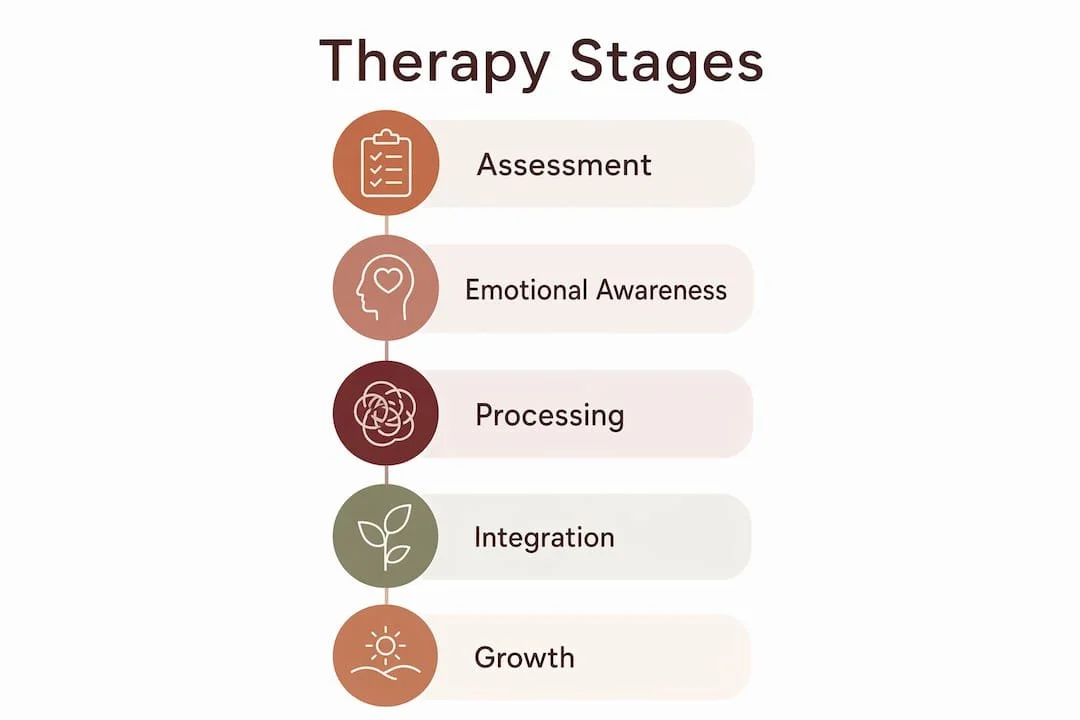
What are the typical stages of emotional healing through therapy?
Emotional healing rarely follows a straight line, but it does follow recognizable stages. Understanding them helps you stay oriented when the process feels slow or difficult.
Safety and stabilization. Early therapy phases focus on building a sense of safety before touching painful material. This is not avoidance. It is preparation. Grounding techniques, psychoeducation, and trust-building happen here. Skipping this stage risks re-traumatization.
Emotional awareness. Once you feel safe, therapy moves toward identifying and naming what you actually feel. Many people arrive in therapy disconnected from their emotions. This stage rebuilds that connection, often through body-based awareness and structured reflection.
Processing and integration. This is where the core work happens. Painful memories, grief, and relational wounds get examined, felt, and reframed. EMDR and EFT are particularly effective at this stage. The goal is not to erase the past but to change how it lives in your body and mind.
Growth and consolidation. Therapy shifts from processing pain to building a life that reflects your values and strengths. Signs of progress include greater self-awareness, improved relationships, and the ability to tolerate difficult emotions without being overwhelmed by them. Therapy builds emotional flexibility rather than simply reducing symptoms.
One challenge worth naming is titration, the practice of pacing how much emotional material you engage with at once. Moving too fast can flood the nervous system. A skilled therapist monitors this carefully and adjusts the pace to match your window of tolerance. This is why working with a trained professional matters far more than following a self-help program.
For those navigating trauma specifically, Alvaradotherapy's PTSD and complex trauma services are built around this staged approach, with particular attention to avoiding re-traumatization at every step.
How do you know when therapy is the right path?
The clearest signal is when emotional difficulties start interfering with daily life. Mental health professionals recommend seeking support when persistent emotional challenges affect your work, relationships, sleep, or sense of self. Waiting until you are in crisis is not required and often makes recovery longer.
Specific signs that therapy is the right next step include:
Recurring anxiety or low mood that does not lift on its own
Intrusive memories, nightmares, or emotional numbness following a traumatic event
Grief that feels stuck or that intensifies over time rather than easing
Relationship patterns that repeat despite your best efforts to change them
A sense of disconnection from yourself or your emotions
Starting therapy begins with a personalized evaluation. The best therapy depends on your symptom profile, and a qualified professional will assess which modality fits your needs before recommending a treatment plan. This is not a one-size-fits-all process.
Choosing a therapist matters as much as choosing a modality. Look for someone trained in the approach that matches your needs, licensed in your state, and someone you feel you can be honest with. The therapeutic relationship is the vehicle for change. If the fit feels wrong after a few sessions, it is reasonable to try someone else.
For expectant parents, emotional distress during pregnancy deserves the same attention. Prenatal emotional support from qualified providers can address anxiety, grief, and relational stress before they compound postpartum.
Pro Tip: You do not need to have your emotions figured out before starting therapy. Arriving confused, numb, or uncertain is completely normal. A good therapist will help you find the words.
If you are in California and looking for a practical starting point, Alvaradotherapy's guide to starting therapy walks through the process step by step.
Key Takeaways
Emotional healing through therapy requires a matched modality, a strong therapeutic alliance, and a staged process that prioritizes safety before processing painful material.
| Point | Details |
|---|---|
| Match therapy to your needs | EFT, EMDR, CBT, and DBT each target different emotional challenges. Choose based on your symptom profile. |
| The relationship drives outcomes | A strong therapeutic alliance predicts success more reliably than any single technique. |
| Healing follows stages | Safety comes first, then awareness, then processing. Skipping stages risks re-traumatization. |
| Emotional honesty is required | Naming emotions as facts, not identities, is what makes therapy move forward. |
| Seek help before crisis | Persistent emotional interference with daily life is the signal to start, not rock bottom. |
What I've learned about emotional healing that most articles won't tell you
Most writing about therapy focuses on techniques and timelines. What gets left out is the part that actually determines whether therapy works: your willingness to stay in the room when it gets uncomfortable.
I have seen people arrive at therapy expecting to feel better quickly. That expectation is understandable and almost always wrong. The early stages of real emotional work often feel worse before they feel better. Not because therapy is failing, but because you are finally paying attention to things you have been carrying for years. That disorientation is not a setback. It is the process.
The other thing people underestimate is how much the relationship with the therapist matters. Research confirms it, but the lived experience is more striking. The moment a client feels genuinely seen without judgment, something shifts. That shift is not just psychological. It is physical. The nervous system registers safety in a way that no technique alone can produce.
One misconception worth addressing directly: therapy is not about becoming a different person. It is about becoming more fully yourself. The goal is not to eliminate difficult emotions but to stop being controlled by them. Emotional flexibility, the ability to feel something hard without it defining your choices, is what lasting recovery actually looks like.
If you are on the fence about starting, the most honest thing I can say is this: the courage required to begin is smaller than the cost of not beginning. Therapy does not ask you to be ready. It asks you to show up.
— Juiced
Alvaradotherapy's approach to your emotional recovery
Alvaradotherapy offers trauma-informed therapy for adults navigating PTSD, complex trauma, grief, anxiety, and relationship difficulties. The practice serves clients across Pasadena, Ventura, and online throughout California, with bilingual care available in English and Spanish.
The team specializes in EMDR, including intensive formats designed for deeper or faster processing. Every client receives a personalized evaluation before treatment begins, so the approach matches your specific needs from the start. To understand exactly what working with Alvaradotherapy looks like, visit the what to expect page for a full overview of the process, structure, and outcomes. When you are ready to take the next step, schedule a consultation to speak with a licensed therapist directly.
FAQ
What is emotional healing through therapy?
Emotional healing through therapy is the process of identifying, processing, and integrating painful emotions with the support of a trained mental health professional. It draws on evidence-based approaches like EFT, EMDR, CBT, and DBT to produce lasting psychological change.
How long does emotional healing in therapy take?
The timeline varies based on the severity of symptoms, the therapy modality used, and the consistency of attendance. Trauma-focused therapies like EMDR can produce significant change in weeks to months, while deeper relational work often takes longer.
What therapy works best for trauma and grief?
EMDR is highly effective for trauma, and EFT shows strong results for grief and depression. A qualified therapist will assess your specific symptoms before recommending a modality.
Can therapy help with emotional numbness?
Emotional numbness is a common trauma response, and therapy directly addresses it. Approaches like somatic awareness, EMDR, and psychodynamic therapy help reconnect people with their emotional experience gradually and safely.
When should I seek therapy for emotional difficulties?
Seek therapy when emotional challenges persistently interfere with your work, relationships, sleep, or daily functioning. Professional guidance recommends not waiting for a crisis before reaching out to a mental health specialist.
