
What Is EMDR Therapy? A Clear Guide for Adults

TL;DR:
EMDR therapy uses bilateral stimulation to help reprocess traumatic memories and reduce emotional distress. It is an evidence-based treatment endorsed by the World Health Organization for PTSD and trauma-related conditions. The therapy involves structured phases, aiming to transform raw memories into balanced autobiographical memories, often without detailed narration or hypnosis.
EMDR therapy is a structured psychotherapy technique that uses bilateral stimulation to help the brain reprocess traumatic memories and reduce their emotional charge. Eye Movement Desensitization and Reprocessing, the full clinical name, is recognized by the World Health Organization as an evidence-based treatment for PTSD and trauma-related conditions. Adults dealing with childhood trauma, grief, anxiety, or complex PTSD consistently find that EMDR reaches emotional roots that talk therapy alone often cannot. This guide explains how the therapy works, what the research says, and what you can realistically expect before your first session.
How does EMDR therapy work?
EMDR therapy works by pairing a targeted traumatic memory with bilateral stimulation, a rhythmic back-and-forth sensory input that activates both brain hemispheres. The most recognized form is guided eye movements, but therapists also use tapping on the knees or alternating auditory tones through headphones. The eye movement label is actually a misnomer. Any bilateral stimulation that shifts attention across brain hemispheres produces the therapeutic effect.

The leading explanation for why this works points to REM sleep. During REM, the brain consolidates memories and strips away excess emotional intensity. Bilateral stimulation appears to mimic that same consolidation process, moving traumatic memories from a raw, emotionally loaded state into normal autobiographical memory networks. The memory does not disappear. It simply loses its grip.
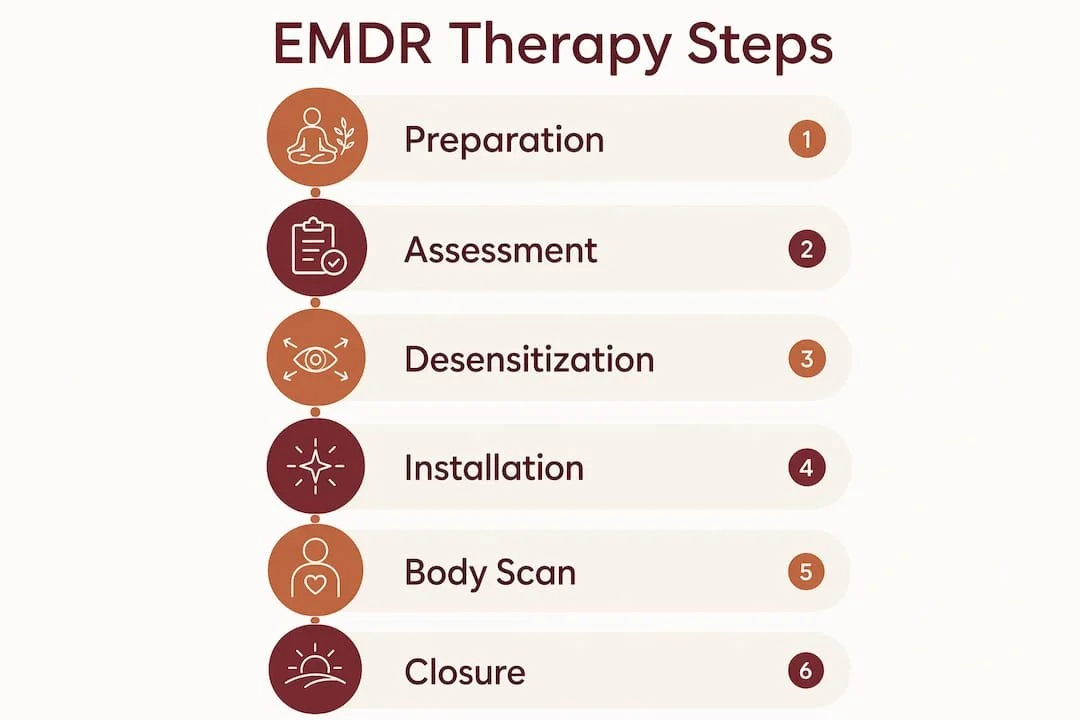
EMDR follows a formal 8-phase protocol that guides you safely from intake to resolution:
History taking — Your therapist maps your trauma history and identifies target memories.
Preparation — You learn grounding and stabilization techniques before any processing begins.
Target assessment — You identify the specific memory, the negative belief attached to it, and the positive belief you want to hold instead.
Desensitization — Bilateral stimulation begins while you hold the target memory in mind.
Installation — The positive belief is strengthened and linked to the memory.
Body scan — You check for any remaining physical tension connected to the memory.
Closure — Each session ends with grounding to restore a sense of safety.
Reevaluation — The next session opens by checking whether progress held.
Standard treatment runs 6–12 sessions, each lasting 60–90 minutes, depending on the complexity of your trauma history. Simpler single-incident traumas often resolve faster than complex or childhood trauma.
Pro Tip: Ask your therapist to walk you through the grounding techniques in session two before any memory work begins. Knowing how to exit a distressing memory quickly makes the desensitization phase far less intimidating.
Is EMDR effective for trauma, PTSD, anxiety, and grief?
EMDR is effective. The World Health Organization formally endorses it for PTSD, and its applications are expanding to anxiety, grief, phobias, and other trauma-related conditions through the Adaptive Information Processing model. That model holds that most psychological distress stems from memories stored in a fragmented, emotionally raw form. Reprocessing those memories resolves the distress at its source.
The clinical evidence is consistent. People who complete EMDR treatment report reduced distress, better sleep, improved emotional regulation, and a measurable shift in how they relate to past events. These are not minor symptom adjustments. For many adults, the change is fundamental.
"EMDR has proved life-changing by addressing trauma's emotional roots rather than symptom management, offering relief where talk therapy alone can stall."
— Expert insight cited in ABC News EMDR reporting, 2025
One reason EMDR stands apart from traditional talk therapy is what it does not require. You do not need to narrate your trauma in detail. You do not need to explain every memory to your therapist. Patients hold the target memory in mind while engaging in bilateral stimulation, which reduces distress without forcing a full verbal retelling. That distinction matters enormously for people who feel unable or unwilling to speak their trauma aloud.
Recovery is not linear for everyone. Some people experience temporary emotional sensitivity or fatigue after sessions, particularly during the desensitization phase. That is a normal sign that processing is active, not a signal that something has gone wrong. Solid preparation and a skilled therapist reduce these reactions significantly. For a deeper look at how EMDR compares with other approaches, the EMDR vs. talk therapy breakdown at Alvaradotherapy covers the key differences clearly.
What are common misconceptions about EMDR therapy?
EMDR is not hypnosis. You remain fully conscious and in control throughout every session. You can stop the process at any point, and you retain complete awareness of your surroundings. The therapy does not erase memories or implant new ones. It changes the emotional weight attached to a memory, not the memory itself.
A second common misunderstanding is that EMDR requires you to relive your trauma in graphic detail. That is not how the protocol works. EMDR does not require detailed trauma narration. You hold the memory internally while the bilateral stimulation does the work. Many people find this far less distressing than they expected.
EMDR is not suitable for everyone at every point in their healing. People in active crisis, those with poor emotional regulation, or those who have not yet built basic coping skills need stabilization work first. Skipping the preparation phase is the most common mistake in poorly delivered EMDR. Preparation includes grounding and stabilization techniques that allow you to exit a distressing memory safely during a session.
Key factors that determine whether EMDR is appropriate for you right now:
Emotional stability — You can tolerate distress without becoming overwhelmed or dissociating.
Safety — You are not in active crisis or experiencing ongoing trauma exposure.
Therapist training — Your provider follows the formal 8-phase protocol and holds recognized EMDR training credentials.
Realistic expectations — You understand that processing can feel uncomfortable before it feels better.
Pro Tip: Before your first EMDR session, practice a simple grounding technique daily, such as the 5-4-3-2-1 sensory method. Arriving with that skill already in place gives you a safety net during processing.
What to expect during EMDR therapy sessions
The first two sessions of EMDR rarely involve any memory processing at all. Your therapist spends that time building your history, explaining the model, and teaching you stabilization skills. This is not wasted time. It is the foundation that makes the processing phase safe and effective. A detailed walkthrough of this structure is available in the step-by-step EMDR guide at Alvaradotherapy.
Once processing begins, a typical session follows a predictable rhythm. Your therapist checks in on your current distress level, identifies the target memory for that session, and begins sets of bilateral stimulation. After each set, you report what came up. The therapist guides you back to the target and repeats the process until distress drops.
Progress is tracked using two objective scales:
| Scale | What it measures |
|---|---|
| Subjective Units of Distress (SUD) | Your emotional distress level from 0 (none) to 10 (maximum) |
| Validity of Cognition (VOC) | How true your positive belief feels, from 1 (not at all) to 7 (completely) |
These quantitative measures give both you and your therapist a clear, session-by-session picture of progress. Watching your SUD score drop from an 8 to a 2 over several sessions is concrete evidence that the therapy is working.
After sessions, you may feel tired, emotionally tender, or unusually reflective. Plan lighter commitments on EMDR days when possible. Temporary emotional sensitivity after sessions is normal and typically resolves within 24–48 hours. Keeping a brief journal between sessions helps you track what surfaces and gives your therapist useful material for the reevaluation phase.
When choosing a therapist, look for someone trained through EMDRIA-approved programs, experienced with your specific type of trauma, and willing to spend adequate time on preparation before any processing begins. For practical guidance on this, the EMDR preparation guide at Alvaradotherapy is a useful starting point.
Key Takeaways
EMDR therapy is a structured, evidence-based treatment that reprocesses traumatic memories through bilateral stimulation, reducing emotional distress at its source rather than managing symptoms.
| Point | Details |
|---|---|
| Bilateral stimulation drives results | Eye movements, tapping, and auditory tones all produce the therapeutic effect equally. |
| Eight phases guide safe treatment | Skipping preparation is the most common cause of poor EMDR outcomes. |
| WHO endorses EMDR for PTSD | Its applications now extend to anxiety, grief, and complex trauma conditions. |
| No detailed retelling required | Patients hold the memory internally, reducing re-traumatization risk significantly. |
| Progress is measured objectively | SUD and VOC scales track distress reduction and belief change session by session. |
Why EMDR reaches where other therapies stop
Most therapy approaches ask you to talk through what happened. That works for many people. For others, the words never quite reach the place where the pain actually lives. EMDR is different because it works at the level of the nervous system, not just the narrative.
What I find most striking about EMDR, having seen its impact across many clients, is how often people describe the same shift. The memory is still there, but it no longer feels like a live wire. They can think about what happened without their body going into alarm. That is not symptom management. That is genuine integration.
The therapeutic relationship matters more in EMDR than people expect. You are not just doing a technique with a technician. You are doing something vulnerable and sometimes disorienting with another person. A therapist who rushes past preparation, who does not check in carefully between sets, or who underestimates the importance of closure is a real risk. The protocol exists for a reason, and the best EMDR therapists treat every phase with equal seriousness.
If you are considering EMDR, the most honest thing I can tell you is this: the discomfort during processing is real, but it is temporary and purposeful. The relief on the other side is also real, and for many people it is lasting in a way that years of talk therapy alone did not produce.
— Juiced
Alvaradotherapy's approach to EMDR trauma treatment
Alvaradotherapy works with adults across California who are ready to address the emotional roots of trauma, PTSD, anxiety, and grief using evidence-based EMDR protocols.

The licensed therapists at Alvaradotherapy follow the formal 8-phase EMDR protocol and offer both individual sessions and EMDR Intensives for those who want to move through treatment more quickly. Services are available in English and Spanish, online throughout California. If you are ready to take the next step, learn what to expect from EMDR therapy at Alvaradotherapy, or schedule a consultation to talk through whether EMDR is the right fit for where you are right now.
FAQ
What is EMDR therapy used to treat?
EMDR therapy is primarily used to treat PTSD and trauma-related conditions, with expanding clinical applications in anxiety, grief, phobias, and complex trauma. The World Health Organization recognizes it as an evidence-based treatment for PTSD.
How many EMDR sessions does recovery take?
Standard EMDR treatment typically runs 6–12 sessions of 60–90 minutes each, depending on the complexity of your trauma history. Single-incident traumas often resolve in fewer sessions than complex or childhood trauma.
Does EMDR require talking about your trauma in detail?
No. EMDR does not require you to narrate your trauma aloud. You hold the target memory internally while bilateral stimulation reduces its emotional charge, which lowers re-traumatization risk compared to traditional talk therapy.
Is EMDR the same as hypnosis?
EMDR is not hypnosis. You remain fully conscious, aware of your surroundings, and in control throughout every session. You can stop the process at any point.
How do therapists measure progress in EMDR?
Therapists use the Subjective Units of Distress scale and the Validity of Cognition scale to track emotional distress reduction and positive belief strength objectively across sessions.
