

TL;DR:
Psychotherapy is a structured, evidence-based treatment that promotes recovery from trauma, anxiety, depression, and relationship issues through phased healing. It involves safe, paced stages of stabilization, trauma processing, and integration, under the guidance of a trained clinician. The therapeutic relationship and structured models like EMDR play crucial roles in producing lasting emotional and neurological growth.
Psychotherapy is a scientifically supported treatment process that helps people recover from trauma, anxiety, depression, and relationship difficulties through structured, evidence-based interventions. The term covers a broad range of methods, from Cognitive Behavioral Therapy (CBT) to Eye Movement Desensitization and Reprocessing (EMDR), each designed to address specific psychological wounds. What unites them is a core principle: healing progresses in phases, moving from safety and stabilization through trauma processing and into lasting integration. Psychotherapy and healing are not the same as venting to a friend or reading a self-help book. They require a trained clinician, a structured plan, and a relationship built on trust.
What are the key stages of psychotherapy and healing?
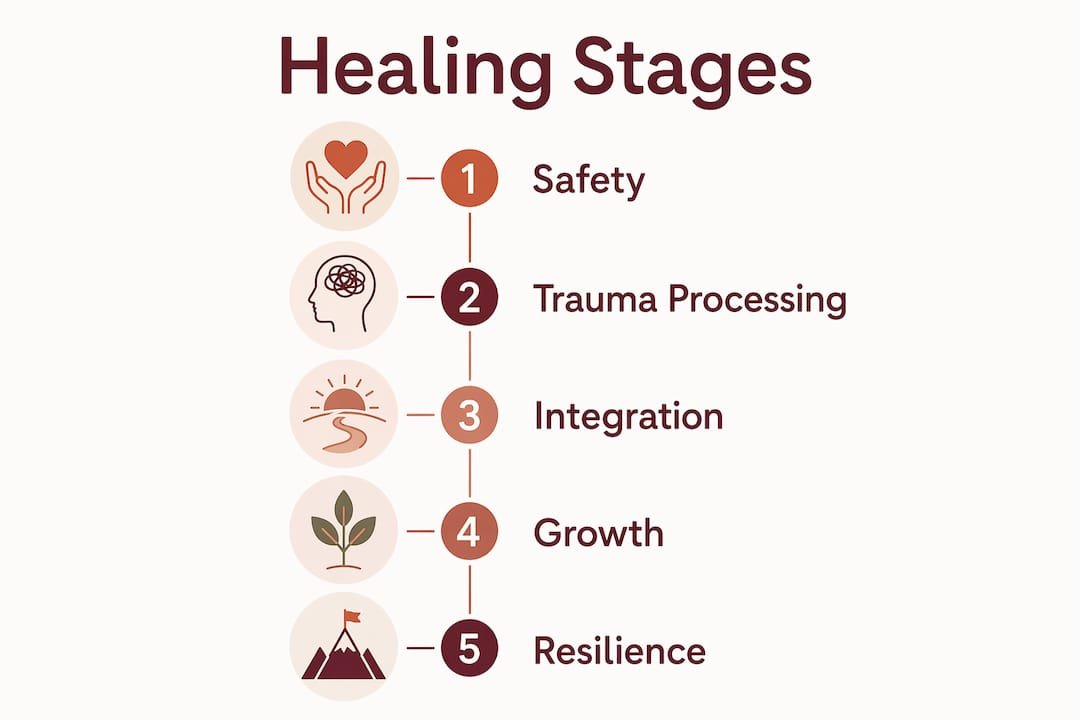
Trauma recovery therapy follows a phased framework. Rushing any stage creates instability and can stall progress entirely. Establishing safety and pacing are foundational to trauma therapy, because moving too fast destabilizes clients before they have the internal resources to process what surfaces.
The three stages work like this:
Safety and stabilization. The first stage builds the foundation. Your therapist helps you develop coping skills, regulate your nervous system, and establish a trusting therapeutic relationship. No trauma processing happens here. The goal is to make sure you are stable enough to handle what comes next.
Trauma processing. Stage two is where the active work occurs. Evidence-based methods like EMDR, Prolonged Exposure (PE), or Cognitive Processing Therapy (CPT) are introduced at a pace matched to your readiness. A multi-stage treatment framework that addresses emotional regulation, self-care, and relationships produces better outcomes than skipping straight to trauma narration.
Integration and rebuilding. Stage three consolidates the work. Clients rebuild relationships, reconnect with their sense of self, and apply new emotional skills to daily life. Post-traumatic growth, including stronger boundaries and deeper self-awareness, often emerges here.
Healing is rarely linear. Setbacks, plateaus, and returns to earlier stages are normal. A week of high stress can temporarily reactivate old symptoms even after significant progress. That is not regression. It is the nervous system doing exactly what it learned to do.
Pro Tip: Keep a brief weekly mood log during therapy. Patterns in your notes help your therapist adjust pacing before a setback becomes a full derailment.

How does EMDR therapy support healing within psychotherapy?
EMDR stands for Eye Movement Desensitization and Reprocessing. It is one of the most researched trauma treatments available, and it works differently from talk therapy. Rather than requiring you to narrate trauma in detail, EMDR uses bilateral stimulation (typically eye movements, taps, or tones) to help the brain reprocess disturbing memories. EMDR helps process disturbing memories to make them less emotionally overwhelming, offering a real alternative for clients who find prolonged verbal recounting difficult or retraumatizing.
A standard EMDR session moves through eight phases, from history taking and preparation to active reprocessing and closure. Most clients work through a target memory across several sessions before moving to the next. Treatment length varies based on the number of traumatic events and their complexity.
Key features of EMDR within a psychotherapy plan:
Lower verbal demand. Clients do not need to describe trauma in full detail, which reduces the risk of flooding or emotional overwhelm.
Neurobiological mechanism. Bilateral stimulation appears to mimic the memory consolidation process that occurs during REM sleep, allowing the brain to file traumatic memories as past events rather than ongoing threats.
Paced integration. EMDR is most effective when embedded within a phased treatment plan, not used as a standalone quick fix. EMDR treatment research consistently supports its use as part of a broader, structured approach.
Flexible delivery. EMDR can be delivered in person or via telehealth, making it accessible for clients across California and beyond.
EMDR is not a passive experience. Between sessions, clients often notice shifts in how they think about themselves or their past. Those shifts are part of the process.
What evidence-based psychotherapy models work for trauma recovery?
Evidence-based trauma therapy is defined by clearly structured, paced treatment matched to the client's symptoms and recovery goals. Generic supportive counseling is not the same thing. The table below outlines the major models used in trauma-informed psychotherapy.
| Therapy Model | Core Method | Typical Duration | Best For |
|---|---|---|---|
| Prolonged Exposure (PE) | Gradual, structured confrontation of trauma memories | ~12 sessions of 90 minutes | Single-incident PTSD, veterans |
| Cognitive Processing Therapy (CPT) | Identifying and restructuring trauma-related beliefs | 12 sessions | PTSD with strong shame or guilt |
| Trauma-Focused CBT (TF-CBT) | Cognitive and behavioral skills with caregiver involvement | 12–20 sessions | Children, adolescents, young adults |
| EMDR | Bilateral stimulation to reprocess traumatic memories | Variable, 8–20+ sessions | Complex trauma, childhood abuse |
| ISTDP | Intensive short-term dynamic work on emotional defenses | 10–40 weekly sessions | Treatment-resistant depression, complex presentations |
PE and TF-CBT are structured, time-limited treatments with strong evidence bases. PE typically runs about 12 sessions of 90 minutes each, while TF-CBT is often delivered across 12 to 20 sessions. That structure matters because it gives clients a clear roadmap and reduces the uncertainty that can make starting therapy feel daunting.
Intensive Short-Term Dynamic Psychotherapy (ISTDP) deserves special mention. ISTDP produces large, durable effects on treatment-resistant depression, with effect sizes above Cohen's d of 1.5 across 10 to 40 weekly sessions. Those gains continue after treatment ends. That durability is significant. It suggests ISTDP does not just suppress symptoms but changes the underlying emotional architecture.
Matching the therapy model to the client's readiness is as important as choosing the right model. A client who is not yet stabilized will not benefit from intensive trauma processing, regardless of how effective the method is in research trials.
Pro Tip: Ask your therapist which specific model they are using and why. A good clinician can explain the rationale in plain language. If they cannot, that is useful information.
How does the therapeutic relationship shape psychological healing?
The therapeutic relationship is the single most consistent predictor of positive outcomes in psychotherapy. The therapeutic alliance is the primary mechanism of change, with the professional relationship creating the foundation for trust and healing. Technique matters, but relationship quality matters more.
What makes this relationship different from other supportive connections is its structure. The therapist holds consistent boundaries, maintains empathy without losing objectivity, and stays regulated even when the client is not. That consistency is itself therapeutic, especially for clients whose early relationships were unpredictable or unsafe.
Ruptures in the therapeutic relationship are not failures. Rupture and repair cycles are vital catalytic moments for clients to re-pattern unhealthy relational dynamics and build secure attachment experiences. When a client feels misunderstood, and the therapist acknowledges it and repairs the connection, that moment teaches the nervous system something new. It demonstrates that conflict does not have to end in abandonment or harm.
Key ways the therapeutic relationship supports healing:
Corrective emotional experience. Clients experience being seen, heard, and responded to without judgment, often for the first time.
Affect regulation modeling. Watching a therapist stay calm during intense emotional content teaches co-regulation skills that clients internalize over time.
Relational repair practice. Managing relational misalignment as a growth opportunity, not a crisis, directly supports engagement and emotional regulation.
"Mental health symptoms are often protective adaptations that become maladaptive over time. Healing transitions clients from fragmentation to integration through a safe therapeutic relationship and paced trauma work. The goal is not to eliminate symptoms by force but to understand what they were protecting and offer something better."
This relational "laboratory" produces changes that extend far beyond the therapy room. Clients report improved relationships with partners, family members, and colleagues as their capacity for trust and self-expression grows. Those changes reflect neurological and emotional growth built through consistent, safe relational experience.
Key Takeaways
Psychotherapy and healing work best when treatment is phased, evidence-based, and grounded in a strong therapeutic alliance that paces trauma processing to match client readiness.
| Point | Details |
|---|---|
| Healing follows three stages | Safety, trauma processing, and integration must occur in sequence for lasting recovery. |
| EMDR reduces verbal burden | Bilateral stimulation reprocesses traumatic memories without requiring full verbal narration. |
| Evidence-based models vary by need | PE, CPT, TF-CBT, and ISTDP each target different presentations with structured session counts. |
| Therapeutic alliance drives outcomes | The quality of the therapist-client relationship predicts success more reliably than technique alone. |
| Ruptures are opportunities | Repair cycles in therapy teach clients new relational patterns and build secure attachment. |
What I've learned about pacing and healing in psychotherapy
The most common mistake I see people make when starting therapy is expecting a linear climb. They have two good weeks, then a hard one, and they conclude that therapy is not working. That conclusion misreads the process entirely.
Psychotherapy is an iterative process involving titration, meaning slow, manageable exposure to painful material alongside the development of self-acceptance, rather than a linear symptom-fighting approach. The nervous system does not heal on a schedule. It heals when it feels safe enough to let go of old defenses, and that safety is built incrementally, session by session.
What I find most underappreciated is this: even when anxiety or depression persists in the early months of therapy, the core active ingredient is already working. The formation of a secure therapeutic relationship builds the emotional and neurological infrastructure for growth, even before symptoms visibly shift. The relationship is not the warm-up. It is the treatment.
Clients who understand this tend to stay in therapy long enough to see real change. Those who expect fast symptom relief often leave just before the work takes hold. Patience is not passive. In therapy, it is the most active thing you can do.
— Juiced
Alvaradotherapy: evidence-based support for your healing process
Alvaradotherapy is a California-based trauma-informed practice with licensed therapists specializing in EMDR, individual counseling, and phased trauma treatment for adults navigating PTSD, complex trauma, anxiety, and relationship difficulties.
If you are ready to begin or deepen your recovery, Alvaradotherapy offers online EMDR trauma therapy for clients throughout California, with bilingual care available in English and Spanish. The practice provides structured, paced treatment plans built around your specific history and goals, not a one-size-fits-all protocol. For those dealing with PTSD or complex trauma, specialized trauma care is available with clinicians trained in evidence-based, phase-oriented approaches. You can also review mental health resources or schedule a consultation to discuss your needs directly with a therapist.
FAQ
What is psychotherapy and how does it support healing?
Psychotherapy is a structured, evidence-based treatment process in which a trained clinician uses specific methods to help clients process trauma, regulate emotions, and rebuild their sense of self. Healing progresses through phases of safety, trauma processing, and integration.
How long does trauma recovery therapy typically take?
Treatment length depends on the therapy model and the complexity of the trauma. Structured approaches like Prolonged Exposure run about 12 sessions, while complex trauma presentations may require 20 or more sessions across multiple phases.
Is EMDR effective for healing from trauma?
EMDR is one of the most researched trauma treatments available. It reduces the emotional intensity of traumatic memories through bilateral stimulation and is most effective when integrated into a phased, paced treatment plan rather than used in isolation.
What makes a therapy relationship therapeutic?
The therapeutic alliance, built on empathy, consistency, and rupture repair, is the strongest predictor of positive outcomes in psychotherapy. Clients learn new relational patterns through the direct experience of being seen and responded to safely.
Can therapy help with anxiety and depression, not just trauma?
Psychotherapy is effective for anxiety, depression, grief, and relationship difficulties, not only PTSD. Evidence-based models like CBT, ISTDP, and EMDR address the underlying emotional patterns that drive these conditions, producing durable change over time.
