
Therapeutic Approaches for Couples: What Actually Works

TL;DR:
Therapeutic approaches for couples are structured, evidence-based methods that help partners improve communication and resolve conflicts.
The most effective techniques target emotional disconnection, conflict cycles, or communication breakdown, with EFT, CBT, and the Gottman Method leading research support.
Therapeutic approaches for couples are structured, evidence-based methods designed to help partners improve communication, resolve conflict, and rebuild emotional connection. The most widely researched models include Emotionally Focused Therapy (EFT), Cognitive Behavioral Therapy (CBT), the Gottman Method, and Imago Relationship Therapy. Each draws on a distinct body of science, from attachment theory to behavioral psychology, and each targets a different root cause of relationship distress. Knowing which approach fits your situation is the first step toward real, lasting change.
What are the most effective couples therapy techniques?

The right therapy technique depends on what is breaking down in the relationship. Most couples struggle with one of three things: emotional disconnection, repeated conflict cycles, or communication breakdown. The leading evidence-based methods each address one or more of these directly.
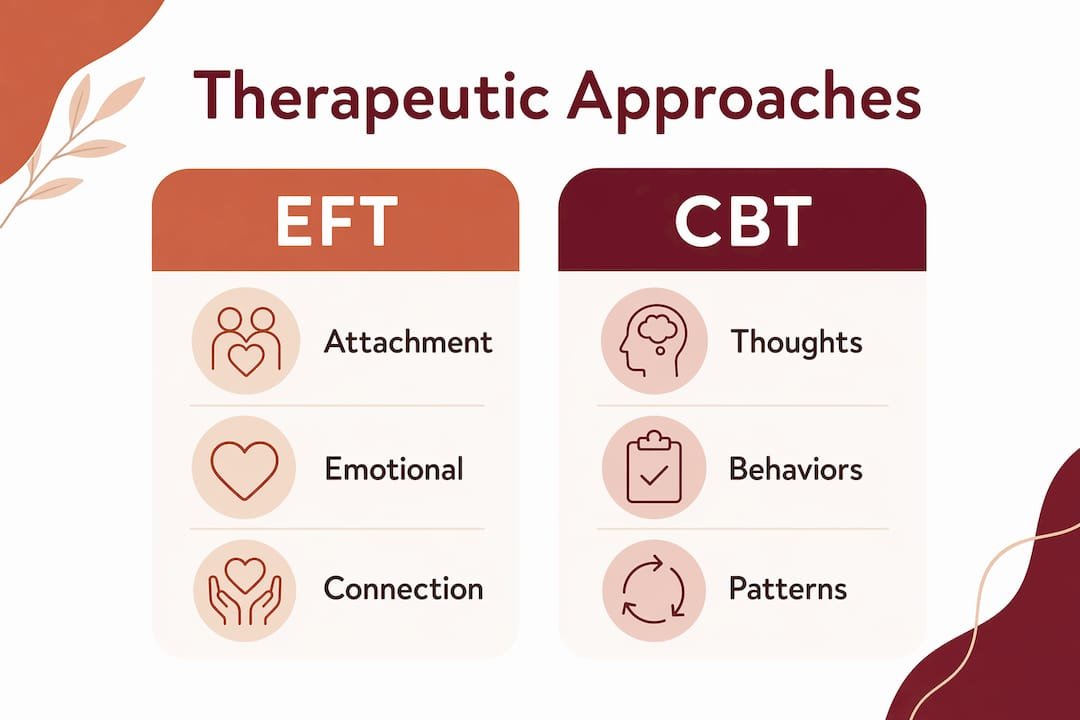
Emotionally Focused Therapy (EFT) is the most rigorously researched couples therapy available, built on attachment science to replace reactive cycles with secure emotional expression. That foundation matters because most conflict in couples is not really about the dishes or the finances. It is about whether each partner feels safe, seen, and valued. EFT helps couples identify the "pursuer-withdrawer" cycle, where one partner pushes for connection and the other pulls back, and replace it with direct, vulnerable communication. Cognitive Behavioral Therapy (CBT) for couples focuses on changing thought and behavior patterns that harm the relationship. A CBT therapist helps partners spot automatic negative interpretations, such as "they ignored me because they don't care," and replace them with more accurate readings of each other's behavior. This approach works especially well when one or both partners have deeply ingrained negative assumptions about the relationship.
The Gottman Method takes a skill-building approach grounded in decades of observational research. It targets what John Gottman called the "Four Horsemen": criticism, contempt, defensiveness, and stonewalling. These four patterns, when left unchecked, predict relationship breakdown with striking accuracy. Gottman-trained therapists teach specific antidotes to each pattern, such as using a gentle startup instead of criticism, or expressing appreciation to counter contempt.
Other approaches worth knowing:
Imago Relationship Therapy connects adult relationship conflicts to childhood experiences, helping partners understand why certain behaviors trigger such strong reactions.
Psychodynamic couples therapy examines how each partner's personal history and unconscious patterns shape the relationship dynamic.
Narrative therapy helps couples rewrite the story they tell about their relationship, shifting from a problem-saturated narrative to one that highlights resilience and shared values.
Different therapeutic approaches suit different couple dynamics. EFT works best for attachment-related disconnection, while CBT targets thought and behavior patterns. Choosing the wrong fit does not mean therapy fails. It means the approach needs adjusting.
How do communication patterns affect therapy outcomes?
Communication style is the single most predictive factor in whether couples therapy succeeds. Research shows that starting a difficult conversation with a softened startup using "I" statements predicts 96% of the conversation's outcome. That statistic reframes the entire goal of couples therapy. The work is not about resolving every argument perfectly. It is about how you begin.
Assertive communication, characterized by "I" statements, directness, and mutual respect, is the only communication style consistently linked to positive relationship outcomes. Aggressive communication creates defensiveness. Passive communication breeds resentment. Neither moves the relationship forward.
Physiological state matters just as much as word choice. Physiological flooding occurs when heart rates exceed 100 bpm during conflict, which shuts down the brain's capacity for rational, empathetic communication. When a partner is flooded, active listening becomes impossible. The body is in survival mode, not connection mode.
Clinical guidance recommends a 20–30 minute break to allow the nervous system to calm before re-engaging. This is not avoidance. It is biology-informed conflict management. Couples who learn to recognize flooding in themselves and each other gain a concrete tool they can use immediately, inside and outside the therapy room.
Notice the signs of flooding. Racing heart, shallow breathing, and a sudden urge to shut down or attack are all signals.
Call a time-out together. Agree in advance on a signal that means "I need 20–30 minutes to regulate."
Use the break to self-soothe. Walk, breathe, or do something calming. Do not rehearse your argument.
Return to the conversation. Re-engagement after a regulated break produces far better outcomes than pushing through while flooded.
Repair attempts, such as apologies, humor, and deliberate breaks, interrupt escalating conflict and predict relationship success more reliably than how often or how intensely couples argue. That finding surprises most couples. The frequency of conflict matters far less than whether partners know how to stop the spiral.
Pro Tip: Create a shared ritual, such as a weekly 20-minute check-in, to practice soft startups and repair attempts in a low-stakes setting. Shared rituals build relational infrastructure that makes conflict easier to manage when it counts.
How can couples engage with therapy and apply what they learn?
Starting therapy is often the hardest step. Many couples wait years before seeking help, and by then, negative patterns are deeply set. Starting therapy early, before entrenched patterns form, leads to significantly better outcomes. The average couple waits six years after problems begin before entering therapy. That gap is costly.
Choosing the right therapist matters. Look for a licensed counselor with specific training in couples modalities, such as EFT, the Gottman Method, or CBT for relationships. A therapist's general credentials are not enough. Couples therapy requires a distinct skill set from individual therapy.
Here is what to expect from the process:
Initial sessions typically involve both partners together, with the therapist gathering a history of the relationship and identifying core patterns.
Individual sessions may be scheduled to allow each partner to speak freely about their experience without the other present.
Skill practice happens between sessions. Therapists assign exercises such as active listening drills, appreciation rituals, or structured conflict conversations.
Progress reviews help couples track change and adjust the approach as needed.
Applying what you learn outside the therapy room is where real change happens. Practice active listening by reflecting back what your partner said before responding. Use "I feel" statements instead of "you always" accusations. Schedule a weekly check-in to address small issues before they compound.
Couples therapy can be effective even if one partner is reluctant to attend. Individual participation still improves understanding and relationship skills. If your partner will not come, going alone is still worth it.
Pro Tip: Track your repair attempts for one week. Notice how often you use humor, a touch, or a brief apology to de-escalate tension. Most couples are already doing this. Therapy helps you do it more deliberately and consistently.
What are the biggest misconceptions about couples counseling?
The most damaging myth about couples therapy is that it is only for relationships in crisis. Therapy works best as a preventive tool, not a last resort. Couples who enter therapy to strengthen a good relationship often make faster progress than those who wait until trust has eroded.
Resistance and defensiveness are the most common barriers inside the therapy room. One partner may feel blamed, or both may fear that the therapist will take sides. A skilled therapist creates safety by maintaining neutrality and pacing conversations so neither partner feels overwhelmed.
A few other misconceptions worth addressing:
"Therapy means we've failed." Seeking professional support for a relationship is no different from seeing a physical therapist for a recurring injury. It is proactive, not shameful.
"One session will fix it." Meaningful change in long-standing patterns typically takes several months of consistent work.
"If we still argue, therapy isn't working." Conflict does not disappear in successful therapy. What changes is how couples handle it.
Realistic expectations protect the process. Celebrating small wins, such as a successful repair attempt or a conversation that stayed calm, builds momentum. Progress in couples therapy is rarely linear. Setbacks are part of the work, not evidence that the work has failed.
Pro Tip: If you feel stuck after several sessions, ask your therapist to name the specific pattern you are working on. Naming the cycle, such as "pursuer-withdrawer" or "demand-withdraw," gives both partners a shared language that reduces blame and increases cooperation. You can also explore trauma-informed conflict steps to supplement what you learn in session.
Key Takeaways
Evidence-based therapeutic approaches for couples work because they target the specific communication patterns, emotional cycles, and physiological states that drive relationship breakdown.
| Point | Details |
|---|---|
| EFT leads in research support | Emotionally Focused Therapy has the strongest empirical backing for improving couple attachment and connection. |
| Conversation startup predicts outcome | Using “I” statements and a soft startup predicts 96% of a conversation’s success or failure. |
| Flooding blocks communication | Heart rates above 100 bpm during conflict require a 20–30 minute break before productive dialogue can resume. |
| Repair attempts matter most | Apologies, humor, and breaks predict relationship success more reliably than how often couples argue. |
| Early therapy produces better results | The average couple waits six years before seeking help; starting sooner leads to significantly better outcomes. |
What I've learned from watching couples do this work
The couples who make the most progress in therapy are rarely the ones with the least conflict. They are the ones willing to be wrong about their partner.
That sounds simple. It is not. After years of watching couples work through entrenched patterns, the clearest predictor of success is not the severity of the problem. It is whether each partner can hold even a small amount of curiosity about why the other person behaves the way they do. EFT calls this "softening." I call it the moment therapy actually begins.
The physiological piece catches most couples off guard. They come in thinking they need better arguments. What they actually need is to learn when to stop arguing. A partner who can recognize their own flooding and call a time-out without it feeling like abandonment has already done something most couples never manage. That skill alone changes the texture of a relationship.
The repair attempt research is the finding I return to most often. Couples who stay together long-term are not the ones who fight less. They are the ones who recover faster. An awkward apology, a hand on the shoulder mid-argument, a moment of shared humor when things get tense. These small moves carry more weight than any perfectly worded "I" statement.
If you are considering therapy and waiting for the right moment, the right moment was probably two years ago. The second-best time is now. Even long-standing difficulties respond to the right approach when both partners bring genuine willingness. That willingness, more than any specific technique, is what makes the work possible.
— Juiced
Alvaradotherapy's approach to couples counseling
Alvaradotherapy is a California-based practice offering trauma-informed couples therapy and online EMDR therapy for clients across Pasadena, Ventura, and throughout California. The licensed therapists at Alvaradotherapy work with couples navigating communication breakdown, conflict cycles, trauma, and emotional disconnection, providing care in both English and Spanish.
Sessions are available online, making professional support accessible without geographic barriers. Alvaradotherapy tailors each therapeutic plan to the couple's specific dynamic, drawing on evidence-based methods including EMDR, trauma-informed care, and structured counseling approaches. If you are ready to understand what therapy looks like before committing, the practice offers clear guidance on what to expect from the first session forward. You can also schedule a consultation to discuss which approach fits your relationship best.
FAQ
What is the most effective therapeutic approach for couples?
Emotionally Focused Therapy (EFT) is the most rigorously researched couples therapy, with strong empirical support for improving emotional connection and reducing conflict. The best approach for any couple depends on their specific challenges, whether attachment-related, behavioral, or communication-focused.
How does communication style affect couples therapy outcomes?
Assertive communication using "I" statements is the only style consistently linked to positive relationship outcomes, and a softened conversation startup predicts 96% of the discussion's result. Aggressive or passive styles consistently produce worse outcomes regardless of the issue being discussed.
What should couples expect in their first therapy session?
Most first sessions involve both partners together, with the therapist gathering relationship history and identifying core conflict patterns. The therapist typically remains neutral and focuses on understanding each partner's experience before introducing any specific technique.
Can couples therapy work if only one partner attends?
Individual participation in couples therapy still improves relationship skills and understanding, even when the other partner does not attend. One partner making changes in their communication and behavior often shifts the dynamic for both.
When is the right time to start couples therapy?
The right time is before negative patterns become entrenched. The average couple waits six years after problems begin before seeking therapy, which significantly reduces the effectiveness of treatment. Starting early, even when things feel manageable, produces the best long-term results.
