
Coming Out Later in Life: A Practical, Therapist-Backed Guide

Coming out later in life is valid, common, and not a sign you got something wrong the first fifty years. If you're realizing your sexual orientation or gender identity later than the movies told you to, here's the short version: you're not behind schedule, and you have real options for how to move forward.
Three steps matter most right now. First, sit with what you know before you act on it. Second, pick one person you trust and tell them before anyone else. Third, do a quick safety check on your living situation, finances, and relationships before wider disclosure. Clinicians at SAGE frame this as reorienting your identity, not starting from zero, and many people report better mental health once their outer life matches what they've always known inside.
Confirm what you're feeling without pressure to label it perfectly yet.
Choose one safe, trusted person for your first disclosure.
Check your safety net (housing, income, key relationships) before going wider.
Fact worth sitting with: Gallup's 2024 data found that a significant portion of LGBTQ+ adults in the US came out after age 30. You are part of a documented pattern, not an outlier.
Key Takeaways
Coming out later in life is a documented, common experience that improves mental health for many people once identity and daily life finally align.
| Point | Details |
|---|---|
| It's common at any age | Gallup found the median coming-out age is 17 for adults aged 18 to 29, compared with 26 for adults 65 and older. |
| Expect mixed emotions | Relief, grief, and anxiety often arrive together and don't cancel each other out. |
| Pace disclosure in circles | Tell one trusted person first, then expand outward on your own timeline rather than all at once. |
| Legal and safety planning matter | Check workplace protections and build a housing or financial contingency plan before high-risk disclosures. |
| Professional support helps | Alvaradotherapy offers identity-affirming, trauma-informed therapy, including EMDR and couples counseling, online across California and New York. |
Table of Contents
Why Coming Out Later in Life Happens More Than People Think
Coming out later in life usually traces back to circumstance, not confusion. Many people knew something earlier but built a life around silence because the cost of speaking up once looked too high.
Gallup's research shows the median coming-out age is 17 for adults aged 18 to 29, compared with 26 for adults 65 and older. That nine-year gap reflects a culture that has only recently made early disclosure survivable for most young people.
A few forces show up again and again in later coming-out stories:
Growing up in an era or community where LGBTQ+ identities carried real social or legal danger
Religious upbringing that framed identity as a moral failing rather than a fact about yourself
Marriage, children, or career paths built before you had the language or safety to explore your identity
Genuinely not recognizing your own orientation or gender identity until later adulthood
Therapist Joanne Fleisher, who works with clients navigating late-life disclosure, advises taking your time rather than rushing toward a finish line:
Readiness means being comfortable not just with your own understanding of your identity, but with how the transition will land on the people you care about. That takes time, and time is not the enemy here.
What Emotions Come Up When You Come Out Later?
Expect a mix, not a single feeling. Relief and grief often arrive in the same week, sometimes the same conversation.
Common experiences include:
Relief at finally living as yourself after years of managing a hidden identity
Grief for relationships, time, or milestones you feel you missed
Guilt, especially if a marriage, family structure, or friendship shifts because of your disclosure
Anxiety about reactions from people whose opinions matter to you
Identity disorientation as you rebuild a sense of self that finally includes this piece
Long-term concealment is linked to higher rates of anxiety and depression, and disclosure tends to ease that specific stress even when it introduces new, different stress. If grief, panic, or hopelessness lingers for weeks rather than days, or if you're having thoughts of self-harm, that's a signal to bring in a therapist rather than manage it alone.
Pro Tip: When the emotional swings feel like too much at once, name the feeling out loud before reacting to it. "This is grief, not regret" is a small sentence that keeps you from confusing the two.
How Do You Come Out as an Adult, Step by Step?
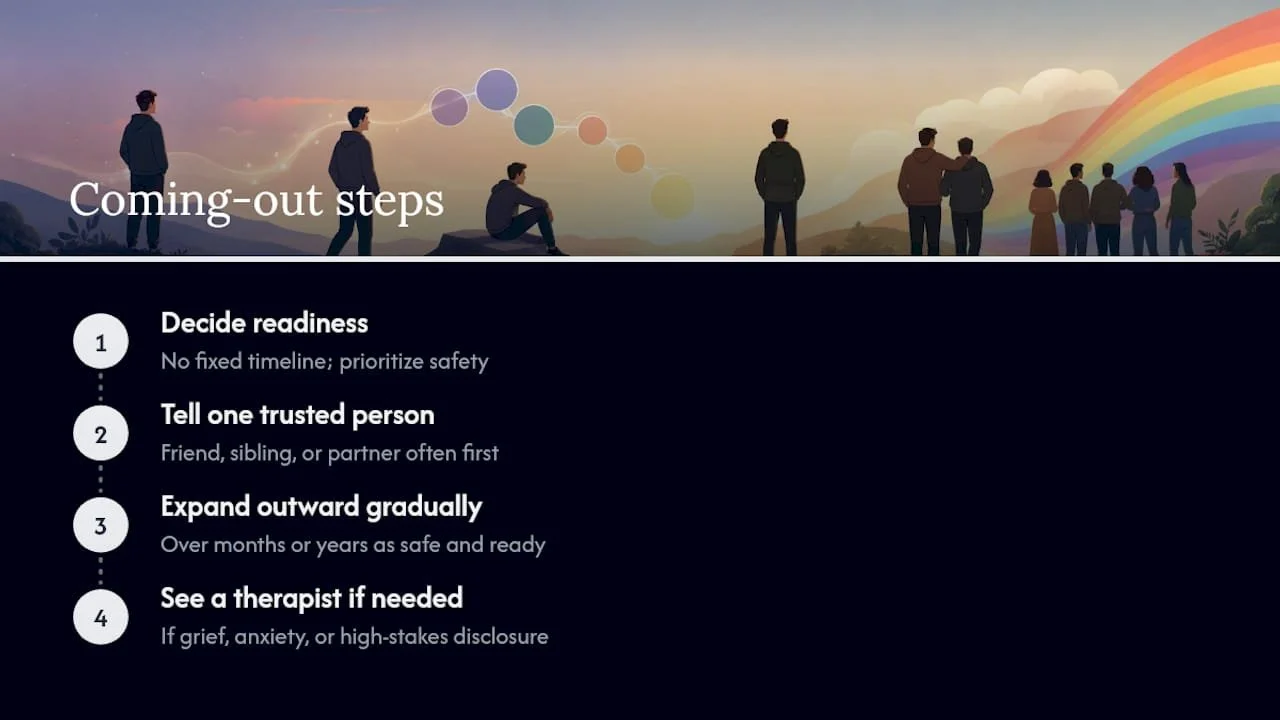
There's no universal script, but there is a reliable order of operations that reduces risk and overwhelm.
Get clear with yourself first. Journaling, therapy, or simply naming it privately all count.
Tell one trusted person before anyone else, someone whose reaction you can reasonably predict.
Let that first conversation inform your pacing for the next ones, rather than telling everyone at once.
Expand outward in circles: close family, then friends, then wider community or work, on your timeline.
Reassess after each disclosure. You're allowed to pause for months between circles.
Conversation openers rarely need to be elaborate:
To a partner: "I need to tell you something about who I am that I've been sitting with for a while. I want us to talk through what it means for us."
To an adult child: "I want you to hear this directly from me: I'm gay/bi/trans. I'm still your parent, and I wanted you to know because I trust you."
To a close friend: "I've realized something about myself I haven't said out loud before, and I wanted you to be one of the first to know."
Before wider disclosure, run a practical safety check: Do you have stable housing if a relationship changes? Is your income independent enough to weather family conflict? Do you have at least one person who will stay in your corner regardless of how others react?
Pro Tip: Prepare for a mixed reaction, not a perfect one. A PsychCentral framing that helps: coming out later is rarely one event. It's a repeated process across different circles, so one difficult reaction doesn't define how the rest will go.
When Should You Talk to a Therapist About Coming Out?
Therapy earns its cost here because you're not just managing a disclosure, you're often processing years of concealment alongside it. A trauma-informed therapist helps you sort grief from guilt, prepare for hard conversations, and rebuild a self-concept that includes this new clarity instead of being destabilized by it.
Before booking, ask a prospective therapist:
Have you worked specifically with clients coming out later in life or in midlife/older adulthood?
Are you trained in identity-affirming or LGBTQ+-competent care?
Do you offer trauma-focused approaches like EMDR if concealment has left lasting anxiety or PTSD symptoms?
How do you typically pace disclosure planning with clients who have spouses, children, or careers at stake?
The Psychology Today therapist directory lets you filter specifically for LGBTQ+-affirming providers by location, which narrows the search fast. Depending on your situation, individual counseling, couples therapy, or trauma-focused EMDR work address different pieces of the same transition.
Where Can You Find Support and Community Resources?
A few organizations consistently show up as reliable starting points:
PFLAG offers chapters, online meetings, and specific guidance for family and allies on how to respond well.
SAGE (Services & Advocacy for GLBT Elders) focuses specifically on older LGBTQ+ adults, with peer support and advocacy.
Psychology Today's directory helps you find identity-affirming therapists near you or online.
LGBT Aging Center publishes first-person accounts and referral resources geared toward older adults.
If you're in crisis or feel unsafe, contact 988 (Suicide & Crisis Lifeline) or the Trevor Project's crisis line immediately. SAGE and the LGBT Aging Center tend to fit older adults best; PFLAG and Psychology Today serve people at any age.
How Do Relationships Change After Coming Out Later?
Telling a spouse or partner often benefits from a direct, private setting: "I need you to know something that's been part of me for a long time. I don't have all the answers about what it means for us yet, but I want to figure it out together." Couples therapy helps if you both want to stay connected while renegotiating the relationship.

Telling adult children usually goes better with simple, steady language: "This doesn't change how much I love you. I wanted you to hear it from me, not guess it."
Disclosing at work deserves more caution. Check your company's nondiscrimination policy first, and consider timing around performance reviews or major projects.
Watch for safety red flags: threats of financial cutoff, housing instability, or verbal aggression. If any of these appear, build a contingency plan first, including separate finances, a place to stay, and legal consultation, before disclosing further. Pause and bring in a couples therapist or attorney when the stakes involve shared property, custody, or immigration status.
How Do You Overcome Shame After Years of Hiding?
Internalized stigma doesn't disappear the moment you say the words out loud. Years of hearing that your identity was wrong, sinful, or shameful leave a residue that outlasts the disclosure itself.
The most common trap is treating self-acceptance as a single decision rather than a practice. You might come out to your sister on a Tuesday and still flinch at your own reflection on Wednesday. Both things can be true at once, and neither cancels the other out.
A few patterns help people move through this faster:
Naming where the shame originated (a specific sermon, a parent's comment, a school environment) instead of treating it as an unexplainable feeling
Limiting exposure to people or media that still frame your identity as a problem to solve
Finding even one other person who has lived a version of your timeline, since peer contact does something therapy alone often can't
Working with a therapist trained in identity-affirming care when shame shows up as anxiety, avoidance, or perfectionism rather than a clear emotion you can name
Self-acceptance after decades of concealment is closer to physical therapy than a light switch. You're rebuilding function you didn't get to use for years, and progress shows up in small, repeatable gains rather than one dramatic breakthrough. Expect setbacks around anniversaries, family gatherings, or unrelated stress. They don't mean you've regressed. They mean the old wiring is still there and slowly getting replaced.
What Legal Protections Apply When You Come Out?
Legal protections for LGBTQ+ people vary by context, and knowing the basics before you disclose at work or in a medical setting changes how much risk you're actually taking on.
In the workplace, the US Supreme Court's Bostock v. Clayton County decision established that discrimination based on sexual orientation or gender identity violates Title VII of the Civil Rights Act for employers with 15 or more employees. That means firing, demoting, or harassing someone for coming out is illegal at covered employers, though enforcement and exceptions (religious organizations, smaller employers) still create real gaps depending on where you work and who you work for.
In healthcare, you have the right to identity-affirming care and to have your gender identity and pronouns respected by providers, though the specifics of nondiscrimination protections differ by state. If a provider dismisses or mistreats you because of your disclosure, you can request a different provider or file a complaint with the practice or state medical board.
Before disclosing in a legally gray situation, especially around custody, immigration status, or employment in a state without explicit protections, a consultation with an attorney familiar with LGBTQ+ rights is worth the cost. This is separate from therapy, but the two often work in parallel: therapy for the emotional load, legal counsel for the practical risk.
How Do You Find LGBTQ+ Community as an Adult?
Building community later in life takes more intention than it did at 22, mostly because the built-in social structures (college, early career friend groups) aren't there anymore. That doesn't mean the door is closed.
Local LGBTQ+ centers often run adult-specific or age-specific groups, and many cities have social or affinity groups organized around shared interests rather than just identity, which can feel less exposed for a first outing. SAGE runs programming specifically for older LGBTQ+ adults if age-related isolation is part of your concern. Online spaces, including moderated forums and virtual PFLAG meetings, work well as a lower-stakes first step before in-person groups.
A practical way to start: pick one group, attend once without committing to anything, and give yourself permission to leave early if it's not a fit. Community building after decades of concealment rarely clicks on the first try, and that's normal rather than a sign you're doing it wrong. Consistency over months matters more than finding the perfect group on the first attempt.
How Does Culture or Religion Affect Coming Out Later?
Cultural, racial, and religious background shape coming out in ways that generic advice often flattens. A disclosure script that works for one family can backfire badly in another, depending on how identity, family loyalty, and faith intersect in that specific community.
For people raised in tightly bound religious communities, coming out can mean risking not just a relationship but an entire support system, including housing or financial ties in some cases. For people whose cultural background treats family reputation as a collective asset, disclosure can feel like it puts relatives at risk too, not just yourself.
None of this means staying silent is the only safe option, but it does mean generic timelines don't apply evenly. Someone navigating coming out within a conservative religious family or a culture with strong collectivist norms may need a longer runway, more contingency planning, and a therapist who understands that specific cultural context rather than a one-size-fits-all approach. Identity-affirming therapy that also respects your cultural or religious framework, rather than asking you to abandon it wholesale, tends to produce better outcomes than approaches that treat faith or heritage as obstacles to remove.
A Clinical Perspective on Coming Out Later
Clinicians who work with clients on late-life disclosure tend to see the same arc: initial fear, a difficult first conversation, then a slow return of energy that concealment had been quietly draining for years. The grief is real and shouldn't be rushed past. But so is the relief that follows once someone stops managing a second, hidden version of themselves. Most clients don't regret coming out. They regret how long the fear kept them from it.
How Alvarado Therapy Supports Adults Coming Out Later in Life
Alvaradotherapy works with adults navigating exactly this transition, using identity-affirming, trauma-informed care built around your actual pace, not a generic timeline. Sessions are available online across California and New York, with bilingual care in English and Spanish for clients who need it.
For clients carrying years of concealment-related anxiety or trauma, trauma-focused EMDR therapy targets that specific weight rather than treating it as generalized stress. If a partner or spouse is part of your disclosure process, couples therapy helps both of you navigate the relationship shift with a licensed clinician in the room instead of figuring it out alone. If you're ready to talk to someone, book a consultation to find the right fit before committing to ongoing sessions.
Frequently Asked Questions
Can you come out at any age? Yes. Gallup's research confirms adults come out across every decade of life, and later disclosure is a documented, common pattern rather than an exception.
What are the benefits of coming out later in life? Many people report reduced anxiety, better self-esteem, and stronger relationships once their external life matches their internal identity, according to clinicians who work with this population.
Is there a typical timeline for coming out later in life? No fixed timeline exists. Most people move through it in stages, telling one trusted person first and expanding outward over months or years depending on safety and readiness.
Should I tell my spouse or partner first? Not necessarily. Choose whoever you trust most to respond steadily, which is sometimes a partner and sometimes a friend or sibling instead.
When should I see a therapist about coming out? Consider therapy if grief, anxiety, or shame feels unmanageable, if you're planning a high-stakes disclosure, or if you simply want support pacing the process with someone trained in identity-affirming care.
This article is general information, not a substitute for advice from a qualified doctor. Consult a qualified healthcare professional about your own circumstances before acting on anything here.
