
LGBTQ+ Trauma Recovery Guide: Heal with Confidence

TL;DR:
LGBTQ+ trauma stems from both personal and structural sources, leaving lasting mental and physical effects. Healing requires safe, affirming support, personalized therapies like EMDR and CPT, and community-based practices. Progress is nonlinear, but with patience and expert care, healing and identity affirmation are possible.
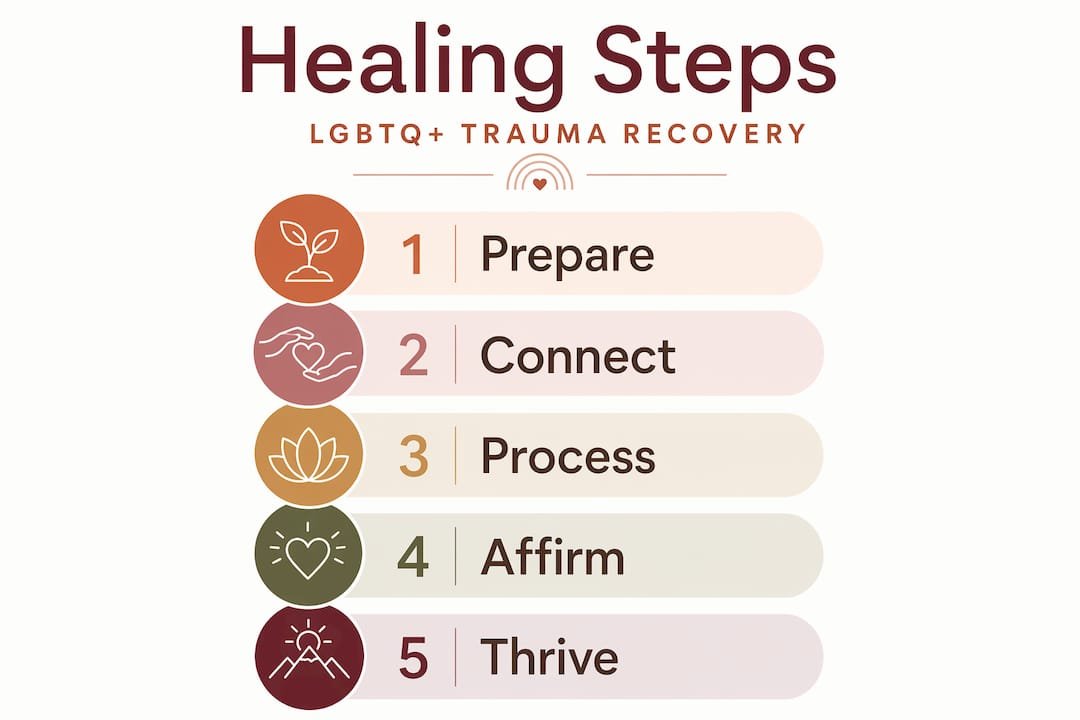
Trauma doesn't look the same for everyone, and for LGBTQ+ individuals, it often carries layers that most people never have to navigate. Rejection from family, bullying, conversion therapy, housing insecurity, and the daily weight of living in spaces that weren't built for you. These experiences leave real marks. This LGBTQ+ trauma recovery guide exists because those marks deserve real attention. You are not broken. You are someone who has been through something hard, and there are evidence-based, identity-affirming pathways that can help you heal. This guide walks you through them step by step.
Table of Contents
Key takeaways
| Point | Details |
|---|---|
| Trauma is specific to your experience | LGBTQ+ trauma often includes minority stress, identity-based rejection, and repeated victimization that compound over time. |
| Safety comes before healing | Building trust with an affirming therapist and a supportive community creates the foundation trauma recovery actually needs. |
| Therapy works best when it fits you | Evidence-based treatments like EMDR, CPT, and IFS are most effective when adapted to your identity and cultural context. |
| Healing happens outside therapy too | Community connection, mindfulness, creative expression, and self-compassion all actively support LGBTQ+ emotional healing. |
| Setbacks are part of the process | Retraumatization and frustration are normal. Compassionate pacing and celebrating small wins protect long-term progress. |
Understanding LGBTQ+ trauma recovery
Trauma is not simply a bad memory. It is what happens in your nervous system when an experience overwhelms your ability to cope. For LGBTQ+ individuals, the sources of that overwhelm are both personal and structural. You may have grown up hiding who you are. You may have been rejected by people who were supposed to love you unconditionally. You may have faced violence, discrimination at work, or being misgendered in medical settings where you needed care most.
These experiences fall into a few categories worth naming. Single-incident trauma includes events like a hate crime or a traumatic coming-out moment. Complex trauma develops from repeated exposure to harm over time, such as chronic family rejection or years of bullying. Minority stress, the ongoing psychological toll of navigating a society that marginalizes your identity, functions as a distinct and cumulative trauma source that many standard PTSD frameworks fail to capture fully.
Common symptoms of trauma in LGBTQ+ individuals include:
Hypervigilance in social or public spaces (constantly scanning for threat)
Emotional numbness or disconnection from your own identity
Intrusive memories, flashbacks, or nightmares
Shame spirals tied specifically to your sexual orientation or gender identity
Difficulty trusting others, including partners, friends, and therapists
Physical symptoms like chronic tension, fatigue, or stomach issues
Intersectionality matters here too. If you hold multiple marginalized identities, such as being a queer person of color or a transgender immigrant, your trauma exposure and the barriers to accessing care both multiply. The Trevor Project's 2025 survey of over 16,000 LGBTQ+ youth found that 36% seriously considered suicide in the past year. That number reflects not individual weakness but systemic harm that has gone unaddressed for too long.
Pro Tip: If you are unsure whether what you experienced "counts" as trauma, trust your body. If a memory or situation causes your nervous system to go into overdrive, it deserves therapeutic attention regardless of how others might label it.
Preparing for recovery: the essential first steps
The most overlooked part of trauma recovery is the preparation phase. People often want to jump straight into processing difficult memories, but without a foundation of safety and trust, that approach can backfire. Healing requires a container before it requires a spotlight.
Start by identifying what safety means for you personally. For some people, safety is a physical space. For others, it is having one person, a therapist, a friend, a peer support group, who genuinely sees them. LGBTQ+ youth in accepting communities attempt suicide at less than a third the rate of those in unaccepting ones. Community is not a nice-to-have. It is a clinical protective factor.

Here is a practical framework for building your recovery foundation:
| Preparation area | What to do | Why it helps |
|---|---|---|
| Affirming therapist | Seek a licensed provider with explicit LGBTQ+ training | Reduces retraumatization during the therapeutic process |
| Peer support | Join an LGBTQ+ specific group in person or online | Normalizes your experience and reduces isolation |
| Personal safety plan | Identify triggers, grounding techniques, and emergency contacts | Gives you agency during difficult moments |
| Paced goal-setting | Set small, specific weekly intentions rather than large milestones | Prevents overwhelm and builds consistency |
Finding an affirming provider can feel like another full-time job, especially in states where LGBTQ+ mental health support is politically contested. Use directories that filter specifically for affirming clinicians. Ask direct questions during a first consultation, such as "What experience do you have working with transgender clients?" or "How do you approach minority stress in your practice?" A therapist who cannot answer those questions clearly is probably not the right fit.
Trauma-informed care also means a provider respects your pace. You should never feel pressured to disclose more than you are ready to share. The APA guidelines emphasize that most people with behavioral health conditions have experienced trauma, and effective treatment requires compassion alongside respect for existing resilience.
Pro Tip: Before your first therapy session, write down three things you want your therapist to know about you that have nothing to do with your trauma. This small act reminds both of you that you are a whole person, not just a collection of difficult experiences.
Evidence-based therapies for LGBTQ+ trauma healing
Knowing your options before walking into a therapist's office puts you in a stronger position. Research on trauma healing for LGBTQ+ populations has grown significantly, and the good news is that several well-validated treatments exist. The APA's updated 2025 guidelines confirm that psychotherapy is the preferred first-line treatment for PTSD, over pharmacotherapy.
Here is how the primary approaches compare:
| Therapy | How it works | Best suited for |
|---|---|---|
| Cognitive Processing Therapy (CPT) | Challenges distorted beliefs formed after trauma | Identity-based shame, internalized homophobia or transphobia |
| Prolonged Exposure (PE) | Gradual, supported exposure to avoided memories and situations | Avoidance patterns, fear of public spaces |
| Trauma-Focused CBT (TF-CBT) | Combines cognitive and behavioral strategies with trauma narrative work | Childhood trauma, family rejection histories |
| EMDR | Uses bilateral stimulation to reprocess traumatic memories | Single-incident and complex trauma, especially when talk feels difficult |
| Internal Family Systems (IFS) | Explores internal “parts” carrying trauma and shame | Deep shame, identity fragmentation, complex trauma |
| Dialectical Behavior Therapy (DBT) | Builds distress tolerance and emotional regulation skills | Emotional overwhelm, self-harm patterns, crisis stabilization |
EMDR, DBT, and IFS are particularly effective complements for LGBTQ+ clients when primary trauma therapies alone do not capture the full picture. EMDR in particular can reach memories that language struggles to access, which matters when trauma is tied to identity experiences that felt unspeakable at the time. Identity-affirming therapy is not a separate modality. It is a lens applied across any of these approaches. It means your therapist understands that your queerness is not the problem to solve. It is part of who you are, and effective treatment honors that completely. You can learn more about PTSD and LGBTQ+ adults to understand how identity-specific PTSD patterns show up and respond to treatment.
The APA guidelines specifically note that culturally responsive treatment that accounts for a patient’s history and identity consistently improves outcomes. You are not an edge case. You deserve treatment designed with your whole life in mind.
Practical healing strategies beyond therapy
Therapy is the foundation, but recovery happens in the other 167 hours of your week too. LGBTQ+ wellness strategies that work outside the therapy room tend to share a few qualities: they are self-directed, they reconnect you to your body or community, and they reinforce that your identity is worth caring for.
Here are evidence-informed practices that actively support LGBTQ+ emotional healing:
Build a chosen family. Biological rejection is one of the most common LGBTQ+ traumas. Intentionally cultivating relationships with people who affirm your full identity fills a real psychological gap. This is not settling for less. It is choosing well.
Practice somatic grounding. Trauma lives in the body. Techniques like deep diaphragmatic breathing, progressive muscle relaxation, or even dancing to music you love help discharge stored stress from your nervous system. Five minutes daily builds more resilience than one hour weekly.
Use creative expression as processing. Writing, visual art, music, and movement offer pathways to meaning-making that bypass the verbal, analytical mind. Journaling specifically about identity milestones, both painful and joyful, can help integrate fragmented experiences.
Engage with affirming representation. Books, films, and podcasts featuring LGBTQ+ people thriving do something measurable for your nervous system. They tell a part of your brain that has been holding its breath that the future is survivable and even beautiful.
Set and enforce boundaries with unsupportive people. This is an active healing practice, not a passive one. Every time you choose your wellbeing over someone else's comfort with your identity, you build self-trust.
Pro Tip: Start a "small wins" log. Every day, write down one moment where you took care of yourself or moved slightly toward who you want to be. Trauma recovery is nonlinear, and this practice creates visible evidence of progress when everything feels stuck.
Gender-affirming care also belongs in this category. For transgender and nonbinary individuals, accessing affirming medical care is not cosmetic. Transgender youth denied access to hormones were nearly twice as likely to attempt suicide. Medical affirmation is trauma prevention and trauma treatment simultaneously.
Common challenges in recovery and how to face them
Even with the right support, LGBTQ+ trauma recovery runs into real obstacles. Knowing what they are ahead of time helps you respond with strategy rather than shame.
Stigma from within the community. Mental health stigma exists inside LGBTQ+ spaces too. The pressure to appear resilient or "over it" can delay people from seeking help. Reaching out for support is not weakness. It is the same courage that got you this far.
Provider mismatch. Many therapists claim to be LGBTQ+ affirming but have little actual training in minority stress, gender identity development, or the specific clinical presentations of LGBTQ+ trauma. Ask about their training directly. A good therapist will not take that question personally.
Retraumatization during treatment. Processing trauma can temporarily intensify symptoms. This does not mean treatment is failing. It means you have hit something real. The solution is not to stop but to adjust pace, reinforce grounding skills, and communicate clearly with your therapist. Trauma-sensitive therapy is specifically designed to manage this risk.
Geographic and financial barriers. Online therapy has genuinely expanded access, particularly in rural areas or states where LGBTQ+ affirming providers are scarce. Many practices offer sliding scale fees. Do not let cost be the last word without exploring what is available.
The comparison trap. Measuring your recovery against someone else's timeline is one of the fastest ways to derail progress. Your trauma history is specific. Your healing will be too.
What I've learned from watching people actually heal
In my experience working alongside clients who have faced identity-based trauma, the most consistent turning point I have seen has nothing to do with the specific therapy modality. It happens the first time someone stops explaining themselves to their therapist and simply says what is true.
There is a particular kind of exhaustion that comes from spending years translating your experience into terms others will find acceptable. When that stops being necessary, something shifts. The therapeutic work becomes less about justifying your pain and more about actually moving through it.
I have also noticed that recovery rarely looks linear from the inside. Clients often arrive at month six feeling like they have regressed, only to describe, within the same session, three specific ways their life has changed. The progress is real. The perception of it lags behind. That gap is where people give up, and it is exactly where they should double down.
The guidelines for LGBTQ+ recovery I believe in most strongly are not clinical protocols. They are this: go at your own pace, find people who see you completely, and refuse the story that your identity is what needs to be fixed. You are not the problem. You never were.
— Alvaradotherapy
Start healing with affirming, expert support
If this guide has resonated with you, the next step does not have to be complicated. Alvarado Therapy is a California-based practice built around trauma-informed, identity-affirming care. The team works specifically with LGBTQ+ individuals navigating PTSD, complex trauma, anxiety, and relationship challenges through modalities like EMDR, CPT, and individual counseling.
Sessions are available online throughout California, making affirming care accessible regardless of where you live. The practice is bilingual in English and Spanish, and every clinician approaches your healing with genuine cultural responsiveness. Whether you are just beginning to explore therapy or returning after a difficult experience with a previous provider, Alvarado Therapy offers a judgment-free space to begin again. You can explore PTSD and complex trauma treatment options or book a consultation to discuss your specific needs with a therapist who is equipped to meet them.
FAQ
What types of trauma are most common in LGBTQ+ individuals?
LGBTQ+ individuals commonly experience identity-based rejection, family estrangement, bullying, hate crimes, and the cumulative effects of minority stress. Complex trauma from repeated exposure over years is particularly prevalent.
Is EMDR effective for LGBTQ+ trauma?
Yes. EMDR is well-suited for both single-incident and complex trauma and is especially useful when verbal processing feels difficult or blocked. It works by helping the brain reprocess distressing memories so they lose their emotional charge.
How do I find an LGBTQ+ affirming therapist?
Use therapist directories that filter for affirming providers and ask direct questions during an initial consultation about their training in minority stress, gender identity, and LGBTQ+ clinical experience. Online therapy options have significantly expanded access in underserved areas.
Can healing happen without formal therapy?
Community support, somatic practices, creative expression, and gender-affirming care all contribute meaningfully to LGBTQ+ emotional healing. These work best alongside professional support but can provide real relief on their own when therapy is not immediately accessible.
How long does LGBTQ+ trauma recovery take?
Recovery timelines vary significantly based on trauma history, access to care, and individual factors. Evidence-based therapies like CPT and EMDR typically show meaningful results within 12 to 20 sessions, though complex trauma often requires longer-term support.
