

Most Californians hurt by a violent crime qualify for reimbursed counseling through the California Victim Compensation Board, and direct victims typically start with up to 40 sessions. Derivative victims (family members, witnesses, Good Samaritans) qualify too, often at different session caps. You'll need to apply within seven years of the crime, cooperate with law enforcement, and eventually submit a Treatment Plan if therapy runs past the first three visits.
TL;DR:
Victims must apply within seven years of the crime and cooperate with law enforcement, though exceptions exist for cases like domestic violence and sexual assault.
Immediate victims typically qualify for up to 40 counseling sessions, with telehealth limited to five sessions before additional approval is required.
Additional treatment beyond the initial sessions requires an approved Treatment Plan demonstrating ongoing clinical necessity and damage from the crime.
Claimants are often billed only after insurance or other resources are exhausted, requiring early disclosure of any other coverage to prevent claim delays.
Proper documentation, including symptom ratings and signed Treatment Plans, is essential for reimbursement and necessary for continued therapy approval.
Alvaradotherapy
Find Trauma-Informed VOCA Support
Alvarado Therapy provides trauma-informed support for victims of crime across California, including online care and bilingual services in English and Spanish.
Table of Contents
What VOCA Counseling Eligibility in California Actually Means
Session Limits, Telehealth Rules, and Getting Extra Sessions Approved
Documentation, Treatment Plans, and What Providers Must Submit
Payor of Last Resort: How Other Insurance Affects Your Claim
How Trauma-Informed Therapy in California Approaches VOCA Cases
Getting VOCA-Eligible Counseling Started With Alvarado Therapy
What VOCA Counseling Eligibility in California Actually Means
VOCA, the federal Victims of Crime Act, funds state programs that help crime survivors pay for therapy, medical bills, and lost wages. In California, the California Victim Compensation Board (CalVCB) administers that money and decides who gets reimbursed and for what.
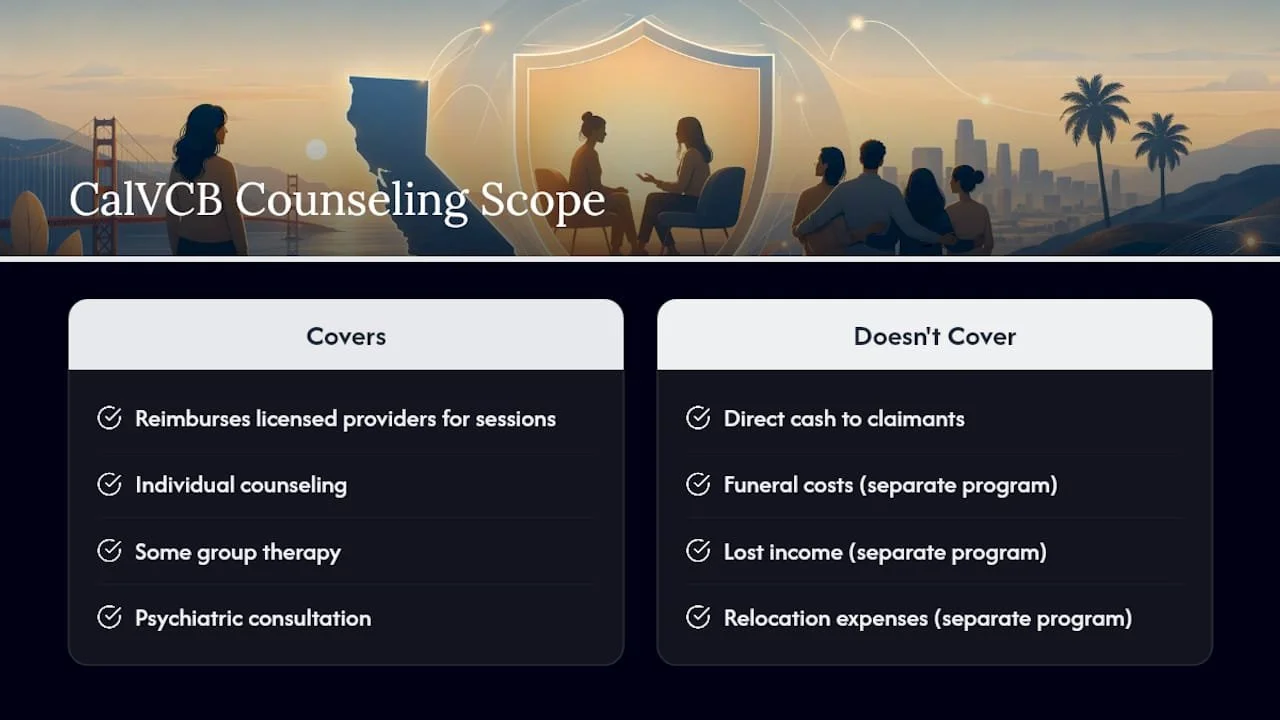
CalVCB operates as the "payor of last resort." That means it steps in only after other resources, private insurance, Medi-Cal, civil settlements, are tapped or unavailable. It doesn't hand cash to claimants directly for counseling; instead, it reimburses licensed providers for sessions already delivered, following its own mental health guidelines.
Covered expenses generally include individual counseling, some group therapy, psychiatric consultation, and related crime-recovery mental health services. Funeral costs, lost income, and relocation expenses fall under CalVCB's broader compensation program, separate from counseling reimbursement. Reimbursement rates and per-session maximums are published in CalVCB's provider rate schedule, which every therapist billing CalVCB should keep on hand.
Who Qualifies: Claimant Categories and Basic Rules
CalVCB sorts applicants into a few defined categories, and which one you fall into shapes your session limits later.
Direct victims: people who were physically injured or threatened with injury during a qualifying crime.
Derivative victims: family members or household members emotionally affected by what happened to a direct victim.
Minor witnesses: children who witnessed violence, even if they weren't physically harmed.
Good Samaritans: bystanders injured or traumatized while helping a crime victim or law enforcement.
Immediate family of a deceased victim: parents, spouses, children, or siblings of someone killed in a qualifying crime.
Two residency rules apply. You must have been a California resident at the time of the crime, or a non-resident victimized within California's borders. Either way, you're expected to cooperate with police or court proceedings, though CalVCB does grant exceptions when cooperation would endanger the victim further, such as certain domestic violence or sexual assault cases.
Filing deadlines matter more than most applicants realize. CalVCB's eligibility rules generally require filing within seven years of the crime, though "discovery" exceptions extend that window when a victim didn't recognize the connection between the crime and their injuries until later, common in childhood abuse cases uncovered in adulthood. Caretakers filing for a minor or a family member filing after a victim's death face slightly different deadlines, so checking your specific scenario with an advocate early saves headaches later.
Session Limits, Telehealth Rules, and Getting Extra Sessions Approved
Direct victims typically start with up to 40 initial mental health counseling sessions under current CalVCB guidelines, a standard that took effect for applications filed on or after January 1, 2016. Certain immediate family members of deceased victims also fall under that 40-session allowance. Other derivative categories may see different initial caps depending on their relationship to the direct victim and the nature of the crime.
Session limit snapshot: Many direct victims and some immediate family of deceased victims have initial session limits as described in current CalVCB guidelines. Telehealth is capped at five sessions per application before providers must file a verification form for more.
Telehealth counts against your session total, but only up to a point. CalVCB allows five telehealth sessions per application before a provider needs to submit a Telehealth Therapy Verification form to continue billing for virtual visits. Skip that step and later telehealth claims can get denied, so it's worth flagging early if you and your therapist plan to meet online.
Getting sessions beyond the initial limit requires an Additional Treatment Plan (ATP). CalVCB reviews ATPs against a few criteria:
Evidence the crime caused permanent or substantial psychological effects.
Additional weight given to sexual assault cases, where longer treatment courses are common.
Documented progress, or lack of it, showing therapy is still clinically necessary.
Documentation, Treatment Plans, and What Providers Must Submit
The first three counseling sessions can typically be reimbursed without any Treatment Plan on file, which gives new clients breathing room to get started before the paperwork catches up. After that, a Treatment Plan becomes mandatory to keep sessions covered.
Submit the initial Treatment Plan once session three is reached, using CalVCB's Treatment Plan form (VCB-71-00001), which asks for diagnosis, treatment goals tied to the crime, and estimated session count.
File an ATP before hitting the session ceiling, not after, since approval takes time and gaps in coverage can leave clients billed directly.
Watch the 90-day rule: bills submitted for sessions beyond the authorized limit generally must be filed within 90 days of the service date, or reimbursement risks denial.
Providers also need to keep legible session notes and some form of symptom progress rating, whether that's a standardized scale or a clear narrative note tracking change over time. Missing documentation is one of the fastest ways an otherwise valid claim gets kicked back for more information, or denied outright.
Pro Tip: Ask your therapist to send you a copy of every Treatment Plan and ATP they file. If CalVCB requests clarification months later, you'll have your own paper trail instead of waiting on your provider's office to dig through old files.
How to Apply and What the Timeline Looks Like
Filing doesn't require a lawyer, but it does require some legwork upfront.
Start your application through CalVCB Online or by contacting a local victim advocate, many district attorney's offices and community organizations have staff who file applications for free.
Gather your documents: the police report number, dates of the crime, and your provider's name and license information if you've already started therapy.
File within the deadline, generally seven years from the crime date, with discovery-based exceptions for cases where the harm wasn't recognized right away.
CalVCB's Advocate Portal connects applicants with community partners who can walk through forms in person, which matters for claimants who find government paperwork intimidating or who need language support. Local victim-service agencies and statewide hotlines can also help track an application once it's submitted, since processing times vary depending on how complete the initial filing is.
Payor of Last Resort: How Other Insurance Affects Your Claim
CalVCB pays after other resources are used, not instead of them. If you have private insurance, Medi-Cal, or an active civil suit related to the crime, those sources generally get billed first, and CalVCB covers what's left uncovered, if anything.
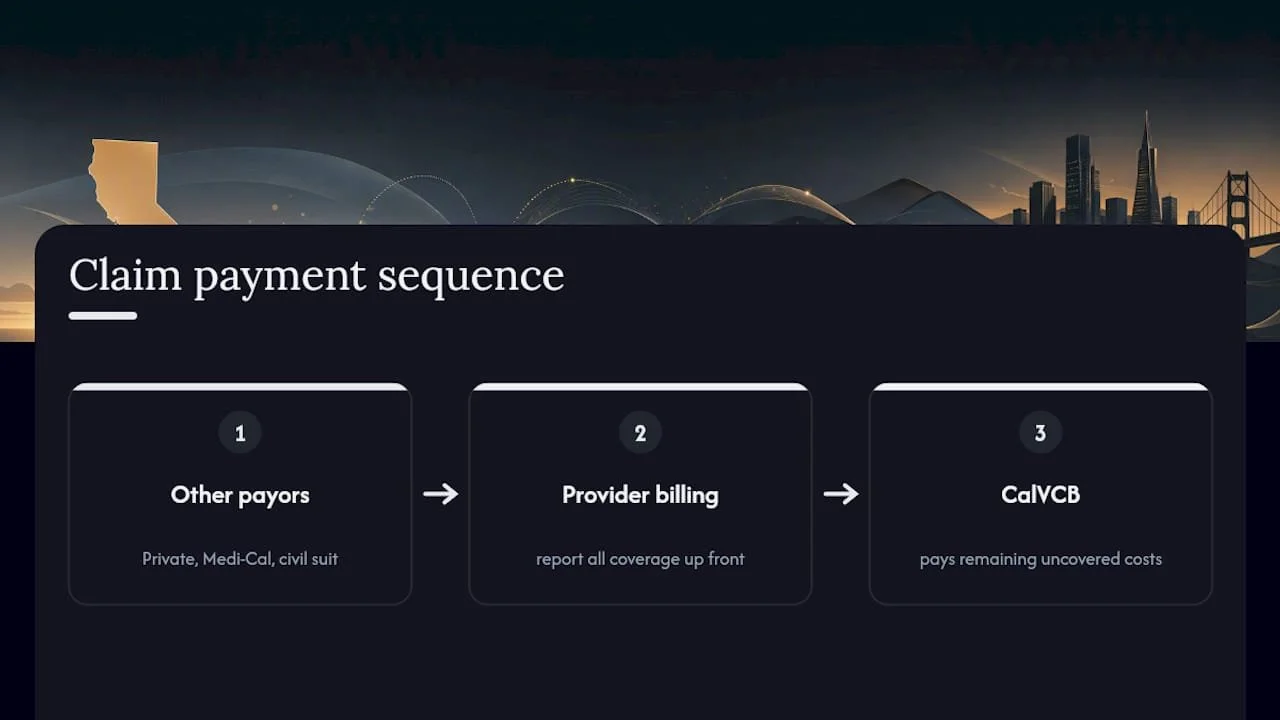
This coordination step is often where claims slow down. Providers need to know about any other coverage upfront so they can bill correctly and avoid CalVCB rejecting a claim for a service another payor should have covered. If you're already in therapy, tell your provider's billing staff about every insurance plan or pending settlement connected to the crime as early as possible, it's the single fastest way to keep your claim moving instead of stalling in review.
What a VOCA Evaluation Looks Like in the Therapy Room
A CalVCB-focused evaluation isn't a separate test; it's woven into how a trauma-informed therapist structures early sessions. Expect questions about trauma history, current symptoms measured against a diagnosis, and treatment goals explicitly tied back to the qualifying crime rather than generic mental health concerns.
Clinicians typically use symptom rating scales alongside narrative progress notes, since CalVCB reviewers weigh both.
Goals in your Treatment Plan should connect directly to how the crime affected you, not unrelated life stressors.
Keep your own copies of records and invoices, and let your provider know ahead of any court dates so session scheduling doesn't conflict with testimony.
Pro Tip: If you're preparing for a hearing or deposition related to the crime, tell your therapist weeks in advance. Coordinating that timeline protects both your legal case and your treatment continuity.
How Trauma-Informed Therapy in California Approaches VOCA Cases
Working with VOCA claimants means treating documentation as part of clinical care, not paperwork bolted onto it. A Treatment Plan that clearly ties symptoms to the crime does double duty: it guides the therapy and it gives CalVCB reviewers what they need to approve continued sessions.
Bilingual, culturally responsive care matters here too. A client who can describe trauma in their first language tends to give more accurate history, and accurate history produces stronger documentation. Good notes protect the clinical relationship and the reimbursement at the same time; neither should come at the expense of the other.
— Juiced
Getting VOCA-Eligible Counseling Started With Alvarado Therapy
If you're a Californian navigating a CalVCB claim, the paperwork shouldn't be the hardest part of getting help. Some therapy practices work with survivors on trauma-focused therapy and EMDR, providing Treatment Plans and progress notes designed to meet CalVCB review requirements for additional sessions.
Some providers offer bilingual care in English and Spanish and see clients online across California, accommodating those who live far from major cities or prefer sessions from home. Therapists can manage the invoice codes and documentation required by CalVCB, reducing the paperwork burden on clients while they focus on healing. If you want to know what a first session looks like before you commit, visit the what to expect page and schedule a consultation to talk through your situation and your CalVCB application.
This article is general information, not a substitute for advice from a qualified doctor. Consult a qualified healthcare professional about your own circumstances before acting on anything here.
FAQ
What Is Marsy's Law in California?
Marsy's Law is a state constitutional amendment guaranteeing crime victims' rights, including notification, participation in proceedings, and restitution; it works alongside, not in place of, CalVCB's counseling reimbursement program.
Is VOCA a Federal Grant?
Yes. VOCA is a federal fund created by the Victims of Crime Act, and California receives an annual allocation that CalVCB distributes through victim compensation, including mental health counseling reimbursement.
How Is VOCA Match Calculated?
VOCA match requirements apply to organizations receiving VOCA subgrants, not individual claimants, and typically require a percentage of non-federal funding tied to grant size; individual applicants filing with CalVCB don't need to calculate any match themselves.
How Much Compensation Do Crime Victims Get in California?
Compensation varies by category and expense type, counseling sessions are reimbursed per CalVCB's published provider rates rather than paid as a lump sum, and total benefits depend on documented losses tied directly to the crime.
Can I Get VOCA Counseling if I Already Have Insurance?
Yes, but CalVCB pays only after your insurance or Medi-Cal has paid its share, since the program functions as the payor of last resort rather than a first-line benefit.
